Lingfield Park
All Weather
Lingfield, Surrey · 25 miles south of central London
Polytrack Surface
Left-Handed
Year-Round & Floodlit
Course Overview
Track Character
Lingfield’s all-weather Polytrack sits on the inside of the turf circuit — a left-handed, triangular loop of 1m2f that is one of the sharpest all-weather tracks in Britain. The surface is also the fastest of the three UK Polytrack circuits, a product of its lighter consistency and the way the track flows. For nearly half its length the course is essentially flat, then rises gently to a slight hill at the start of the back straight before running downhill around the bottom corner and levelling off into the home straight. That downhill section — broadly from the 4f pole to the 2f pole — is the defining feature of the track. It is where races are shaped, where jockeys make their moves, and where horses that don’t handle the camber visibly shorten their stride and fade.
The home straight is only around 2f, which means the race is largely decided before the final bend. Horses that travel well through the race and can quicken off that downhill turn are consistently favoured; those that need a strong gallop to get into a race rarely find it materialising. The Polytrack’s mild kickback — the least of any all-weather circuit in Britain — means horses that are sensitive to dirt in their face are worth finding here.
The 5f and 6f starts are both draw-dependent and require quick positioning. The 5f begins in a small chute on the crown of the bend; the 6f starts just before the bend on the main track. Over these trips, a middle-to-low draw is ideal — wide draws face an immediate disadvantage on the initial turn and horses that miss the break can find themselves trapped in a pocket with nowhere to go. Over 7f and beyond the draw becomes less critical, but position through the bends matters more. David Probert’s advice holds: over a mile or more, third or fourth one off the rail is the sweet spot — close enough to be in the race, free enough to avoid being bottled up on the tight final bend.
The pace data reinforces an important nuance: Lingfield’s reputation as a hold-up track is overstated. The Pace Indicator across all distances sits between 1.07 and 1.33, meaning prominent horses win more than their share at every trip. The course rewards the horse that travels well and picks up — not one anchored at the back. The “third wave” pattern described by jockeys — where a horse sits handy, angles off the bend, and attacks inside the final furlong — reflects the track’s geometry rather than any advantage to hold-up horses per se.
Lingfield staged Britain’s first ever all-weather fixture in 1989 and has been the country’s leading all-weather track ever since. It hosts the Winter Derby on Polytrack in February — a prestigious 1m2f trial — and is one of four venues that form the All-Weather Championships, whose Finals Day has been held at Lingfield on Good Friday since 2014. The course is also unique in staging all three codes: Flat turf, All-Weather and National Hunt, and its turf Derby and Oaks Trials in mid-May carry genuine Classic form clues given the similarity to Epsom’s profile.
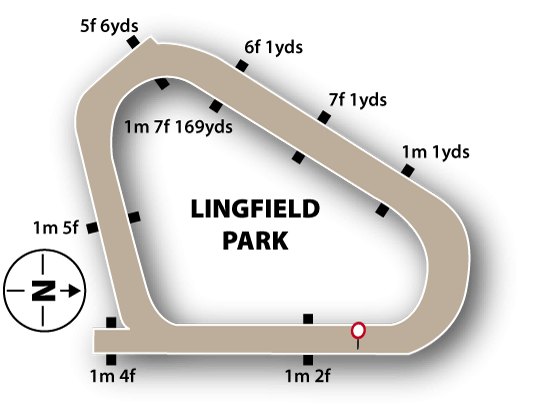
Lingfield AW Course
- Distances 5f, 6f, 7f, 1m, 1m2f, 1m3f, 1m4f, 2m
- Home straight ~2f — short run-in; races are largely decided before the final bend
- Bends Two left-handed bends on every trip including 5f and 6f — there is no straight course on the AW
- Run style Handy and prominent horses thrive; front-runners are vulnerable on the downhill run to the home straight but can hold on with a soft lead
- Draw bias Low draws favoured at 5f, 6f and 1m2f; broadly fair over middle distances on the round course
Surface & History
- Surface Polytrack — the UK’s first, originally laid in 2001 and relaid in October 2012
- First AW fixture Lingfield staged Britain’s first ever all-weather race meeting in 1989
- Triple discipline The only UK venue to host Flat Turf, All-Weather and National Hunt racing
- Winter Derby The headline AW race — a prestigious winter trial run over 1m2f on the Polytrack
- vs other tracks Generally considered faster than Kempton’s deeper surface; similar to Chelmsford
Key Betting Angles
- 5f & 6f Low draw + early speed = significant advantage on the straight track.
- Direction One of two left-handed Polytracks in the UK alongside Chelmsford — but the sharper, more undulating layout means left-handed course specialists are still systematically underrated here.
- Front pace Lingfield rewards pace much more than Kempton’s outer course. Back the pace aggressively.
- AW form Chelmsford and Kempton form transfers reasonably well, though Lingfield’s tighter bends suit a different profile.
- 1m 2f start The 1m2f start is particularly draw-dependent — tight run to the first bend and wide draws in big fields face a genuine structural problem.
Draw Bias by Distance
Top Trainers & Jockeys
Placeholder data: These figures will be replaced with real 12-month Lingfield AW stats once provided. Structure and format matches the live data.
Top Trainers
Lingfield AW · Last 12 months · min. 15 runs
Placeholder data: These figures will be replaced with real 12-month Lingfield AW trainer stats once provided. Structure and format matches the live data.
| Trainer | Runs | Wins | SR | Places | Place% | P/L (SP) | A/E |
|---|---|---|---|---|---|---|---|
| 1 A W Carroll | 252 | 32 | 12.70% | -42.5 | 36.51% | -42.50 | 0.88 |
| 2 A M Balding | 110 | 22 | 20.00% | -13.71 | 47.27% | -13.71 | 1.08 |
| 3 M Appleby | 96 | 14 | 14.58% | -2.75 | 37.50% | -2.75 | 0.88 |
| 4 J P Owen | 85 | 14 | 16.47% | -26.35 | 41.18% | -26.35 | 0.76 |
| 5 Richard Hannon | 99 | 13 | 13.13% | -3.12 | 28.28% | -3.12 | 0.92 |
| 6 D M Simcock | 60 | 12 | 20.00% | 6.07 | 48.33% | +6.07 | 1.25 |
| 7 Richard Hughes | 66 | 12 | 18.18% | -15.6 | 45.45% | -15.60 | 0.97 |
| 8 Charlie Johnston | 79 | 12 | 15.19% | 13.85 | 40.51% | +13.85 | 0.95 |
| 9 Roger Varian | 44 | 11 | 25.00% | -8.53 | 59.09% | -8.53 | 0.85 |
| 10 George Boughey | 81 | 11 | 13.58% | -41.44 | 35.80% | -41.44 | 0.78 |
| 11 J H M Gosden | 31 | 10 | 32.26% | -3.99 | 61.29% | -3.99 | 1.28 |
| 12 Simon Crisford | 24 | 9 | 37.50% | 30.63 | 58.33% | +30.63 | 1.63 |
| 13 B R Millman | 36 | 9 | 25.00% | 29 | 38.89% | +29.00 | 1.47 |
| 14 J R Boyle | 45 | 9 | 20.00% | 56.96 | 35.56% | +56.96 | 1.39 |
| 15 Chelsea Banham | 40 | 9 | 22.50% | -2.84 | 37.50% | -2.84 | 1.23 |
| 16 P M Phelan | 63 | 9 | 14.29% | 98.08 | 39.68% | +98.08 | 1.08 |
| 17 Ed Walker | 48 | 9 | 18.75% | -3.42 | 41.67% | -3.42 | 1.07 |
| 18 Archie Watson | 74 | 9 | 12.16% | -39.77 | 24.32% | -39.77 | 0.87 |
| 19 Gary & Josh Moore | 75 | 8 | 10.67% | 54.74 | 18.67% | +54.74 | 1.14 |
| 20 S C Williams | 45 | 8 | 17.78% | 0.33 | 28.89% | +0.33 | 1.03 |
Top Jockeys
Lingfield AW · Last 12 months · min. 15 rides
Placeholder data: These figures will be replaced with real 12-month Lingfield AW jockey stats once provided. A/E above 1.0 indicates market underestimation.
| Jockey | Rides | Wins | SR | Places | Place% | P/L (SP) | A/E |
|---|---|---|---|---|---|---|---|
| 1 Rossa Ryan | 167 | 41 | 24.55% | 20.89 | 44.31% | +20.89 | 1.15 |
| 2 Luke Morris | 225 | 35 | 15.56% | -30.52 | 38.22% | -30.52 | 1.11 |
| 3 Jack Mitchell | 102 | 23 | 22.55% | -6.25 | 48.04% | -6.25 | 1.17 |
| 4 Billy Loughnane | 133 | 19 | 14.29% | -33.54 | 37.59% | -33.54 | 0.78 |
| 5 David Probert | 110 | 16 | 14.55% | -22.19 | 44.55% | -22.19 | 1.08 |
| 6 Oisin Murphy | 65 | 15 | 23.08% | -13.7 | 52.31% | -13.70 | 0.85 |
| 7 Robert Havlin | 112 | 14 | 12.50% | -58.85 | 33.93% | -58.85 | 0.88 |
| 8 William Carson | 113 | 14 | 12.39% | -9.41 | 38.05% | -9.41 | 1.03 |
| 9 Paddy Bradley | 160 | 14 | 8.75% | 19.92 | 33.13% | +19.92 | 0.69 |
| 10 Joe Leavy | 59 | 11 | 18.64% | -5.04 | 32.20% | -5.04 | 1.32 |
| 11 Marco Ghiani | 72 | 11 | 15.28% | 80.78 | 33.33% | +80.78 | 1.10 |
| 12 Callum Shepherd | 93 | 11 | 11.83% | -9.09 | 30.11% | -9.09 | 0.84 |
| 13 S D Bowen | 56 | 10 | 17.86% | 35.6 | 30.36% | +35.60 | 1.69 |
| 14 Harry Davies | 56 | 10 | 17.86% | 6.88 | 42.86% | +6.88 | 1.33 |
| 15 Joey Haynes | 64 | 10 | 15.63% | -17.21 | 35.94% | -17.21 | 1.05 |
| 16 Finley Marsh | 79 | 10 | 12.66% | -19.6 | 32.91% | -19.60 | 0.79 |
| 17 K T O’Neill | 116 | 10 | 8.62% | 14.45 | 19.83% | +14.45 | 1.02 |
| 18 Ali Rawlinson | 34 | 9 | 26.47% | 14 | 44.12% | +14.00 | 1.43 |
| 19 Tom Marquand | 48 | 9 | 18.75% | 0.74 | 41.67% | +0.74 | 0.86 |
| 20 Callum Hutchinson | 64 | 9 | 14.06% | -10.14 | 32.81% | -10.14 | 1.25 |
Top Sires
Placeholder data: These figures will be replaced with real 12-month Lingfield AW sire stats once provided. A/E above 1.0 indicates market underestimation.
Top Sires
Lingfield AW · Last 12 months · min. 15 runs
| Sire | Runs | Wins | Win% | Places | Place% | A/E | P/L |
|---|---|---|---|---|---|---|---|
| 1Havana Grey | 108 | 22 | 20.37% | 11.12 | 40.74% | 1.27 | +11.12 |
| 2Kodiac | 117 | 13 | 11.11% | -28.95 | 28.21% | 0.93 | -28.95 |
| 3Harry Angel | 69 | 12 | 17.39% | -25.24 | 34.78% | 0.90 | -25.24 |
| 4Mehmas | 78 | 12 | 15.38% | -9.53 | 35.90% | 0.83 | -9.53 |
| 5Dandy Man | 74 | 11 | 14.86% | 46.59 | 22.97% | 1.37 | +46.59 |
| 6Dark Angel | 119 | 11 | 9.24% | -76.21 | 36.13% | 0.60 | -76.21 |
| 7Swiss Spirit | 37 | 11 | 29.73% | 60.25 | 37.84% | 2.24 | +60.25 |
| 8Blue Point | 57 | 10 | 17.54% | 17.73 | 31.58% | 1.01 | +17.73 |
| 9Kingman | 59 | 10 | 16.95% | -25.44 | 44.07% | 0.91 | -25.44 |
| 10Oasis Dream | 75 | 10 | 13.33% | -34.99 | 32.00% | 0.86 | -34.99 |
| 11Cotai Glory | 54 | 9 | 16.67% | 7.27 | 37.04% | 1.02 | +7.27 |
| 12Muhaarar | 53 | 9 | 16.98% | -2.49 | 37.74% | 0.98 | -2.49 |
| 13Profitable | 59 | 9 | 15.25% | -15.08 | 47.46% | 0.87 | -15.08 |
| 14Frankel | 41 | 8 | 19.51% | 11.21 | 46.34% | 1.10 | +11.21 |
| 15Invincible Spirit | 72 | 8 | 11.11% | -27.92 | 40.28% | 0.75 | -27.92 |
| 16Outstrip | 65 | 8 | 12.31% | 65.83 | 29.23% | 1.09 | +65.83 |
| 17Adaay | 39 | 7 | 17.95% | 107.5 | 28.21% | 2.35 | +107.50 |
| 18Gutaifan | 22 | 7 | 31.82% | 2.6 | 72.73% | 1.30 | +2.60 |
| 19Mastercraftsman | 48 | 7 | 14.58% | -4.18 | 39.58% | 1.08 | -4.18 |
| 20Night Of Thunder | 36 | 7 | 19.44% | -12.75 | 38.89% | 1.09 | -12.75 |
Betting Tips for Lingfield AW
Pace is key — but not blindly
Lingfield rewards handy horses, but making the running over 1m+ is very hard to sustain — the downhill run to the straight takes the lead horse’s advantage away quickly. The ideal position over a mile or more is 3rd or 4th, one off the rail — close enough to be in the race, wide enough to avoid being bottled up on the bend. Over 5f and 6f, pace from the gate is non-negotiable.
Left-handed track specialists
One of only two left-handed Polytracks in Britain, alongside Chelmsford — but the two tracks ride very differently. Lingfield is sharper, more undulating, and the downhill turn sorts horses in a way Chelmsford’s sweeping oval does not. Horses that have performed well at Chester, Windsor, or Epsom often translate their form well to Lingfield. The directional factor is consistently underpriced.
5f & 6f — middle draw is the sweet spot
These are tricky starts. The 5f begins in a chute on the crown of the bend; the 6f just before the bend on the main track. Inside draws need a perfect break — if they don’t get position immediately they get pocketed. Wide draws are burning ground. A middle draw gives the most options: able to cut the corner without the risks at either extreme. The 6f is slightly more forgiving with half a furlong before the bend, but you still need to jump and position quickly.
Evening midweek cards
Lingfield hosts large volumes of evening AW racing. Markets are often thin and bookmaker attention is spread — particularly in lower-grade handicaps. Value surfaces regularly for those doing their prep work.
Kempton form transfers — with caveats
Form from Kempton’s outer course translates reasonably well to Lingfield, but the key difference is direction and bend tightness. Horses that were outpaced at Kempton can improve markedly if they have a left-handed preference.
The “third wave” — position, not patience, over 1m+
Lingfield over a mile tends to split into three distinct groups: the pace horses who kick with 5f to go, a second wave that hits the home straight, and a third wave that attacks at the 1f pole. But don\’t misread this as a hold-up track. The third wave succeeds because those horses were travelling well through the race and timed their run — not because they were anchored at the back. The ideal shape is handy, one off the rail, with the ability to quicken off the downhill bend. Panic-free, but not passive.
Turn of foot over stamina
Lingfield’s sharp circuit and undulating profile mean stamina is rarely the decisive factor. Horses that travel strongly through their races and quicken off a bend consistently outperform those that grind — even over 1m4f. In handicaps, favour the slick traveller over the relentless galloper.
The hill — it sorts horses out
The descent from 4f to 2f is the most important part of the track. Horses that don’t handle it visibly shorten their stride and fade; those that flow down it naturally pick up rhythm into the straight. If a horse has run at Lingfield before, how it travelled down that hill tells you more than the bare form figure. It’s a genuine ability filter.
Check the trainer
Some trainers have a markedly better record at Lingfield than their overall AW numbers suggest — and vice versa. The stable’s proximity to the track and familiarity with the surface can create exploitable patterns in the data.
Want the thinking behind Lingfield bets?
FormDial posts every selection before the off with the full reasoning — the angle, the price, the logic. See how course knowledge feeds into real tips.