Wolverhampton
All Weather
Dunstall Park, West Midlands · Britain’s first floodlit racecourse
Tapeta Surface
Left-Handed
Floodlit & Year-Round
Course Overview
Track Character
Wolverhampton is the workhorse of British all-weather racing. Over 80 fixtures a year, most of them under floodlights, grinding through cards from Monday to Saturday while the turf tracks sit idle. The volume masks the fact that this track has real structural edges worth understanding.
Start with the shape. It is a tight, left-handed oval, roughly a mile in circumference, with two sharp bends and a home straight under two furlongs. That straight is the key number. Under two furlongs means that by the time a jockey asks for an effort turning in, the race is almost over. Position at the final bend matters more here than at any other AW track in Britain.
The surface changed the track’s identity. Fibresand from 1993 to 2004 was deep and punishing. Polytrack from 2004 to 2014 was faster but deteriorated badly in its final years. Tapeta, installed in August 2014, was the first of its kind in Europe — a blend of fibres, wax, PVC and sand developed by Michael Dickinson. The reviews from jockeys and trainers were immediate and overwhelmingly positive: consistent, safe, minimal kickback. It rides quicker than Polytrack but not as fast as Lingfield. Stamina at Wolverhampton is relative — the surface demands speed but the tight turns demand balance.
Two dedicated chutes feed into the main oval. The 6f start sits on a spur in the back straight; the 7f start branches off a spur approaching the home bend. Both chutes mean the first bend arrives quickly, and where you are when it does often decides the race. Over five and six furlongs, front-runners dominate. The data is unambiguous: at 5f, leaders have posted a 35% recent win rate against a 20% long-term norm, with an A/E of 1.48. At 6f, backing front-runners blind has returned profit over six consecutive seasons.
Stretch the trip beyond a mile and the geometry loosens. Hold-up horses can compete. But even at 1m4f and beyond, the short home straight punishes anything that needs daylight to finish. Wolverhampton never stops rewarding position.
The comparison to American racing is apt — tight left-handed oval, synthetic surface, speed-biased configuration. Several US-based trainers have noted the similarity. That is not a coincidence: Dickinson’s Tapeta was designed with exactly this kind of track geometry in mind.
“[Quote slot open — awaiting verified jockey or trainer attribution for Wolverhampton AW specifically. Do not fabricate.]”
— Placeholder
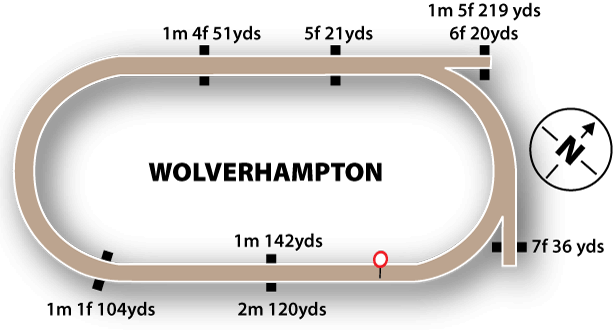
The Main Oval
- Distances1m 141y, 1m 1f, 1m 4f, 1m 5½f, 1m 6½f, 2m ½f
- Home StraightUnder 2f — one of the shortest AW straights in Britain
- BendsTwo sharp left-hand turns; tight and quick
- Run StylePosition at the final bend is critical; hold-up horses need an exceptional turn of foot to get involved
- Draw BiasLow draw favoured at 1m 141y; broadly neutral at longer trips
The Sprint Chutes
- Distances5f 21y, 6f 20y, 7f 36y
- 6f StartSpur in the back straight; runners hit the first left-hand bend quickly
- 7f StartSpur approaching the home bend; the stalls are angled into the turn
- Run StyleFront-runners dominate at 5f and 6f. Gate speed is non-negotiable at the minimum trip
- Draw BiasLow draw advantage at 5f and 6f in larger fields; marginal lean at 7f
Surface & History
- SurfaceTapeta — installed August 2014, replacing Polytrack. First Tapeta racing surface in Europe
- Previous SurfacesFibresand (1993–2004), Polytrack (2004–2014). The Polytrack deteriorated badly in its final years, prompting the switch
- FloodlightsBritain’s first floodlit racecourse, opened under lights in December 1993. The Queen reopened the venue in January 1994
- Feature RaceLady Wulfruna Stakes (Listed, 7f) — the most valuable race on the Wolverhampton calendar
- vs Other TracksRides quicker than old Polytrack but slower than Lingfield. The tight configuration is closer to US ovals than any other British AW venue
- Greyhound TrackDunstall Park Greyhounds opened inside the horse-racing oval in September 2025 — the first new greyhound venue in Britain since Towcester in 2014
Key Betting Angles
- 5f runnersGate speed and a low draw are everything. Leaders have posted a 35% win rate recently, A/E 1.48
- 6f paceFront-runners have returned level-stakes profit over six consecutive seasons at this trip
- Tapeta formForm on Tapeta at Newcastle and Southwell transfers well. Polytrack form from Kempton, Lingfield and Chelmsford is less reliable here
- Short straightAny horse that needs daylight and a long run to the line is structurally disadvantaged. Factor this into every race
- Stall 5 at 6fData from 2021–2025 shows stall 5 at six furlongs returning a level-stakes profit of +65.42 — a genuine, exploitable edge
- Evening cardsMost fixtures are floodlit evening meetings. Market liquidity is thinner, prices are softer, and bookmaker attention is lower
Draw Bias by Distance
Strong bias — material handicapping factor
Moderate lean — worth noting
Broadly fair — not a primary factor
Top Trainers & Jockeys
| Trainer | Runs | Wins | Win% | Places | Place% | A/E | P/L |
|---|---|---|---|---|---|---|---|
| 1 A W Carroll | 784 | 87 | 11.10% | 245 | 31.25% | 0.90 | -146.36 |
| 2 Daniel Mark Loughnane | 480 | 56 | 11.67% | 157 | 32.71% | 0.89 | -85.84 |
| 3 Mick Appleby | 385 | 52 | 13.51% | 135 | 35.06% | 0.86 | -3.80 |
| 4 Ian Williams | 303 | 44 | 14.52% | 101 | 33.33% | 1.09 | +13.43 |
| 5 George Boughey | 248 | 43 | 17.34% | 96 | 38.71% | 0.91 | -47.53 |
| 6 Peter Evans | 278 | 32 | 11.51% | 89 | 32.01% | 0.89 | -117.66 |
| 7 J P Owen | 136 | 31 | 22.79% | 62 | 45.59% | 1.11 | +1.98 |
| 8 Scott Dixon | 428 | 27 | 6.31% | 82 | 19.16% | 0.82 | -142.92 |
| 9 Archie Watson | 205 | 25 | 12.20% | 78 | 38.05% | 0.83 | -53.00 |
| 10 David Loughnane | 259 | 25 | 9.65% | 82 | 31.66% | 0.77 | -70.03 |
| 11 Charlie Appleby | 67 | 24 | 35.82% | 43 | 64.18% | 0.87 | -11.08 |
| 12 Richard Fahey | 204 | 23 | 11.27% | 55 | 26.96% | 1.07 | -20.87 |
| 13 Marco Botti | 162 | 23 | 14.20% | 64 | 39.51% | 0.80 | -42.22 |
| 14 Andrew Balding | 146 | 23 | 15.75% | 48 | 32.88% | 0.79 | -61.91 |
| 15 D Shaw | 197 | 22 | 11.17% | 57 | 28.93% | 1.12 | +10.18 |
| 16 Roger Varian | 86 | 22 | 25.58% | 44 | 51.16% | 0.95 | -5.64 |
| 17 David Simcock | 162 | 22 | 13.58% | 61 | 37.65% | 0.89 | -53.80 |
| 18 Hugo Palmer | 134 | 21 | 15.67% | 57 | 42.54% | 0.91 | +30.80 |
| 19 Stuart Williams | 148 | 21 | 14.19% | 46 | 31.08% | 0.85 | -67.39 |
| 20 David O’Meara | 161 | 20 | 12.42% | 53 | 32.92% | 0.87 | -37.36 |
| Jockey | Runs | Wins | Win% | Places | Place% | A/E | P/L |
|---|---|---|---|---|---|---|---|
| 1 Billy Loughnane | 495 | 101 | 20.40% | 219 | 44.24% | 1.00 | -7.99 |
| 2 Rossa Ryan | 480 | 98 | 20.42% | 232 | 48.33% | 0.95 | -56.49 |
| 3 Luke Morris | 514 | 69 | 13.42% | 184 | 35.80% | 1.06 | -40.95 |
| 4 David Probert | 386 | 49 | 12.69% | 124 | 32.12% | 0.84 | -49.26 |
| 5 Jack Mitchell | 269 | 42 | 15.61% | 110 | 40.89% | 0.78 | -107.85 |
| 6 Hector Crouch | 177 | 40 | 22.60% | 81 | 45.76% | 1.06 | -12.93 |
| 7 Hollie Doyle | 291 | 37 | 12.71% | 104 | 35.74% | 0.74 | -117.84 |
| 8 Callum Shepherd | 239 | 36 | 15.06% | 89 | 37.24% | 0.99 | -12.97 |
| 9 Kieran O’Neill | 394 | 36 | 9.14% | 95 | 24.11% | 0.95 | -101.05 |
| 10 David Muscutt | 254 | 33 | 12.99% | 93 | 36.61% | 0.78 | -74.60 |
| 11 Finley Marsh | 264 | 31 | 11.74% | 80 | 30.30% | 1.04 | +80.26 |
| 12 Marco Ghiani | 237 | 29 | 12.24% | 76 | 32.07% | 0.77 | -70.70 |
| 13 Clifford Lee | 217 | 25 | 11.52% | 76 | 35.02% | 0.71 | -76.95 |
| 14 Joanna Mason | 199 | 24 | 12.06% | 59 | 29.65% | 1.03 | +80.88 |
| 15 Jason Watson | 168 | 23 | 13.69% | 63 | 37.50% | 0.89 | -42.58 |
| 16 Oisin Murphy | 60 | 22 | 36.67% | 33 | 55.00% | 1.35 | +24.25 |
| 17 Kevin Stott | 100 | 22 | 22.00% | 45 | 45.00% | 1.10 | -0.99 |
| 18 Jason Hart | 214 | 22 | 10.28% | 63 | 29.44% | 0.77 | -59.83 |
| 19 George Wood | 133 | 21 | 15.79% | 54 | 40.60% | 1.15 | +20.76 |
| 20 Sean Levey | 158 | 21 | 13.29% | 64 | 40.51% | 0.72 | -65.15 |
Top Sires
| Sire | Runs | Wins | Win% | Places | Place% | A/E | P/L |
|---|---|---|---|---|---|---|---|
| 1 Dark Angel (IRE) | 372 | 55 | 14.78% | 159 | 42.74% | 0.87 | -103.00 |
| 2 Kodiac | 428 | 55 | 12.85% | 140 | 32.71% | 0.98 | +62.06 |
| 3 Lope De Vega (IRE) | 224 | 41 | 18.30% | 81 | 36.16% | 1.05 | -11.21 |
| 4 Kingman | 177 | 33 | 18.64% | 70 | 39.55% | 1.00 | -3.01 |
| 5 No Nay Never (USA) | 170 | 30 | 17.65% | 60 | 35.29% | 1.21 | +1.98 |
| 6 Dandy Man (IRE) | 370 | 30 | 8.11% | 106 | 28.65% | 0.70 | -162.20 |
| 7 Muhaarar | 144 | 29 | 20.14% | 56 | 38.89% | 1.24 | -13.47 |
| 8 Mehmas (IRE) | 251 | 29 | 11.55% | 83 | 33.07% | 0.78 | -91.28 |
| 9 Sea The Stars (IRE) | 157 | 23 | 14.65% | 58 | 36.94% | 0.82 | -43.51 |
| 10 Havana Grey | 163 | 23 | 14.11% | 65 | 39.88% | 0.94 | -22.22 |
| 11 Bated Breath | 236 | 23 | 9.75% | 66 | 27.97% | 0.77 | -83.75 |
| 12 Oasis Dream | 212 | 22 | 10.38% | 58 | 27.36% | 0.82 | -78.19 |
| 13 Cotai Glory | 118 | 21 | 17.80% | 43 | 36.44% | 1.13 | +42.02 |
| 14 Exceed And Excel (AUS) | 185 | 21 | 11.35% | 65 | 35.14% | 0.86 | -36.06 |
| 15 Bungle Inthejungle | 99 | 20 | 20.20% | 38 | 38.38% | 1.58 | +22.52 |
| 16 Invincible Spirit (IRE) | 163 | 20 | 12.27% | 54 | 33.13% | 0.88 | -49.91 |
| 17 Iffraaj | 196 | 20 | 10.20% | 58 | 29.59% | 0.78 | -61.08 |
| 18 Dubawi (IRE) | 95 | 19 | 20.00% | 39 | 41.05% | 0.83 | -47.98 |
| 19 Mayson | 207 | 19 | 9.18% | 66 | 31.88% | 0.72 | -99.79 |
| 20 Saxon Warrior (JPN) | 81 | 18 | 22.22% | 34 | 41.98% | 1.27 | +7.86 |
Betting Tips for Wolverhampton AW
Front-runners at 5f — the sharpest edge on the card
Leaders at 5f have a 35% recent win rate and an A/E of 1.48. The run to the first bend is too short for anything drawn wide or held up to recover. Gate speed decides these races.
Stall 5 at 6f — the single most profitable draw
Between 2021 and 2025, stall 5 at six furlongs returned an LSP of +65.42. That is not a marginal edge. It is a structural advantage worth building into any racecard analysis before reading a single form line.
Avoid stall 9 at 7f
Stall 9 at seven furlongs has returned an LSP of −287.42 over the same period. The 7f chute feeds into a left-hand bend almost immediately — outside stalls lose ground they never recover.
Tapeta form transfers — selectively
Newcastle and Southwell both race on Tapeta. Form from those tracks transfers to Wolverhampton reliably. Polytrack form from Kempton, Lingfield and Chelmsford is less predictive — the surface characteristics differ more than most punters assume.
Floodlit meetings — thinner markets, softer prices
Most Wolverhampton cards are evening fixtures under lights. Bookmaker attention is lower, market liquidity is thinner, and prices are often softer than equivalent afternoon meetings at other AW tracks. The value is structural.
The short straight changes everything beyond a mile
Under two furlongs of home straight means that even at 1m4f, hold-up horses need an explosive turn of foot to get involved. Position at the final bend matters at every trip. Never back a closer here without evidence they can quicken on a sixpence.
Common Mistakes at Wolverhampton
- Backing hold-up horses at 5f or 6f without checking their early speed figures. The short straight and tight bends make it structurally near-impossible to come from behind at the minimum trips.
- Ignoring the draw at 1m 141y. This is the most draw-biased distance on the card and punters routinely overlook it because “a mile should be fair.”
- Treating Polytrack and Tapeta form as interchangeable. The surfaces ride differently. Newcastle and Southwell Tapeta form is a far better guide than Kempton or Lingfield Polytrack.
- Assuming floodlit evening meetings carry the same market efficiency as afternoon cards. They do not. Prices are softer and the edge available is larger.
Want the thinking behind Wolverhampton bets?
FormDial posts every selection before the off with the full reasoning — the angle, the price, the logic. No tips without context.