Racing Surfaces Explained: Turf vs All-Weather
The surface a horse runs on is not background detail. It is a fundamental variable that determines which horses are competitive, which form lines are relevant, and where the market makes its most consistent pricing errors. British racing uses three distinct surfaces — turf, Polytrack, and Tapeta — and each produces different form, favours different running styles, and rewards different physical types. A horse’s surface preference is not a nice-to-know. It is essential information.
Turf
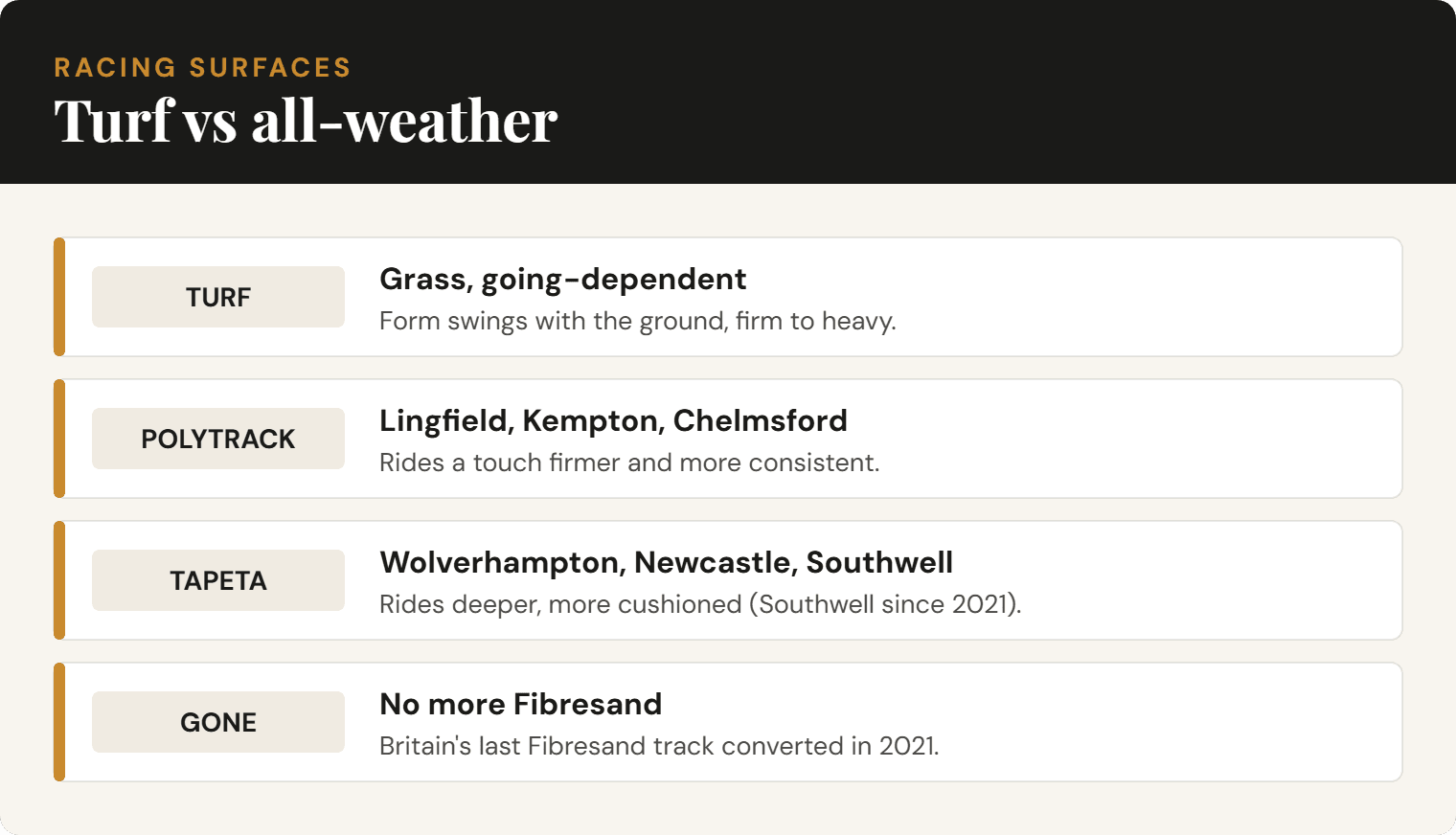
Natural grass, used at every British racecourse bar two — Wolverhampton and Chelmsford City are all-weather only — for flat and jumps racing. Turf is the default surface, and it introduces the most significant variable in the sport: the going. The condition of the ground changes with rainfall, drainage, time of year, and even the position on the track. A strip of ground on the rail that has been raced on all afternoon rides differently from fresh ground in the centre of the course.
Turf going ranges from hard (dry, fast, minimal give) to heavy (saturated, deep, energy-sapping). The official British descriptions are: hard, firm, good to firm, good, good to soft, soft, and heavy (BHA General Instructions, BHAGI 3.2 (3 October 2022), paragraphs 21–23) — hard survives on the books but is effectively never posted, and a blended soft to heavy is an Irish description, not a British one. Each stage represents a material change in how the race unfolds. A sprint on firm ground at Ascot in July and a sprint on heavy ground at Haydock in November share a distance and little else.
How often each description actually comes up — the frequency table, and the caveats that travel with it — is on going descriptions explained.
Going preference is the single most underpriced factor in turf racing. A horse with a 0-for-8 record on good-to-firm ground that suddenly appears on soft ground at 12/1 is not a long shot. It is a horse that has never raced on its preferred surface and is finally getting the conditions it needs. The market sees eight losses. The handicapper sees eight irrelevant runs. Check the going record before anything else.
Turf also varies by course. The grass at Newmarket — a wide, galloping track with well-drained chalk downland — rides faster and firmer than the clay-based turf at Pontefract, even when both are described as “good.” Official going descriptions are a guide, not a guarantee. Course knowledge — understanding how each track drains, where the ground rides fastest, and which rail position is favoured — separates serious punters from everyone else. For a full breakdown, see Going Descriptions Explained. For per-track turf character, our Flat Racecourse Guides cover how each course rides.
Polytrack
An artificial surface made from a blend of sand, fibres, and recycled materials, coated in wax. Used at Lingfield, Kempton, and Chelmsford City. Polytrack drains rapidly, producing consistent going year-round — typically described as “standard” or “standard to slow.” Reducing the going variable makes Polytrack form more repeatable and speed figures more comparable across meetings — though the surface is not a fixed constant, and watering still moves it within the five-point all-weather scale (fast, standard to fast, standard, standard to slow, slow).
Polytrack favours a specific type of horse. Front-runners perform significantly better on Polytrack than on turf because the surface does not tire speed horses as quickly. Hold-up horses, which rely on a fast pace to close into, find Polytrack races harder to win when the pace is moderate and the surface allows the leaders to sustain their effort. As a slightly firmer, faster-rebounding surface, Polytrack also rewards a sharp, efficient action over a long, rolling stride.
| Surface | Courses | Going Range | Key Bias |
|---|---|---|---|
| Polytrack | Lingfield, Kempton, Chelmsford | Standard / Std-Slow | Front-runners strongly favoured at Kempton over 5f; the longer outer-loop trips and long straight reverse this and suit hold-up types. Lingfield’s Polytrack leans mildly to low draws at 5f and 6f — not to be confused with its turf course, which leans the opposite way and harder. |
| Tapeta | Wolverhampton, Newcastle, Southwell | Standard / Std-Fast | Wolverhampton favours prominent racers who handle the tight bends. Newcastle is fairer on the turns but its uphill finish punishes lone front-runners. Southwell is tight and left-handed. |
| Turf | All bar Wolverhampton & Chelmsford | Hard / Firm / Gd-Firm / Good / Gd-Soft / Soft / Heavy | Varies by going. Firm favours speed; heavy favours stamina. Course-specific. |
Tapeta
A newer synthetic surface, different from Polytrack in composition and behaviour. Tapeta uses a mix of sand, wax, and fibres, and is usually described as riding a touch deeper than Polytrack, with more cushion and a more energy-absorbing footfall — a characterisation, not a published spec. Wolverhampton, Newcastle and Southwell race on Tapeta, and the three tracks produce distinct form despite sharing a surface. Because it absorbs and returns energy more gradually, Tapeta tends to suit longer-striding, hold-up types better than the sharper-actioned speed horses that thrive on Polytrack.
Wolverhampton is a tight, left-handed oval — one of the sharpest tracks in the country. The combination of Tapeta and tight bends creates a severe bias toward horses that break well and race prominently. Wide runners consistently lose ground on the turns, and horses drawn high in sprints have a measurable disadvantage. Newcastle, by contrast, is wider and more galloping, with the only all-weather straight mile and an uphill finish — it is fairer on the turns than Wolverhampton, but that stiff rise to the line tests stamina and punishes lone front-runners, making it the hardest all-weather track to make all on. Southwell, the third Tapeta course, is another tight, left-handed circuit; it raced on Fibresand from 1989 until December 2021, when it became Britain’s third Tapeta track, so its pre-2021 form is on a different surface and should be treated with caution.
Do not treat Polytrack and Tapeta as the same surface. A horse that performs well on Polytrack at Lingfield may not reproduce that form on Tapeta at Wolverhampton — and vice versa. The market routinely treats all all-weather form as interchangeable. It is not. Track shape and surface composition produce different results. Assess each track individually.
A Note on Fibresand
For decades a third synthetic surface ran in Britain: Fibresand, a deeper, sandier mix used at Wolverhampton until 2004 and latterly only at Southwell. It rode slow and stamina-sapping, threw up heavy kickback in behind, and produced such specialist form that few horses transferred cleanly off it. It is now history — Southwell switched to Tapeta in December 2021, and no British track uses Fibresand any more. If you are reading old Southwell form from before that date, treat it as a different surface entirely.
All-Weather Going Is Not Fixed
It is tempting to treat all-weather as a constant, but that overstates it. Synthetic tracks are graded on a five-point scale (fast, standard to fast, standard, standard to slow and slow), and watering and weather still move them within that range. The variable is smaller than turf going, not zero. Kickback is part of the picture too: Polytrack sprays more in big fields, which can blunt hold-up horses dropped in behind, while lower-kickback Tapeta is kinder to those ridden off the pace. Read the stated going and the likely kickback before assuming today’s surface plays exactly like the last meeting.
Can Form Cross Between Surfaces?
This is the question that costs punters the most money. The short answer is: sometimes, but not reliably. Horses that excel on all-weather surfaces do not automatically transfer that form to turf, and turf specialists often underperform when switched to synthetic tracks. Britain has no dirt racing — the synthetics are the all-weather code — and jump racing in Britain is run on turf only, so a horse’s surface CV is built across turf, Polytrack and Tapeta alone.
Turf to AW
Turf horses dropping to all-weather often outperform because they hold a class edge. The overall standard on all-weather cards is lower than equivalent turf races. A horse rated 80 on turf is often competing against horses rated 80 on all-weather — but the turf 80 has been tested in stronger company. Look for first-time AW runners from decent turf yards.
AW to turf
The riskier crossover. All-weather form is roughly 5-7lb below equivalent turf form. A horse winning Class 5 handicaps on Polytrack may struggle in the same class on turf. The market often prices these horses as if their AW form translates directly. It rarely does — unless the horse has previous turf form to support it.
Polytrack to Tapeta
Less dramatic than turf crossovers, but still imperfect. A Lingfield Polytrack specialist may not handle Wolverhampton’s tighter turns on Tapeta, and the deeper Tapeta footfall asks a different question of a horse’s action. Course form within the all-weather code is more reliable than surface form alone.
A Worked Example
Take a common pattern. A four-year-old has run six times on turf, peaking with a close third off a mark of 78 in a competitive Class 4 handicap at York, then tailed off twice on quick summer ground. On its first start on Polytrack at Lingfield, over the same trip and off the same mark, it is friendless in the market at 11/1 — the bare form reads as a horse out of sorts. But the pace map shows it can lie handy off a likely strong gallop, the consistent surface removes the fast-ground excuse, and it is dropping into weaker company than the York race. It bolts up by two lengths. The mistake everyone made was reading six turf runs as one form line; in truth the surface switch reset the question, and the only honest answer beforehand was “unproven, but priced as exposed.” That gap — exposed price, unproven profile — is exactly where the synthetic switch pays.
Practical Application
Before assessing any runner, answer two questions. First: does this horse have proven form on today’s surface? If yes, use that form as your primary assessment. If no, treat it as an unknown — regardless of how impressive its form on other surfaces may be.
Second: is there a surface-related reason the market might be mispricing this horse? The most common scenario is a turf horse running on all-weather for the first time — the market undervalues the class crossover. The second most common is an all-weather specialist appearing on turf — the market overvalues recent form without adjusting for surface.
Surface preference is not always obvious from a single run. Some horses need two or three outings on a new surface to adjust. But a horse that has run three or more times on all-weather without placing is giving you a clear message: it does not act on the surface. Believe the data.
For how going conditions interact with surface, see Going Descriptions Explained. For how the draw interacts with track shape on all-weather surfaces, see Draw Bias Explained. For course-specific guides, explore our All-Weather Racecourse Guides.
Common Questions
Two: Polytrack at Lingfield, Kempton and Chelmsford, and Tapeta at Wolverhampton, Newcastle and Southwell. Fibresand was retired when Southwell switched to Tapeta in December 2021, so no British track uses it any more.
Both are waxed sand-and-fibre surfaces. Polytrack tends to ride a touch firmer and faster and more consistently; Tapeta rides deeper and more cushioned, absorbing more energy and tending to suit longer-striding, hold-up horses.
Not reliably. Some horses act on both, but many turf performers fail on synthetics and vice versa. Proven form on today’s surface should be your primary read; treat an unproven switcher as an unknown.
Newcastle’s wider bends and longer straight make it fairer on the turns than the tight Wolverhampton oval, but its uphill finish tests stamina and makes it the hardest all-weather track to front-run on. None is truly bias-free — each is biased differently.
Yes. Southwell replaced its long-standing Fibresand surface with Tapeta and raced on the new surface from December 2021, becoming Britain’s third Tapeta track. Its form from before that date is on a different surface.
No. Synthetic tracks are graded on a five-point scale (fast, standard to fast, standard, standard to slow and slow), and watering and weather still move them within that range. The going variable is smaller than on turf, not absent.