Kempton Park
All Weather
Sunbury-on-Thames, Surrey · 16 miles west of central London
Polytrack
Right-Handed
Floodlit
Kempton also stages jumps racing through the winter, including the King George VI Chase on Boxing Day. Read the National Hunt guide →
What is Kempton Park like as an all-weather track?
Track Character
Kempton didn’t drift into the all-weather era — it forced its way in. The turf Flat course went in 2006, Polytrack replaced it, and the place became a year-round, floodlit betting track. Races like the Magnolia and Rosebery survived, but their purpose changed. This is now a schooling ground. When Charlie Appleby or John & Thady Gosden run a well-bred type here, it’s education — break, travel, handle kickback, quicken. Read the intent, not just the result.
Kempton works because it’s predictable. Same surface, same layout, same patterns. That gives you something rare — control. If you can’t find an edge here, you won’t find one anywhere.
But you don’t start with horses. You start with the track. Kempton is the only right-handed synthetic in Britain, and it’s effectively two tracks. The inner loop (5f and 1m1f219y) is brutal. A short run to the first bend, straight into a fairly tight turn all the way back onto themselves and then barely two furlongs home. Position is everything… Low draw, clean break, rail — that’s the race shape. Anything wide without gate speed, or held up from a poor position, is fighting a real disadvantage over the 5f, where the draw measures a genuine low bias — though a wide horse that can lead is a different proposition, as the draw and run style box below sets out. Over the inner mile and a quarter that is a pace judgement rather than a draw one — the measured draw effect there is not significant, and Probert’s point is about position, not the stall.
The outer loop — 6f, 7f, the mile and everything longer bar the inner mile and a quarter — gives more time and more room, and through the middle distances it is genuinely fairer. It is not fair everywhere on it: the 6f is the strongest low-draw bias on the card and the two-mile start is nearly as one-sided, and over 6f the mechanism is the opposite of a long build-up: from both the five- and six-furlong starts there is a relatively short run to the first bend, so a wide stall concedes ground before the field has settled. In between, pace still dominates, especially at 6f–7f. High draws give away ground wherever the run to the turn is short. The market half-understands this and overbets the inside at a mile, where the lowest stalls are among the worst value on the card; but the conclusion that follows is the negative one: do not pay extra for a low stall at a mile. Above the lowest quarter the value is flat — 0.88, 0.88 and 0.87 — so what you are avoiding matters more than what you are choosing, and if you’re on one who likes being held up, don’t be put off by a wide draw.
Step up in trip and the low-draw edge loosens its grip through the middle distances — from a mile to a mile and a quarter the inside is more often a trap than a gift, and by a mile and a half the lean has moved to the middle of the draw rather than disappearing. It tightens again over two miles, where the low third runs at an impact value of 1.28 against 0.75 for the high across 326 handicaps. But the surface still matters — traditionally slower than both Lingfield and Wolverhampton though harrowing depth moves that about, honest enough to expose anything that can’t travel or handle kickback.
Kempton doesn’t hide anything. It rewards position and pace, and it punishes hesitation. Treat it like turf and you’ll keep finding excuses. Treat it like a system — which loop, what draw, what early position, what surface, what comparable-course form — and the questions get a lot easier to answer.
David Probert, who rides Kempton regularly, puts the mechanical read plainly:
— David Probert, jockey
The pace data supports the picture: Kempton strongly rewards pace from 5f to 7f, and the edge softens beyond that on the outer loop. At 1m2f on the inner loop the pace constraint returns even though the measured draw effect does not — over 178 handicaps the stall you break from settles very little there, and the position you take settles a great deal. One further note Probert flags: with Kempton being the only right-handed AW track in Britain, some horses genuinely act better here than at left-handed circuits — it is a real effect worth tracking in the form.
Two further characteristics are worth treating as part of the track’s DNA rather than occasional betting tips. First, on the outer loop experienced jockeys tend to track two or three lanes off the inside rail through the cutaway because, as Probert puts it, it seems a bit quicker further out and horses seem to finish a bit better there. A horse that appears to be giving ground to the rail may simply be in the smarter position; conversely, one that hugs the fence and finds nothing in the straight has a structural explanation. Second, how the track is prepared on the day has an outsized effect on the racing. A deeply harrowed surface (Standard to Slow) can ride materially differently to a firmer, more compacted one (Standard), shifting the balance between front-runners and closers in ways the official going description rarely captures. Watching the early race sectionals is the most reliable way to calibrate the day’s bias before the feature races.
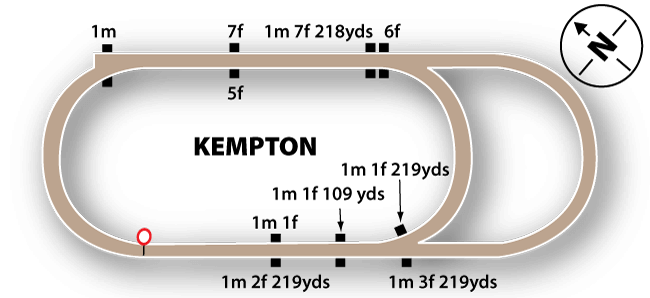
The Outer Course
- Distances 6f, 7f, 1m, 1m2f219y (eleven furlongs, the Rosebery), 1m3f219y (twelve, the September Stakes) and 2m
- Home Straight ~3f — one of the longer AW straights in Britain
- Bends More sweeping; horses need to travel through them
- Run Style Fairer to closers than the inner loop — but not anti-pace. Published run-style research makes Kempton one of the strongest front-running tracks on the all-weather over 6f and 7f, both run on this loop. The bias softens sharply from a mile rather than reversing — and it is the trip that does it, not the switch of circuit
- Draw Bias Strong low-draw edge at 6f and 2m, and at 7f in big fields; fair through the middle distances
The Inner Course
- Distances 5f and 1m1f219y — a yard under ten furlongs, and the trip Probert pairs with the sprint as run on the tight inside bend. The Rosebery’s 1m2f219y is eleven furlongs and runs on the outer
- Home Straight Under 2f — very sharp run-in, almost no room to finish
- Bends Tight, quick turns; horses need balance through the corner
- Run Style Strong advantage to front-runners; races over 5f often decided from the gate
- Draw Bias Low draw is significant; wide draws in sprint handicaps are a material disadvantage
Surface & History
- Surface Polytrack — converted from turf in 2006 as part of a multi-million pound redevelopment
- Refurbished Four times since it opened — 2012, 2015, 2018 and July 2021, when a £320,000 programme laid 1,000 tonnes of specially blended Polytrack and replaced the top three inches of the inside 12 metres
- King George VI Chase Kempton’s most famous race — but a Grade 1 chase run each December on the separate turf jumps course, not on this Polytrack
- vs other tracks Traditionally rides deeper and slower than both Lingfield and Wolverhampton, but that is not a fixed ranking — preparation, harrowing depth and temperature move it, and stamina plays differently to what the trip alone suggests
- Direction The only right-handed all-weather track in Britain — a structural advantage for course-direction specialists
- Feature races The Group 3 September Stakes (1m3f219y) and Group 3 Sirenia Stakes (6f) produce the best Polytrack form staged here; the Listed Magnolia (1m1f219y, ten furlongs on the inner loop), the Listed Snowdrop Fillies’ Stakes (1m) and the Class 2 Rosebery Handicap (1m2f219y, eleven furlongs on the outer) headline the spring programme. The autumn and winter add three more Listed races: the Hyde Stakes over a mile, and the Floodlit and Wild Flower Stakes, both over the September Stakes trip of 1m3f219y
Key Betting Angles
- 5f runners Gate speed and a low draw carry a real edge, on a smaller sample than the 6f
- Outer course Kinder to closers than the inner — but front-runners are strong over 6f and 7f. It is the trip that softens the pace bias, not the loop.
- Polytrack form Form at Lingfield and Chelmsford frequently transfers well to Kempton, though Chelmsford has staged no racing since March 2026 while its operating licence is resolved, so that form is ageing — and so does Dundalk form, on the same surface and a near identical circuit, provided the horse handles the switch from left-handed to right.
- Direction The only right-handed AW in the UK — riders report a genuine directional preference in some horses, so check a poor left-handed record before writing one off.
- Outer loop lane On the outer loop, jockeys tend to run 2–3 lanes off the inside rail past the cutaway because, in Probert’s words, it “seems a bit quicker further out” and horses “seem to finish a bit better there”. Don’t assume the rail is best.
- Wide draws Over the inner 5f a wide draw in a handicap is a measured disadvantage. Over the inner mile and a quarter the measured draw effect is not there, so treat it as a pace question — and note Probert wants gate speed from a wide inner stall at either trip.
Do front-runners win at Kempton Park?
Kempton runs two Polytrack configurations off one home straight, and they ask different questions. The inner loop takes the five furlongs and the mile and a quarter — 1m1f219y, a yard under ten — turning tighter and finishing up a straight of under two furlongs. The outer loop handles six and seven furlongs, the mile, and every trip longer than the inner loop’s mile and a quarter — the Rosebery’s eleven-furlong 1m2f219y among them — sweeping wider into nearly three furlongs of straight.
That difference is the whole pace story. On the inner loop there is very little room after the bend, so a horse off the pace is fighting the track as well as the field — the inner mile and a quarter is far less forgiving of patience than the trip suggests. The outer loop gives closers a genuine chance, and riders get going a long way out as a result — but it is not a closers’ track at the shorter trips. Published run-style research puts Kempton among the strongest front-running all-weather tracks over 6f and 7f, and both of those are run on the outer loop; front-running favourites there have returned a profit while held-up favourites have lost heavily. The bias evens out once past 7f rather than reversing — even at a mile the published work still makes a front-runner a better proposition than a hold-up horse. Check the trip as well as the loop before you judge a race’s shape.
Run Style Bias — Qualitative Only
Strong on the inner loop
Travels into either straight
Workable on the outer loop
Little room on the inner loop
Treat these bars as directional — a reading of how the track rides rather than a statistical measurement. The inner and outer loops ride differently; the bars read across both.
Draw and Run Style Together
The two reads on this page are more useful combined than separately, because at Kempton early position is what turns a draw into an advantage. Published run-style research covering 2016 to 30 September 2021 in handicaps of eight or more runners puts it this way, trip by trip:
- 5f — pace outranks the stall. Front runners “seem to be able to win from anywhere”, so a wide-drawn horse with gate speed is not the write-off the draw alone suggests.
- 6f — the combination trip. Front runners can still win from anywhere, “but in general over this furlong longer trip the lower drawn the better”, and the study’s own conclusion is that “a potential front runner drawn 6 or lower is the type of horse that might be expected perform well”. That matches the strongest measured draw bias on our card.
- 7f — “more of the lower drawn horses lead early, but it seems that front runners are able to win from any draw”. Read the low draw here as a route to the lead rather than an edge in itself — our own figures make the 7f draw bias a big-field effect only.
- 1m and beyond — the research draws no draw-and-pace combination at a mile, and the run-style bias evens out once past 7f without reversing: a front-runner is still rated the better proposition than a hold-up horse at the trip. The one thing our figures do say is negative: the lowest quarter of the draw is among the poorest value on the page, at an A/E of 0.73.
Run-style figures from published research, 2016 to 30 September 2021, handicaps of eight or more runners. Draw figures are our own, measured in handicaps of eight or more runners since 2010.
Does the draw matter at Kempton Park?
Strong bias — material handicapping factor
Moderate lean — worth noting
Broadly fair — not a primary factor
Which trainers and jockeys win most at Kempton Park?
| Trainer | Runs | Wins | Win% | Places | Place% | A/E | P/L |
|---|---|---|---|---|---|---|---|
| 1 Gosden, J H M | 1120 | 248 | 22.14% | 530 | 47.32% | 0.87 | -153.02 |
| 2 Balding, A M | 1556 | 238 | 15.30% | 615 | 39.52% | 0.87 | -183.31 |
| 3 Appleby, Charlie | 577 | 185 | 32.06% | 347 | 60.14% | 0.97 | -33.40 |
| 4 Beckett, R M | 998 | 180 | 18.04% | 408 | 40.88% | 0.98 | -18.91 |
| 5 Fanshawe, J R | 957 | 171 | 17.87% | 403 | 42.11% | 1.00 | -101.93 |
| 6 Varian, Roger | 752 | 155 | 20.61% | 340 | 45.21% | 0.92 | -112.39 |
| 7 Hannon (Jnr), Richard | 1435 | 152 | 10.59% | 444 | 30.94% | 0.80 | -442.78 |
| 8 Botti, M | 1131 | 138 | 12.20% | 394 | 34.84% | 0.84 | -223.79 |
| 9 Suroor, Saeed Bin | 534 | 135 | 25.28% | 293 | 54.87% | 0.94 | -1.12 |
| 10 Carroll, A W | 1631 | 131 | 8.03% | 440 | 26.98% | 0.75 | -635.27 |
| 11 Cox, C G | 860 | 116 | 13.49% | 310 | 36.05% | 0.93 | -108.17 |
| 12 Haggas, W J | 651 | 116 | 17.82% | 282 | 43.32% | 0.84 | -141.73 |
| 13 Moore, Gary and Josh | 1016 | 107 | 10.53% | 276 | 27.17% | 0.88 | -295.82 |
| 14 Charlton, Roger/Harry | 697 | 103 | 14.78% | 234 | 33.57% | 0.95 | -104.46 |
| 15 Simcock, D M | 790 | 95 | 12.03% | 255 | 32.28% | 0.84 | -208.65 |
| 16 Walker, Ed | 667 | 90 | 13.49% | 237 | 35.53% | 0.92 | -190.34 |
| 17 Williams, S C | 763 | 86 | 11.27% | 230 | 30.14% | 0.85 | -195.27 |
| 18 Hughes, Richard | 628 | 83 | 13.22% | 221 | 35.19% | 0.92 | -86.13 |
| 19 Butler, John | 811 | 78 | 9.62% | 211 | 26.02% | 0.95 | -290.33 |
| 20 Osborne, J A | 748 | 78 | 10.43% | 223 | 29.81% | 0.91 | -133.62 |
Kempton AW · Current trainers, since 2010
| Jockey | Runs | Wins | Win% | Places | Place% | A/E | P/L |
|---|---|---|---|---|---|---|---|
| 1 Morris, Luke | 3108 | 284 | 9.14% | 853 | 27.45% | 0.83 | -942.30 |
| 2 Murphy, Oisin | 1410 | 258 | 18.30% | 617 | 43.76% | 0.89 | -209.83 |
| 3 Probert, David | 2035 | 231 | 11.35% | 606 | 29.78% | 0.94 | -217.17 |
| 4 Buick, William | 935 | 225 | 24.06% | 458 | 48.98% | 0.93 | -145.74 |
| 5 Doyle, James | 1061 | 205 | 19.32% | 460 | 43.36% | 0.96 | -149.73 |
| 6 Havlin, Robert | 1292 | 154 | 11.92% | 414 | 32.04% | 0.86 | -395.66 |
| 7 Kingscote, Richard | 1119 | 153 | 13.67% | 383 | 34.23% | 0.96 | -113.97 |
| 8 Marquand, Tom | 1195 | 146 | 12.22% | 383 | 32.05% | 0.89 | -145.18 |
| 9 Sousa, Silvestre De | 829 | 141 | 17.01% | 321 | 38.72% | 1.00 | -83.28 |
| 10 Muscutt, D | 1073 | 129 | 12.02% | 353 | 32.90% | 0.91 | -170.88 |
| 11 Keniry, L P | 1702 | 120 | 7.05% | 364 | 21.39% | 0.81 | -694.57 |
| 12 Doyle, Hollie | 988 | 120 | 12.15% | 306 | 30.97% | 0.92 | -275.14 |
| 13 Ryan, Rossa | 851 | 115 | 13.51% | 309 | 36.31% | 0.89 | -159.48 |
| 14 Mitchell, Jack | 901 | 112 | 12.43% | 303 | 33.63% | 0.83 | -199.02 |
| 15 Moore, Ryan | 531 | 112 | 21.09% | 244 | 45.95% | 0.86 | -38.60 |
| 16 Atzeni, Andrea | 687 | 107 | 15.58% | 272 | 39.59% | 0.90 | -10.98 |
| 17 Spencer, Jamie | 663 | 105 | 15.84% | 245 | 36.95% | 0.89 | -80.25 |
| 18 Callan, N | 679 | 98 | 14.43% | 249 | 36.67% | 1.09 | +52.42 |
| 19 Hornby, Rob | 1005 | 97 | 9.65% | 251 | 24.98% | 0.96 | -203.89 |
| 20 Queally, T P | 969 | 91 | 9.39% | 254 | 26.21% | 0.83 | -287.08 |
Kempton AW · Current riders, since 2010
Which sires do best at Kempton Park?
| Sire | Runs | Wins | Win% | Places | Place% | A/E | P/L |
|---|---|---|---|---|---|---|---|
| 1 Exceed And Excel (AUS) | 1093 | 164 | 15.00% | 382 | 34.95% | 1.04 | -5.68 |
| 2 Invincible Spirit (IRE) | 1166 | 155 | 13.29% | 437 | 37.48% | 0.88 | -182.38 |
| 3 Dubawi (IRE) | 808 | 141 | 17.45% | 312 | 38.61% | 0.83 | -206.71 |
| 4 Kodiac | 1209 | 140 | 11.58% | 371 | 30.69% | 0.91 | -317.01 |
| 5 Dark Angel (IRE) | 1275 | 139 | 10.90% | 370 | 29.02% | 0.82 | -507.03 |
| 6 Oasis Dream | 1193 | 134 | 11.23% | 391 | 32.77% | 0.86 | -372.29 |
| 7 Shamardal (USA) | 633 | 114 | 18.01% | 254 | 40.13% | 1.01 | -10.49 |
| 8 Cape Cross (IRE) | 719 | 101 | 14.05% | 229 | 31.85% | 1.00 | -131.66 |
| 9 Iffraaj | 841 | 95 | 11.30% | 269 | 31.99% | 0.90 | -221.60 |
| 10 Acclamation | 1002 | 92 | 9.18% | 281 | 28.04% | 0.76 | -412.93 |
| 11 Dansili | 597 | 92 | 15.41% | 224 | 37.52% | 1.01 | -74.38 |
| 12 Pivotal | 644 | 91 | 14.13% | 215 | 33.39% | 0.98 | -35.25 |
| 13 Kyllachy | 854 | 86 | 10.07% | 240 | 28.10% | 0.89 | -208.98 |
| 14 Kingman | 440 | 83 | 18.86% | 174 | 39.55% | 0.96 | -60.40 |
| 15 Sea The Stars (IRE) | 519 | 77 | 14.84% | 187 | 36.03% | 0.88 | -217.15 |
| 16 Lope De Vega (IRE) | 588 | 75 | 12.76% | 191 | 32.48% | 0.84 | -203.46 |
| 17 Showcasing | 715 | 69 | 9.65% | 224 | 31.33% | 0.82 | -177.97 |
| 18 Dutch Art | 619 | 69 | 11.15% | 180 | 29.08% | 0.90 | -63.05 |
| 19 Kheleyf (USA) | 720 | 68 | 9.44% | 197 | 27.36% | 0.82 | -114.82 |
| 20 Frankel | 375 | 64 | 17.07% | 144 | 38.40% | 0.85 | -124.21 |
Kempton AW · Since 2010
Betting Tips for Kempton AW
Front-runners — know your trip, not just your circuit
On the inner loop (5f and 1m1f219y) front-runners dominate, and the sub-two-furlong straight is why. But the outer loop is not the mirror image: over 6f and 7f the published run-style work makes Kempton one of the strongest front-running all-weather tracks in Britain, and front-running favourites have been profitable there while held-up favourites have been expensive. The pace bias fades with the trip — from a mile upwards — not the moment a race moves to the outer circuit.
Right-handed preference — a real effect worth checking
Kempton is the only right-handed AW track in Britain, and riders confirm the directional preference is genuine in some horses. One that has underperformed at Lingfield, Chelmsford or Wolverhampton is worth a second look here rather than an automatic write-off. Cross-reference form at Ascot, Sandown and Salisbury — all right-handed turf tracks.
Flag wide-draw inner loop performers
If a horse wins or runs a big race from a wide draw over the inner 5f in a handicap, mark it down — that is the inner trip where the low-draw bias is measured, and a horse that beats it deserves marking up. Over the inner mile and a quarter the draw measures no clear bias across 178 handicaps, so a wide winner there is a race-shape note rather than a mark-up.
William Buick’s Kempton record
Buick has the highest strike rate of the twenty riders in the table — 225 winners from 935 rides (24.1%) — though the smaller books below it go higher still. The market has him well found: at A/E 0.93 and a level-stakes loss his runners have returned a little under their odds. Respect the ability, but he is rarely an overlay.
5f, 6f and the inner loop — the draw-critical trips
The 6f–6½f is the strongest draw bias on the card and the best evidenced — 882 handicaps of eight or more runners, the low third of the draw taking 44% of them against 23% for the high, and the gap widening rather than closing in big fields. The 5f leans the same way on a much smaller sample, and that lean does not hold once fields pass ten runners. Wide draws over both are a real disadvantage in ordinary fields without being write-offs: the published run-style work finds Kempton front runners “seem to be able to win from anywhere” over 5f, so a wide-drawn horse with genuine gate speed is a different proposition from a wide-drawn closer. Two things not to carry across: the inner loop’s mile and a quarter, where the rider read and the measured read part company and the draw is a race-shape question rather than a rule, and the mile, where a low draw is among the worst value on the card. The one trip that does belong with the sprints is the two miles — see the draw section above.
Evening floodlit meetings
Kempton hosts some of the busiest evening AW cards in the country, and the lower-class handicaps are where the mechanical reads on this page do most of the work. With less class between the runners, which loop, what draw and what run style are left to decide more of the race than they would in better company.
At the sharper trips, patient horses get punished
On the inner loop and over the outer 6f and 7f there is a strong tendency for jockeys to ask their horses to make a move well before the straight, often a long way from home. At a mile and beyond, where the pace bias softens, do not apply it as a blanket rule. Horses that need to be covered up and delivered late can find themselves with nowhere to go. Prefer hold-up horses with the ability to travel smoothly through a race.
No Trainer to Follow Blind — the Market Is Sharp
Every high-volume yard on this page runs at or below its market rating, with A W Carroll (A/E 0.75 from 1,631 runs) and Richard Hannon Jr (A/E 0.80) historically the most overbet of them. That is a read on these yards at this track rather than a ranking of the track itself. Read the other way round, it is a table that argues against following the big yards blind. It does not isolate favourites, so read it as a caution about those yards rather than a case for opposing market leaders.
Exceed And Excel Has the Strongest Large-Sample Profile
In a sire table where almost everything underperforms its price, Exceed And Excel progeny are the pick on weight of evidence — A/E 1.04 from a large 1,093-runner sample, with Shamardal, Dansili and Cape Cross the others at or above fair price — and not one of the four actually profitable to level stakes: Exceed And Excel is £5.68 down, Shamardal £10.49, Dansili £74.38 and Cape Cross £131.66. Dark Angel (A/E 0.82) and Acclamation (A/E 0.76) have the weakest historical figures of the big-sample names here.
Dundalk form travels — if the horse can turn right
Dundalk is the closest thing to Kempton’s outer loop anywhere in these islands. The same Polytrack surface, a ten-furlong oval, and a run-in of about two and a half furlongs against Kempton’s three. A horse that has produced its form there is telling you it handles this exact kind of racing — a synthetic surface, a galloping circuit and a finish that asks the same question. Treat it as a big pointer, not a footnote.
The one condition is direction. Dundalk turns left and Kempton is the only right-handed all-weather track in Britain, so good Dundalk form still has to survive the switch. That is the whole test: can this one go the other way round? Check the right-handed record before you commit.
And when the answer is yes twice over — Dundalk form plus Kempton course form, or a record that is visibly better going right-handed — you have one of the strongest transferable profiles for this track.
Common Mistakes to Avoid
- Reading the outer loop as a hold-up track. Front-runners dominate the inner loop, and the outer is fairer to closers — but it is not anti-pace: over 6f and 7f, both run on the outer, Kempton is among the strongest front-running all-weather tracks in Britain. It is the trip that softens the pace bias, from a mile upwards, not the switch of circuit. Check the distance as well as the loop before backing on running style alone.
- Writing off a horse’s poor form at Lingfield, Chelmsford City or Wolverhampton as proof it can’t act on synthetic ground. All three are left-handed all-weather tracks (Lingfield and Chelmsford run Polytrack, Wolverhampton runs Tapeta) — Kempton is Britain’s only right-handed all-weather track, and the directional switch is a genuine factor in some horses. Cross-check form at right-handed turf tracks like Ascot, Sandown or Salisbury instead.
- Assuming draw bias rules from other all-weather tracks transfer directly, or that the draw stops mattering once the trip stretches. Kempton’s inner and outer loops behave differently, and generic high-draw or low-draw heuristics from Lingfield or Chelmsford don’t automatically apply here. Nor does the draw fade tidily with distance: measured in handicaps of eight or more runners, the two-mile start is one of the strongest low-draw trips on the card, while between a mile and a mile and a half it is the low-draw edge that stops paying rather than the draw itself — a mile and a half carries the card’s one genuine middle lean.
- Chasing tiny-sample angles here. Not one high-volume yard in the table on this page clears an A/E of 1.00, so a 19-run sire or a sub-100-run trainer flashing a big A/E is a provisional pointer carrying a lot of uncertainty rather than a standalone angle — weight the large-sample reads (Exceed And Excel, A/E 1.04) well above an eye-catching small book.
Kempton Park Racecourse FAQs
Is there a draw bias at Kempton, and how does it work on the two loops?
Which way does Kempton race, and what kind of track is it?
What surface is Kempton and how does its form transfer to other tracks?
Which trainers and jockeys do best at Kempton’s all-weather?
What is the biggest mistake punters make at Kempton?
Other All-Weather Tracks
Lingfield Park
Polytrack — one of the strongest low-draw biases.
Chelmsford City
Tight Polytrack — pace and a low draw.
Newcastle
Tapeta — galloping straight mile, sharp round track.
Southwell
Tapeta (ex-Fibresand) — a speed-favouring surface.
Wolverhampton
Tight Tapeta — speed from a low draw.
Want the thinking behind Kempton bets?
FormDial posts every selection before the off with its full reasoning: the angle, the price, the logic. See how course knowledge and draw analysis feeds into real tips.
The Trackside Companion is your day at the races, written to order — every race on your meeting’s card broken down, plus this track’s draw, angles and people distilled from the guide you’ve just read. Order at least a week before your raceday.
Plan your raceday →