Wolverhampton
All Weather
Dunstall Park, West Midlands · Britain’s first floodlit racecourse
Tapeta
Left-Handed
Floodlit
What is Wolverhampton like as an all-weather track?
Track Character
Wolverhampton is the workhorse of British all-weather racing. Around 80 fixtures a year, most of them under floodlights, grinding through cards right through the week while the turf tracks sit idle. The volume masks the fact that this track has real structural edges worth understanding.
Start with the shape. It is a tight, left-handed oval, roughly a mile in circumference, with two sharp bends and a home straight under two furlongs. That straight is the key number. Under two furlongs means that by the time a jockey asks for an effort turning in, the race is almost over. Position at the final bend matters more here than at most tracks.
The surface changed the track’s identity. Fibresand from 1993 to 2004 was deep and punishing. Polytrack from 2004 to 2014 was faster but deteriorated badly in its final years. Tapeta, installed in August 2014, was the first of its kind in Europe — a blend of fibres, wax, PVC and sand developed by Michael Dickinson. The reviews from jockeys and trainers were immediate and overwhelmingly positive: consistent, safe, minimal kickback. It has generally ridden quicker than the old Polytrack but not as fast as Lingfield, though Tapeta’s speed responds to preparation and maintenance rather than being fixed. Stamina at Wolverhampton is relative — the surface demands speed but the tight turns demand balance.
Two dedicated chutes feed into the main oval. The 6f start sits on a spur in the back straight; the 7f start branches off a spur approaching the home bend. Both chutes mean the first bend arrives quickly, and where you are when it does often decides the race. Over five furlongs the early-speed advantage is the real thing: two separate published samples of eight-plus-runner handicaps point the same way. Across the eleven months to 31 August 2022, early leaders won 13 of 37 qualifying races — 35%. Over the longer window from January 2017 to the same date they won a little over 20% and returned an A/E of 1.48, so they beat their prices as well as winning often. Over six the edge is milder and covers prominent racers as much as outright leaders. ⚠ Two cautions on those figures. They come from published run-style data that classifies a horse as having led AFTER the race, so they measure the value of getting the lead, not the return on backing a horse you expect to lead. Both figures come from published studies of eight-plus-runner handicaps, so the samples behind them are stated rather than assumed.
Stretch the trip beyond a mile and the geometry loosens. Hold-up horses can compete. But even at 1m4f and beyond, the short home straight punishes anything that needs daylight to finish. Position keeps its value as the trip rises, but it stops being the whole story.
The comparison to American racing is apt — a tight left-handed oval with a synthetic surface and a sharp, position-sensitive configuration. Tapeta was already well established on North American tracks before Wolverhampton laid it, which is part of why the comparison holds.
“Wolverhampton’s 5f, 7f and extended 1m starts can be tricky from a jockey’s point of view, because they’re very much draw-dependent. It’s a big advantage being among the low, left-hand numbers. The 1m 4f start can also be a slight problem, but at least from there you’ve got a longer trip to get sorted out. Nobody went round the inside in the early days and, while I’m not sure it’s a disadvantage to be there now, most jocks still shy away from that rail. It’s a tight course, but well laid-out and very fair.”
— Jason Weaver, former jockey (At The Races View From the Saddle)
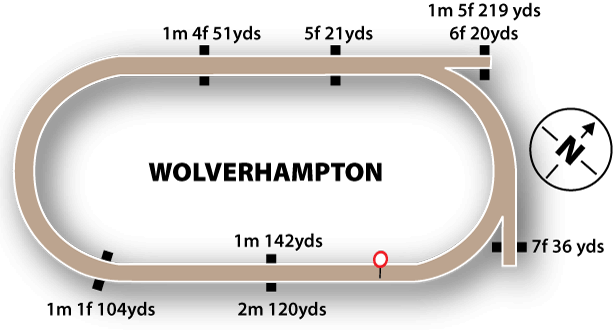
The Main Oval
- Distances1m 142y, 1m 1f 104y, 1m 4f 51y, 1m 5f 219y, 2m 120y
- Home StraightUnder 2f — one of the shortest AW straights in Britain
- BendsTwo sharp left-hand turns; tight and quick
- Run StylePosition at the final bend matters more here than at most tracks, clearest over the sprint trips and less so as the distance rises
- Draw BiasFair at 1m 142y; middle draws favoured from 1m1f to 1m6f
The Sprint Chutes
- Distances5f 21y, 6f 20y, 7f 36y
- 6f StartSpur in the back straight; runners hit the first left-hand bend quickly
- 7f StartSpur approaching the home bend; the stalls are angled into the turn
- Run StyleEarly speed is a real edge at 5f and milder at 6f; being handy matters more than leading outright
- Draw BiasLow draw advantage at 5f; only in big fields at 6f; wide draws penalised at 7f
Surface & History
- SurfaceTapeta — installed August 2014, replacing Polytrack. First Tapeta racing surface in Europe
- Previous SurfacesFibresand (1993–2004), Polytrack (2004–2014). The Polytrack deteriorated badly in its final years, prompting the switch
- FloodlightsBritain’s first floodlit racecourse, opened under lights in December 1993. The Queen reopened the venue in January 1994
- Feature RaceLady Wulfruna Stakes (Listed, 7f) — the most valuable race on the Wolverhampton calendar
- vs Other TracksHas generally ridden quicker than old Polytrack but slower than Lingfield, though preparation can alter surface speed. The tight configuration is unusually reminiscent of a North American synthetic oval
- Greyhound TrackDunstall Park Greyhounds opened inside the horse-racing oval in September 2025 — the first new greyhound venue in Britain since Towcester in 2014
Key Betting Angles
- 5f runnersGate speed and a low draw are the two things to weigh together. Early leaders won 13 of 37 qualifying handicaps in the eleven months to August 2022 (35%), and returned an A/E of 1.48 across the longer 2017–22 sample — and a horse with the speed to cross can take much of the sting out of a wide stall, so the combination to avoid is a high draw AND a likely hold-up ride
- 6f paceFront-runners have returned level-stakes profit across the six-season study period at this trip
- Tapeta formTapeta experience at Newcastle and Southwell is a useful secondary positive, but configuration, trip and pace matter more than matching the branded surface
- Short straightAny horse that needs daylight and a long run to the line is structurally disadvantaged. Factor this in, especially over the shorter trips
- Wide draws at 7f, and the middle over furtherAcross 1,320 handicaps of 8+ runners the outer third of the draw runs 16% below its share at 7f
- Feature racesThe Listed Lady Wulfruna Stakes (7f36y, March) and the Lincoln Trial, an extended-mile handicap run on the same March card and a traditional pointer to the Lincoln at Doncaster
- Evening cardsMost fixtures are floodlit evening meetings — an unusual programme, though we have not measured whether the market prices them differently
Do front-runners win at Wolverhampton?
Wolverhampton is a tight track where position counts for a good deal, for a simple reason: the home straight is under two furlongs. A horse that has not got itself into the race by the final bend has almost no room left to do anything about it.
The two chute starts sharpen that further — both feed into a bend within a short run — so most trips begin close to a bend rather than on a long run at it. Tapeta, laid in 2014, throws up markedly less kickback than the Fibresand and Polytrack that preceded it, so coming from behind is less punishing than it was; it is still the harder way to win here. The strength of the run-style effect varies a great deal by trip, so treat these bars as directional rather than a universal rule: be handy, most of all over the sprint trips.
Run Style Bias — Sprint Trips — Qualitative Only
Strongest at 5f, milder over 6f–7f
The safest profile
Less favoured over the sprint trips
At a clear disadvantage, most of all at 5f
Treat these bars as directional — a reading of how the track rides rather than a statistical measurement. The published recent and long-term samples differ in magnitude but point the same way.
Does the draw matter at Wolverhampton?
Strong bias — material handicapping factor
Moderate lean — worth noting
Broadly fair — not a primary factor
Which trainers and jockeys win most at Wolverhampton?
| Trainer | Runs | Wins | Win% | Places | Place% | A/E | P/L |
|---|---|---|---|---|---|---|---|
| 1 Evans, P D | 2322 | 265 | 11.41% | 708 | 30.49% | 0.88 | -507.34 |
| 2 Carroll, A W | 2434 | 242 | 9.94% | 717 | 29.46% | 0.83 | -657.75 |
| 3 Fahey, R A | 1697 | 192 | 11.31% | 530 | 31.23% | 0.87 | -332.96 |
| 4 Appleby, M | 1739 | 191 | 10.98% | 508 | 29.21% | 0.83 | -325.97 |
| 5 Botti, M | 1175 | 189 | 16.09% | 470 | 40.00% | 0.92 | -79.18 |
| 6 Loughnane, Daniel Mark | 1847 | 181 | 9.80% | 539 | 29.18% | 0.84 | -392.52 |
| 7 Gosden, J H M | 518 | 152 | 29.34% | 297 | 57.34% | 0.97 | -30.09 |
| 8 Dascombe, Tom | 1000 | 148 | 14.80% | 394 | 39.40% | 0.85 | -75.99 |
| 9 Williams, Ian | 1138 | 142 | 12.48% | 333 | 29.26% | 0.92 | -167.00 |
| 10 O’Meara, D | 1136 | 131 | 11.53% | 357 | 31.43% | 0.82 | -210.15 |
| 11 Osborne, J A | 942 | 124 | 13.16% | 300 | 31.85% | 0.91 | -164.12 |
| 12 Simcock, D M | 823 | 122 | 14.82% | 314 | 38.15% | 0.87 | -214.25 |
| 13 Tate, James | 635 | 122 | 19.21% | 297 | 46.77% | 0.93 | -77.73 |
| 14 Appleby, Charlie | 340 | 112 | 32.94% | 214 | 62.94% | 0.93 | -61.13 |
| 15 Varian, Roger | 448 | 111 | 24.78% | 251 | 56.03% | 0.92 | +22.53 |
| 16 Hannon (Jnr), Richard | 801 | 106 | 13.23% | 280 | 34.96% | 0.84 | -151.97 |
| 17 Butler, John | 871 | 101 | 11.60% | 240 | 27.55% | 0.94 | -215.46 |
| 18 Prescott, Sir Mark | 575 | 100 | 17.39% | 207 | 36.00% | 0.94 | -146.76 |
| 19 Watson, Archie | 644 | 98 | 15.22% | 264 | 40.99% | 0.88 | -158.17 |
| 20 Haggas, W J | 453 | 97 | 21.41% | 221 | 48.79% | 0.81 | -147.78 |
Wolverhampton AW · Current trainers, since 2010
| Jockey | Runs | Wins | Win% | Places | Place% | A/E | P/L |
|---|---|---|---|---|---|---|---|
| 1 Morris, Luke | 4229 | 501 | 11.85% | 1379 | 32.61% | 0.86 | -1044.54 |
| 2 Kingscote, Richard | 1595 | 247 | 15.49% | 637 | 39.94% | 0.89 | -223.76 |
| 3 Probert, David | 1830 | 199 | 10.87% | 561 | 30.66% | 0.84 | -386.27 |
| 4 Ryan, Rossa | 968 | 197 | 20.35% | 420 | 43.39% | 1.08 | +69.93 |
| 5 Doyle, Hollie | 1161 | 166 | 14.30% | 409 | 35.23% | 0.89 | -249.79 |
| 6 Mitchell, Jack | 972 | 163 | 16.77% | 406 | 41.77% | 0.94 | -60.01 |
| 7 Loughnane, Billy | 783 | 150 | 19.16% | 350 | 44.70% | 0.94 | -52.67 |
| 8 Sousa, Silvestre De | 805 | 145 | 18.01% | 305 | 37.89% | 0.90 | -144.82 |
| 9 Murphy, Oisin | 618 | 138 | 22.33% | 298 | 48.22% | 0.94 | -42.87 |
| 10 Havlin, Robert | 804 | 130 | 16.17% | 311 | 38.68% | 0.92 | -122.90 |
| 11 O’Neill, K T | 1283 | 124 | 9.66% | 312 | 24.32% | 0.95 | -291.50 |
| 12 Donohoe, Stephen | 1073 | 123 | 11.46% | 310 | 28.89% | 0.96 | -170.66 |
| 13 Muscutt, D | 878 | 123 | 14.01% | 311 | 35.42% | 0.94 | -165.89 |
| 14 Eaves, Tom | 1550 | 119 | 7.68% | 375 | 24.19% | 0.80 | -574.63 |
| 15 Doyle, James | 504 | 109 | 21.63% | 235 | 46.63% | 0.96 | +72.84 |
| 16 McDonald, P J | 923 | 103 | 11.16% | 315 | 34.13% | 0.80 | -188.12 |
| 17 Shepherd, Callum | 807 | 99 | 12.27% | 264 | 32.71% | 0.92 | -211.10 |
| 18 Carson, William | 1166 | 96 | 8.23% | 328 | 28.13% | 0.76 | -563.58 |
| 19 Spencer, Jamie | 527 | 93 | 17.65% | 229 | 43.45% | 0.77 | -175.35 |
Wolverhampton AW · Current riders, since 2010
Which sires do best at Wolverhampton?
| Sire | Runs | Wins | Win% | Places | Place% | A/E | P/L |
|---|---|---|---|---|---|---|---|
| 1 Kodiac | 1972 | 208 | 10.55% | 595 | 30.17% | 0.82 | -511.73 |
| 2 Dark Angel (IRE) | 1465 | 199 | 13.58% | 536 | 36.59% | 0.88 | -385.71 |
| 3 Exceed And Excel (AUS) | 1563 | 191 | 12.22% | 538 | 34.42% | 0.86 | -304.94 |
| 4 Invincible Spirit (IRE) | 1207 | 159 | 13.17% | 409 | 33.89% | 0.86 | -366.94 |
| 5 Oasis Dream | 1271 | 157 | 12.35% | 412 | 32.42% | 0.85 | -324.02 |
| 6 Acclamation | 1364 | 142 | 10.41% | 417 | 30.57% | 0.80 | -387.17 |
| 7 Iffraaj | 1080 | 140 | 12.96% | 358 | 33.15% | 0.91 | -114.90 |
| 8 Cape Cross (IRE) | 748 | 136 | 18.18% | 289 | 38.64% | 1.15 | +107.05 |
| 9 Kyllachy | 1259 | 132 | 10.48% | 359 | 28.51% | 0.90 | -107.85 |
| 10 Dubawi (IRE) | 567 | 115 | 20.28% | 233 | 41.09% | 0.93 | -102.86 |
| 11 Dandy Man (IRE) | 1141 | 114 | 9.99% | 329 | 28.83% | 0.79 | -114.46 |
| 12 Pivotal | 687 | 109 | 15.87% | 262 | 38.14% | 1.03 | -57.23 |
| 13 Shamardal (USA) | 555 | 109 | 19.64% | 222 | 40.00% | 1.00 | -73.69 |
| 14 Lope De Vega (IRE) | 613 | 105 | 17.13% | 230 | 37.52% | 1.02 | -90.04 |
| 15 Kheleyf (USA) | 822 | 95 | 11.56% | 244 | 29.68% | 1.00 | -165.14 |
| 16 Dansili | 578 | 89 | 15.40% | 222 | 38.41% | 0.95 | -22.84 |
| 17 Holy Roman Emperor (IRE) | 715 | 84 | 11.75% | 233 | 32.59% | 0.90 | -135.35 |
| 18 Bated Breath | 670 | 78 | 11.64% | 200 | 29.85% | 0.89 | -163.50 |
| 19 Footstepsinthesand | 664 | 77 | 11.60% | 213 | 32.08% | 0.86 | -203.40 |
| 20 Showcasing | 863 | 71 | 8.23% | 220 | 25.49% | 0.73 | -357.96 |
Wolverhampton AW · Since 2010
Betting Tips for Wolverhampton AW
Front-runners at 5f — the sharpest edge on the card
Early leaders at 5f won 13 of 37 qualifying handicaps in the eleven months to August 2022 (35%) and returned an A/E of 1.48 across the longer 2017–22 sample — two separate samples pointing the same way. The run to the first bend is short, so early speed decides most of these races — but a wide stall is not fatal to a horse fast enough to cross. It is the wide-drawn horse that will also be ridden patiently that struggles.
Wide draws at 7f, and the middle over further
Single-stall profit figures over a few seasons are the least reliable statistic in draw analysis — a stall that runs in a few hundred races can post a large profit or loss on a handful of results. Counted properly, the two angles that hold at Wolverhampton are these. At 7f the outer third of the draw runs at an impact value of 0.84 across 1,320 handicaps of eight or more runners, so a wide draw is a genuine negative. And from 1m1f to 1m6f the middle third runs at 1.15 against 0.89 for the low, with the lowest quarter returning an A/E of 0.71 against a 0.85 baseline — the inside is the place to avoid over the middle distances, not the place to be.
Treat a wide draw as a negative at 7f
The 7f chute feeds into a left-hand bend almost immediately, so a wide stall costs ground — a mild statistical negative rather than a rule, and one a horse ridden forward can mitigate. The thirds show: 1.05 low, 1.11 middle, 0.84 high.
Tapeta form transfers — selectively
Newcastle and Southwell both race on Tapeta, and that shared experience is worth something — but published work on all-weather returners finds no general rule that same-surface form transfers better, and Newcastle is a straight galloping track against Wolverhampton’s tight oval. Treat the surface as a secondary factor behind configuration, trip and pace.
Most cards are floodlit evening fixtures
A large part of Wolverhampton’s programme runs under lights, outside the main afternoon window. Punters often assume that means softer prices. We have not measured overrounds, BSP efficiency or A/E for evening cards against afternoon ones, so we make no claim that the market is weaker here — only that the fixture pattern is unusual.
The short straight changes everything beyond a mile
Under two furlongs of home straight means position at the final bend is worth more here than at most tracks, and that is clearest at the sprint trips. Over a mile and a half and beyond, do not carry the sprint rule up in distance: we have not measured run style by distance at this course, so read the likely shape of the race rather than assuming a closer cannot win.
Common Mistakes to Avoid
- Backing hold-up horses at 5f or 6f without checking their early speed figures. The short straight and tight bends put held-up runners at a meaningful tactical disadvantage, strongest at 5f and milder at 6f.
- Carrying the sprint low-draw habit up in distance. The 5f low-draw edge is real and worth 1.17 against 0.83, but it does not extend the way punters assume: at a mile the track is fair (0.96 / 1.01 / 1.04 across 1,063 handicaps of eight or more runners), and from 1m1f to 1m6f the inside is the worst place to be drawn, with the lowest quarter returning an A/E of 0.71. The mile in particular is often called the most draw-biased trip here; counted per field size, it is one of the fairest.
- Treating Polytrack and Tapeta form as interchangeable. The surfaces do ride differently, but the reverse error is just as common: treating a Tapeta line as automatically superior. Configuration and trip matter more than the surface brand.
- Assuming evening cards must be softer markets because they attract less attention. We have not measured overrounds or A/E for evening fixtures against afternoon ones, so judge the individual race and price rather than the time of day.
Wolverhampton Racecourse FAQs
Is there a draw bias at Wolverhampton?
What surface is Wolverhampton and how does it ride?
Which way does Wolverhampton race and what kind of track is it?
Does Wolverhampton form transfer to other all-weather tracks?
What is the biggest mistake punters make at Wolverhampton?
Other All-Weather Tracks
Kempton Park
Polytrack — prominent racers and a handy draw.
Lingfield Park
Polytrack — one of the strongest low-draw biases.
Chelmsford City
Tight Polytrack — pace and a low draw.
Newcastle
Tapeta — galloping straight mile, sharp round track.
Southwell
Tapeta (ex-Fibresand) — a speed-favouring surface.
Want the thinking behind Wolverhampton bets?
FormDial posts every selection before the off with its full reasoning: the angle, the price, the logic. No tips without context.
The Trackside Companion is your day at the races, written to order — every race on your meeting’s card broken down, plus this track’s draw, angles and people distilled from the guide you’ve just read. Order at least a week before your raceday.
Plan your raceday →