Lingfield Park
Flat
Lingfield, Surrey · 26 miles south of central London
Turf
Left-Handed
Triangular
Derby & Oaks Trials
Course Overview
Track Character
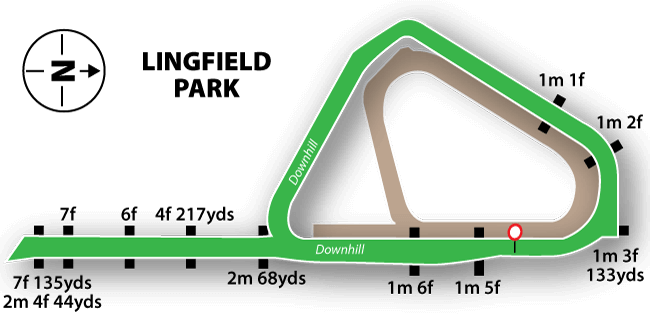
Lingfield’s turf track is one of the most bias-prone and idiosyncratic flat courses in Britain — and it is emphatically not the same animal as the Polytrack oval inside it. The round course runs approximately a mile and a half around a left-handed triangle, climbing stiffly up the back straight before a sharp downhill turn into a home straight of roughly three and a half furlongs. That descent is the decisive moment. Horses that arrive at the bend travelling and organised carry their momentum into the straight; those that have been fighting the track or losing ground on the climb are already beaten. The straight course — entirely separate, running seven furlongs and one hundred and forty yards — is a pure speed test with a different bias problem altogether. Treating them as one track is the first mistake a casual punter makes.
The ground changes the course completely. On quick turf, Lingfield is a sharp, balance-dependent track that rewards speed and adaptability; the stands’-rail bias on the straight is at its most pronounced and the downhill turn is where races are decided. When the going turns soft, the whole complexion shifts — stamina becomes the commodity, the usual pace-and-position calculus is disrupted, and the form of previous quick-ground meetings loses much of its relevance. You are, in effect, handicapping two different racecourses depending on what the weather has done.
The round course is where Lingfield most resembles Epsom, which is precisely why the Derby and Oaks trials are staged here in mid-May. The sharp left-hand descent into the home straight demands the same balance and tractability that Tattenham Corner will later require. A horse that gallops stiffly or hangs under pressure on the downhill bend at Lingfield is giving you advance warning about how it will behave at Epsom. This is not incidental — it is the point of the exercise. The trials have a genuine predictive value, and the yards that use them are usually looking for an Epsom rehearsal, not just a run.
Lingfield Park holds the distinction of being the only racecourse in Britain to stage all three codes — flat turf, flat all-weather and National Hunt — and its history stretches back to 1890, when the Prince of Wales opened it amid the Surrey countryside near the borders of Kent and Sussex. The Derby and Oaks Trials in May are the turf flat highlights; the Derby Trial alone has produced subsequent Epsom Derby winners including Slip Anchor, Kahyasi, Teenoso and High-Rise. These are not throwaway prep races. When Ballydoyle or another major operation sends a lightly raced three-year-old to run here in May, pay attention.
Jason Weaver rode the track extensively and his assessment of the straight-course bias is unambiguous:
— Jason Weaver, former jockey
What Weaver is describing is a track with a structural tilt that can be exploited by those who understand it and who punish those who do not. The stands’ rail on the straight course is the golden line on quick ground — being drawn to the stands’ side and being able to hold position near it is worth lengths. The downhill turn on the round course is the fulcrum of every race beyond a mile — get there in a good position travelling and you are dangerous; get there flat out and off the bridle and the race is gone.
Course Facts
- Round course 1m4f, left-handed, triangular — stiff climb up the back, sharp downhill turn into a ~3.5f home straight
- Straight course 7f 140y — entirely separate track, pure speed test, no bends
- Draw bias Straight course: middle-to-high draws (stands’ rail) strongly favoured on quick ground at 6f–7f140y. Round course: no significant draw bias
- Run style Straight course: pace plus rail position. Round course: handling and position before the downhill bend
- Ground sensitivity Quick ground amplifies all biases; soft ground brings stamina into play and can scramble the usual pattern entirely
The Straight Course
- Distances 5f, 6f, 7f, 7f 140y
- Key bias Middle-to-high draws, stands’ rail, on quick ground
- 6f–7f140y The core draw-bias zone — high rail plus pace is the dominant combination
- 5f Bias present but less absolute than at 6f/7f; high still preferable
- Run style Early pace from middle/high stalls; leaders outperform especially from favoured draws
The Round Course
- Distances 1m1f, 1m3f 133y, 1m6f, 2m+
- Draw No significant stall bias — handling and position matter more
- Key moment The downhill bend — those arriving here travelling win; those under pressure lose
- 1m3f 133y The Derby/Oaks Trial trip — balance and tractability trump stall numbers
- Run style Get handy before the descent; do not be shuffled back into the straight
Ground & History
- Quick ground Bias tracks fully — stands’ rail dominant, speed and adaptability at premium
- Soft ground Completely different course — stamina replaces speed, biases blunt
- Opened 1890, by the Prince of Wales (Edward VII)
- Derby Trial Won by Slip Anchor, Kahyasi, Teenoso, High-Rise among others
- Oaks Trial User Friendly, Lady Carla, Ramruma all won here before Epsom
Draw Bias by Distance
Draw data based on straight-course bias studies and round-course form analysis. Straight-course biases most pronounced on good or faster ground; can diminish significantly on soft.
Top Trainers & Jockeys
Placeholder data: These figures will be replaced with real 12-month Lingfield flat turf trainer and jockey stats once provided. A/E above 1.0 indicates market underestimation.
Top Trainers
Lingfield flat turf · Last 12 months · min. 15 runs
| Trainer | Runs | Wins | SR | Places | Place% | P/L (SP) | A/E | |
|---|---|---|---|---|---|---|---|---|
| 1 | R M Beckett | 26 | 7 | 26.92% | -4.39 | 42.31% | -4.39 | 1.00 |
| 2 | W J Haggas | 15 | 7 | 46.67% | 16.02 | 60.00% | +16.02 | 1.30 |
| 3 | Richard Hannon | 48 | 7 | 14.58% | -17.66 | 27.08% | -17.66 | 0.81 |
| 4 | Gary & Josh Moore | 39 | 7 | 17.95% | -14.18 | 33.33% | -14.18 | 1.03 |
| 5 | Charlie Johnston | 33 | 6 | 18.18% | -16.69 | 42.42% | -16.69 | 0.82 |
| 6 | M Botti | 21 | 5 | 23.81% | -2.91 | 42.86% | -2.91 | 1.24 |
| 7 | J R Boyle | 21 | 5 | 23.81% | 1.63 | 38.10% | +1.63 | 1.32 |
| 8 | A W Carroll | 36 | 5 | 13.89% | 11.75 | 33.33% | +11.75 | 1.05 |
| 9 | Alice Haynes | 39 | 5 | 12.82% | -15.71 | 33.33% | -15.71 | 1.02 |
| 10 | Archie Watson | 24 | 5 | 20.83% | 6.69 | 33.33% | +6.69 | 0.96 |
| 11 | Tom Clover | 13 | 4 | 30.77% | -0.67 | 61.54% | -0.67 | 1.32 |
| 12 | J R Fanshawe | 15 | 4 | 26.67% | 4.11 | 53.33% | +4.11 | 0.95 |
| 13 | J P Owen | 14 | 4 | 28.57% | 4.5 | 42.86% | +4.50 | 1.11 |
| 14 | George Scott | 15 | 4 | 26.67% | 0.95 | 46.67% | +0.95 | 1.12 |
| 15 | A M Balding | 25 | 3 | 12.00% | -10.3 | 36.00% | -10.30 | 0.60 |
| 16 | Jim/Suzi Best | 9 | 3 | 33.33% | 7.13 | 44.44% | +7.13 | 2.10 |
| 17 | George Boughey | 18 | 3 | 16.67% | -7 | 55.56% | -7.00 | 0.79 |
| 18 | P R Chamings | 22 | 3 | 13.64% | -4 | 36.36% | -4.00 | 1.15 |
| 19 | Simon Crisford | 17 | 3 | 17.65% | -8.92 | 47.06% | -8.92 | 0.73 |
| 20 | Dylan Cunha | 16 | 3 | 18.75% | -2.62 | 43.75% | -2.62 | 1.17 |
Top Jockeys
Lingfield flat turf · Last 12 months · min. 15 rides
| Jockey | Rides | Wins | SR | Places | Place% | P/L (SP) | A/E | |
|---|---|---|---|---|---|---|---|---|
| 1 | Hector Crouch | 29 | 9 | 31.03% | 7.06 | 44.83% | +7.06 | 1.40 |
| 2 | Callum Shepherd | 39 | 9 | 23.08% | -3.9 | 41.03% | -3.90 | 1.26 |
| 3 | N Callan | 38 | 8 | 21.05% | 2.5 | 39.47% | +2.50 | 0.79 |
| 4 | Cieren Fallon | 24 | 7 | 29.17% | 6.01 | 58.33% | +6.01 | 1.21 |
| 5 | Joe Leavy | 35 | 7 | 20.00% | 2.38 | 34.29% | +2.38 | 1.29 |
| 6 | Alexander Voikhansky | 18 | 7 | 38.89% | 25.59 | 50.00% | +25.59 | 2.02 |
| 7 | Pat Cosgrave | 22 | 6 | 27.27% | -0.75 | 45.45% | -0.75 | 1.26 |
| 8 | Tom Marquand | 25 | 6 | 24.00% | 7.17 | 44.00% | +7.17 | 1.07 |
| 9 | David Probert | 35 | 6 | 17.14% | -1.25 | 37.14% | -1.25 | 1.20 |
| 10 | Harry Davies | 33 | 5 | 15.15% | -12.25 | 39.39% | -12.25 | 0.88 |
| 11 | Hollie Doyle | 23 | 5 | 21.74% | 11.75 | 30.43% | +11.75 | 0.95 |
| 12 | Marco Ghiani | 16 | 5 | 31.25% | 3.96 | 68.75% | +3.96 | 1.53 |
| 13 | Darragh Keenan | 29 | 5 | 17.24% | 22.75 | 31.03% | +22.75 | 1.45 |
| 14 | Ashley Lewis | 13 | 5 | 38.46% | 1.32 | 46.15% | +1.32 | 1.67 |
| 15 | Billy Loughnane | 33 | 5 | 15.15% | 1.05 | 30.30% | +1.05 | 1.00 |
| 16 | Jack Mitchell | 29 | 5 | 17.24% | -6.69 | 55.17% | -6.69 | 0.83 |
| 17 | Jack Callan | 13 | 4 | 30.77% | 21 | 61.54% | +21.00 | 2.05 |
| 18 | R Dawson | 26 | 4 | 15.38% | -11.5 | 26.92% | -11.50 | 1.06 |
| 19 | Josephine Gordon | 17 | 4 | 23.53% | 16.83 | 41.18% | +16.83 | 2.29 |
| 20 | Robert Havlin | 16 | 4 | 25.00% | 22.25 | 43.75% | +22.25 | 1.77 |
Top Sires
Placeholder data: These figures will be replaced with real 12-month Lingfield flat turf sire stats once provided. A/E above 1.0 indicates market underestimation.
Top Sires
Lingfield flat turf · Last 12 months · min. 15 runs
| Sire | Runs | Wins | Win% | Places | Place% | A/E | P/L |
|---|---|---|---|---|---|---|---|
| 1Havana Grey | 38 | 9 | 23.68% | 0.66 | 44.74% | 1.02 | +0.66 |
| 2Harry Angel | 27 | 7 | 25.93% | 8.06 | 40.74% | 1.58 | +8.06 |
| 3Aclaim | 19 | 6 | 31.58% | 24.75 | 36.84% | 1.80 | +24.75 |
| 4Kodiac | 58 | 6 | 10.34% | -10 | 32.76% | 0.67 | -10.00 |
| 5Sea The Stars | 20 | 6 | 30.00% | -0.36 | 35.00% | 1.40 | -0.36 |
| 6Ardad | 27 | 5 | 18.52% | 14.63 | 29.63% | 1.51 | +14.63 |
| 7Oasis Dream | 34 | 5 | 14.71% | -13.51 | 44.12% | 0.90 | -13.51 |
| 8Time Test | 27 | 5 | 18.52% | 7.13 | 37.04% | 1.17 | +7.13 |
| 9Bated Breath | 24 | 4 | 16.67% | 9.13 | 58.33% | 1.19 | +9.13 |
| 10Dandy Man | 37 | 4 | 10.81% | -0.12 | 18.92% | 0.87 | -0.12 |
| 11Gleneagles | 11 | 4 | 36.36% | 8.67 | 45.45% | 1.25 | +8.67 |
| 12Havana Gold | 25 | 4 | 16.00% | 13.5 | 24.00% | 1.63 | +13.50 |
| 13Iffraaj | 23 | 4 | 17.39% | 0.43 | 26.09% | 1.40 | +0.43 |
| 14Land Force | 14 | 4 | 28.57% | 29.5 | 35.71% | 3.57 | +29.50 |
| 15Nathaniel | 16 | 4 | 25.00% | 6 | 56.25% | 1.79 | +6.00 |
| 16New Bay | 21 | 4 | 19.05% | -5.79 | 42.86% | 0.92 | -5.79 |
| 17Night Of Thunder | 13 | 4 | 30.77% | -0.67 | 46.15% | 1.37 | -0.67 |
| 18Showcasing | 29 | 4 | 13.79% | -12.91 | 24.14% | 1.23 | -12.91 |
| 19Adaay | 15 | 3 | 20.00% | 1.5 | 20.00% | 1.61 | +1.50 |
| 20Blue Point | 19 | 3 | 15.79% | 5.25 | 31.58% | 0.94 | +5.25 |
Betting Tips for Lingfield Flat Turf
The stands’ rail is not optional on quick ground
On the straight course in conditions of good or faster, middle-to-high draws nearest the stands’ side have an advantage that is among the most consistent in British racing. Backing well-handicapped horses from low draws in 6f and 7f straight-course handicaps on fast ground is a persistent losing strategy. The rail is not a preference — it is a structural edge. If the horse you want is drawn low, wait for a round-course race or a soft-ground day.
Soft ground reprice everything
Lingfield turf on soft is a different betting puzzle from Lingfield turf on quick. The stands’-rail straight-course bias diminishes, stamina replaces speed as the decisive factor, and the form of recent quick-ground winners is only partially relevant. Horses bred or proven to stay further than their usual trip become live contenders; horses that have been thriving on pace and position may find the ground neutralising their advantages. The two going conditions demand separate form assessments.
The downhill turn is the race within the race
On every round-course trip, the left-handed descent into the home straight sorts horses. Those arriving at the bend already travelling and balanced carry momentum that is very difficult for hold-up horses to overcome. Horses that quicken in a straight line but are awkward through bends — or that hang under pressure — will often give away ground here that they cannot recover. Make a habit of watching how horses negotiate this bend and note it in their form record.
The Derby and Oaks Trials tell you something real
The 1m3f133y trials in mid-May are the most important Lingfield flat races in the calendar. The course is genuinely Epsom-like in its demands — left-handed, downhill, requiring balance and tractability — and the results carry predictive value that other Classic trials often do not. A horse that handles Lingfield’s descent confidently is giving you a read on how it will cope with Tattenham Corner. When major yards send well-bred three-year-olds here in May, the run is almost always about Epsom, not Lingfield.
Mark up horses that win from adverse draws
When a horse wins on the straight course from a low draw on quick ground, or wins on the round course after being shuffled back before the descent, it has done something worth noting. These are wins achieved despite the course geometry, not because of it. Horses that can overcome structural disadvantages and still win are often operating at a level above what their bare form figure captures. They are worth following into their next race.
Course form is transferable — with caveats
Lingfield turf form translates reasonably well to other left-handed, sharp or undulating turf tracks — Epsom especially, but also Chepstow, Chester and Brighton to varying degrees. It translates less cleanly to galloping tracks that reward a different kind of horse. And as Jason Weaver explicitly notes, Lingfield turf form sometimes needs a pinch of salt in the way Chester form does — a horse may have been flattered by the rail or the track topology in a way that will not replicate elsewhere. Know why the form happened before projecting it forward.
Pace from the right place, not pace from anywhere
On the straight course, the optimal shape is pace combined with a favourable draw. Leaders who race from low draws on quick ground are not in the optimal position even if they are in front — they may be conceding the rail advantage to rivals who settle just behind them on the better strip. The best Lingfield straight-course punting angles combine a middle or high draw with the ability to take up a prominent position quickly. Pure front-runners from disadvantaged draws are only candidates when the ground has reduced the rail’s relevance.
Specificity of course experience matters
A horse with winning form at Lingfield turf is not automatically a course specialist — check whether that win came on the straight or round course, and on what ground. A horse that won a 6f straight-course race on good has done something completely different from one that won over 1m3f on the round course in testing conditions. Lingfield turf course form is only reliable context when the conditions that produced it match the conditions of the day’s race.
Respect the big-yard Classic trial entries
When Aidan O’Brien, John Gosden or Charlie Appleby sends a lightly raced three-year-old to Lingfield’s Derby or Oaks Trial, the operational logic is almost never “we want a Lingfield winner.” It is: this horse needs a proper left-handed, undulating test before Epsom. The trial result itself is informative — a horse that wins it fluently has passed an Epsom-specific examination. One that gets beaten but runs with credit may still be Epsom-bound. In either case, treating these as normal handicap-style form analysis misses the point of the race.
Want the thinking behind Lingfield turf bets?
FormDial posts every selection before the off with the full reasoning — the angle, the price, the logic. See how course knowledge feeds into real tips.