Catterick
Flat
Richmond, North Yorkshire · 5 miles south of Scotch Corner
Course Overview
Track Character
Catterick is one of the sharpest, most idiosyncratic flat tracks in Britain — a tight, undulating, left-handed oval measuring just nine furlongs round. Nothing about it is straightforward. The ground rises from the winning post into the back straight, then falls continuously for the final three furlongs to the line, creating a downhill finish that converts stamina races into tactical speed tests and sprint races into demolition derbies.
The key fact about Catterick is that it punishes big, long-striding gallopers. The tight turns, the constant shifts in gradient, and the compressed circumference demand balance, agility, and the ability to quicken off a bend. Horses trained on the rolling gallops around Middleham — the track has been compared to The Low Moor — handle it instinctively. Southern raiders from flat, conventional gallops frequently get turned over here, especially first time.
Course form is more significant at Catterick than at almost any other flat track in the country. The dips and rolls catch out horses and jockeys who haven’t experienced them before. A horse that wins here coming from behind is doing something genuinely impressive and deserves marking up for stiffer tracks. Conversely, a horse that leads and wins here has done nothing more than exploit the geography.
“The dips and rolls at Catterick catch out plenty of horses and you often see hotpots from the south turned over because they can’t handle them. It’s certainly a big advantage for a jockey to be on one that can kick on from the home turn in the longer races, especially on fast ground, because it’s really hard to make up the leeway. Lots of Catterick races are lost early on by a lack of tactical pace.”
— Jason Weaver, ex-Jockey (At The Races Course Guide)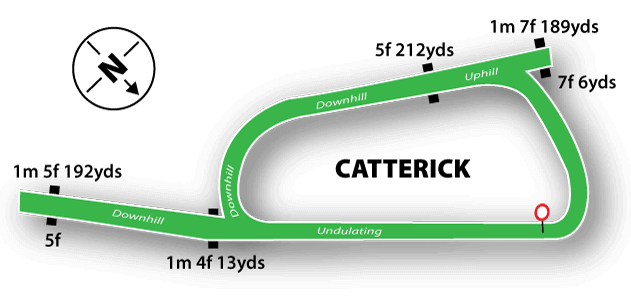
The Straight Course
- 5f sprint course runs entirely downhill, joining the round course at the entrance to the home straight
- The steepest gradient comes in the first two furlongs — horses break downhill immediately
- Heavily favours front-runners who can exploit the gradient from a low draw
- Large fields regularly see high-drawn runners disadvantaged by being forced wide on the camber
The Round Course
- 9 furlongs (1m 198y) left-handed oval with sharp bends at both ends
- Ground rises for approximately 1f from the winning post into the back straight, then falls for the remaining circuit
- 3f downhill run-in — jockeys who kick from the home turn hold a decisive advantage
- Races over 6f and 7f start on a spur joining the round course; 1m4f+ start on the oval itself
Track & History
- Racing at Catterick Bridge since 1783; permanent course laid down in 1813
- 17 flat meetings per year, April to November; 10+ NH fixtures in winter
- Feature flat race is the Catterick Dash (October) — a 5f sprint that exploits the downhill straight
- Collier Hill, winner of the Hong Kong Vase and Irish St Leger, won his first race here in 2002
Key Betting Angles
- Course specialists dominate — first-time visitors have a significantly lower strike rate
- Front-runners and prominent racers have a structural edge at every distance
- Low draws are a material handicapping factor at 5f, 6f, and 7f
- Local trainers (particularly those based around Middleham and the Hambleton Hills) outperform visitors consistently
Draw Bias by Distance
Top Trainers & Jockeys
Leading Trainers
Flat · Catterick| Trainer | Runs | Wins | SR% | Places | Pl% | P/L | A/E | |
|---|---|---|---|---|---|---|---|---|
| 1 | T D Easterby | 275 | 38 | 13.82% | 90 | 32.73% | -33.83 | 0.98 |
| 2 | K R Burke | 37 | 9 | 24.32% | 15 | 40.54% | -2.93 | 1.11 |
| 3 | D Carroll | 65 | 9 | 13.85% | 28 | 43.08% | +40.50 | 0.92 |
| 4 | Mrs R A Carr | 76 | 9 | 11.84% | 24 | 31.58% | -12.00 | 0.99 |
| 5 | Craig Lidster | 40 | 8 | 20.00% | 19 | 47.50% | +16.50 | 1.39 |
| 6 | J J Quinn | 63 | 8 | 12.70% | 21 | 33.33% | +4.90 | 0.77 |
| 7 | P T Midgley | 59 | 7 | 11.86% | 18 | 30.51% | -10.25 | 0.82 |
| 8 | Charlie Johnston | 47 | 7 | 14.89% | 15 | 31.91% | -12.37 | 1.08 |
| 9 | B Ellison | 50 | 7 | 14.00% | 17 | 34.00% | -15.04 | 0.90 |
| 10 | R A Fahey | 57 | 7 | 12.28% | 18 | 31.58% | -17.62 | 0.93 |
| 11 | Ed Bethell | 22 | 7 | 31.82% | 13 | 59.09% | -0.40 | 1.23 |
| 12 | Seb Spencer | 31 | 6 | 19.35% | 13 | 41.94% | +2.58 | 1.61 |
| 13 | M Dods | 63 | 6 | 9.52% | 27 | 42.86% | -41.41 | 0.56 |
| 14 | Micky Hammond | 51 | 5 | 9.80% | 11 | 21.57% | -20.17 | 1.00 |
| 15 | Jack Channon | 9 | 5 | 55.56% | 7 | 77.78% | +10.58 | 2.46 |
| 16 | John Riches | 37 | 5 | 13.51% | 12 | 32.43% | -7.00 | 1.13 |
| 17 | D O’Meara | 46 | 5 | 10.87% | 13 | 28.26% | -18.42 | 0.81 |
| 18 | Grant Tuer | 57 | 5 | 8.77% | 16 | 28.07% | +5.00 | 0.57 |
| 19 | G A Harker | 17 | 5 | 29.41% | 6 | 35.29% | +33.00 | 3.14 |
| 20 | George Scott | 15 | 5 | 33.33% | 9 | 60.00% | +13.50 | 1.57 |
A/E = Actual vs Expected winners. Values above 1.00 indicate the trainer outperforms market expectations at this track.
William Haggas doesn’t appear in the top 20 by volume, but his Catterick record is extraordinary: 23 wins from 58 runners (39.7%), with a 69% place rate. Since 2020 he’s 10 from 18 (55.6%). In maidens and novices specifically, he strikes at 43.9%. When Haggas sends one to Catterick, pay attention.
Leading Jockeys
Flat · Catterick| Jockey | Rides | Wins | SR% | Places | Pl% | P/L | A/E | |
|---|---|---|---|---|---|---|---|---|
| 1 | Jason Hart | 133 | 19 | 14.29% | 48 | 36.09% | +7.49 | 0.82 |
| 2 | Connor Beasley | 107 | 18 | 16.82% | 41 | 38.32% | +8.51 | 1.07 |
| 3 | David Allan | 136 | 17 | 12.50% | 48 | 35.29% | -59.27 | 0.77 |
| 4 | Sean Kirrane | 75 | 14 | 18.67% | 26 | 34.67% | +4.30 | 1.24 |
| 5 | Callum Rodriguez | 39 | 12 | 30.77% | 19 | 48.72% | -0.01 | 1.09 |
| 6 | Joanna Mason | 78 | 10 | 12.82% | 26 | 33.33% | -18.79 | 0.94 |
| 7 | D Nolan | 66 | 10 | 15.15% | 23 | 34.85% | -15.62 | 1.06 |
| 8 | S H James | 69 | 9 | 13.04% | 19 | 27.54% | +14.23 | 0.93 |
| 9 | Oisin Orr | 64 | 9 | 14.06% | 22 | 34.38% | -21.35 | 0.87 |
| 10 | Ben Robinson | 45 | 8 | 17.78% | 18 | 40.00% | +4.66 | 1.22 |
| 11 | Aiden Brookes | 71 | 7 | 9.86% | 18 | 25.35% | -25.42 | 1.10 |
| 12 | Joe Fanning | 44 | 7 | 15.91% | 16 | 36.36% | -5.62 | 1.17 |
| 13 | Mr Dale Swift | 28 | 7 | 25.00% | 10 | 35.71% | +18.58 | 1.92 |
| 14 | Tom Eaves | 74 | 6 | 8.11% | 16 | 21.62% | -20.00 | 0.85 |
| 15 | Clifford Lee | 20 | 6 | 30.00% | 6 | 30.00% | -2.47 | 1.39 |
| 16 | P J McDonald | 47 | 6 | 12.77% | 17 | 36.17% | +23.32 | 0.81 |
| 17 | Luke Morris | 16 | 6 | 37.50% | 9 | 56.25% | +17.08 | 2.43 |
| 18 | James P Sullivan | 60 | 6 | 10.00% | 14 | 23.33% | +4.00 | 0.81 |
| 19 | Billy Garritty | 70 | 5 | 7.14% | 17 | 24.29% | -41.97 | 0.60 |
| 20 | O McSweeney | 23 | 5 | 21.74% | 8 | 34.78% | +25.25 | 1.79 |
P/L = level-stakes profit/loss to SP. Jason Hart leads on volume; Connor Beasley and Sean Kirrane show the strongest A/E ratios among regulars.
Top Sires
Leading Sires
Flat · Catterick| Sire | Runners | Wins | SR% | Places | Pl% | P/L | |
|---|---|---|---|---|---|---|---|
| 1 | Kodiac | 108 | 12 | 11.11% | 33 | 30.56% | -6.15 |
| 2 | Dandy Man | 99 | 11 | 11.11% | 25 | 25.25% | +8.38 |
| 3 | Dark Angel | 76 | 10 | 13.16% | 28 | 36.84% | -31.69 |
| 4 | Kodi Bear | 33 | 10 | 30.30% | 13 | 39.39% | +28.82 |
| 5 | Bated Breath | 51 | 8 | 15.69% | 22 | 43.14% | +13.00 |
| 6 | Lope De Vega | 26 | 8 | 30.77% | 13 | 50.00% | +9.45 |
| 7 | Mehmas | 46 | 8 | 17.39% | 18 | 39.13% | +13.25 |
| 8 | Profitable | 56 | 8 | 14.29% | 19 | 33.93% | -3.39 |
| 9 | Sixties Icon | 33 | 8 | 24.24% | 14 | 42.42% | +8.83 |
| 10 | Cotai Glory | 33 | 7 | 21.21% | 15 | 45.45% | -0.01 |
| 11 | Bungle Inthejungle | 41 | 6 | 14.63% | 10 | 24.39% | -4.17 |
| 12 | Due Diligence | 29 | 6 | 20.69% | 11 | 37.93% | -0.29 |
| 13 | Havana Grey | 33 | 6 | 18.18% | 15 | 45.45% | -8.73 |
| 14 | Iffraaj | 25 | 6 | 24.00% | 11 | 44.00% | +19.25 |
| 15 | Slade Power | 24 | 6 | 25.00% | 13 | 54.17% | +9.50 |
| 16 | Havana Gold | 24 | 5 | 20.83% | 9 | 37.50% | +9.00 |
| 17 | Nayef | 17 | 5 | 29.41% | 7 | 41.18% | +18.00 |
| 18 | Oasis Dream | 30 | 5 | 16.67% | 9 | 30.00% | +28.83 |
| 19 | Alhebayeb | 14 | 4 | 28.57% | 7 | 50.00% | +6.33 |
| 20 | Camacho | 40 | 4 | 10.00% | 10 | 25.00% | -5.00 |
| 21 | Captain Gerrard | 14 | 4 | 28.57% | 9 | 64.29% | +17.25 |
| 22 | Cloth Of Stars | 13 | 4 | 30.77% | 6 | 46.15% | +9.33 |
| 23 | Fast Company | 32 | 4 | 12.50% | 9 | 28.13% | -14.29 |
| 24 | Land Force | 46 | 4 | 8.70% | 12 | 26.09% | -18.50 |
| 25 | Red Jazz | 17 | 4 | 23.53% | 8 | 47.06% | +7.00 |
Speed-oriented sires dominate. Kodi Bear (A/E 2.28) and Nayef (A/E 2.66) are significant overperformers relative to market expectations.
Betting Tips for Catterick Flat
Low Draw at 5f Is the Strongest Edge
Stalls 1–5 win nearly 80% of all 5f races on the straight course. In a competitive handicap with double-figure runners, a horse drawn in stalls 10+ needs to be significantly better than the opposition to overcome the bias. Adjust your tissue prices accordingly — the draw is not a tiebreaker here, it’s a primary factor.
Front-Runners Dominate
Pace analysis at every distance confirms that prominent racers have a structural edge. The downhill finish makes it extremely difficult to close ground in the final furlong. A horse that leads into the straight at Catterick is significantly harder to peg back than at a galloping track like Newbury or York.
Course Form Beats Class
Catterick is a course-specialists’ paradise. Horses that handle the undulations and tight bends outperform classier rivals who haven’t raced here before. The data consistently shows that a course winner returning to Catterick has a better strike rate than a horse dropping in class from a higher-grade track.
Local Trainers, Local Knowledge
Yards based around Middleham, the Hambleton Hills, and the broader North Yorkshire training centres have a demonstrable edge. Their horses gallop over similar terrain daily. Keith Dalgleish has historically posted the best level-stakes profit among trainers here, and David O’Meara’s strike rate at Catterick outperforms his overall record.
Going Changes the Draw Picture
On soft ground, the racing line shifts — jockeys move off the rail in search of better surface. This can reduce the low-draw advantage at sprint distances and create opportunities for higher-drawn runners to exploit fresher ground near the stands’ rail.
Come-From-Behind Winners Are Upgrades
If a horse wins at Catterick having come from well off the pace, mark it up heavily for its next run at a fairer track. The geometry of the course makes closing from behind genuinely difficult — a horse that does it here is better than the bare result suggests.
The 7f Sample Is Your Most Reliable Data
With 554 races, the 7f draw data is the deepest and most statistically robust dataset at Catterick. The 66% low-draw win rate across that sample is not noise — it’s signal. Weight it accordingly in your analysis.
Market Leaders in Non-Handicaps
Favourites in non-handicap races — particularly juvenile events — perform well at Catterick. The sharp track exaggerates ability differentials. A well-regarded newcomer from a top yard, drawn low at 5f, is close to a banker bet in weak maiden company.
Common Mistakes
- Ignoring the draw in sprints. The 5f bias is not subtle — 79% low-half win rate. Backing a high-drawn favourite in a 5f handicap without adjusting expectations is giving money away.
- Backing southern raiders first time. Class advantage evaporates when a horse can’t handle the undulations. Catterick debutants from big southern yards are among the worst value bets in British flat racing.
- Treating the 3f run-in as a finishing straight. It’s downhill. Closers don’t close the same ground here that they would at Ascot or Newmarket. The leader into the final furlong at Catterick holds on far more often than the raw distance suggests.
- Assuming longer distances neutralise the draw. The bias persists at 1m4f (72% low) — much stronger than most punters expect over a trip. Only at 2m does it genuinely wash out.
Want the thinking behind Catterick bets?
FormDial posts every selection before the off with the full reasoning — the angle, the price, the logic. See how course knowledge feeds into real tips.