Bath
Flat
Lansdown Hill, Somerset · 780ft above sea level — Britain’s highest Flat course
Left-Handed
Undulating, Galloping
Course Overview
Track Character
Bath is a left-handed kidney-shaped oval of one mile, four furlongs and 25 yards, perched 780 feet up Lansdown Hill. It has the highest elevation of any Flat racecourse in Britain and is the only one without a watering system. The home straight runs nearly half a mile, climbs steadily to the line, and bends gently left. Sprint races start from a chute that joins the round course at the head of the home straight.
The combination of elevation, no watering and free-draining ground produces conditions that are firmer than almost anywhere else in the country. Good to firm is the default; genuinely firm crops up regularly between June and September; soft is rare. That alone changes how form imports — a horse that handles fast turf has a structural edge here that figures from softer tracks won’t capture.
The track is undulating throughout. The back straight falls gently from the seven-furlong start; the home turn is sharp and sits on a camber that pushes runners off the inside rail; the run-in then climbs all the way to the post. Horses that commit too early up that long uphill straight tend to get collared late. Specialist form is real here — proven course winners are worth more than their ratings suggest, and ratings imported from sharper, level tracks need discounting.
— At The Races, Bath Course Guide
- Location
- Lansdown Hill, Bath, Somerset
- Postcode
- BA1 9BU
- Opened
- 1811 · racing on Lansdown since 1728
- Capacity
- ~7,000
- Signature Race
- Lansdown Stakes (Listed, 5f)
- Nearest Station
- Bath Spa · ~3.5 miles
- Parking
- Free on-site
- Meetings / year
- ~19 between April and October
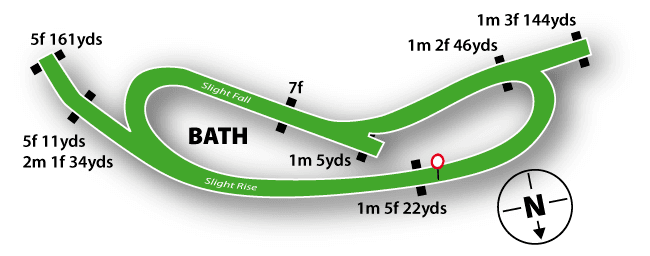
The Round Course
- Distance 1m4f 25y, left-handed, kidney-shaped — never properly straight, runners spend much of the trip on the turn
- Home turn Sharp and cambered — pushes horses off the rail late, often makes the difference
- Run-in ~3.5f, climbing the entire way to the post — finishers prosper, front-runners that go early get collared
- Trips 1m, 1m 2f 46y, 1m 3f 144y, 1m 5f, 2m 1f all run on the round course with varying first-bend dynamics
- First-bend issue Mile starts go right-handed briefly before the long left-hander, much like Epsom — a wide draw is no penalty
The Sprint Chute
- Distance 5f 11y and 5f 161y — both run from a chute that joins the round course at the top of the home straight
- Profile Always turning, always rising — there is no “straight” sprint at Bath, which separates it from every other Flat track in Britain
- Pace Truly run almost without exception — fast ground and the long uphill finish keep front-runners honest
- Sectional shape Sharp early acceleration off the chute, then the sustained climb — closers finish strongly when the lead group has overcommitted
- 6f races Use a separate start on the round course proper — different shape, different draw read
Surface & History
- Surface Turf only — no all-weather, no jumps
- Watering None — the only Flat racecourse in Britain without a watering system, by accident of geography rather than choice
- Going pattern Good to firm or quicker is the norm; genuinely firm common; soft very rare
- First raced 1728 on Claverton Down; moved to Lansdown by the Blathwayt family in 1811
- Owner Arena Racing Company since 2015 — Langridge Grandstand opened 2016
Key Betting Angles
- Course form Bath rewards specialists — repeat winners are common, and a previous course win is worth more than the bare RPR suggests
- Fast-ground form Imports from softer tracks need discounting; horses with proven good-to-firm form are at home here when others struggle
- Stamina & balance The undulations, the climb and the camber on the home turn all reward balanced, genuine stayers — pure speed types get found out
- Front-runners Can hold on against weak fields, but the uphill finish makes early leaders vulnerable when the pace is hot
- Jockeyship Bath is one of the most demanding rides in Britain — proven course riders carry a real edge
Draw Bias by Distance
Despite running entirely on the turn, Bath produces strikingly little draw bias. The conventional logic — left-handed turn, low draws save ground — does not show up in the figures. If anything, the longer-running stat sources point to a marginal high-draw advantage over 5f and 6f, possibly because horses drawn on the inner feel pressured to lead from the gates and overcommit before the long uphill finish. Over 7f and a mile, the field has time to find its level and the draw becomes irrelevant. For practical handicapping, treat Bath as a fair track and weight everything else — pace, course form, ground — ahead of stall position.
Strong bias — material handicapping factor
Moderate lean — worth noting
Broadly fair — not a primary factor
The headline finding at Bath is the absence of a finding. Across thousands of races analysed by industry trackers, no distance returns a draw bias strong enough to reset the shortlist. The sprint trips show a marginal lean toward higher numbers, which runs against the visual logic of a left-hand turn — most likely because lower-drawn runners feel forced to commit early on a track that punishes early leaders. Take it as a mild tiebreaker over 5f, nothing more.
Over 7f and beyond, the field has time to settle and the draw drops out of the equation entirely. Mile starts begin with a brief right-handed kink before the long left-hander — a wider draw is no penalty here, and may even help a slow-starter avoid traffic. Pace, course form and proven ground preference all carry far more weight at this track than stall position.
Top Trainers & Jockeys
| Trainer | Runs | Wins | Win% | Places | Place% | A/E | P/L |
|---|---|---|---|---|---|---|---|
| 1 A W Carroll | 307 | 44 | 14.33% | 98 | 31.92% | 1.22 | -17.24 |
| 2 Alan Wintle | 214 | 29 | 13.55% | 72 | 33.64% | 0.96 | -22.04 |
| 3 Clive Cox | 98 | 26 | 26.53% | 43 | 43.88% | 1.20 | +38.42 |
| 4 Richard Hannon | 128 | 18 | 14.06% | 46 | 35.94% | 0.81 | -31.69 |
| 5 Miss G Harris | 92 | 17 | 18.48% | 33 | 35.87% | 1.36 | +46.18 |
| 6 Roger Harris | 159 | 16 | 10.06% | 52 | 32.70% | 0.97 | -15.83 |
| 7 John Portman | 157 | 15 | 9.55% | 50 | 31.85% | 0.81 | -39.79 |
| 8 Brian Millman | 125 | 15 | 12.00% | 42 | 33.60% | 1.21 | +18.27 |
| 9 George Boughey | 61 | 14 | 22.95% | 21 | 34.43% | 0.99 | -3.65 |
| 10 Eve Johnson Houghton | 75 | 12 | 16.00% | 30 | 40.00% | 1.12 | -3.74 |
| 11 John Moore | 80 | 11 | 13.75% | 23 | 28.75% | 1.04 | -3.55 |
| 12 Richard Hughes (ret. 2015) | 81 | 11 | 13.58% | 29 | 35.80% | 1.04 | +5.83 |
| 13 Moore (Gary & Josh) | 51 | 9 | 17.65% | 20 | 39.22% | 1.41 | -2.34 |
| 14 Peter Evans | 65 | 9 | 13.85% | 18 | 27.69% | 1.32 | +9.66 |
| 15 J L Flint | 91 | 9 | 9.89% | 28 | 30.77% | 0.85 | -39.46 |
| 16 Roy Teal | 108 | 9 | 8.33% | 30 | 27.78% | 0.69 | -50.04 |
| 17 George Scott | 53 | 8 | 15.09% | 16 | 30.19% | 1.27 | +16.00 |
| 18 Michael Appleby | 58 | 8 | 13.79% | 12 | 20.69% | 1.04 | -12.04 |
| 19 Declan Coakley | 114 | 8 | 7.02% | 34 | 29.82% | 0.88 | -39.50 |
| 20 John Tickle | 116 | 8 | 6.90% | 28 | 24.14% | 1.05 | -2.00 |
| Jockey | Runs | Wins | Win% | Places | Place% | A/E | P/L |
|---|---|---|---|---|---|---|---|
| 1 David Probert | 184 | 30 | 16.30% | 61 | 33.15% | 1.03 | +36.61 |
| 2 Trevor Whelan | 188 | 21 | 11.17% | 55 | 29.26% | 0.95 | -46.55 |
| 3 Billy Loughnane | 117 | 19 | 16.24% | 44 | 37.61% | 1.04 | -26.88 |
| 4 K T O’Neill | 174 | 19 | 10.92% | 47 | 27.01% | 1.12 | +41.49 |
| 5 Luke Morris | 214 | 15 | 7.01% | 46 | 21.50% | 0.69 | -93.84 |
| 6 Finley Marsh | 107 | 14 | 13.08% | 28 | 26.17% | 1.09 | -9.69 |
| 7 Rob Hornby | 112 | 13 | 11.61% | 35 | 31.25% | 0.84 | -29.13 |
| 8 Hollie Doyle | 139 | 12 | 8.63% | 28 | 20.14% | 0.65 | -69.31 |
| 9 Charles Bishop | 130 | 11 | 8.46% | 30 | 23.08% | 0.82 | -29.00 |
| 10 Hector Crouch | 100 | 11 | 11.00% | 33 | 33.00% | 0.75 | -37.79 |
| 11 Pat Cosgrave | 97 | 11 | 11.34% | 21 | 21.65% | 0.91 | -13.50 |
| 12 Taylor Fisher | 80 | 10 | 12.50% | 21 | 26.25% | 1.41 | +40.00 |
| 13 Jack Doughty | 95 | 10 | 10.53% | 29 | 30.53% | 0.87 | -9.21 |
| 14 Gina Mangan | 105 | 10 | 9.52% | 28 | 26.67% | 1.04 | -22.00 |
| 15 David Egan | 97 | 10 | 10.31% | 21 | 21.65% | 0.91 | -5.50 |
| 16 Rossa Ryan | 85 | 9 | 10.59% | 21 | 24.71% | 0.79 | -31.05 |
| 17 L P Keniry | 107 | 9 | 8.41% | 32 | 29.90% | 1.05 | +2.50 |
| 18 Jason Watson | 118 | 9 | 7.63% | 33 | 27.97% | 0.84 | -22.00 |
| 19 Oisin Murphy | 46 | 8 | 17.39% | 18 | 39.13% | 0.71 | -1.04 |
| 20 Tom Marquand | 54 | 8 | 14.81% | 15 | 27.78% | 0.62 | -23.40 |
Top Sires
| Sire | Runs | Wins | Win% | Places | Place% | A/E | P/L |
|---|---|---|---|---|---|---|---|
| 1 Dandy Man (IRE) | 172 | 29 | 16.86% | 55 | 31.98% | 1.30 | +60.60 |
| 2 Mayson | 71 | 16 | 22.54% | 24 | 33.80% | 1.36 | +11.18 |
| 3 Dark Angel (IRE) | 108 | 15 | 13.89% | 30 | 27.78% | 1.05 | +2.51 |
| 4 Showcasing | 116 | 13 | 11.21% | 33 | 28.45% | 0.95 | -49.08 |
| 5 Kodiac | 116 | 12 | 10.34% | 36 | 31.03% | 0.84 | -37.04 |
| 6 Air Force Blue (USA) | 55 | 11 | 20.00% | 17 | 30.91% | 1.51 | +21.00 |
| 7 Golden Horn | 47 | 10 | 21.28% | 17 | 36.17% | 1.49 | +16.79 |
| 8 Coach House (IRE) | 54 | 10 | 18.52% | 23 | 42.59% | 1.27 | -9.60 |
| 9 Havana Grey | 94 | 10 | 10.64% | 28 | 29.79% | 0.92 | -19.34 |
| 10 Ardad (IRE) | 46 | 9 | 19.57% | 18 | 39.13% | 1.45 | +18.70 |
| 11 Cotai Glory | 46 | 9 | 19.57% | 15 | 32.61% | 1.61 | +5.50 |
| 12 Iffraaj | 80 | 9 | 11.25% | 21 | 26.25% | 1.16 | -19.79 |
| 13 Poets Voice | 73 | 9 | 12.33% | 16 | 21.92% | 1.21 | -13.41 |
| 14 Australia | 47 | 8 | 17.02% | 14 | 29.79% | 1.36 | +1.50 |
| 15 Starspangledbanner (AUS) | 55 | 8 | 14.55% | 16 | 29.09% | 1.18 | -12.71 |
| 16 Twilight Son | 59 | 8 | 13.56% | 15 | 25.42% | 1.04 | -7.50 |
| 17 Cable Bay (IRE) | 65 | 8 | 12.31% | 21 | 32.31% | 1.13 | +4.79 |
| 18 Zoustar (AUS) | 70 | 8 | 11.43% | 21 | 30.00% | 1.16 | -2.83 |
| 19 Muhaarar | 75 | 8 | 10.67% | 21 | 28.00% | 0.91 | -15.59 |
| 20 No Nay Never (USA) | 80 | 8 | 10.00% | 18 | 22.50% | 0.92 | -19.40 |
Betting Tips for Bath Flat Turf
Trust course form over ratings
Bath produces specialists. The undulations, the camber on the home turn and the long uphill finish all create a unique test that ratings imported from level tracks can’t capture. A horse with a course win to its name is often worth backing again, even at a stiff mark — and ratings-led shortlists from sharper, more conventional venues underrate the demands of this hill.
Fast-ground form is gold
No watering plus free-draining turf plus summer-only fixtures equals firm ground far more often than anywhere else in Britain. Horses with proven good-to-firm form should be the starting point of any shortlist between June and September. Soft-ground specialists imported from a different code or season will struggle, regardless of figures.
Don’t get sucked in by early leaders
The home straight rises for nearly half a mile to the post. Horses that go for home turning in look superb at the three-furlong pole and are routinely collared inside the final furlong. When backing a front-runner here, look for one with proven uphill stamina — and when fading one, the long climb is your friend.
Pace beats draw
Despite the constant turning, Bath produces no meaningful draw bias outside a marginal high-draw lean over 5f. Stop weighting stall position; start weighting pace. A held-up horse drawn anywhere in a truly-run sprint is better off than a front-runner forced to commit early — the configuration of the track matters far more than the gate.
Specialist riders carry an edge
The home turn is sharp and cambered, the run-in is uphill, and the camber pushes runners off the rail late. Jockeys who haven’t ridden Bath before routinely make the same mistakes: committing too early, losing the rail at the wrong moment, getting wide on the climb. Riders with a strong track record here are usually worth a small bump in confidence.
Sprints are truly run
The 5f chute joins the round course at the head of the home straight, so sprinters are turning and rising for almost the entire trip. Pace is invariably hot — there is no easy lead at Bath — and the long climb finds out anything that has overcommitted. Closers travel into the race well; pure speed types without a finishing kick get found out.
Repeat winners pay off
Track specialists are a real category at Bath. A horse that has won here once is statistically more likely than the field to do so again, all things equal. When sifting handicaps, give weight to course form even when it sits a few months back, especially for the type of horse — balanced, stamina-laden, fast-ground — that the track favours structurally.
Wind matters more than usual
Bath sits 780 feet above sea level on an exposed hill. Strong headwinds are common down the back straight and gusts on the climb to the line genuinely affect outcomes. When the going report flags strong winds, expect slow times, hold-up riders to dominate, and any front-running selection to be at greater risk than the race shape alone would suggest.
Mile starts go right then left
Races starting at 1m and 1m 2f begin with a brief right-handed kink before joining the long left-hander into the back straight — much like the Derby start at Epsom. A wide draw at these trips is no penalty and can actually help a slow-starter avoid traffic. The field has more than enough distance to find its level before the home turn.
Common Mistakes at Bath
- Reading Bath as a galloping flat track Bath is sharply undulating with a stiff uphill finish at altitude (780ft). Hold-up rides who can’t pick up off the climb tail off late. Genuine stayers and uphill-finishers are systematically under-priced; flat-track form transfers poorly.
- Backing fancied southern-yard runners blind Bath rewards the regulars. Carroll, Wintle, Cox, Millman and Eve Johnson Houghton run a high volume here for a reason — they know the gradient, they know the going. A first-time-here yard at short odds is structurally overpriced.
- Ignoring David Probert and K T O’Neill on the card Probert returns +36.61 P/L, O’Neill +41.49 P/L over five years. Both are local specialists with sustained profit. If they ride a stable’s second string, that’s often the live one. The market under-prices their bookings.
- Treating Dandy Man and Mayson as par sires Dandy Man (A/E 1.30, +60.60 P/L) and Mayson (A/E 1.36) deliver positive returns from sustained samples. They’re no longer hidden but the market still under-prices them on debut runs and second-time-out. Trust the breeding angle here.
- Spreading exotic bets across small fields Bath cards run light — 7 to 10 runners is common. Exacta and trifecta combinations get expensive fast. Singles and place bets on positive A/E angles return more consistent profit than chasing big-payout combinations on this card.
Want the thinking behind Bath turf bets?
FormDial posts every selection before the off with the full reasoning — the angle, the price, the logic. See how course knowledge feeds into real tips.