Ayr
Flat Turf
Whitletts Road, Ayr · Scotland’s premier Flat venue
Turf
Left-handed
Galloping
Course Overview
Track Character
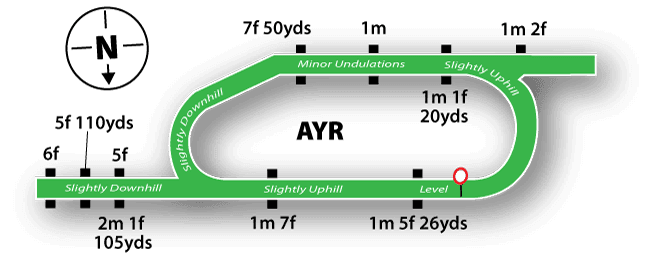
Ayr is the most westerly racecourse in Britain and Scotland’s premier Flat venue. The round course is a left-handed oval of about twelve furlongs in circumference, with a home straight of roughly four furlongs that rises gently into the line. The bends are sweeping and well-graduated rather than tight; the turn into the straight is slightly downhill, allowing prominent racers to flow into the lane with momentum intact. The straight is exceptionally wide, accommodating sprint fields of up to 28 runners — a configuration that defines how the course’s signature race, the Ayr Gold Cup, plays out.
What Ayr rewards above all is sustained galloping. The terrain is flat, exposed, and unforgiving for horses that hit a peak early and shorten before the line. Honest stayers who can maintain their cruising speed around the bend and sustain it up the run-in win at a higher rate than their ratings suggest. The course’s character changes dramatically with the going — quick ground produces a true Flat test where prominent racers thrive, while soft or heavy turns it into one of the most attritional galloping tracks in the country.
The straight 5f and 6f course runs alongside the round track and is the centrepiece of the Western Meeting in September. The Ayr Gold Cup, contested over six furlongs with up to 26 runners, is one of the most studied draw races in the British calendar — a race where ground bias along each rail can split the field into two effectively separate contests, and where the side with the faster strip almost always wins outright.
— Jason Weaver, At The Races View From The Saddle
- Location
- Whitletts Road, Ayr, South Ayrshire
- Postcode
- KA8 0JE
- Established
- 1907 (current site)
- Capacity
- ~15,000
- Signature Race
- Ayr Gold Cup (Heritage Handicap, 6f)
- Nearest Station
- Ayr · ~1 mile
- Parking
- Free on-site
- Meetings / year
- ~25 dual-purpose, ~13 Flat
The Round Course
- Configuration Left-handed galloping oval of approximately twelve furlongs with a run-in of around half a mile
- Bends Sweeping and well-graduated, no tight turns — horses lose less ground around the bend than at sharper tracks like Chester or Musselburgh
- Turn into straight Slightly downhill, allowing prominent racers to flow into the lane with momentum and gain a lasting advantage
- Trips on the round course 7f, 1m, 1m 1f, 1m 2f, 1m 5f, 1m 7f, 2m 1f — all share the long left-handed bend and uphill finish
- First-bend dynamics Mile starts from a chute on the back straight; longer-distance starts run a section of the back straight before the long left-handed turn
The Sprint Course
- Distances 5f and 6f run on the wide straight course alongside the round track
- Field capacity Up to 28 runners — the Ayr Gold Cup’s full field is the largest sprint field at any British track
- Camber The straight is genuinely flat with no significant ridge; the bias is created by ground variation along each rail rather than topography
- Rail dynamics Stands-side and far-side hold moisture and recover from rainfall at slightly different rates — in big-field sprints the field splits into two groups, and the faster strip almost always wins
- Pace shape Honest, sustained gallop from the gates to the line in big fields — front-runners get pressed hard and rarely last
Surface & History
- Surface Turf only — no all-weather, no jumps surface mixed in
- Drainage Excellent by Scottish standards; the course handles rain well but can ride truly heavy after sustained wet weather
- Watering Full watering system installed; ground reports are widely trusted and reliable
- Founded Current Ayr Racecourse opened in 1907; racing in the area dates to the early 1800s
- Owner Western Meeting Club founded the modern course; now operated independently as Scotland’s leading racing venue
Key Betting Angles
- Course form Ayr is a specialist’s track — proven Ayr winners outperform their ratings, particularly in sprint and middle-distance handicaps
- Stamina The flat exposed terrain offers no recovery from a stamina deficit; horses with proven staying credentials at galloping tracks (Musselburgh, Newcastle, Doncaster) translate better than those from sharper courses
- Northern yards Local Scottish and northern stables consistently outperform the market — Goldie, Dalgleish, Fahey, Dods all hold structural edges that southern-focused markets undervalue
- Western Meeting The September festival concentrates competitive sprint and middle-distance handicaps; targeted horses arrive well-handicapped and lightly raced — late market moves from Scottish yards carry weight
- Ground reading Watch the first sprint race of any Ayr card before the feature — the winner’s draw is the best real-time evidence of which side of the straight is riding faster
Draw Bias by Distance
The two sprint distances run straight at Ayr and produce a real, persistent low-draw advantage in the data. The round-course trips run almost perfectly fair — the long sweeping bends and four-furlong straight give horses on any draw enough time and room to recover. The figures below cover all going types and field sizes.
Strong bias — material handicapping factor
Moderate lean — worth noting
Broadly fair — not a primary factor
Top Trainers & Jockeys
| Trainer | Runs | Wins | Win% | Places | Place% | A/E | P/L |
|---|---|---|---|---|---|---|---|
| 1 Jim Goldie | 709 | 102 | 14.39% | 230 | 32.44% | 1.04 | -101.96 |
| 2 Iain Jardine | 396 | 50 | 12.63% | 119 | 30.05% | 1.07 | -62.16 |
| 3 David O’Meara | 265 | 34 | 12.83% | 98 | 36.98% | 0.78 | -50.79 |
| 4 Michael Dods | 283 | 31 | 10.95% | 86 | 30.39% | 0.81 | -34.04 |
| 5 R Michael Smith | 362 | 31 | 8.56% | 84 | 23.20% | 0.93 | -154.49 |
| 6 Richard Fahey | 243 | 24 | 9.88% | 73 | 30.04% | 0.69 | -101.33 |
| 7 Tim Easterby | 261 | 23 | 8.81% | 64 | 24.52% | 0.74 | -74.29 |
| 8 Karl Burke | 139 | 22 | 15.83% | 49 | 35.25% | 0.94 | +2.88 |
| 9 Keith Dalgleish | 202 | 20 | 9.90% | 57 | 28.22% | 0.75 | -94.12 |
| 10 Kevin Ryan | 187 | 17 | 9.09% | 53 | 28.34% | 0.75 | -100.39 |
| 11 Katie Scott | 120 | 16 | 13.33% | 39 | 32.50% | 1.10 | +66.00 |
| 12 Charlie Johnston | 99 | 15 | 15.15% | 33 | 33.33% | 1.13 | +3.83 |
| 13 Linda Perratt | 270 | 15 | 5.56% | 46 | 17.04% | 0.78 | -129.83 |
| 14 Archie Watson | 34 | 14 | 41.18% | 22 | 64.71% | 1.63 | +35.75 |
| 15 John Quinn | 91 | 14 | 15.38% | 36 | 39.56% | 0.88 | -27.55 |
| 16 C Johnston (fmr M Johnston) | 89 | 12 | 13.48% | 29 | 32.58% | 0.78 | -44.37 |
| 17 Mick Easterby | 104 | 11 | 10.58% | 29 | 27.88% | 0.98 | -6.47 |
| 18 Adrian Paul Keatley | 62 | 10 | 16.13% | 21 | 33.87% | 1.25 | +10.51 |
| 19 Tristan Davidson | 70 | 10 | 14.29% | 27 | 38.57% | 1.01 | -8.82 |
| 20 Ewan Whillans | 84 | 10 | 11.90% | 21 | 25.00% | 1.13 | -14.42 |
| Jockey | Runs | Wins | Win% | Places | Place% | A/E | P/L |
|---|---|---|---|---|---|---|---|
| 1 Paul Mulrennan | 459 | 79 | 17.21% | 175 | 38.13% | 0.98 | -35.46 |
| 2 Jason Hart | 273 | 38 | 13.92% | 94 | 34.43% | 0.93 | -4.54 |
| 3 Andrew Mullen | 323 | 37 | 11.46% | 84 | 26.01% | 1.08 | -62.43 |
| 4 Daniel Tudhope | 217 | 35 | 16.13% | 84 | 38.71% | 0.86 | -29.51 |
| 5 Joe Fanning | 177 | 29 | 16.38% | 64 | 36.16% | 1.03 | -18.30 |
| 6 Connor Beasley | 240 | 26 | 10.83% | 80 | 33.33% | 0.84 | -53.66 |
| 7 David Allan | 180 | 20 | 11.11% | 51 | 28.33% | 0.85 | -57.92 |
| 8 Clifford Lee | 126 | 18 | 14.29% | 45 | 35.71% | 1.01 | -5.54 |
| 9 Billy Garritty | 122 | 17 | 13.93% | 35 | 28.69% | 1.16 | +16.83 |
| 10 Ben Curtis | 76 | 15 | 19.74% | 28 | 36.84% | 1.22 | +4.13 |
| 11 Callum Rodriguez | 171 | 15 | 8.77% | 49 | 28.66% | 0.62 | -98.21 |
| 12 Kevin Stott | 108 | 14 | 12.96% | 38 | 35.19% | 0.79 | -4.95 |
| 13 Oisin Orr | 167 | 14 | 8.38% | 52 | 31.14% | 0.57 | -76.38 |
| 14 Daniel Nolan | 105 | 13 | 12.38% | 38 | 36.19% | 0.87 | -27.46 |
| 15 Hollie Doyle | 41 | 12 | 29.27% | 20 | 48.78% | 1.32 | +24.61 |
| 16 Joanna Mason | 92 | 12 | 13.04% | 28 | 30.43% | 1.09 | -9.05 |
| 17 Sam James | 112 | 12 | 10.71% | 32 | 28.57% | 0.76 | -34.31 |
| 18 Paul Hanagan | 69 | 10 | 14.49% | 20 | 28.99% | 1.13 | -10.70 |
| 19 Patrick Mathers | 131 | 10 | 7.63% | 32 | 24.43% | 0.71 | -62.79 |
| 20 Oliver McSweeney | 45 | 9 | 20.00% | 14 | 31.11% | 1.63 | +1.13 |
Top Sires
| Sire | Runs | Wins | Win% | Places | Place% | A/E | P/L |
|---|---|---|---|---|---|---|---|
| 1 Dandy Man (IRE) | 140 | 17 | 12.14% | 36 | 25.71% | 0.98 | -14.66 |
| 2 Kodiac | 168 | 16 | 9.52% | 49 | 29.17% | 0.85 | -43.25 |
| 3 Orientor | 171 | 16 | 9.36% | 49 | 28.66% | 0.74 | -93.00 |
| 4 Dark Angel (IRE) | 109 | 15 | 13.76% | 34 | 31.19% | 1.07 | +36.24 |
| 5 Lope De Vega (IRE) | 68 | 13 | 19.12% | 27 | 39.71% | 1.07 | +18.60 |
| 6 Mehmas (IRE) | 93 | 13 | 13.98% | 28 | 30.11% | 1.10 | +55.80 |
| 7 Sea The Moon (GER) | 54 | 11 | 20.37% | 18 | 33.33% | 1.29 | +13.25 |
| 8 Acclamation | 90 | 11 | 12.22% | 36 | 40.00% | 0.89 | -25.65 |
| 9 New Bay | 34 | 10 | 29.41% | 16 | 47.06% | 1.99 | +29.50 |
| 10 Muhaarar | 44 | 10 | 22.73% | 14 | 31.82% | 1.69 | +31.00 |
| 11 Epaulette (AUS) | 75 | 10 | 13.33% | 22 | 29.33% | 1.13 | -16.29 |
| 12 Sioux Nation (USA) | 22 | 8 | 36.36% | 11 | 50.00% | 1.68 | +8.40 |
| 13 Australia | 42 | 8 | 19.05% | 11 | 26.19% | 1.19 | -11.88 |
| 14 Poets Voice | 49 | 8 | 16.33% | 22 | 44.90% | 0.99 | -10.92 |
| 15 Coach House (IRE) | 56 | 8 | 14.29% | 16 | 28.57% | 1.17 | -10.87 |
| 16 Churchill (IRE) | 58 | 8 | 13.79% | 23 | 39.66% | 1.12 | -9.75 |
| 17 Awtaad (IRE) | 59 | 8 | 13.56% | 20 | 33.90% | 0.92 | +5.19 |
| 18 Iffraaj | 78 | 8 | 10.26% | 19 | 24.36% | 0.88 | +1.75 |
| 19 Frankel | 34 | 7 | 20.59% | 11 | 32.35% | 0.82 | -16.45 |
| 20 Elzaam (AUS) | 42 | 7 | 16.67% | 16 | 38.10% | 1.27 | +17.25 |
Betting Tips for Ayr Flat Turf
Trust the inside in sprints
The 5f and 6f straight courses produce a real, persistent low-draw advantage in the data — stalls 1–6 win at well above their share, with the drop-off after stall 7 sharp enough to factor into every selection in fields of 10 or more.
Watch the early card
In big-field 6f sprints — the Gold Cup especially — ground variation along each rail can override the structural low-draw bias. The first sprint race of any Ayr afternoon is your real-time going meter; whichever side wins that race tells you which strip is riding faster.
Oppose front-runners in big sprints
A 26-runner Gold Cup is run at a relentless gallop from the gates. Front-runners and prominent racers get pressed from every direction and rarely last. Hold-up types with a sustained finishing kick from the two-furlong pole consistently outperform the market in the feature.
Stamina is non-negotiable
The flat exposed terrain offers no recovery from a stamina deficit. Horses stepping up in trip with proven galloping form translate well; horses dropping back from a trip that exposed their staying limitations rarely improve enough to win.
Northern yards carry an edge
The market consistently underprices Goldie, Dalgleish, Fahey, Dods and Jardine at Ayr. Local track knowledge, a short journey for the horse, and ground familiarity combine into a structural edge that southern-focused books undervalue — particularly in mid-tier handicaps where less attention is paid.
Course form is real currency
Ayr is a specialist’s track. A horse with two or three solid runs at the course is worth more than its rating implies, while a horse with no Ayr form on a high mark from sharper tracks is consistently overrated. Course-and-distance winners deserve a hard second look every time they reappear.
Read the going honestly
Ayr’s exposed west-coast position means the going can shift mid-card. Soft-ground form translates only if the horse has handled flat, attritional turf — not at undulating tracks where downhill sections offer relief. Look for evidence at Musselburgh, Newcastle, Doncaster.
Late market moves matter
Money for a Scottish-trained runner in the final 30 minutes is often informed. Yard staff who’ve seen the horse work on the gallops have visibility the market doesn’t. A drift from a Scottish yard is worth opposing; a shortener is worth following.
Each-way the Western Meeting
September’s three-day festival concentrates the year’s most competitive handicaps. Field sizes are big, place terms generous, and ante-post draws don’t always land favourably. Spreading across two or three horses each-way at 16/1+ has a stronger long-run profile than chasing the single winner.
Common Mistakes at Ayr
- Treating Ayr like a generic left-handed mile Ayr is one of Britain’s longest galloping tracks with a sweeping bend and a stiff three-furlong finish. Hold-up rides built for sharp tracks get caught flat-footed. Adjust pace expectations — sustained galloping types are rewarded here in a way they aren’t at Catterick or Hamilton.
- Reading west-coast going reports the same as the rest of the calendar Ayr’s exposed Ayrshire position means going can shift two categories in 24 hours. The pre-race ground stick is the only one that matters. Soft-ground form from drier southern tracks translates poorly to a genuinely heavy Ayr surface.
- Ignoring Scottish-trained value Goldie, Jardine, Dods, Tuer, Bethell and Whillans (combined) win nearly half the prize money on this card. Backing imports without home form at the prices is structurally expensive. Local strike rates aren’t coincidence — they reflect repeat trips and proven ground.
- Backing Western Meeting fancies blind The September three-day festival concentrates big-field handicaps where the market over-shortens stable names. Field sizes of 16-20 reward each-way plays at 14/1+; spreading two-or-three each-way returns more long-run profit than chasing the favourite.
- Underrating Hollie Doyle’s Ayr book Doyle only takes selective rides north of the border — 41 rides, 12 wins (29.27%), A/E 1.32, +24.61 P/L. When she travels here she’s booked for the live ones. The market still treats her as a journey rider.
Want the thinking behind Ayr turf bets?
FormDial posts every selection before the off with the full reasoning — the angle, the price, the logic. See how course knowledge feeds into real tips.