Nottingham
Flat
Colwick Park, Nottinghamshire · 2 miles east of Nottingham city centre
Turf
Left-Handed
Galloping Oval
Further Flight Stakes
Course Overview
Track Character
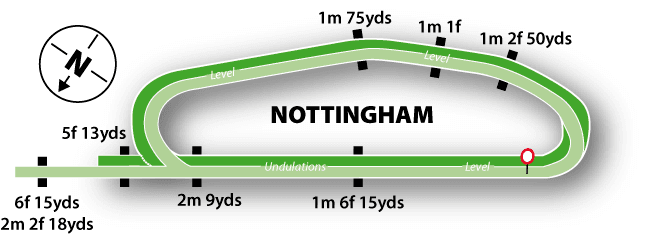
Nottingham is a flat left-handed oval at Colwick Park, two miles east of the city centre. It measures roughly a mile and a half around with a four-and-a-half-furlong home straight. The track is essentially flat — there is one minor undulation two furlongs from home and it is irrelevant to all but the most badly balanced horse. The turn into the home straight is sharp, but the length of the straight that follows is generous enough that big galloping types are not punished in the way they would be at a tighter track like Chester or Catterick.
What is unusual about Nottingham is that there are two separate circuits running in parallel. The inner — which features a five-furlong straight chute — is used in spring and autumn. The outer, with a six-furlong straight, takes the summer fixtures. Rotating between them protects the ground and keeps the racing surface honest across an April-to-November season of around 20 fixtures. Sprint races are run on the straight course; everything from a mile up takes the round.
The most important thing to understand about Nottingham, however, has very little to do with its physical shape. It has to do with what the top stables use it for. When National Hunt racing ceased here in February 1996, the Jockey Club reconfigured the course with explicit policy: build two tracks, keep the ground fresh, attract the best horses. Three decades later that policy still works. Nottingham is one of the courses that the major Newmarket and Lambourn yards use to introduce their best two-year-olds. Slip Anchor, Oh So Sharp, Oath, Golden Horn and Adayar all broke their maidens here. That changes how you should read the maiden form coming out of this track — and is the basis of the single strongest betting angle the course offers.
The straight course has a documented draw bias, but it is not the one most casual guides describe. The headline insight — high draws favoured towards the stands rail — is only half right. The actual variable is which side the stalls are placed on at each meeting, and the bias runs to whichever group is closest to the running rail. Combined with a pace-orientated track — the relatively sharp final bend slows the gallop and rewards prominent runners — the front-runner edge in 5f handicaps is among the strongest in British racing. Hold-up sprinters here are riding into a structural disadvantage.
Pace is the dominant variable across the round course. The relatively sharp turn into the straight slows the early fractions, which means prominent runners can dictate and then kick clear once they straighten up. Over five and six furlongs on the straight, this is well-documented. Over a mile on the round, those drawn high in big fields are forced wide on the bend and either lose ground or use up energy crossing over to get a position before the turn. Both are bad. Over a mile and a quarter and beyond, the draw becomes immaterial and class wins out.
The headline angle, though, is the maiden form. The late-October fixture here is the most productive juvenile race on the British calendar that is not held at a Group venue. Five named Classic winners in forty years have come through this track’s autumn maidens. The race now called the Golden Horn Maiden Stakes — over a mile and seventy-five yards in late October — is the spiritual home of the angle. Maiden winners from this fixture, and well-bred runner-ups behind them, are systematically underpriced when they reappear off their first handicap mark in the spring.
— Longshot Scott
Course Facts
- Round course 1m4f, left-handed, flat oval — sharp final turn into a 4½f home straight
- Straight course 5f (inner) or 6f (outer) — separate chute joining at the top of the home straight
- Two circuits Inner used spring/autumn, outer used summer — protects ground across the season
- Draw bias Straight course: rail-side group favoured in 14+ runner fields. Round 1m: low marginal edge. 1m2f+: broadly fair
- Run style Front-runners in 5f handicaps win at 21.9% — Impact Value 2.32. Hold-up types punished over sprint trips
- Maiden angle Top stables use the late-October fixture for classic prospects. Five named Classic winners since 1985
The Straight Course
- Distances 5f, 6f (inner straight = 5f only)
- Key bias Rail-side group plus early pace
- 5f handicaps Front-runner SR 21.9%, IV 2.32 — one of the strongest pace edges in UK racing
- Soft ground Bias to high-draw / stands-rail strengthens as the going eases
- Large fields 14+ runners is where the rail bias bites hardest
- Stalls position Varies meeting to meeting — always check before applying the bias
The Round Course
- Distances 1m, 1m½f, 1m2f, 1m6f, 2m+
- 1m draw Slight low-draw edge — wide horses forced to cross or sit off the pace
- 1m2f+ Draw broadly fair — long straight neutralises stall position
- Pace pattern Steady early fractions favour prominent runners — hold-up types rarely succeed
- Big fields High draws over 1m forced wide on the turn — either lose ground or expend energy
- Final bend Sharp but the 4½f straight gives gallopers time to recover
Track History & Stakes
- First raced 1892, Colwick Park
- NH ceased February 1996 — flat-only since
- Further Flight Stakes Listed, 1m6f, April — Alcazar won twice before Prix Royal Oak
- Kilvington Fillies’ Stakes Listed, 6f, May
- Nottinghamshire Oaks Listed, 1m2f, fillies & mares, June
- Maiden graduates Slip Anchor, Oh So Sharp, Oath, Golden Horn, Adayar — all broke their maidens here
Draw Bias by Distance
Real data: Nottingham win counts by stall, all field sizes, all going, sourced from FormDial’s draw bias engine. 5f sample: 481 races. 6f: 410. 1m½f: 681. 1m2f: 325. 1m6f: 192. 2m: 45.
The pace edge at Nottingham is more decisive than the draw. The relatively sharp final bend tends to slow the gallop, which lets prominent runners control fractions and kick. Front-runners in 5f handicaps win at 21.9%, Impact Value 2.32 — one of the strongest pace biases on the UK calendar. Hold-up sprinters are pushing water uphill. Over a mile and beyond the pattern softens but prominent runners still hold a structural edge.
Why Nottingham Maidens Matter
Nottingham’s value to punters is not in its shape but in its calendar position. The late-October fixture is a deliberate testing ground for next year’s classic prospects. The major Newmarket and Lambourn yards — Gosden, Haggas, Appleby, Suroor — routinely use it to school their best lightly-raced juveniles. The track knows it, the trainers use it, and the form book has decades of evidence.
When the Jockey Club reconfigured the course after dropping National Hunt in 1996, it did so with explicit intent. Build two circuits, protect the ground, attract the best horses. The race now run as the Golden Horn Maiden Stakes, over a mile and 75 yards in late October, is the spiritual home of the angle — winners go on to win Group 1s with unusual frequency for what is, on paper, a Class 4 contest.
Documented Nottingham Maiden Graduates
- Slip Anchor — won maiden at Nottingham → 1985 Epsom Derby
- Oh So Sharp — won maiden at Nottingham under Sir Henry Cecil → 1985 Fillies’ Triple Crown (1000 Guineas, Oaks, St Leger)
- Oath — won maiden at Nottingham → 1999 Epsom Derby
- Golden Horn — won the 32Red EBF Oath Maiden Stakes on 29 October 2014 by a head in a course record → 2015 Dante, Derby, Eclipse, Irish Champion Stakes, Arc. European Horse of the Year
- Adayar — fourth on debut at Nottingham in October 2020, then won the Golden Horn Maiden at the same track later that month → 2021 Epsom Derby and King George VI & Queen Elizabeth Stakes
The pattern is structural, not anecdotal. Godolphin’s own profile of Adayar confirms the route: a green run, then a win at the same track to set up a Derby campaign. John Gosden used the Nottingham maiden as Golden Horn’s only two-year-old start, and the colt won by a head in a new course record before going unbeaten through the Feilden, the Dante, the Derby and the Arc. The same yards — Gosden, Haggas, Appleby, Suroor — keep sending well-bred late-developing types to the autumn fixture, year after year.
The punting angle has two edges. First — back the maiden winners next time out, particularly when the runner-up was well-bred and shaped with promise. Multiple “smart performers” out of the same race is the Nottingham signature. Second — the market forgets. On a wet Tuesday in March, a Nottingham maiden winner dropping into handicaps off its first official rating is systematically underpriced relative to what the form actually represents.
The angle in one line: back maiden winners from autumn Nottingham races on their next two starts, and watch the well-bred runner-ups from those races at generous prices.
The course is a deliberate testing ground for the best two-year-olds in training. The form has produced five named Classic winners in forty years. The bias to maiden form here is one of the most under-priced angles on the UK Flat calendar.
Top Trainers & Jockeys
Real data: Nottingham flat turf, last 5 seasons (top 20 displayed). Min 15 runs. A/E above 1.0 indicates market underestimation; below 0.8 indicates systematic overbetting.
| Trainer | Runs | Wins | Win% | Places | Place% | A/E | P/L |
|---|---|---|---|---|---|---|---|
| 1 M Appleby | 224 | 33 | 14.73% | 68 | 30.36% | 1.18 | +23.49 |
| 2 W J Haggas | 104 | 22 | 21.15% | 52 | 50.00% | 0.93 | -6.15 |
| 3 R M Beckett | 105 | 22 | 20.95% | 41 | 39.05% | 0.89 | -11.20 |
| 4 P T Midgley | 90 | 20 | 22.22% | 48 | 53.33% | 1.30 | +31.48 |
| 5 Roger Varian | 83 | 18 | 21.69% | 42 | 50.60% | 0.89 | -3.54 |
| 6 K R Burke | 99 | 18 | 18.18% | 36 | 36.36% | 0.89 | -24.80 |
| 7 T D Easterby | 176 | 17 | 9.66% | 56 | 31.82% | 0.83 | -40.21 |
| 8 Richard Hannon (Jnr) | 121 | 15 | 12.40% | 46 | 38.02% | 0.91 | +3.86 |
| 9 J H M Gosden | 67 | 14 | 20.90% | 25 | 37.31% | 0.87 | -13.02 |
| 10 Ed Walker | 56 | 13 | 23.21% | 22 | 39.29% | 1.41 | +22.71 |
| 11 Ed Bethell | 41 | 12 | 29.27% | 18 | 43.90% | 1.48 | +24.09 |
| 12 Sir Michael Stoute (ret. end 2024) | 53 | 12 | 22.64% | 21 | 39.62% | 0.93 | +9.58 |
| 13 Charlie Appleby | 36 | 11 | 30.56% | 20 | 55.56% | 0.92 | -14.59 |
| 14 A M Balding | 70 | 11 | 15.71% | 25 | 35.71% | 1.02 | -24.59 |
| 15 George Boughey | 56 | 10 | 17.86% | 19 | 33.93% | 0.83 | -15.14 |
| 16 M Johnston | 65 | 10 | 15.38% | 23 | 35.38% | 0.98 | -18.06 |
| 17 C G Cox | 80 | 10 | 12.50% | 25 | 31.25% | 0.72 | -34.44 |
| 18 Dylan Cunha | 34 | 8 | 23.53% | 14 | 41.18% | 1.53 | +29.13 |
| 19 Charles Hills | 51 | 8 | 15.69% | 20 | 39.22% | 0.93 | -14.22 |
| 20 Simon Crisford | 68 | 8 | 11.76% | 33 | 48.53% | 0.65 | -22.92 |
| Jockey | Runs | Wins | Win% | Places | Place% | A/E | P/L |
|---|---|---|---|---|---|---|---|
| 1 James Doyle | 88 | 27 | 30.68% | 45 | 51.14% | 1.08 | +14.09 |
| 2 Rob Hornby | 108 | 20 | 18.52% | 40 | 37.04% | 1.11 | +41.01 |
| 3 Rossa Ryan | 123 | 19 | 15.45% | 41 | 33.33% | 0.80 | -18.63 |
| 4 David Egan | 101 | 17 | 16.83% | 40 | 39.60% | 0.96 | +28.89 |
| 5 Hector Crouch | 93 | 16 | 17.20% | 35 | 37.63% | 0.95 | -23.17 |
| 6 Robert Havlin | 65 | 15 | 23.08% | 29 | 44.62% | 1.16 | -1.69 |
| 7 Richard Kingscote | 110 | 15 | 13.64% | 35 | 31.82% | 0.80 | -35.08 |
| 8 William Buick | 58 | 14 | 24.14% | 23 | 39.66% | 1.00 | -2.38 |
| 9 Andrea Atzeni | 69 | 14 | 20.29% | 32 | 46.38% | 1.11 | +20.83 |
| 10 Daniel Tudhope | 79 | 14 | 17.72% | 37 | 46.84% | 0.92 | -12.47 |
| 11 Cieren Fallon | 105 | 14 | 13.33% | 33 | 31.43% | 0.81 | -44.25 |
| 12 Oisin Murphy | 50 | 12 | 24.00% | 19 | 38.00% | 1.10 | +2.78 |
| 13 R Dawson | 82 | 12 | 14.63% | 26 | 31.71% | 0.96 | -13.99 |
| 14 Clifford Lee | 84 | 12 | 14.29% | 29 | 34.52% | 0.96 | -16.30 |
| 15 Tom Marquand | 86 | 12 | 13.95% | 37 | 43.02% | 0.76 | +7.85 |
| 16 Jason Hart | 84 | 11 | 13.10% | 30 | 35.71% | 0.94 | -21.75 |
| 17 Hollie Doyle | 91 | 11 | 12.09% | 28 | 30.77% | 0.70 | -7.94 |
| 18 David Probert | 106 | 11 | 10.38% | 24 | 22.64% | 0.83 | -22.54 |
| 19 Jim Crowley | 36 | 10 | 27.78% | 15 | 41.67% | 1.51 | +76.50 |
| 20 Callum Rodriguez | 52 | 10 | 19.23% | 17 | 32.69% | 1.05 | -2.04 |
Top Sires
Real data: Nottingham flat turf sire records, last 5 seasons (top 20 displayed). Min 15 runs. A/E values track market valuation of progeny.
| Sire | Runs | Wins | Win% | Places | Place% | A/E | P/L |
|---|---|---|---|---|---|---|---|
| 1 Dark Angel (IRE) | 126 | 17 | 13.49% | 35 | 27.78% | 0.94 | -19.60 |
| 2 Kodiac | 149 | 17 | 11.41% | 52 | 34.90% | 0.96 | +15.96 |
| 3 Kingman | 76 | 16 | 21.05% | 28 | 36.84% | 1.34 | +36.38 |
| 4 Showcasing | 97 | 15 | 15.46% | 30 | 30.93% | 1.00 | -0.43 |
| 5 Dandy Man (IRE) | 115 | 15 | 13.04% | 43 | 37.39% | 0.96 | -17.26 |
| 6 Nathaniel (IRE) | 73 | 14 | 19.18% | 29 | 39.73% | 1.14 | -12.33 |
| 7 Invincible Spirit (IRE) | 78 | 14 | 17.95% | 35 | 44.87% | 1.21 | +60.66 |
| 8 Mehmas (IRE) | 116 | 14 | 12.07% | 35 | 30.17% | 0.77 | -49.19 |
| 9 Iffraaj | 67 | 13 | 19.40% | 25 | 37.31% | 1.29 | +7.66 |
| 10 Night Of Thunder (IRE) | 82 | 13 | 15.85% | 34 | 41.46% | 0.90 | -15.96 |
| 11 Lope De Vega (IRE) | 93 | 13 | 13.98% | 38 | 40.86% | 0.70 | -38.37 |
| 12 Siyouni (FR) | 46 | 12 | 26.09% | 19 | 41.30% | 1.40 | +21.48 |
| 13 Camelot | 66 | 11 | 16.67% | 27 | 40.91% | 0.97 | +4.90 |
| 14 Sea The Stars (IRE) | 69 | 11 | 15.94% | 33 | 47.83% | 0.76 | -31.23 |
| 15 Dubawi (IRE) | 73 | 11 | 15.07% | 25 | 34.25% | 0.68 | -36.17 |
| 16 Bated Breath | 95 | 10 | 10.53% | 32 | 33.68% | 0.72 | +8.83 |
| 17 Wootton Bassett | 37 | 9 | 24.32% | 14 | 37.84% | 1.45 | +12.13 |
| 18 Make Believe | 39 | 9 | 23.08% | 14 | 35.90% | 1.41 | -0.01 |
| 19 Muhaarar | 83 | 9 | 10.84% | 24 | 28.92% | 0.82 | -35.00 |
| 20 Mukhadram | 33 | 8 | 24.24% | 11 | 33.33% | 1.63 | +7.38 |
Betting Tips for Nottingham Flat Turf
Maiden winners from autumn fixtures are systematically under-priced
Nottingham maidens have produced Slip Anchor, Oh So Sharp, Oath, Golden Horn and Adayar in forty years. The yards know it, the racecourse knows it, the market forgets. A maiden winner reappearing in handicaps off its first official mark is the cleanest angle on the calendar.
Front-runners in 5f handicaps are a structural edge, not an opinion
Sample of 219 produced 48 winners — 21.9% strike rate, Impact Value 2.32. The sharp final bend slows the gallop and rewards prominent runners. Hold-up sprinters here are pushing water uphill regardless of class.
Check the stalls position before applying any draw bias
The straight-course bias is rail-side, not absolute high-side. Stalls are placed stands-side at some meetings and far-side at others. Read which rail the stalls are against before you decide whether low or high is the favoured group.
The late-October fixture is a different animal
The Golden Horn Maiden Stakes — 1m 75y, late October — is the most productive 2yo race in the calendar that is not run at a Group venue. Top yards school their classic prospects here. Treat maiden form from this meeting as Pattern-quality intelligence.
James Doyle is the closest thing to a free pass at the course
27 wins from 88 rides — 30.7% strike rate, A/E 1.08, P/L +£14.09. Profit-positive on both volume and rate. The standard rider angle worth backing whenever he turns up with a fancied mount.
Fade Fahey and Williams despite the old reputations
R A Fahey 5 wins from 82, A/E 0.48, –£58.63. Ian Williams 3 wins from 86, A/E 0.31, –£47.50. Both still appear in older guides as Nottingham specialists. The 5-year record says otherwise. The market has not fully caught up.
Watch the well-bred runner-ups from autumn maidens
The 2014 Golden Horn race produced Storm The Stars in second — subsequently placed in two Derbys. Multiple smart performers out of the same race is the Nottingham signature. Map the placings, not just the winners.
Handicap favourites pay at level stakes
Backing the favourite in every Nottingham handicap returns a 36% strike rate and +£39.04 LSP across recent seasons. Unusual for a Class 4/5 venue. The market gets it right here more often than it gets it right elsewhere.
Further Flight Stakes form points to summer Cup contenders
The Listed Further Flight Stakes — 1m6f, April — has produced subsequent Cup-class horses. Alcazar won here twice before the Prix Royal Oak. Treat the form-line as a serious early-season stayers trial, not a Listed afterthought.
Common Mistakes
- Applying the high-draw bias blindly The straight-course bias runs to whichever side the stalls are against the rail. Check the meeting before deciding low or high — getting it backwards is the single biggest unforced error here.
- Trusting older guides on Fahey or Williams Both still appear as Nottingham specialists in legacy course profiles. Five-year data shows both at –£45 P/L or worse with A/E below 0.5. The narrative is stale; the bookmakers have not fully caught up but they will.
- Backing held-up sprinters at 5f Front-runner Impact Value is 2.32. The track structurally punishes patience over the minimum trip. Class is not enough — running style matters more here than at most flat tracks.
- Treating Nottingham maiden winners as ordinary form Late-autumn maidens at this track are not Class 4 form. They are Group-level intelligence dressed in handicap clothes. Read them as Pattern races and bet accordingly when the winners reappear.
- Backing Frankel progeny on name alone 3 wins from 44, A/E 0.34. His Nottingham record is one of the worst-priced lines among major sires. The name attracts money; the form does not justify it.
- Ignoring field size when applying draw bias In 8-runner straight-course fields the rail edge is broadly neutral. The bias only really bites in 14+ runner contests. Small fields here are draw-fair regardless of stalls position.
Want the thinking behind Nottingham turf bets?
FormDial posts every selection before the off with the full reasoning — the angle, the price, the logic. See how course knowledge feeds into real tips.