Betting Odds Explained
The price next to a horse’s name is not just a return figure. It is a statement of probability — the bookmaker’s published opinion of how likely that horse is to win, expressed in a form that also determines how much you get paid if you are right. Most punters look at odds and see a payout. The serious ones look at odds and see a probability they can disagree with. That disagreement — when it is informed, specific, and backed by evidence — is the entire foundation of profitable betting.
What Odds Actually Tell You
Every set of odds carries two pieces of information at once, and most punters only read one of them.
Return vs implied probability
The first is the return. Odds of 5/1 mean you receive £5 profit for every £1 staked. That part is obvious. The second is the implied probability — the bookmaker’s assessment of the horse’s chance of winning. This is the piece most bettors ignore, and it is the more important of the two.
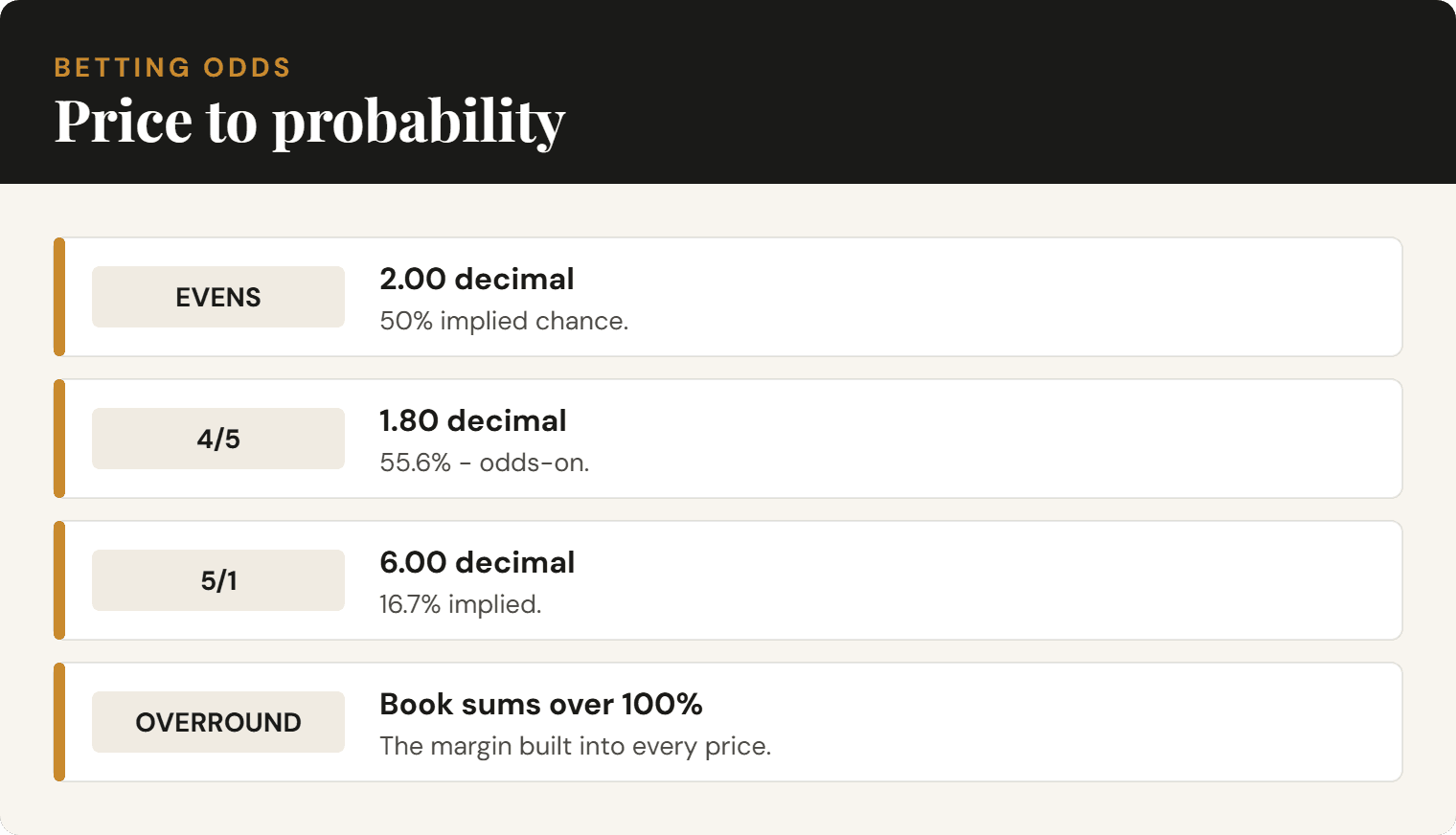
A horse at 5/1 implies the bookmaker believes it has approximately a 1-in-6 chance of winning. A horse at 2/1 implies roughly 1-in-3. When you back a horse, you are not just saying “I think this will win.” You are saying “I think this horse’s true chance of winning is higher than the probability implied by this price.” That is value. Everything else is hope.The foundation of every serious betThe conversion is simple: Probability = denominator ÷ (numerator + denominator). At 5/1, that is 1 ÷ (5+1) = 16.7%. At 2/1, it is 1 ÷ (2+1) = 33.3%. At 4/5, it is 5 ÷ (4+5) = 55.6%.
Decimals make it simpler still: implied probability = 1 ÷ decimal odds. A price of 4.0 is 1 ÷ 4.0 = 25%; 6.0 is 1 ÷ 6.0 = 16.7%. The format changes, the probability does not. To go the other way — fractional to decimal — divide the numerator by the denominator and add 1: 6/4 = (6 ÷ 4) + 1 = 2.50, and 4/5 = (4 ÷ 5) + 1 = 1.80.
The Odds Reference
Fractional odds remain the standard in British and Irish racing. Decimal odds are common on exchanges and with some online bookmakers. Both express the same underlying probability — the format is different, the maths is identical.
| Fractional | Decimal | Implied Probability | In Plain English |
|---|---|---|---|
| 1/2 | 1.50 | 66.7% | Wins roughly 2 in every 3 |
| 4/5 | 1.80 | 55.6% | Wins roughly 5 in every 9 |
| Evens | 2.00 | 50.0% | Coin flip — wins half the time |
| 6/4 | 2.50 | 40.0% | Wins roughly 2 in every 5 |
| 2/1 | 3.00 | 33.3% | Wins roughly 1 in every 3 |
| 3/1 | 4.00 | 25.0% | Wins roughly 1 in every 4 |
| 5/1 | 6.00 | 16.7% | Wins roughly 1 in every 6 |
| 10/1 | 11.00 | 9.1% | Wins roughly 1 in every 11 |
| 20/1 | 21.00 | 4.8% | Wins roughly 1 in every 21 |
| 50/1 | 51.00 | 2.0% | Wins roughly 1 in every 51 |
Working Out Your Returns
Once odds are in decimal, returns take one line: stake × decimal odds = total return, and total return − stake = profit. Back a 6/1 shot (decimal 7.0) for £20 and the total return is 20 × 7.0 = £140, of which £120 is profit and £20 is your stake back. In fractional terms it is the same sum: £5 profit per £1 at 5/1, so a £20 win bet on a 5/1 winner returns £100 profit plus the £20 stake. For singles through to accumulators, the Formdial bet calculator will work out returns on any stake at any odds.
Odds-On: When the Market Says “Probably”
When a horse is priced at less than evens it is odds-on — the market believes it is more likely to win than to lose. A horse at 4/5 implies a 55.6% chance of winning. A horse at 1/3 implies 75%. These prices feel safe. They are not.
Odds-on favourites are beaten regularly. A 4/5 shot loses roughly four times in every nine starts. That is not a malfunction — that is what 55.6% looks like across a meaningful sample. The question is never “will this favourite win?” The question is “is this price fair for this probability?”
Starting Price (SP)
The Starting Price is the official settlement price for the race. Since May 2022 it has been set from a sample of major off-course bookmakers rather than the on-course ring: their prices are ranked longest to shortest, split in half, and the SP is the shortest price in the half holding the longest. That method has a consequence worth keeping hold of — by construction, the SP can never be the best price on offer. It is the default settlement price if you bet without locking in a fixed price beforehand. For most punters, SP is what they get because they never think to take a price early.
That is a mistake. SP is not optimised for you. It is the end result of every bit of money — smart and dumb — that has flowed into the market since it opened. By the time SP is set, the early value has usually been squeezed out. SP can move either way: a horse that shortens from 10/1 in the morning to 6/1 SP rewarded the punter who took the early price, while a drifter — say 6/1 out to 10/1 — rewards the one who waited. Taking a price locks it in; SP is whatever the market settles on.
The rule: Take a price when you have a reason to bet, not when the market tells you to. Use Best Odds Guaranteed where available — it gives you the higher of your fixed price or SP, which means you are protected if the price drifts but you keep the early value if it shortens. Take 8/1 in the morning under BOG: if it drifts to 10/1 SP you are paid at 10/1; if it shortens to 6/1 you keep your 8/1. BOG applies to bets struck from a set time on the day of the race (commonly around 8am), not to ante-post, and the place-part upgrade is bookmaker-dependent — but on the win it removes the penalty for taking a price early.The Overround: The Tax You Are Already Paying
How the margin is built in
Add up the implied probabilities of every horse in a race. In a fair market they would sum to exactly 100% — every horse’s chance accounted for, no excess. In practice, they sum to 110%, 115%, sometimes 130% or higher in big fields. The excess above 100% is the overround — the bookmaker’s margin, embedded in every price in the race. A race priced to 117% carries a 17% overround.
Same horses. Same race. But in the bookmaker’s book every price is shorter than it should be, and the implied probabilities now sum to 117% rather than 100%. That 17% excess is the tax you pay for placing a bet. You do not see it on your slip. You do not feel it on any individual bet. But across a season, it is the structural disadvantage that makes winning hard even when your selections are good.
Shopping for the best available price on every selection directly reduces the overround you are paying. The difference between taking 8/1 and 10/1 on a horse you back forty times per season is the difference between a losing year and a profitable one. That is not an exaggeration — it is arithmetic.
Value in Practice
Value is the single concept that separates betting from gambling. It is not mystical. It is not a feeling. It is a specific, measurable situation: your assessment of a horse’s chance of winning is higher than the probability implied by the price you are being offered.
A Worked Example
Put numbers on the stake and the edge becomes money: you make a horse 33% (a true 2/1) but it is offered at 3/1, implying 25%. Stake £10 and at 3/1 you collect £30 profit when it wins, versus £20 at the fair price. It only wins one time in three — but over many such bets, that gap between the price you took and the price that was fair is your edge.
You will lose plenty of value bets. A 20% chance means the horse loses four times out of five. That is not failure — that is what 20% looks like. Value is a long-term concept. Over a sufficient sample, consistently backing selections where your assessed probability exceeds the implied probability produces profit. The key word is “consistently.” One bet proves nothing. Fifty bets start to show whether your assessments are better than the market’s.
The Mistakes That Cost Money
This is the foundation. The Each-Way Betting page covers how the place portion of a bet changes the value calculation, and the each-way calculator works the place return out for you. The Handicap Racing page covers how the rating system creates structural pricing errors. And the Bookmakers’ Odds blog post goes deeper into how markets are built and where the overround is thickest.
Common Questions
5/1 means £5 profit for every £1 staked, so a £10 winning bet returns £50 profit plus your £10 stake. In decimal it is 6.00, and it implies a 16.7% chance of winning — roughly one win in six.
Divide the numerator by the denominator and add 1. So 6/4 = (6 ÷ 4) + 1 = 2.50, and 4/5 = (4 ÷ 5) + 1 = 1.80. The decimal already includes your stake, so total return = stake × decimal.
For fractional odds, probability = denominator ÷ (numerator + denominator); 5/1 = 1 ÷ 6 = 16.7%. For decimals it is simpler still: probability = 1 ÷ decimal odds, so 4.0 = 25%.
It is the bookmaker’s margin. Add up every horse’s implied probability and the total exceeds 100% — often 110–130% in big fields. A book priced to 117% carries a 17% overround, and that excess is the edge built into every price in the race.
Not usually. Since May 2022 the SP has been taken from a sample of major off-course bookmakers, and the way it is worked out means it can never be the best price on offer. Taking a price early — ideally with Best Odds Guaranteed, which pays the bigger of your price and the SP — can pay more.
Multiply your stake by the decimal odds for the total return, then subtract the stake for profit. £20 at 6/1 (decimal 7.0) returns 20 × 7.0 = £140, of which £120 is profit. The bet calculator does this for singles through accumulators.
Try the Calculator
Convert fractional to decimal, work out returns on any stake at any odds — singles through accumulators.