Best Odds Guaranteed (BOG) Explained
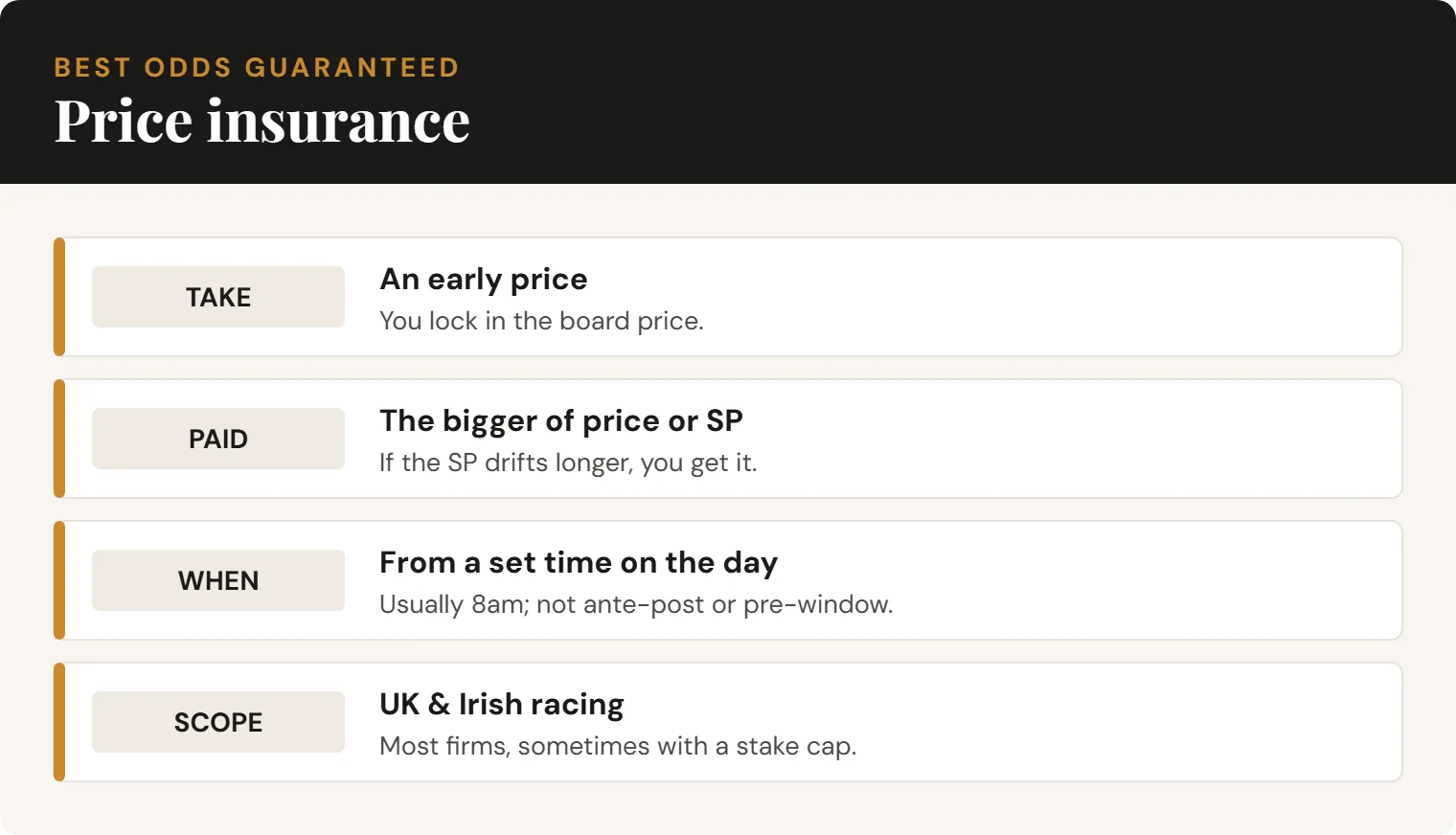
Best Odds Guaranteed — commonly abbreviated to BOG — is a bookmaker offer that protects you when the Starting Price (SP) of your horse is higher than the price you took. If you back a horse at 8/1 and it drifts to 12/1 by the off, a bookmaker offering BOG pays you at 12/1. You get the best of both prices — the early price if the horse shortens, the SP if it drifts. There is no extra cost and no separate opt-in. It is one of the few bookmaker promotions that genuinely shifts value toward the punter, but it comes with a fixed set of terms — when it applies, what it covers, and where it stops — and those terms are the whole point of this page.
How BOG Works
The mechanics are straightforward. You place your bet at the available price. At the off, the bookmaker compares your price with the SP. If the SP is higher, they automatically upgrade your payout to the SP. If the SP is lower, your original price stands. You always receive whichever is greater.
BOG eliminates the biggest risk of taking an early price. Without BOG, backing a horse at 8/1 means you are locked in at 8/1 even if the market decides the horse is a 14/1 chance by post time. That gap — 8/1 to 14/1 — represents money left on the table. With BOG, the gap closes automatically. You benefit from the early price if the horse shortens, and from the SP if the market moves against you.When BOG Applies
This is the qualifier most guides skip, and it is the one that costs people money. BOG only applies to bets struck from a set time on the day of the race — commonly 8am, though some firms do not switch it on until 9am or 10am. A price you take before that window opens, including any ante-post bet placed days or weeks out, is settled at the price you took or at SP, with no guarantee attached. So the “best of both prices” only kicks in once BOG is live for that day’s card.
What it runs on
The scope is also narrow. BOG runs on the win and each-way markets of UK and Irish horse racing — and, at some firms, greyhounds. It is built for day-of-race markets, not long-range speculation, which is why ante-post sits outside it. Check the firm’s start time and you will know exactly when your early price starts carrying the guarantee.
Which Bookmakers Offer BOG
Most major UK bookmakers offer BOG on UK and Irish horse racing, but the terms vary. Some apply it to all races automatically. Others restrict it to specific meetings, exclude certain bet types, or cap the maximum payout enhancement. The differences matter.
Check the capSome bookmakers cap BOG enhancements at a certain profit level — often around £50,000 per race or per day, though smaller limits exist. If you are backing horses at big prices with large stakes, the cap may limit the benefit. Most recreational punters will never hit these caps, but they exist. Check the race coverageSome bookmakers only offer BOG on races from selected meetings — typically the major UK tracks. Others extend it to all UK and Irish racing. A BOG offer that excludes Monday cards at Wolverhampton is less valuable than one that covers every race. Check the bet typesBOG typically applies to win and each-way singles. Some bookmakers extend it to multiples; most do not. If you bet in accumulators, confirm whether BOG applies to each leg before assuming it does. Check the timingBOG applies only from the firm’s daily start time — usually 8am, sometimes 9am or 10am. Bets struck before that, and ante-post bets placed days or weeks in advance, are excluded and settled at the price taken or SP.What BOG Does Not Cover
The “best of both prices” framing is true within the rules, but the rules carve out a fair amount. Treat BOG as a guarantee on single and each-way win bets, and assume nothing beyond that until you have read the terms.
Typically excluded from BOG
- Bets struck before the firm’s daily start time, and all ante-post bets
- Tote and pool (pari-mutuel) bets
- Forecasts and tricasts
- Full-cover multiples such as the Lucky 15, Lucky 31 and Lucky 63
- Price boosts, enhanced odds and extra-place promotions
- In-play bets struck after the race has started
Caps and account limits
On top of the exclusions, firms cap the maximum upgrade — often around £50,000 per race or per day — and a bookmaker can withdraw BOG from an account it judges to be abusing it, just as it can with any promotion. None of this makes BOG less worth having; it simply means “free money” overstates a perk that is real but bounded.
Why BOG Changes Your Strategy
Without BOG, there is a genuine tension between taking an early price and waiting for the SP. If you take 10/1 in the morning and the horse drifts to 16/1, you have left value on the table. If you wait for SP and the horse shortens to 7/1, you have lost value by waiting. BOG removes this tension — but only once it is live. From the firm’s BOG start time onward, you can take your price with no downside.
Within the BOG window, early prices are strictly better than SP in every scenario. If the horse shortens, you hold the higher early price. If it drifts, you get the higher SP. There is no situation in which taking an early price under BOG leaves you worse off than waiting. So once BOG is live for the card, take your price as soon as you have made your selection. There is no reason to wait — and good reason not to, because prices can shorten as well as drift. The one trap is the early-morning or ante-post price taken before the window opens: that carries no guarantee, so the “no downside” logic does not apply to it.
What it’s worth over a season
The practical impact is real but modest, and it is worth seeing as a number rather than a slogan. Say you bet £10 win singles and, over a season, 40 of your selections that win have drifted from your taken price to a bigger SP — on average by the equivalent of two points, say 6/1 out to 8/1. On those 40 winners alone, BOG pays an extra £10 per point of drift on a £10 stake, so roughly £20 a winner, or about £800 in upgrades you would not otherwise have collected. The exact figure depends entirely on your stakes, strike-rate and how often your winners drift, but the direction is fixed: over a full season BOG delivers a measurable lift to your return for no extra outlay. For win and each-way singles on UK and Irish racing, there is no reason to use a firm that does not offer it.
BOG and Each-Way Bets
How BOG treats an each-way bet depends on the firm. The win part is upgraded to the bigger SP everywhere. At most major bookmakers the place part is upgraded too, so a horse that places at a larger SP than your early price sees both halves of the bet improved. A minority of firms — Sky Bet among them — apply BOG to the win part only and settle the place part at the price you took, so always check the terms before assuming the place is covered.
Where it’s worth most
Where both parts are upgraded, BOG is especially valuable on each-way bets in big-field handicaps, where the place part often represents the more likely return and where price drift is common in large, volatile markets.
For how odds work in practice, see Betting Odds Explained. For how to decide between win-only and each-way, see Win-Only Betting Explained. Where a Rule 4 deduction applies, it comes off your fixed price only — the SP is struck after the withdrawal and normally carries none, the exception being a withdrawal too late for a new market to form — and you are paid the better of the two.
Common Questions
It is a bookmaker offer where, if you take an early price and the Starting Price turns out bigger, you are paid at the SP; if your early price is bigger you keep it. You always get the better of the two prices, at no extra cost.
Only on bets struck from a set time on the day of the race — usually 8am, though some firms start at 9am or 10am — on the win and each-way markets of UK and Irish racing. Bets before that, including ante-post, are not covered and are settled at the price taken or SP.
The win part is upgraded at every firm. Most major bookmakers also upgrade the place part, but a minority — Sky Bet among them — guarantee the win part only and settle the place at the price you took, so check the terms.
Typically ante-post, tote and pool bets, forecasts and tricasts, full-cover multiples such as the Lucky 15, 31 and 63, price boosts, enhanced or extra-place promotions, and in-play bets. Firms also cap the maximum upgrade, often around £50,000 per race or per day.
Rule 4 comes off your fixed price only. An SP bet is normally not affected — the SP is struck after the withdrawal and already reflects the smaller field — with one exception: a horse withdrawn too late for a new market to form can still carry a deduction on SP. Under Best Odds Guaranteed you are paid the better of the two: your price less the deduction, or the SP as returned.
Yes, for win and each-way singles on UK and Irish racing. It only ever pays you the same or more than the price you took, so over a season it adds a measurable lift to your return for no extra outlay — bounded only by the exclusions and the payout cap.
Try the Calculator
Compare advised price against SP — see exactly how much Best Odds Guaranteed added to your return.