Win-Only Betting Explained
A win-only bet is the purest form of racing wager. You back a horse to win. If it wins, you collect. If it finishes second, third, or anywhere else, you lose your stake. There is no place safety net, no consolation return, no fractional payout for a near-miss. That simplicity is the point. Every penny of your stake is working toward the maximum return, and you are not subsidising a place bet you may not need. The whole skill is knowing which races reward that discipline and which punish it.
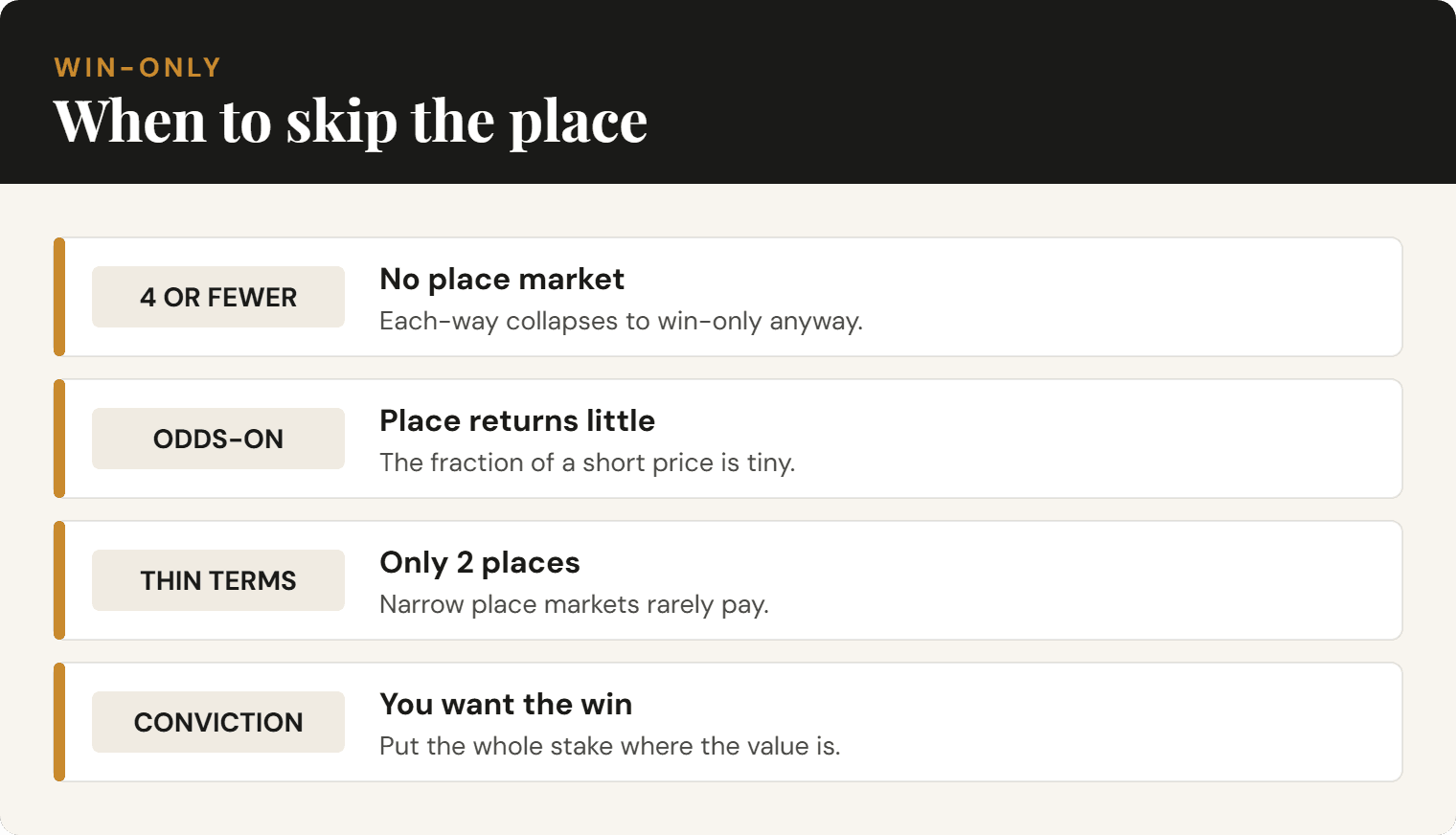
When Win-Only Is the Right Call
Win-only makes mathematical sense in specific, identifiable conditions. The thread through all of them is the same: the place half of an each-way bet costs you a second stake, and in these spots that stake either cannot exist, cannot pay its way, or is too thin to be worth the dead money. Choosing win-only here is not bravado — it is the cheaper, sharper play.
Four or fewer runners
- With four runners or fewer there is no place market at all. Bookmakers offer no place terms, so an each-way bet simply runs as win-only whether you ask for it or not.
- In a four-runner conditions race the place half has nothing to pay on. Backing to win is not a choice you are making — it is the only bet on offer.
- The lesson generalises: the smaller the field, the weaker the case for paying for a place at all.
Odds-on and short prices
- The place part pays a quarter or a fifth of an already short price, so it returns almost nothing. On a 4/6 shot at 1/4 terms the place part pays just 1/6 — about 17p to the £1.
- Worked numberStake £10 each-way (£20 total) on that 4/6 chance. If it places but does not win, the place leg returns £11.67 against £20 staked — a net loss of £8.33. The “safety net” books a loss.
- Back a short price to win, or leave it alone. Do not pay for a place that cannot cover its own stake.
Thin place terms
- Five to seven runners pays only two places at 1/4 odds. The net is narrow: your horse must run first or second for the place half to pay anything.
- If you fancy a horse to finish in the first two, you usually fancy it to win — so the place stake is buying very little insurance.
- Two places at 1/4 in a small field is barely better than win-only. When the terms are this thin, take the win price and keep the second stake.
Your edge is to win
- When your analysis points to one horse as the likely winner — not merely a place contender — concentrating the stake on the win maximises the return if you are right.
- Each-way dilutes conviction. Splitting the stake hedges against an outcome you do not actually expect.
- If the read is “this wins”, back it to win. The place leg only matters when you are unsure, and being unsure is itself information about the price you should take.
The place ladder — know where the terms thin out
- 2–4 runners: win only, no place market exists.
- 5–7 runners: 2 places at 1/4 the odds.
- 8+ runners (non-handicap): 3 places at 1/5.
- 8–11 runner handicaps: 3 places at 1/5.
- 12–15 runner handicaps: 3 places at 1/4.
- 16+ runner handicaps: 4 places at 1/4 — the maximum standard terms. Anything beyond four places is an enhanced bookmaker promotion, not the norm.
Read the ladder as a sliding scale: the smaller and shorter the field, the weaker the case for the place half, until at four runners or fewer it vanishes entirely. For the full breakdown of how these tiers are calculated, see place terms explained.
The Win-Only Advantage
The core advantage of win-only is stake efficiency. Every penny is allocated to the outcome that pays the most, with nothing siphoned off into a place bet paying a fraction of the win price. On a 4/1 shot at 1/4 place terms the place part pays exactly evens (1/1) — that is the break-even, where the place half returns precisely what it cost. Below 4/1 it returns less than it cost. Win-only puts the full stake on the nose.
The break-even, price by price
A £20 each-way bet puts £10 on the place. Here is exactly what that half returns at each price, on both standard fractions — and where it stops costing you money:
| Win price | 1/4 place | Placed return | vs £20 | 1/5 place | Placed return | vs £20 |
|---|---|---|---|---|---|---|
| 4/6 | 1/6 | £11.67 | –£8.33 | 2/15 | £11.33 | –£8.67 |
| 2/1 | 1/2 | £15.00 | –£5.00 | 2/5 | £14.00 | –£6.00 |
| 3/1 | 3/4 | £17.50 | –£2.50 | 3/5 | £16.00 | –£4.00 |
| 4/1 | 1/1 | £20.00 | level | 4/5 | £18.00 | –£2.00 |
| 5/1 | 5/4 | £22.50 | +£2.50 | 1/1 | £20.00 | level |
| 6/1 | 3/2 | £25.00 | +£5.00 | 6/5 | £22.00 | +£2.00 |
| 10/1 | 5/2 | £35.00 | +£15.00 | 2/1 | £30.00 | +£10.00 |
| 20/1 | 5/1 | £60.00 | +£40.00 | 4/1 | £50.00 | +£30.00 |
At quarter odds the place part reaches evens at exactly 4/1; at fifth odds, at exactly 5/1. Below those prices the place half of an each-way bet cannot pay for itself even when it lands.
Which bands actually pay?
Run the same arithmetic across every standard band, for a horse with an average chance of its field, and one line stands out:
| Band | Terms | Place part pays its way when the win price is above | Verdict |
|---|---|---|---|
| 5–7 runners | 2 places @ 1/4 | about 2.5–2.8/1 | against you |
| 8+ non-handicap / 8–11 handicap | 3 places @ 1/5 | about 3.3–3.6/1 | against you |
| 12–15 handicap | 3 places @ 1/4 | about 3.2–3.3/1 | against you |
| 16+ handicap | 4 places @ 1/4 | about 3.4–3.7/1 | GENEROUS |
Exactly one of the standard bands pays the punter — four places at a quarter in 16+ runner handicaps. And note the fifth-odds twist: at 1/5 the place part pays its way at short prices and stops at long ones, so the popular each-way-is-for-8/1-plus rule runs the wrong way round in that band. The place half must land often enough to cover itself: at 2/1 that means placing 66.7% of the time on quarter odds (71.4% on fifths); at 4/1, 50.0% (55.6%); at 6/1, 40.0% (45.5%); at 10/1, 28.6% (33.3%); at 20/1, 16.7% (20.0%).
These verdicts assume every runner has an equal share of the place chances (the Harville baseline). That baseline under-rates a longshot’s real place chance, so read the table as the hurdle a horse must beat, not a prediction.
Consider two punters backing the same 8/1 winner in a 10-runner race. Punter A stakes £20 win-only. Return: £180, a £160 profit. Punter B stakes £10 each-way (£20 total). The win part returns £90; the place part, at 1/5 of 8/1, returns £26. Total return: £116, a £96 profit. Same outlay, same winner — yet Punter A collects £64 more. The each-way punter’s place bet was never needed, because the horse won. That £10 was dead money.
The counterargument is that each-way protects you when the horse places but does not win. True — but that protection is paid for. Across a season, the running total spent on place legs that were either unnecessary (the horse won) or lost (it finished out of the places) is a real drag on profit. You can test any of these returns yourself on the each-way calculator and compare them side by side with the win-only line.
When Win-Only Is Wrong
Win-only is the wrong choice in big-field handicaps at longer prices. A 20/1 shot in a 16-runner handicap, with 1/4 terms paying four places, is a clear each-way proposition. The place part pays 5/1, and the horse only has to finish in the top four to return a profit. Backing it win-only means accepting nothing for a top-four finish — which is the most likely positive outcome at that price.
It is also wrong when a horse’s profile says it places more often than it wins — a consistent top-three finisher without the tactical speed to get its head in front. These are place machines, and backing them win-only ignores their most likely route to a return. For a horse like that, a straight place bet on the exchange or Tote can even beat each-way, because you are not forced to pay for a win you do not expect.
Every race, every horse, every price needs its own assessment. The punter who bets “everything win-only” makes the same error as the one who bets “everything each-way” — applying a blanket rule to a variable problem. The win-or-each-way call rests on turning the price into a probability; for the mechanics of that, see implied probability, and for the case on the other side of the ledger, see each-way betting in full.
Win-Only in Doubles, Trebles and Accumulators
Win-only is the default for multiples. A double, treble or accumulator combines win bets, and every leg must win for the bet to stand — the same all-or-nothing logic as a single, compounded across the card. Each-way multiples exist, but they double the stake and apply each leg’s place terms in turn, so they are rarely good value unless every leg carries genuinely generous places.
Because the returns compound, small differences in each win price swing the payout hard, which is exactly where short-priced legs drag and a missed place safety net is felt most. Work the numbers before committing: the bet calculator handles win singles, doubles, trebles and accumulators at any odds, so you can see the win-only return on a multi-leg bet before you place it.
The Price Where the Place Half Starts Paying for Itself
There is an exact answer to this, and it does not depend on the horse. If your selection places without winning, the win half is gone and the place half returns its stake plus the win odds multiplied by the place fraction. Those two cancel out at one price and one price only — when the odds equal the reciprocal of the fraction. At a quarter the odds that is 4/1; at a fifth it is 5/1.
| Race | Place terms | Break-even price |
|---|---|---|
| 5–7 runners, any race | 2 places at 1/4 | 4/1 |
| 8–11 runners, any race | 3 places at 1/5 | 5/1 |
| 12 or more, non-handicap | 3 places at 1/5 | 5/1 |
| 12–15 runners, handicap | 3 places at 1/4 | 4/1 |
| 16+ runners, handicap | 4 places at 1/4 | 4/1 |
Below the break-even price, a horse that places without winning costs you money. On a £10 each-way bet at quarter odds — a £20 outlay — a placed-not-won runner returns: 2/1 gives back £15 · 3/1 gives back £17.50 · 4/1 gives back exactly £20 · 6/1 gives back £25 · 10/1 gives back £35 · 20/1 gives back £60.
Common Questions
A win-only bet pays out only if your horse wins. Finishing second, third or anywhere else loses the whole stake — there is no place return, unlike each-way. The full stake works toward the win and nothing is held back for a place.
In fields of four or fewer, where no place market exists; on odds-on or very short-priced runners, where the place return cannot cover the place stake; when the terms are thin, such as two places at 1/4 in a five-to-seven-runner race; and when your edge is clearly to win rather than to place.
No place market is offered with four or fewer runners, so an each-way bet simply runs as win-only — the place half has nothing to pay on. You are backing to win whether you ask for it or not.
The place part pays a quarter or a fifth of an already short price. On a 4/6 shot at 1/4 terms that is just 1/6 — about 17p to the £1 — so a placed-but-not-won runner returns less than it cost. A £10 each-way bet (£20 staked) returns only £11.67 if the horse places without winning.
No. A place-only bet (on the Tote or an exchange) pays if the horse finishes in the places and ignores the win entirely; win-only pays only on a win. Each-way is the two combined, as two separate stakes on the one horse.
Yes. Multiples combine win bets, and every leg must win for the bet to pay. Each-way multiples are available but double the stake and apply each leg’s place terms, so they rarely offer value unless the places are generous.
Try the Calculator
Work out returns on win singles, doubles, trebles, and accumulators at any odds.