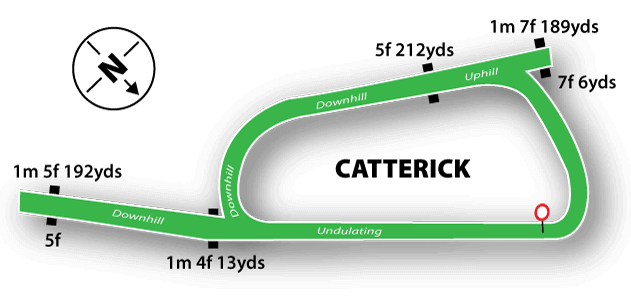
Catterick is one of the sharpest, most idiosyncratic flat tracks in Britain — a tight, undulating, left-handed oval measuring just nine furlongs round. Nothing about it is straightforward. The ground rises from the winning post into the back straight, then falls continuously for the final three furlongs to the line, creating a downhill finish that converts stamina races into tactical speed tests and sprint races into demolition derbies.
The key fact about Catterick is that it punishes big, long-striding gallopers. The tight turns, the constant shifts in gradient, and the compressed circumference demand balance, agility, and the ability to quicken off a bend. Horses trained on the rolling gallops around Middleham — the track has been compared to The Low Moor — often handle it well. Southern raiders from flat, conventional gallops frequently get turned over here, especially first time.
Course form deserves more weight here than at most conventional flat tracks. The dips and rolls catch out horses and jockeys who haven’t experienced them before. A horse that wins here coming from behind is doing something genuinely impressive and deserves marking up for stiffer tracks. Conversely, a horse that leads and wins here may have had a significant track-and-pace assist, so be careful taking the bare form at face value when it moves to a galloping course.
“The dips and rolls at Catterick catch out plenty of horses and you often see hotpots from the south turned over because they can’t handle them. It’s certainly a big advantage for a jockey to be on one that can kick on from the home turn in the longer races, especially on fast ground, because it’s really hard to make up the leeway. Lots of Catterick races are lost early on by a lack of tactical pace.”
— Jason Weaver, former jockey — At The Races
The 5f Chute
5f sprint course runs entirely downhill, joining the round course at the entrance to the home straight
The steepest gradient comes in the first two furlongs — horses break downhill immediately
Heavily favours front-runners; a low draw helps at 5f on quick ground
On quicker ground a high-drawn runner without early speed can be forced to cover extra ground; on soft the favoured line shifts towards the stands side and that reverses
The Round Course
9 furlongs (1m 220y) left-handed oval with sharp bends at both ends
Ground rises for approximately 1f from the winning post into the back straight, then falls for the remaining circuit
3f downhill run-in — jockeys who kick from the home turn hold a decisive advantage
The 5f and 1m6f starts use a spur that joins the main track at the head of the home straight; 6f, 7f and the middle-distance trips are run on the round course
Track & History
Racing at Catterick Bridge since 1783; permanent course laid down in 1813
17 Flat meetings a year, April to late October (the 2026 Flat Finale is 27 October); 10 NH fixtures in winter
Feature flat race is the Catterick Dash (October) — a 5f sprint run down the downhill chute
Collier Hill, winner of the Hong Kong Vase and Irish St Leger, made a winning racecourse debut here in a 2002 bumper
Key Betting Angles
Course suitability matters unusually much here — a first-time visitor carries an extra unknown
Front-runners and prominent racers have a structural edge, clearest over 5f–7f
Low draws matter at 5f and only on quick ground; 6f, 7f and 1m4f are fair
Local trainers (particularly those based around Middleham and the Hambleton Hills) can be worth a second look, though the trainer table shows big differences between individual yards rather than a blanket local edge
Pace Analysis
Do front-runners win at Catterick?
Catterick is a sharp nine-furlong circuit that runs downhill from around six furlongs out to the three-furlong pole and then swings into a tight home turn. That is close to an ideal arrangement for a horse on the pace: the descent lets it build an advantage cheaply, and the bend arrives before anything behind has the room to respond.
The five-furlong chute is downhill for its whole length before it joins the round course, which makes the minimum trip the most one-sided test on the card. The bias eases as the trip stretches, but on a circuit this short it never really goes away — there is simply not enough time or track for a hold-up horse to recover what the leaders take early.
Run Style Bias — Qualitative Only
▲ Front-runners
Strongest at 5f
▲ Prominent
Handy, agile types
▼ Mid-division
Little time to recover ground
▼ Held up
Rarely overhaul the pace
Treat these bars as directional — a reading of how the track rides rather than a statistical measurement. The effect eases with distance but does not disappear on a circuit this short.
Draw Analysis
Does the draw matter at Catterick?
Draw Bias Strength by Distance
Stars rate the strength of a directional bias — ★ mild, ★★ moderate, ★★★ strong. Non-directional reads (Broadly Fair, No Clear Bias, Conflicting, Unstable, Going-Dependent) carry no stars.
Measured in handicaps of eight or more runners since 2010, with the draw cut into thirds inside each field size, split by going where the going changes the answer, and cross-checked against the value returned by each quarter of the draw. Higher bar = stronger handicapping signal.
5f (chute)
226 races
Going-Dependent
6f
216 races
Broadly Fair
7f
308 races
Broadly Fair
1m4f
171 races
Broadly Fair
1m6f
57 races
Low Draws Worst ★
2m
75 races
Broadly Fair
Strong bias — material handicapping factor
Moderate lean — worth noting
Broadly fair — not a primary factor
5f (chute)
Going-Dependent
Across all 453 qualifying races since 2010 — a wider population than the 226 eight-plus-runner handicaps charted above. The draw on the five reverses with the ground, which is exactly why an all-going figure shows almost nothing (impact value 1.05 low against 1.03 high). On quick ground the low third of the draw wins about 30% more often than its share of runners predicts, and the high third about 20% less (244 races). On soft that flips almost exactly: low third 24% below par, high third 29% above (209 races). In fields of eight or more the contrast is stark — 67 low-third winners to 49 high-third on quick ground, against 28 to 63 on soft. Establish the going here before you look at the stalls.
6f
Broadly Fair
Fair once the count is done properly. Across 216 handicaps of eight or more runners the three thirds of the draw finish at 0.97 / 1.01 / 1.02 — nothing to act on. The older reading here came from splitting the stalls at a fixed number and counting wins either side, which gives the low half about 61% and looks decisive; but low stalls run in every race and high stalls only when the field is big. Split each race at its own midpoint and it is 50.0% against 50.0%, dead level. Low draws do get the rail into the first bend from the round-course start — it simply does not convert into wins in the handicap sample.
7f
Broadly Fair
575 races across all race types — the largest sample at Catterick, and 308 of them eight-plus-runner handicaps, and it shows no draw bias worth acting on: impact values run 0.99 low, 1.00 middle, 1.01 high. Whatever operates over the sprint trips has washed out by seven furlongs, and it stays washed out on quick ground and soft alike. Treat the stalls as a non-factor here and weight pace and course form instead.
1m4f
Broadly Fair
Fair, not a persistent low-draw edge. Across 171 handicaps of eight or more runners the thirds finish at 0.97 / 1.03 / 1.00. The old “72% of wins go to the lower half” figure is the same fixed-split artefact as at 6f: counted per race, the split is 51.2% against 48.8%. The tight oval does reward inside position through the bends, but over a mile and a half the field has time to arrange itself and the stall stops mattering.
1m6f
Low Draws Worst ★
The draw does not soften here — it turns over. Across 57 handicaps of eight or more runners the low third of the draw runs at an impact value of 0.51 against 1.33 for the middle and 1.18 for the high, and counted per race the low half takes only 37% of the races against 63% for the high. That is the opposite of the old reading, which had the low half on 57.6% from a fixed split. ⚠ It is a small sample and we would not build a bet on it, but there is no evidence here for a low-draw lean at this trip and some evidence against it.
2m
Broadly Fair
Draw is close to irrelevant at the longest trip: across 75 handicaps of eight or more runners the thirds finish at 0.91 / 1.11 / 0.99, with the middle marginally best and no end penalised. The extra distance gives wide-drawn runners time to find position. The sample is small, so treat even the middle lean as a curiosity rather than an angle.
Statistics · Since 2010
Which trainers and jockeys win most at Catterick?
Trainer
Runs
Wins
Win%
Places
Place%
A/E
P/L
1 Easterby, T D
1076
128
11.90%
360
33.46%
0.92
-200.53
2 Fahey, R A
542
88
16.24%
196
36.16%
1.02
-77.72
3 O’Meara, D
537
71
13.22%
175
32.59%
0.77
-213.95
4 Quinn, J J
466
60
12.88%
171
36.70%
0.84
-78.69
5 Carr, Mrs R A
451
54
11.97%
136
30.16%
1.00
-12.05
6 Ellison, B
278
46
16.55%
96
34.53%
1.07
+31.37
7 Ryan, K A
272
42
15.44%
100
36.76%
0.96
-11.80
8 Midgley, P T
341
36
10.56%
95
27.86%
0.88
-71.21
9 Burke, K R
186
36
19.35%
68
36.56%
1.11
-0.28
10 Dods, M
274
32
11.68%
103
37.59%
0.76
-65.08
11 Easterby, M W
427
31
7.26%
102
23.89%
0.74
-106.37
12 Carroll, D
245
30
12.24%
84
34.29%
0.97
+69.31
13 Pears, Ollie
235
25
10.64%
67
28.51%
0.91
-32.25
14 Appleby, M
192
24
12.50%
62
32.29%
1.05
+0.71
15 Harker, G A
158
23
14.56%
51
32.28%
1.19
-10.62
16 Tuer, Grant
149
21
14.09%
51
34.23%
0.91
+58.88
17 Dixon, Scott
198
20
10.10%
58
29.29%
0.87
-39.34
18 Prescott, Sir Mark
74
20
27.03%
39
52.70%
1.03
+9.39
19 Kirby, P A
317
19
5.99%
68
21.45%
0.70
-126.12
Catterick Flat, since 2010. Tim Easterby has the winners (128 from 1,076) but at A/E 0.92 and £200.53 down, and Richard Fahey is the better of the two big northern yards at 16.24% and A/E 1.02. That Fahey row is the historical Richard Fahey record; son Peter joined the Musley Bank licence in March 2026 and the yard now runs as Richard & Peter Fahey. Geoffrey Harker is who has historically outperformed market expectation here: 14.56% from 158 runners at A/E 1.19. The eye-catcher below the table is William Haggas — only 39 runners here, but 43.59% of them have won, a southern raider who tends to come only when it is worth coming. Historically below market expectation, on big books: P A Kirby (317 runs, A/E 0.70), Mick Easterby (427, A/E 0.74), Michael Dods (274, A/E 0.76) and David O’Meara (537, A/E 0.77). Catterick Flat · Current trainers, since 2010
Jockey
Runs
Wins
Win%
Places
Place%
A/E
P/L
1 Hart, Jason
506
73
14.43%
177
34.98%
0.96
-23.14
2 Allan, David
625
69
11.04%
215
34.40%
0.73
-205.73
3 Tudhope, Daniel
392
68
17.35%
165
42.09%
0.83
-96.22
4 McDonald, P J
493
65
13.18%
157
31.85%
0.96
+7.41
5 Mulrennan, Paul
412
60
14.56%
139
33.74%
1.02
-78.46
6 Sullivan, James P
561
51
9.09%
127
22.64%
0.91
-86.18
7 Beasley, Connor
306
43
14.05%
103
33.66%
1.03
+74.39
8 Curtis, B A
289
43
14.88%
113
39.10%
0.83
-72.65
9 Sousa, Silvestre De
177
42
23.73%
81
45.76%
1.11
+20.76
10 Eaves, Tom
469
37
7.89%
104
22.17%
0.78
-124.44
11 James, S H
267
31
11.61%
79
29.59%
0.90
-32.81
12 McHugh, B
254
30
11.81%
71
27.95%
1.12
+26.43
13 Stott, Kevin
209
29
13.88%
86
41.15%
0.84
-54.71
14 Rodriguez, Callum
142
27
19.01%
50
35.21%
0.99
-21.05
15 Fentiman, Duran
359
24
6.69%
84
23.40%
0.82
-97.37
16 Garritty, Jack
170
22
12.94%
54
31.76%
1.10
-19.62
17 Morris, Luke
122
22
18.03%
42
34.43%
0.94
-22.12
18 Lee, Clifford
92
21
22.83%
36
39.13%
1.24
-7.53
19 Nolan, D
215
20
9.30%
63
29.30%
0.72
-103.66
Catterick Flat, since 2010. Jason Hart leads on winners (73 from 506) at A/E 0.96, close to fair value; David Allan has 69 but is £205.73 down at A/E 0.73, which tells you how heavily the market backs the local book. Clifford Lee is the rider who has historically most outperformed his prices here: 22.83% from 92 at A/E 1.24. Further down, Stephen Donohoe has returned +£47.00 from 32 rides at A/E 1.97 and O McSweeney A/E 1.65 from 39 — and on genuinely tiny books, Edward Greatrex has won 40.00% of 15 and Jamie Spencer 41.67% of 12, too thin to bet but too striking to leave out. Tom Eaves (469 rides, A/E 0.78) and D Nolan (215, A/E 0.72) have historically returned below market expectation here. Catterick Flat · Current riders, since 2010
Sire Statistics · Since 2010
Which sires do best at Catterick?
Sire
Runs
Wins
Win%
Places
Place%
A/E
P/L
1 Kodiac
403
54
13.40%
134
33.25%
1.00
-58.37
2 Dandy Man (IRE)
289
40
13.84%
85
29.41%
1.07
+24.74
3 Dark Angel (IRE)
247
30
12.15%
88
35.63%
0.85
-93.17
4 Acclamation
264
28
10.61%
72
27.27%
0.92
+7.05
5 Kyllachy
230
28
12.17%
62
26.96%
0.96
-67.08
6 Exceed And Excel (AUS)
173
28
16.19%
57
32.95%
1.31
+37.03
7 Invincible Spirit (IRE)
208
27
12.98%
72
34.62%
0.88
-64.54
8 Shamardal (USA)
101
24
23.76%
41
40.59%
1.31
+21.05
9 Poets Voice
90
22
24.44%
39
43.33%
1.47
-1.25
10 Equiano (FR)
148
21
14.19%
54
36.49%
1.11
-16.76
11 Bated Breath
131
21
16.03%
51
38.93%
1.14
+47.69
12 Compton Place
150
19
12.67%
48
32.00%
1.15
-18.47
13 Sixties Icon
84
19
22.62%
29
34.52%
1.51
+13.76
14 Camacho
225
18
8.00%
73
32.44%
0.64
-111.27
15 Zebedee
162
18
11.11%
58
35.80%
0.76
-11.34
16 Showcasing
141
18
12.77%
47
33.33%
0.90
-46.14
17 Mehmas (IRE)
94
18
19.15%
37
39.36%
1.29
+38.68
18 Lawman (FR)
92
18
19.57%
35
38.04%
1.31
+48.16
19 Kheleyf (USA)
167
17
10.18%
48
28.74%
0.83
-40.74
20 Oasis Dream
132
17
12.88%
43
32.58%
0.95
-22.84
Catterick Flat, since 2010. This is an unusually generous sire page — Kodiac tops the winners (54 from 403) at a flat A/E 1.00, but ten of the twenty beat their price on A/E. The best of them are Poets Voice (24.44% from 90, A/E 1.47), Sixties Icon (22.62% from 84, A/E 1.51), Lawman (19.57% from 92, A/E 1.31, +£48.16) and Mehmas (19.15% from 94, A/E 1.29, +£38.68). Below the table, Coach House has returned +£71.63 from 74 runners at A/E 1.63 and Bushranger +£57.88 from 39, while Frankel’s 27 runners here have won 44.44% — small, but hard to ignore. Historically under market expectation: Camacho (225 runs, A/E 0.64) and Zebedee (162, A/E 0.76). Catterick Flat · Since 2010
How to read these tables. The figures are a first-party pull for this course and code covering runs since 1 January 2010, taken as a snapshot rather than updated live. A/E compares actual wins with the wins implied by starting price, so a figure above 1.00 means the group has won more often than its SP suggested. P/L is profit or loss to £1 win stakes at starting price.
Insider Knowledge
Betting Tips for Catterick Flat Turf
🎯
Read the Going Before the Draw
On quick ground the low draws do the damage over 5f — they win about 30% more often than their share of runners predicts, while the high third comes in about 20% short. On soft that reverses almost exactly, the high numbers finishing about 29% above par. Because the two halves cancel out, an all-going draw figure for Catterick tells you very little: establish the ground first, and only then decide whether a wide draw is a problem or an advantage.
🏇
Front-Runners Dominate
Catterick is strongly pace-sensitive, with the clearest evidence over 5f to 7f; over longer trips the sharp circuit and downhill run-in still make position matter, but treat that as coursecraft rather than a measured leader bias. The downhill finish makes it extremely difficult to close ground in the final furlong. A horse that leads into the straight at Catterick is often harder to peg back than on a more galloping track such as Newbury or York.
🧭
Read the Draw and the Likely Position Together
An inside stall is worth much less to a horse that is going to surrender it. Published work on eight-plus-runner handicaps from 2009 to 2019 found that of 548 low-drawn hold-up runners over trips of 7f and shorter here, just 17 won — 3.1%, and only 3 from 140 over the 5f chute. The converse is the useful half: enough early speed to cross and dictate makes a wider stall far less of a problem. That window ends in 2019, so treat it as a strong historical pattern rather than a current-season measurement — but at Catterick, forecast position is worth as much thought as the number on the racecard.
📍
Course Form Beats Class
Catterick is a course-specialists’ paradise. Horses that handle the undulations and tight bends can beat classier rivals who have yet to prove themselves here. Course suitability can outweigh a modest class edge here, so proven track form deserves extra weight when two runners are otherwise closely matched.
🗺️
Local Trainers, Local Knowledge
Yards based around Middleham, the Hambleton Hills, and the broader North Yorkshire training centres are worth a second look, though the individual trainer figures matter more than geography — the table runs from Harker at A/E 1.19 down to Mick Easterby at 0.74. Their horses gallop over similar terrain daily. Declan Carroll has posted the best level-stakes profit of any trainer in the table here (+£69.31 from 245 runners), with Grant Tuer next at +£58.88, while Brian Ellison combines a 16.55% strike rate with an A/E of 1.07. David O’Meara, by contrast, has historically returned below market expectation despite the local profile – 537 runners at A/E 0.77 for a £213.95 loss.
🌧️
Going Changes the Draw Picture
On soft ground, the racing line shifts — jockeys move off the rail in search of better surface. This can reduce the low-draw advantage, particularly over 5f and create opportunities for higher-drawn runners to exploit fresher ground near the stands’ rail.
⚡
Come-From-Behind Winners Are Upgrades
If a horse wins at Catterick having come from well off the pace, mark it up heavily for its next run at a fairer track. The geometry of the course makes closing from behind genuinely difficult — a horse that does it here is better than the bare result suggests.
📏
The 7f Sample Says the Draw Does Not Matter
With 575 races across all types — 308 of them eight-plus-runner handicaps — the seven-furlong data is the deepest on the course — and it returns nothing: impact values of 0.99 low, 1.00 middle and 1.01 high, on quick ground and soft alike. A deep sample producing no signal is a real result, not a gap. Over this trip you can set the stalls aside and put the effort into pace and course form instead.
🎰
A Short Price Still Has to Handle the Track
A short-priced favourite still has to handle the undulations, the tight bends and the tactical speed the track demands — the very things this page says catch good horses out. Judge it on suitability, not on the price. ⚠ Note the tension with the course-specialist angle above: a newcomer is also a first-time visitor, and a low draw at 5f is only a positive on quick ground.
Common Mistakes to Avoid
Ignoring the going when reading the 5f draw — and trusting half-share win rates anywhere else. Over the five the draw is decided by the ground: on quick going the low third wins about 30% more often than its share of runners predicts, and on soft that reverses almost exactly. Figures like “79% of wins to the low half” come from splitting the stalls at a fixed number, which hands the low side every race while the high side only turns up when the field is big; counted per race, Catterick’s 6f splits 50/50 and its 1m4f 51/49.
Backing southern raiders first time. A class advantage can evaporate when a horse can’t handle the undulations. Catterick debutants from big southern yards deserve extra scrutiny — Jason Weaver specifically notes that well-fancied southern runners get caught out by the dips and rolls.
Treating the 3f run-in as a finishing straight. It’s downhill. Closers don’t close the same ground here that they would at Ascot or Newmarket. The leader into the final furlong at Catterick holds on far more often than the raw distance suggests.
Assuming the sprint draw carries up in trip. It does not: measured in handicaps of eight or more runners with the draw cut into thirds inside each field size, 1m4f is fair at 0.97 / 1.03 / 1.00, and at 1m6f the low third is actually the WORST of the three at 0.51. The old “72% low at 1m4f” reading was a fixed-stall split, not a bias. Beyond the sprint trips — the 1m6f small-sample warning above aside — pace and the tight bends decide these races rather than the gate.
Common Questions
Catterick Racecourse FAQs
Is there a draw bias at Catterick?
Yes, but it depends almost entirely on the going, which is the most useful thing to know about the place. On quick ground the low draws do the damage: over the 5f chute they win about 30% more often than their share of runners predicts, and 6f leans the same way across all race types (219 quick-ground races, low a shade under 1.27 against 0.87 high) even though the eight-plus-runner handicaps at that trip come out level. On soft the five reverses — the low third falls about 24% below par while the high numbers finish about 29% above it. Because the two halves cancel each other out, an all-going figure for Catterick shows almost nothing, which is why a single flat “low draw” verdict misleads here. At 7f — the deepest sample on the course at 575 races across all types — there is no draw bias worth acting on whatever the ground. Establish the going first, then the draw.
Which way does Catterick race, and what kind of track is it?
Left-handed, sharp and relentlessly undulating, a tight nine-furlong oval that races like nowhere conventional. The ground rises briefly out of the winning post then falls for the final three furlongs, turning the run-in into a downhill dash rather than a finishing straight. It punishes big, long-striding gallopers and rewards balanced, agile types who can quicken off a bend. Course form counts for more here than almost anywhere, because the dips and rolls catch out horses and jockeys meeting them for the first time.
Does soft ground change things at Catterick?
It can, in two ways. The going rarely gets truly testing thanks to a gravel subsoil that drains well, so genuine soft ground is the exception rather than the rule. When it does soften, jockeys abandon the inside rail for better surface nearer the stands, which can blunt the low-draw advantage, particularly over 5f and hand higher-drawn runners a chance on fresher ground. Treat a soft-ground sprint as the one time the Catterick draw map is worth second-guessing.
Which trainers and jockeys do best at Catterick?
Local knowledge travels well here. Yards based around Middleham and the Hambleton Hills gallop over similar rolling terrain daily, though the individual yard matters far more than the geography: Geoffrey Harker has the strongest market-adjusted record in the table at A/E 1.19, with Karl Burke 1.11 and Brian Ellison 1.07, while Richard Fahey sits close to par at 1.02 and several other northern names are well below it. Clifford Lee (22.83% from 92, A/E 1.24) has most outperformed his prices and Jason Hart rides the most winners. The flip side matters as much. Several high-profile names underperform the market here, including Michael Dods, Mick Easterby and David O’Meara among trainers, and David Allan (A/E 0.73), Tom Eaves (A/E 0.78) and D Nolan (A/E 0.72) among riders.
What is the biggest mistake punters make at Catterick?
Backing classy southern raiders first time and treating the run-in as a normal finishing straight. A well-regarded horse from a big flat-gallops yard regularly gets turned over here because it cannot handle the undulations and tight bends, so course debutants from those stables deserve extra scrutiny before you take a short price. And because the last three furlongs are downhill, closers simply do not close the ground they would at Ascot or York. The horse leading into the final furlong holds on far more often than the bare distance suggests, so back the best-positioned runner, not just the best one.
The Trackside Companion is your day at the races, written to order — every race on your meeting’s card broken down, plus this track’s draw, angles and people distilled from the guide you’ve just read. Order at least a week before your raceday.
To provide the best experiences, we use technologies like cookies to store and/or access device information. Consenting to these technologies will allow us to process data such as browsing behaviour or unique IDs on this site. Not consenting or withdrawing consent, may adversely affect certain features and functions.
Functional
Always active
The technical storage or access is strictly necessary for the legitimate purpose of enabling the use of a specific service explicitly requested by the subscriber or user, or for the sole purpose of carrying out the transmission of a communication over an electronic communications network.
Preferences
The technical storage or access is necessary for the legitimate purpose of storing preferences that are not requested by the subscriber or user.
Statistics
The technical storage or access that is used exclusively for statistical purposes.The technical storage or access that is used exclusively for anonymous statistical purposes. Without a subpoena, voluntary compliance on the part of your Internet Service Provider, or additional records from a third party, information stored or retrieved for this purpose alone cannot usually be used to identify you.
Marketing
The technical storage or access is required to create user profiles to send advertising, or to track the user on a website or across several websites for similar marketing purposes.