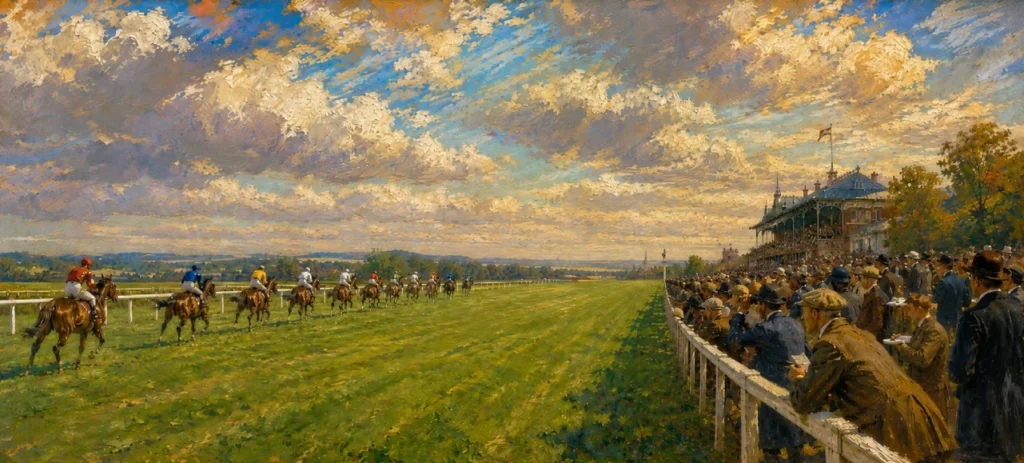
If I had to pick one variable in racing that matters more than any other, I wouldn’t pause to think about it. It’s distance. Not class, not draw, not the ground, not the jockey, not the trainer, not the track. The trip. Every other factor in the game is relative. A well-handicapped horse can cope with a rise in grade. A well-drawn horse can steal a soft lead. A versatile horse can shrug off a change in going. But stamina has a hard ceiling, and when a horse hits it, that is that. No amount of talent, no shrewd ride, no favourable pace, no kind draw can override a fundamental mismatch between the horse’s engine and the distance of the race.
I say this after years of logging the same misread over and over in my own notebooks and, more painfully, in my own betting record. The horse that travels beautifully two furlongs out. The jockey sitting motionless. Everything looking comfortable, almost too comfortable. And then inside the final furlong, the wheels quietly come off. The stride shortens. The head lifts. The finish weakens. The instinct — and it is a powerful instinct, because it happens fast and the commentary is already finding someone to blame — is to have a go at the jockey. Why didn’t he kick on sooner? What was he waiting for? The answer, nine times out of ten, is far simpler than that. The horse was running over a trip it couldn’t quite get. You just didn’t see it until the last 100 yards.
The reverse is just as common, and every bit as costly. You’ll see a horse that looks one-paced over short. It gets shuffled back as the sprint begins. It’s off the bridle earlier than ideal. But when everything else starts to flatten out late, it’s still galloping. It’s still finishing. Step that horse up in trip and suddenly it looks like a different animal — not because it’s “improved” in any meaningful sense, but because it’s finally running over a distance that suits the engine it was born with. That’s not improvement from nowhere. That’s alignment.
Class, draw, ground — these are the things most punters read first. I don’t blame them for it. They’re the things the cards shout at you. Distance, by contrast, whispers. It sits quietly underneath everything else, and if you haven’t trained yourself to notice it, you’ll go on missing the biggest single edge in form study. This post is about how to notice it, what to look for, how to read the picture, and how to bet the edge when you find it.
The Most Common Misread in Racing
Here’s the pattern that should jump out first. A horse runs over its current trip four or five times. Each time it travels strongly into the race, each time it’s there with a chance three furlongs out, and each time it fails to see it out. The jockey gets a hard time in the Racing Post comments. The trainer drops a hint in the press about “a step up in class” or “ground against him.” The market keeps pricing the horse at single-figure odds because the travelling ability looks electric.
What is actually happening is simpler and more structural. The horse has enough speed to put itself in the race but not enough stamina to finish it out at that distance. The Racing Post form comments will tell you the same story, if you sit with three or four of them side by side. Travelled strongly, weakened inside the final furlong. Prominent, no extra at the finish. Held every chance two out, emptied quickly. Once is fitness. Twice is circumstance. Three times is the horse telling you it wants less ground.
And when the jockey realises mid-race that the horse has nothing left to give, the good ones stop asking. This is where a bit of insider knowledge comes in handy. A jockey who feels the engine empty will often mind the horse home — ease off the urgency, stop riding it out, let the horse finish on its own terms rather than flog it into the ground for a minor place it isn’t going to make anyway. From the stands that looks dreadful. The horse appears to run backwards; rivals pass it at will in the last hundred yards. What a terrible ride, says the bloke next to you, and you can almost hear the Twitter posts writing themselves. But the ride was compassionate, not lazy. The jockey was thinking about the horse’s next three starts, not just this one. Recognising that difference — between a horse that was eased down and a horse that was outrun — is one of the first real tools you pick up in form reading.
Signs a Horse Needs Shorter
You don’t need sectional times to spot this. The visual clues, once you know them, are obvious — and they’re sitting in plain sight in the Racing Post running commentary if you prefer to read rather than watch. There are four patterns I look for specifically, and when I see them stack up on the same horse, I know the trip is the problem.
Pattern 1. Travels well, fades in the final furlong. The horse looks beaten inside the last 100 yards after cruising into contention. Two out it’s travelling like the winner. At the line it’s fourth or fifth and going backwards.
Pattern 2. Hits the front before the final furlong and can’t sustain it. Headed late by horses with less apparent ability — the kind of horses that couldn’t live with its travelling speed but had more in reserve when it mattered.
Pattern 3. Finds nothing when pressure is applied. The jockey asks the question, and the answer is flat. The horse looked fine right up to the point where it was asked to do actual work. Comfortable isn’t the same as having petrol in the tank.
Pattern 4. Repeats the same fade at the same trip across multiple runs. One run can be fitness. Two might be circumstance. Three is a pattern. Four is the horse waving a flag.
When a horse shows that shape, a drop in trip unlocks it. Instead of stretching its stamina to the limit, it can use its cruising speed more efficiently — sit handy, quicken off a fair gallop, and be gone before stamina becomes the question. Plenty of horses are beaten because they’re running a furlong or two too far. That’s all it takes. If you’ve fancied one and watched it fit this shape, don’t write it off. Watch for the drop in trip. Watch for a first-time 6f after a string of 7f runs, or a first-time mile after a miler has been tried at 1m2f and come up short. The market often takes a while to price it properly, because the recent form figures still say 7-6-5-4. The horse stepping back in trip is running in fundamentally different conditions. The price hasn’t caught up.
Signs a Horse Needs Further
This is where most punters misread races, and it’s where the deeper edge lives. They see a horse running on at the finish and assume it was unlucky. They talk about a stronger pace at the head of affairs, or traffic problems, or a slow-away start. Sometimes that’s the right read. Often it’s a horse running over a trip that’s just slightly sharp for the stamina it carries, and running on because its best work always arrives when everyone else is starting to tire.
If a horse is consistently outpaced mid-race and only finds top stride in the final furlong, that isn’t a shortage of ability. It’s a shortage of distance. The strongest section of its race is the final 100–200 yards every single time. Give that kind of horse an extra furlong or two and the late rattle becomes a sustained move rather than a gallant near-miss. Instead of passing beaten rivals in the last fifty yards, it can engage with three or four furlongs left and use stamina as a weapon.
Pattern 1. Outpaced mid-race, picks up ground only in the final furlong. The best work always comes in the section of the race where the result is already being sorted out for someone else.
Pattern 2. Off the bridle earlier than rivals but keeps galloping when others stop. Grinds rather than quickens. The sort of horse where you find yourself wondering why it never looks fluent.
Pattern 3. Form figures read 5th, 4th, 3rd at the same trip. Each run closer, each time the narrative is “making progress.” But the narrative changes fundamentally when the trip does. Those four placings at 1m2f can turn into a win first time out at 1m4f, and the market will ask afterwards what changed. Nothing changed. The horse was finally allowed to run its race.
Pattern 4. Pedigree suggests further. Sire is a middle-distance or staying influence. Dam’s side was campaigned over ground. But for whatever reason — owner preference, trainer caution, a promising debut over a sharp trip that set a template — the horse has only been tried over the minimum of the range it was bred for.
That fourth pattern is the quiet gold. A horse running over a trip that its pedigree flatly contradicts is, in effect, running with one hand tied behind its back. The market usually doesn’t penalise it enough, because the form figures look moderate. But the horse stepping up in trip for the first time is running in fundamentally new conditions. The reasoning the market is using to price it — recent form is ordinary — doesn’t apply to the race you’re about to watch.
Case Study: Amazonian Dream
There was a horse I backed twice on this site, Rod Millman’s Amazonian Dream, a seven-year-old gelding, who was showing exactly the pattern described above to the letter. Look at his career and almost every run sat at 6f, with a scattering of 5f efforts earlier on. He had won over both trips. He was a known quantity at that range.
But in his last three races, the same thing kept happening. There’d be a flat spot mid-race, almost always in the phase where the pace heats up and the speed horses start to commit. Amazonian Dream couldn’t pick up with them in that phase. He’d drop three or four places while the race was being taken away from him — and then, once the leaders started to tire, he’d begin passing them back. But it was always too late. By the time his best work arrived, the race had already been settled. He was good for fourth, fifth, a minor place.
He’d never been tried over 7f. Not once in a long career. But both the running style and the pedigree — and I mean the obvious parts of the pedigree, not some obscure inbreeding theory — suggested the extra furlong was precisely what he needed. Whether the trainer would actually make that call was the question, and it’s exactly the kind of situation that the Daily Dial is built to flag in advance rather than narrate after the fact.
The broader lesson travels well beyond one horse. When you see a sprinter who keeps getting tanked along into contention and then drawing a blank; when you see a miler who never quite gets involved until the last hundred yards of what should be their best trip; when you see a chaser who looks spent three out but is still galloping past the line — look at the pedigree, look at the trip, and ask whether anyone has actually tried what the horse is plainly asking for. Frequently the answer is no. Frequently it’s because the trainer has a template for the horse that was set in its first three runs and never seriously revisited. That’s an edge. A quiet one, but a real one.
The Distance Bands: A Reference
Distance isn’t a dial you turn smoothly. It’s a set of bands, and each band has a character of its own — a different energy system, a different pace shape, a different type of horse. This is the framework, not the detail — the full breakdown lives in the Betting Guide. But a working tipster carries this table in their head whether they’ve written it down or not.
| Band | Flat | National Hunt | Profile |
|---|---|---|---|
| Sprint | 5f – 6f | — | Pure speed. Explosive types. Early pace is everything. Margins are tight and the market is cruel to any inefficiency out of the stalls. |
| Hybrid | 7f | — | Not a sprint, not a mile. Tactical speed and enough stamina to finish. This is where the trip debates concentrate — more mis-campaigned horses live in this band than anywhere else. |
| Mile | 1m (8f) | — | The foundation distance. Tests the balance between pace and stamina. Exposes weaknesses in both directions, which is why so many horses end up somewhere else eventually. |
| Middle | 1m2f – 1m4f | — | Stamina becomes a serious factor. Strong travellers who settle. The Derby is 1m4f — that’s the distance Flat racing uses to crown its best middle-distance three-year-old. |
| Staying | 1m6f – 2m+ | — | Specialist stayers. Grind rather than quicken. Often improve with age — older legs and a settled mind are bigger assets here than raw speed. |
| Minimum | — | 2m – 2m1f | The speed end of jumps. Quick jumpers, strong travellers, tactical pace. Often won by the horse that jumps the most efficiently, not the fastest one on the bridle. |
| Intermediate | — | 2m4f – 2m5f | The bridge. A lot of horses improve significantly stepping up from 2m into this band. The sharper 2m horses often fall apart here if they lack true stamina. |
| Staying | — | 3m | Stamina is non-negotiable. The benchmark staying trip in National Hunt — the Gold Cup, the National, the big Saturday handicaps all live here. |
| Extreme | — | 3m2f+ | Attritional. Exposes weak stamina, poor jumping technique, and mental fragility. A different kind of horse wins at this range and you learn who they are by watching, not reading. |
Two things to take from the table. First, the bands aren’t equal in width. A furlong on a sprint means something very different to a furlong on a staying chase. A 5f horse dropped to 6f is a bigger change than a 3m horse dropped to 2m7f, even though the numerical drop is identical. Second — and this is the one most punters never internalise — the transitions between bands are where the real interpretive work happens. The hybrid 7f range on the Flat and the intermediate 2m4f range over jumps are absolutely riddled with horses who shouldn’t be there. These are the two places I look first when I’m hunting for a trip misread.
How to Compare Distance-Split Form
Most punters glance at finishing positions and move on. They see 5-4-3-2-3 and think that’s a horse making progress, worth another look. Maybe it is. But that reading tells you nothing about whether the horse is running at its correct trip, and without that, the rest of the signal is noise. What you actually want to do is compare runs by distance, by effort distribution, and by race shape. There are four questions I walk through for every run of interest.
Question 1. At what point in the race did the horse come off the bridle? Earlier than expected suggests the trip is stretching it. A horse that’s already niggled along before the turn for home in a 1m2f race is telling you something. The same horse dropped to a mile might be cruising at the same stage.
Question 2. Where did it make ground, and where did it lose ground? The distribution of effort tells you more than the finishing position does. Two horses finish fourth. One gained four lengths in the final furlong, the other lost four. They are not the same horse, they are not making the same statement, and you cannot bet them as equivalents.
Question 3. Did it finish stronger than it travelled, or weaker? Stronger suggests further. Weaker suggests shorter. This is the single fastest diagnostic in racing and it costs you nothing but attention.
Question 4. Does the pattern repeat across multiple runs at the same trip? Line up three or four runs at the same distance. If the effort profile is the same each time — travelling well and fading, or being outpaced and running on — that’s a template. Single runs can lie. Templates don’t.
Break the form down by trip brackets. Ignore finishing position for a moment and focus on effort distribution through the race. If a horse weakens late over 1m4f but finishes strongly at 1m2f, that is a stamina ceiling staring you in the face. If it’s repeatedly doing its best work at the line over a mile, further might suit. And here’s the part that’s easy to miss: distance is rarely about dramatic swings. One or two furlongs either way — the difference between 7f and a mile, between 2m and 2m4f, between 1m4f and 1m6f — is usually all it takes to turn a horse that looks exposed into a horse that looks progressive.
A practical exercise, if you’re new to this. Pick a horse that’s had six or eight runs over more than one trip. Print off or list out the Racing Post comments for each run. Don’t look at the finishing positions. Read only the in-running language. Travelled strongly. Faded last furlong. Outpaced halfway. Ran on strongly at the finish. Pattern them by distance. You will find — almost every time — that the horse has been trying to tell the trainer, the jockey, and anyone who’ll listen exactly where it wants to run, and that the record is a lot clearer once you strip the finishing positions out and look at the shape of the effort instead. Once you’ve done that three or four times, you won’t need to do it consciously anymore. You’ll start seeing it at a glance in the form string.
Why the Market Misses It
Here is the part that turns all of this from a reading exercise into a betting edge. The market reacts quickly and sometimes aggressively to class moves, jockey bookings, trainer hot streaks, and recent wins. It reacts to cheekpieces. It reacts to a drop in grade. These are the things the big money is watching, and the price moves accordingly.
Trip adjustments, unless they’re extreme, are priced lazily. A horse dropping from 1m4f to 1m2f moves the right direction in the market but often not nearly far enough. A horse stepping up from 7f to a stiff mile barely moves at all. A staying chaser being tried over two-and-a-half miles for the first time in six runs usually drifts, because the commentary still reads “wants further” and the punter skim-reads that as a negative rather than a positive. The angles are subtle and they require the punter to understand how the horse runs, not just what its rating is, and most punters never look beyond the rating.
This is the structural edge. If you consistently back horses running at their correct distance and consistently leave alone horses running at trips they can’t handle — even when the form figures look good — you remove one of the most common structural errors in betting. That alone puts you ahead of the field. Not because you’re cleverer than everyone else. Because you’re looking at something most of the field isn’t looking at.
Distance doesn’t shout the way a last-time-out win does. It doesn’t make headlines the way a big stable switch does. It requires interpretation. It requires watching races, logging patterns, building a mental file on how a horse’s running style suggests where it wants to be. The racecourse guides cover how track geometry interacts with trip at individual venues — a stiff 6f at one course is a different proposition to a downhill 6f at another, and that matters too. But the principle here is the foundation underneath all of it. Everything starts with the trip.
A Final Word
Think about the horses you’ve backed recently that let you down. Not the obvious losers where everything went wrong from the stalls. The frustrating ones. The ones where the horse travelled like the winner and then emptied. The ones that ran on bravely for fourth when you thought you’d landed one. Those are almost always — not sometimes, almost always — trip problems dressed up as something else. The jockey wasn’t the problem. The ground wasn’t quite the problem. The draw was probably incidental. The horse was running over the wrong distance.
The good news is that this is an edge you can build for yourself without paying for anything. The Racing Post running commentary is free to read after every race. The pedigrees are on every card. The pattern of effort across a horse’s last six runs is sitting there waiting to be noticed. All that’s missing is the discipline to sit with it and read it properly before looking at the finishing positions and letting them colour your view. Do that, and you’ll find yourself backing fewer of the flashy travellers and more of the quiet grinders — and over a year or two, the P&L will tell you which type of horse was actually worth the money.
Get the trip right first. Build everything else around it. The horse that travels beautifully for six furlongs and then empties is not the horse the market thinks it is, and the horse that keeps finishing fourth over a mile when bred for 1m4f is a bigger price than it should be every time it steps up in trip. Those two misreadings alone are where most of the value in handicap racing hides. Once you start seeing them you won’t be able to stop.
A companion piece to this one sits alongside it on the site. Trip Notes: The Edge Hidden in Plain Sight covers the other meaning of the word “trip” — not the race distance but the horse’s journey through the race, what gets recorded when you actually watch rather than read. Distance is the taxonomy. Trip notes are the craft of watching.
Be Lucky!

Common questions
On the Flat: sprint (5-6f), 7f (a hybrid), the mile (8f), middle distance (1m2f-1m4f) and staying (1m6f-2m+). Over jumps the minimum is 2m, with 3m the benchmark staying trip and 3m2f+ the extreme staying range.
It is outpaced through the middle of the race but keeps finding the line, doing its best work in the final 100-200 yards every single time. Add a furlong or two and that late rally becomes a sustained move rather than a gallant near-miss.
It travels strongly into contention then fades inside the final furlong, repeatedly at the same distance. It has the cruising speed to be involved but not the stamina to finish; dropping in trip lets it use that speed before stamina becomes the question.
One mile four furlongs (12 furlongs; 1m4f10y exactly) – the distance Flat racing uses to crown its best middle-distance three-year-old.
The market reacts fast to class moves, headgear, jockey bookings and recent wins, but prices trip changes lazily. A horse stepping up to a stiff mile, or a stayer tried over further for the first time, often barely moves in the market – which is where the value hides.
Bet logs, spreadsheets and course cheatsheets — built the same honest way as the tips.
Visit the Shop →How do I follow this bet?
Best route is Oddschecker. It pulls every UK bookmaker's price into one screen so you can grab the top of the market — and crucially it shows the place terms, which vary by firm. One bookmaker might offer 11/1 paying 3 places at 1/4 odds; another might offer the same 11/1 paying 4 places at 1/5. Maximum win return vs hedged each-way return — your call which serves the bet better.
If the price has shortened since I advised it, judge it on the case in the prose. Rule of thumb: I'm generally happy down to about two-thirds of the advised price — 14/1 down to 10/1, 8/1 down to 5/1. Below that it's marginal and probably worth passing. Keep an eye on the price in the last 20 minutes too — short prices often drift back out as the off approaches, especially on outsiders. Bet with bookmakers offering Best Odds Guaranteed and you're covered either way.
What if the price has shortened by the time I get to it?
Judge it bet by bet. The cleaner the case in the prose, the more decay I'll tolerate. Rule of thumb is about two-thirds of the advised price — 14/1 down to 10/1 is still in, 9/1 down to 6/1 still fine, anything below that is marginal.
Worth knowing: short prices often drift back out as the off approaches, especially on outsiders. Keep checking in the last 20 minutes — you may get back to the advised price or close to it. And always bet with bookmakers offering Best Odds Guaranteed so you're covered if the SP comes back bigger.
Why are some bets win-only and others each-way?
Three things decide it: confidence, race shape, and the betting market.
If I think a horse has an outstanding win chance, I'll back it win-only to maximise the return — even at a bigger price, where each-way would normally be the safer call. If the win case is more speculative but the place case is strong, each-way carries the bet.
Concrete example: Almanack at Kempton, 2 July 2014. Advised at 22/1 win-only in the morning. The price shortened to 16/1 SP and he won by a short head on the line. Win-only on a confident shout at a generous price is where the real returns come from — when the case is right, you back it to win, not to hedge.
What happens if my horse is a non-runner?
If a horse is declared a non-runner before the race, your stake is returned in full on win or each-way singles.
If it's part of a multiple (accumulator, lucky-15, etc), the bet runs on without that leg and the remaining legs are recalculated. For ante-post bets the rules differ — usually no refund unless the bookmaker is offering NRNB ("Non-Runner No Bet") on the race. Full breakdown here.
New to this? Read up on: Place Terms · Speed Figures · Each-Way Betting
Get tomorrow's pick before the off
Every selection posted before the race — the angle, the reasoning, the price. Free, no fluff.