The racing tipster industry has a structural problem. The majority of people selling or giving away tips on social media are not making money from betting. They are making money from you betting. The business model is affiliate commissions, paid subscriptions, or both — and none of those revenue streams require the tipster to be profitable at the bookmaker. They require volume: followers clicking links, opening accounts, placing bets. Whether those bets win or lose is, from a business standpoint, irrelevant.
The BBC investigated the affiliate tipster model and found that many of the most-followed racing accounts on social media earn commission every time a follower places a bet through their referral link — regardless of the outcome. The tipster profits when the follower loses. That is not a conflict of interest buried in the small print. It is the entire business model.BBC — The social media tipsters who win when you lose
Once you understand this, the behaviour makes sense. The high-volume tipsters who post fifteen or twenty selections a day are not doing so because they have identified fifteen genuine betting opportunities. They are doing so because volume increases the probability that some of those selections win, which generates social proof, which attracts more followers, which generates more affiliate income. Track the actual profit and loss of any high-volume social media tipster across a full week. The cumulative number will almost certainly be negative, and often significantly so.
The Anatomy of a Tipster Scam
The mechanics vary, but the patterns repeat.
Pattern 1
The Affiliate Accumulator
A tipster posts a £20 rolling accumulator across the week. Five legs, six legs, sometimes more. The odds look enormous. The potential return is life-changing. The accumulator almost never lands — the mathematics of compounding probabilities make completion wildly unlikely — but that is beside the point. Every leg sends traffic through an affiliate link. If the accumulator loses, the tipster runs it again next week. If it wins, the publicity generates a wave of new followers who will fund the next cycle. Some platforms wipe accumulated profit monthly, meaning the house starts clean regardless. The customer rarely understands any of this.
Pattern 2
The “Inside Information” Merchant
If anyone genuinely had inside information — the kind that would reliably identify winners before the market — they would not be selling it for a few pounds a month on Telegram. The economics do not work. Genuine private information is worth far more when exploited quietly than when distributed widely, because distribution moves the market and destroys the value. What these accounts actually do is identify horses that have been backed heavily — information that is already publicly visible — and repackage it as secret intelligence. When the horse wins, they claim credit. When it loses, there is no accountability.
Pattern 3
The Screenshot Merchant
Selectively posting winning bet slips while deleting losing ones. A tipster with a 20% strike rate and a 200-selection sample will have roughly 40 winning slips to screenshot. Those 40 images, posted across a month without the 160 losers, create the impression of a profitable operation. The actual P&L tells a different story, but the actual P&L is never published.
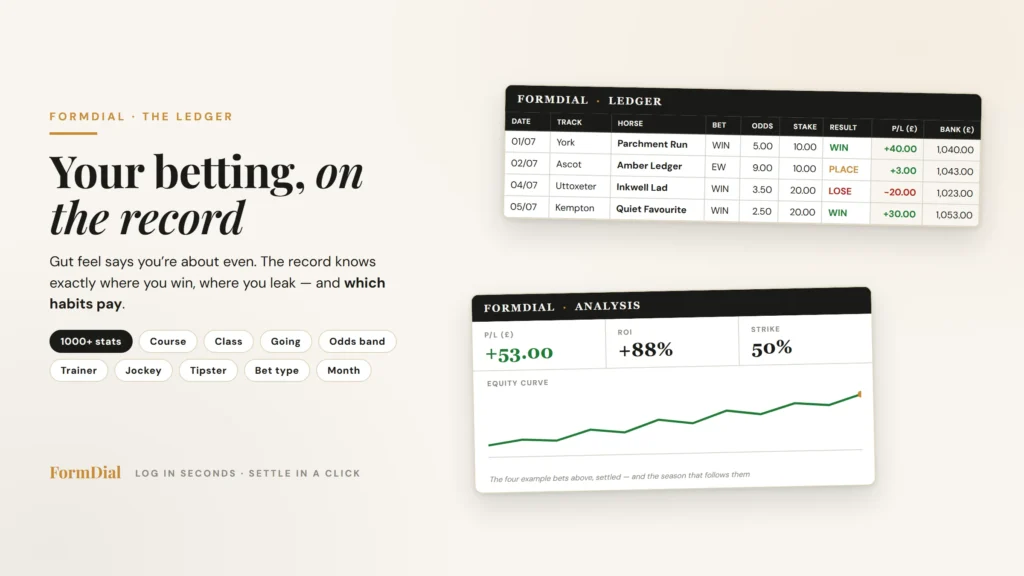
The test: Does the tipster publish a full, auditable profit and loss record from day one? If the answer is no, everything else they post is unverifiable. Screenshots are not evidence. Volume is not proof. Only a complete, unedited ledger means anything.
Why Blind Following Fails Even When the Tipster is Honest
Set aside the scams. Assume you find a tipster who is genuinely trying and genuinely transparent. Blind following still fails, for reasons that have nothing to do with the tipster’s ability.
7/1
Posted Price
The tipster posts at 8am. By the time you see it, the price has collapsed. Over hundreds of bets, this erosion compounds into a significant reduction in expected value.
0
Adjustments Made
The ground changes, a rival is withdrawn, the pace scenario shifts. Without understanding the thesis, you have no mechanism to adjust. The value may no longer exist.
0
Lessons Learned
Following teaches nothing. When the tipster disappears — and they always do — you are back to zero. Worse than zero: you have the habit of betting without understanding why.
The principle: Even honest tips lose their value in transit. The price erodes, the conditions change, and the reasoning — the only part that teaches you anything — is lost entirely. Following is renting. Understanding is owning.
What Actually Works
The alternative is not complicated. It is just slower, and it does not promise overnight results, which is why it does not sell on social media.
Understanding racing — the handicap system, how going changes a race, what draw bias means at a specific course over a specific distance, how pace interacts with track geometry, why trainer patterns at individual venues are more predictive than headline strike rates — builds a framework that compounds. Every race you watch with that framework becomes data. Every result you analyse deepens your model. The knowledge does not disappear when someone else stops posting.
There is no other betting market where so many exploitable structural edges exist in plain sight. Draw biases that persist for years. Trainers who outperform at specific tracks by double-digit percentage points above expectation. Handicap horses running off marks that do not reflect their ability because the handicapper rated what happened, not why. Going changes that flip the form picture for half the field between declaration and race time. These are not secrets. They are public information that most bettors never learn to read because they were too busy following someone else’s selections.
Horse racing rewards understanding more generously than almost any other betting market, precisely because so few participants bother to develop it. The people who write the sport off as bent or rigged are almost always the ones who never learned how it works.The structural edge
The Standard This Site Is Built On
Every selection published on this site includes the reasoning before the race, not after. The course angle, the price logic, the conditions assessment. Every result is logged — winners and losers both — with full P&L tracked publicly from the first bet. No screenshots. No edited history. No affiliate links paying us when you lose.
The racecourse guides quantify the structural edges at individual venues with real data: draw bias by distance, trainer strike rates with meaningful sample sizes, pace analysis grounded in results. The betting guide covers every concept a serious punter needs, from odds mechanics to handicap ratings, written in depth and connected to each other.
The goal is not to give you tips. It is to give you the framework to evaluate any tip — including ours — on its merits. The difference between a bettor who follows and a bettor who understands is the difference between someone who needs a tipster and someone who does not.
See Transparent Betting in Practice
Full reasoning before every race. Complete results log with no edits. The P&L speaks for itself.