Ante-Post Betting Explained
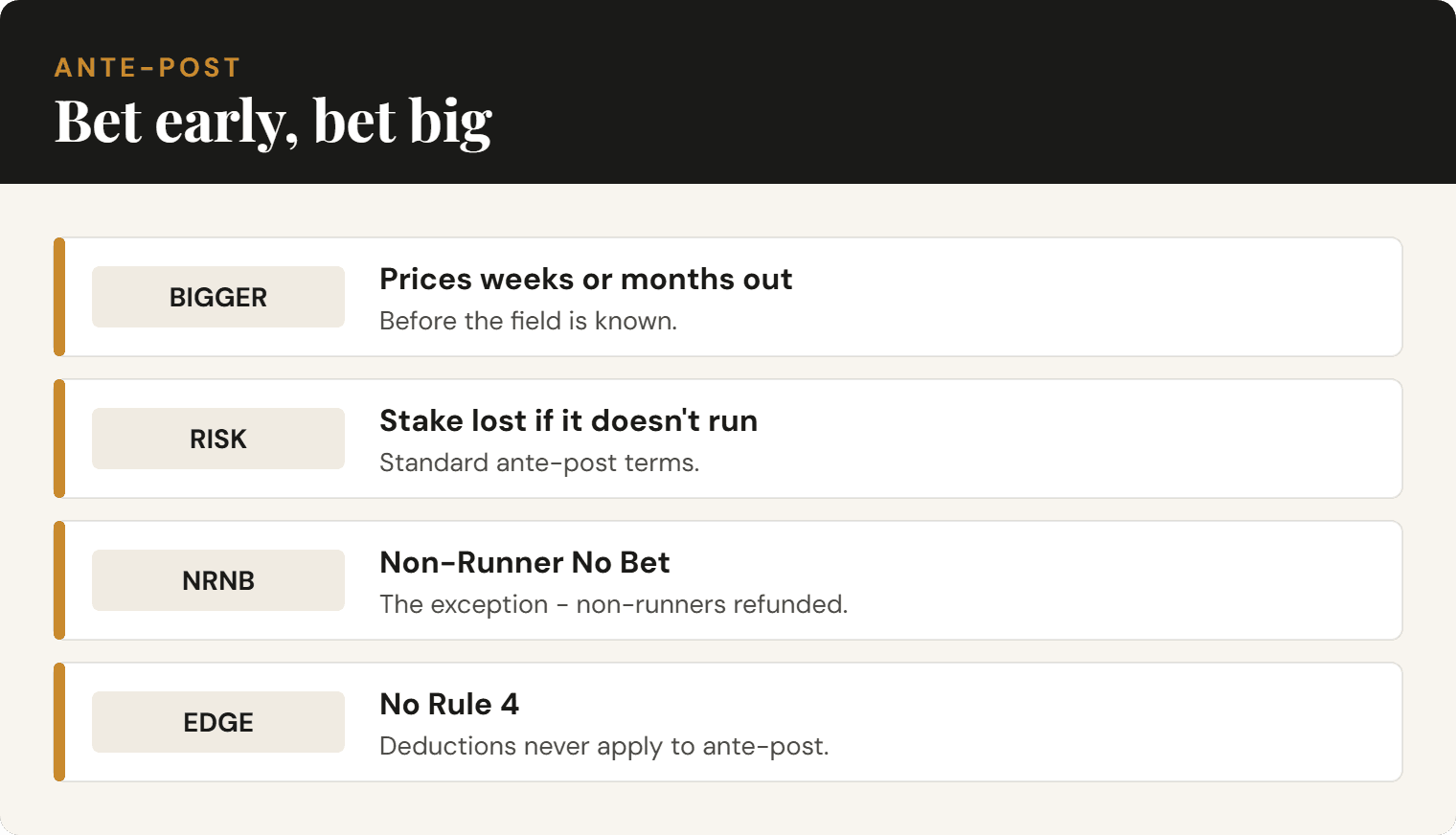
An ante-post bet is a wager placed before the final declarations for a race — in Britain the 48-hour stage, closing at 10am two days before raceday — and often weeks or months out. The appeal is simple: the odds are bigger. The catch is almost as simple — under standard terms, if your horse does not run, you lose your stake. The exceptions are specific: a Non-Runner No Bet market (covered below), and the Rule 4(A) voids — race abandoned or declared void, entry conditions changed, venue altered, or your horse balloted out — where a single ante-post bet is refunded and accumulators stand on the surviving legs. The other side of the ledger is two edges that are easy to miss: a price that can be twice the day-of-race figure, and complete protection from Rule 4 deductions. Reading those edges against the run risk is a distinct skill, and it is what this page is about.
The line that matters is the final-declaration stage. Before it, a market is ante-post and these terms apply. After it, the race switches to normal non-runner rules and Rule 4, and the ante-post premium disappears. In Britain declarations close at 10am two days before raceday, Flat and jumps alike (BHA, June 2020, permanent from November 2022); the 2026 Grand National is the one exception, declaring three days out with six reserves.
Why Ante-Post Odds Are Bigger
The bookmaker offers longer odds ante-post because it is absorbing less risk per bet. Once a market is formed on the day of the race, the bookmaker must manage liability across a defined field. Ante-post, the field is uncertain — horses may be withdrawn, supplemented, or rerouted. The bookmaker prices in that uncertainty by offering a bigger price, knowing a proportion of ante-post stakes will simply be kept when selections fail to make the line-up.
The ante-post edge is mathematical, not speculative. A horse that will be 4/1 on the day can often be backed at 8/1 or 10/1 weeks in advance. If it runs, you hold twice or more the value of the day-of-race price. The question is rarely whether the price is good — it almost always is. The question is whether the horse will run, and every ante-post decision comes down to that single assessment.
There is a second edge that is easy to miss. Rule 4 deductions do not apply to ante-post bets. On a same-day bet, if a well-fancied rival is withdrawn before the off, your winnings are cut under the Tattersalls Rule 4 scale — a 4/1 shot coming out can shave a meaningful slice off the payout. An ante-post bet is exempt: you are paid in full at the price you took, however many runners are later scratched — with one carve-out: a withdrawal that leaves only one runner makes the race a walkover, and all bets on it are void (Tattersalls 4(C)). Lock in 10/1 ante-post and your 10/1 stays 10/1, even if half the market drops out. For the full deduction scale, see Rule 4 deductions.
When Ante-Post Betting Works
Ante-post pays when the price you take now is clearly bigger than the price the horse will be on the day, and the run risk is low enough — or removed entirely — to make that gap worth banking. Four situations stack the odds in your favour.
A price about to contract
- Back a horse whose odds will obviously shorten once it wins a trial or is confirmed a definite runner. Markets sharpen on news — a Cheltenham favourite trading at 6/1 a month out can be 3/1 by raceday once it bolts up in its prep. Take the 6/1 before the trial, not the 3/1 after it.
A stable market with one stand-out
- Commit when the field is settled and connections have a single obvious target. A top-class horse pointed at one championship race, with no rival of its calibre and no reason to reroute, is far more likely to line up than a horse juggling options.
An early price far bigger than the likely SP
- The biggest value appears when a market first opens and the layers are pricing on reputation and thin information. If the early quote is well above where you expect the starting price to land, the edge can be large enough to accept the run risk and still show a clear profit over time.
A Non-Runner No Bet market
- When a market is NRNB, your stake comes back if the horse does not run — the single biggest objection to ante-post, removed. It is not free: the NRNB grid is priced shorter than the same firm’s all-bets-stand grid, so you are trading price for protection. Whether that trade is right depends on how likely the horse is to line up and how much of the price you are giving up.
Non-Runner No Bet (NRNB)
Non-Runner No Bet is the single most important thing to check before placing any ante-post bet. On an NRNB market, if your selection does not run, the bet is voided and your stake refunded. It converts ante-post from stake-lost to refund-if-it-does-not-run — but not for free: NRNB grids are priced shorter than the all-bets-stand grid on the same horse at the same firm, and several firms run both side by side so you can choose.
Bookmakers usually switch big-race markets to NRNB a few weeks out — most commonly in the weeks before the Cheltenham Festival and the Grand National, and often on the Classics nearer their entry stages. Outside those windows, and on more obscure markets, standard ante-post terms still apply and a non-runner means a lost stake. The rule is simple: confirm a market’s NRNB status before you stake, and treat the words “all bets stand” as your cue that the full run risk is on you. The mechanics of voided bets and refunds are covered in Non-Runner Rules Explained.
When Ante-Post Betting Does Not Work
The most common losing ante-post bet is the horse backed for one race that is rerouted to another. It happens constantly. A trainer enters a novice in both the Arkle Chase and the Brown Advisory — both run at the Cheltenham Festival, but the Arkle is the two-mile novice championship and the Brown Advisory is run over an extra mile — waits for the trials to unfold, then runs it in whichever suits. If you backed it ante-post for the Arkle and it goes for the Brown Advisory instead, your bet is lost, even though the horse won. Pairings like this, at clearly different trips, are exactly where the reroute risk bites.
The second common loss is the going-dependent runner. A horse whose connections will only let it run on soft ground is a dangerous ante-post proposition for a spring festival where the going could be anything from good to heavy. If the ground dries, the horse stays at home and your stake is gone.
The third is simple attrition. The longer the gap between your bet and the race, the more time there is for injury, a setback, or a change of plan. A fragile horse — one with known wind issues, a tendon history, or a stop-start record — is a high-risk ante-post bet regardless of ability. A sound horse that has been to the track 15 times and never missed an engagement is a far safer proposition than one that breaks down as often as it turns up.
Before you stake ante-post, confirm
- The exact race, and that your horse is realistically aimed at it rather than holding it as one of several options.
- Whether the market is Non-Runner No Bet or standard “all bets stand” terms.
- The horse’s likely going needs against the time of year — a soft-ground specialist into a drying spring is a trap.
- The each-way terms on offer, which can differ from the raceday race and are worth fixing before you bet.
Managing Ante-Post Positions
Ante-post betting creates exposure over time. Between placing the bet and the race being run, the market will move. If your horse shortens significantly you hold value — but you also hold risk until the race is over, and managing that risk is part of the strategy.
Some punters lay their selection back on an exchange as the race approaches, locking in a profit regardless of the result. This is known as greening up. Back a horse at 10/1 ante-post and, once it is trading at 4/1, lay it at 4/1 on the exchange to guarantee a return either way. It is a legitimate approach for large ante-post positions, but it needs exchange access and the discipline to accept a smaller guaranteed profit over a larger speculative one. You can model the back-and-lay numbers with the bet calculator before you commit.
For how non-runners affect bets generally, see Non-Runner Rules Explained. For odds mechanics, see Betting Odds Explained. When you want a current angle rather than the theory, the day’s reasoned selections are on the Daily Dial.
Common Questions
Under standard ante-post terms, yes — the bet is settled as a loser with no refund. The exceptions: an NRNB market refunds the stake, and under Tattersalls Rule 4(A) a single ante-post bet is void if the race is abandoned or declared void, its conditions or venue change, or the horse is balloted out. Always check which terms apply before you bet.
NRNB means the bet is voided and your stake refunded if the horse does not run. The protection is priced in: an NRNB quote is shorter than the same firm’s all-bets-stand price on the same horse. Bookmakers usually offer it a few weeks out on big-race markets such as the Cheltenham Festival and Grand National.
No. Ante-post bets are exempt from Rule 4 (Tattersalls) deductions, so a winning bet is paid in full at the price you took even if other runners are later withdrawn. A same-day bet would have its winnings cut instead.
At the final-declaration stage: in Britain, 10am two days before raceday, Flat and jumps alike. After that, normal non-runner and Rule 4 terms apply instead of ante-post terms, and the bigger ante-post price is no longer available.
Laying your selection back on a betting exchange once its price has shortened, to lock in a guaranteed profit whatever the result — for example back at 10/1, lay at 4/1. It needs exchange access and the discipline to take the smaller, certain return over a larger speculative one.
Yes. The place fraction and number of places on an ante-post each-way bet can differ from the raceday market, so confirm the terms you are taking before you stake rather than assuming the day’s terms.
Try the Calculator
Work out potential returns on an ante-post bet at the price you took.