Non-Runner Rules Explained
A non-runner is a horse that was declared to run but is withdrawn before the race goes off. It happens for plenty of reasons — injury, unsuitable going, a trainer’s change of plan, or a self-certificate withdrawal. When a horse comes out, two things matter to you as a punter: what happens to your bet, and how the change reshapes the rest of the field. Both turn on one question — when the horse was withdrawn — and on what kind of bet you placed. This guide is part of the wider horse racing betting guide; the deductions and place-term mechanics it touches on are covered in full on the sibling pages linked throughout.
What Happens to Your Bet
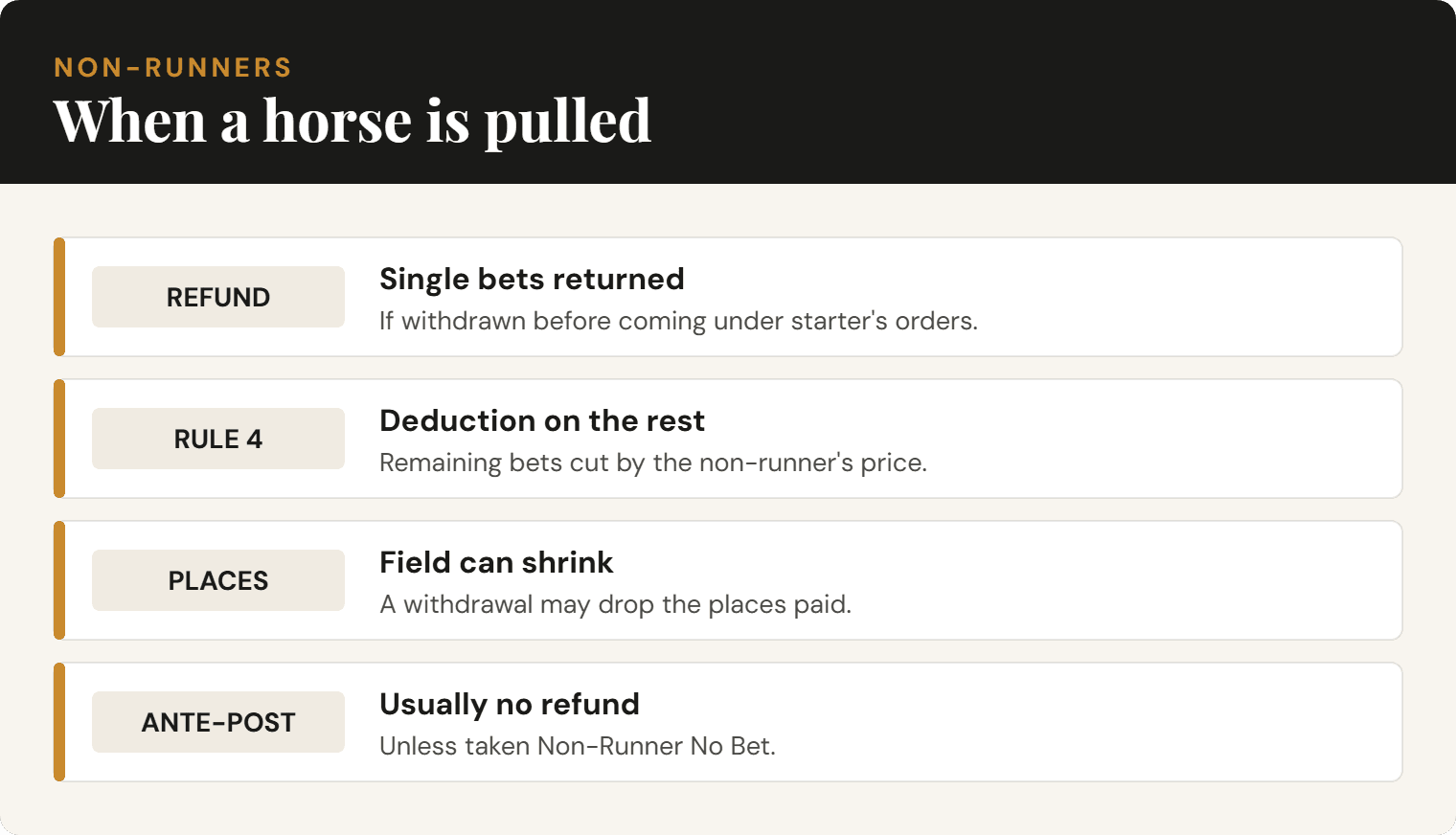
If you backed a horse and it becomes a non-runner, your stake is returned in full on a straight win single. You get your money back and the selection is treated as if the bet never ran.
There is one condition, and it matters. The refund holds only as long as the horse is withdrawn before it comes under starter’s orders. A horse that comes under orders and then fails to race — plants itself in the stalls, whips round, or refuses to break with the field — counts as a runner. That bet loses, and the stake is not returned. So “withdrawn” and “came under orders but didn’t race” are two very different outcomes for your slip, even though the horse covered no ground in either case.
That same line matters for everyone else in the race. If you backed a different horse and another runner is withdrawn, your bet stands — but your odds may be cut by a Rule 4 deduction. The bookmaker takes a slice out of your winnings, not your stake, scaled to the price of the horse that came out: the shorter the non-runner, the bigger the bite. It tops out at 90p in the pound — a cap only reached when the withdrawn horse was 1/9 or shorter — and tapers to nothing once the absentee drifts beyond about 14/1. Crucially, Rule 4 does not apply to ante-post bets. For the full scale and the worked sums, see Rule 4 deductions explained.
Timing decides everything
- Withdrawn before final declarations — 10am two days before raceday, Flat and jumps alike (BHA, June 2020, permanent from November 2022) — and the horse drops out cleanly, with no Rule 4.
- Withdrawn after declarations, at the overnight stage or on the day, and a Rule 4 deduction can apply to other bets in the race.
- Withdrawn after coming under starter’s orders, and the horse counts as a runner: your bet on it loses, and a very late Rule 4 can still hit the rest of the field.
Rule 4 in Practice
Numbers make this concrete. Say you back a horse at 5/1 and the 6/4 favourite is withdrawn after the market has formed. A 6/4 shot is short enough to trigger a sizeable deduction — around 40p in the pound off winnings. Stake £10, your horse wins, and instead of £50 profit you collect roughly £30 profit: the £40 of winnings is cut by about 40 per cent, the £10 stake comes back untouched. The shorter the non-runner, the harder this bites — at the extreme, a withdrawal at 1/9 or shorter strips 90p in the pound. Drift the other way and it fades fast: a non-runner bigger than around 14/1 attracts no deduction at all, because the market barely had it priced to win.
One nuance worth holding on to. Rule 4 generally applies to early-price and fixed-price bets, not to bets taken at SP, because the starting price already reflects the reformed market. The exception is a withdrawal so late that no fresh market can form — the rules put the line at an on-course market formed less than 90 minutes before the off — where an SP deduction can still be applied.
Types of Non-Runner
Withdrawals fall into a handful of buckets, and the bucket tells you both why the horse came out and how cleanly your bet is treated.
Cleanly refunded
- OvernightAn early or overnight withdrawal at the declaration stage — a trainer’s change of plan, or the ground coming up wrong. Removed before the off; stake returned in full.
- Self-certA self-certificate withdrawal: the trainer certifies the reason himself, without a vet’s certificate to back it. Allowed under BHA rules but limited in frequency, often a tactical call to wait for a better opportunity.
- Vet / lameA vet’s-certificate withdrawal — lame, injured or failing the pre-race inspection at the track. No penalty to the trainer, and the horse cannot run again for two days. Still a non-runner for betting purposes, so the stake comes back.
- GoingA going-related withdrawal: the trainer pulls the horse because the ground has turned unsuitable. The most informative type for your records — it confirms the horse’s surface preference.
Where it gets sharp
- Declared NRA horse listed as a declared non-runner before the off is simply void on your slip — money back, no questions.
- ReserveReserves are nominated at the declaration stage and called up after it, when a non-runner is notified by 1pm the day before; a bet on a reserve that never runs is void, and when a reserve replaces a declared runner, bets already struck on it settle at Starting Price (Tattersalls 4(E)).
- At the startA horse withdrawn at the start, after coming under starter’s orders, is the trap. It counts as a runner: your bet on it loses, and a late Rule 4 can dock the rest of the race.
- Under ordersThe dividing line is the starter’s orders, not whether the horse galloped. A horse the starter cannot load is withdrawn — stake back, Rule 4 on the rest. Loaded, under orders and planting or whipping round: a runner, bet lost. And since May 2024 at the stalls (October 2025 for tape and flag starts) the stewards can declare a non-runner where a horse was denied a fair start through no fault of its own — blindfold left on, handler still holding, riderless at the off — voiding bets under Tattersalls 4(B).
How Non-Runners Affect the Race
A withdrawal changes the race. It shifts the pace scenario, the competitive landscape, and — critically — the each-way terms. That last one is where non-runners quietly cost punters money, and it is worth re-checking before the off, because the terms you were shown are not always the terms you will be paid on.
Formdial’s free Pace Analyser does the mechanical half of this: it scores a field’s recent run styles and maps the likely shape.
The each-way knock-on. Each-way place terms are set by the number of horses that come under starter’s orders, not by the declared field, and a non-runner can drag the race across a band line. The standard SP place scale runs like this: 2–4 runners is win-only; 5–7 runners pays 2 places at 1/4 the odds; 8 or more non-handicaps pay 3 places at 1/5; handicaps of 8–11 pay 3 places at 1/5 and handicaps of 12–15 pay 3 places at 1/4; and handicaps of 16-plus pay 4 places at 1/4. The maximum standard is four places — anything billed as five places is an enhanced bookmaker promotion, not a default outcome.
Now watch the threshold. An 8-runner non-handicap paying 3 places at 1/5 loses one to a withdrawal: at 7 runners it reforms to 2 places at 1/4, and the third place you thought you were backing has gone. A 16-runner handicap on 4 places at 1/4 slips to 15 runners and reverts to 3 places. The terms are not locked in when you strike the bet, either: under Tattersalls Rule 3 an each-way bet is settled on the places for the field that actually goes to post unless the firm clearly displays otherwise — an advertised guaranteed-terms or extra-place offer is a concession to check for, not a default protection. So a bet struck at the old price loses the vanished place and takes the Rule 4 deduction on top, while a bet struck after the reform gets the true terms at a shorter price — the value has already gone. If you are weighing an each-way play near a band line, it is worth knowing exactly how field size sets each-way places before you commit.
The pace picture. If the likely front-runner comes out, the expected shape of the race changes. A contest set up to be strongly run can become a tactical crawl, which helps hold-up horses and hurts closers who need a fast pace to run at. Re-read the race whenever a pace-setter is withdrawn.
The favourite comes out. The market recalculates: the second favourite shortens and the whole field is repriced. If you took 10/1 and the jolly is then withdrawn, your horse might be 7/1 in the new market — but you keep the 10/1 you struck. This is one of the rare cases where a non-runner works squarely in your favour, Rule 4 aside.
Non-Runners in Forecasts, Tricasts and Accumulators
Multi-selection bets are not simply voided when a leg comes out — more often they are re-settled, and it pays to know how.
Accumulators and multiples. A non-runner leg is taken out at odds of 1.00 (which returns the stake and nothing more), and the bet recomputes on the surviving legs. A four-fold with one non-runner becomes a treble on the other three; your stake rides on, it does not come back. The bet calculator does this for you — void the leg and it re-settles the remaining returns automatically, Rule 4 included.
Forecasts and tricasts. Treatment depends on how many of your picks survive. Lose one leg of a forecast and many firms stand it as a win single on the remaining selection rather than voiding it; lose one leg of a tricast and it can stand as a straight forecast on the other two. But the minimums count actual runners: a forecast needs 3, and a tricast is only offered in handicaps of 8 or more declared runners — if withdrawals cut the race to five or fewer actual runners, the tricast is re-settled as a straight forecast on your first two selections rather than refunded. So “forecast with a non-runner” is rarely a clean refund; it is usually a re-settlement, and the rule varies by bookmaker.
Ante-Post Bets and Non-Runners
Place an ante-post bet — struck days or weeks out — and if your horse becomes a non-runner you normally lose the stake. That is the trade-off for the bigger price: ante-post odds are generous precisely because they carry the risk of the horse never making the line, with no refund. The compensating edge is that Rule 4 never applies to ante-post, so a big price you took early is safe from deductions if other horses come out.
Some firms offer non-runner no bet (NRNB) on selected ante-post markets — your stake is returned if the horse is withdrawn — but it is a concession, not a right. The protection is paid for in the price: an NRNB quote is shorter than the all-bets-stand odds on the same horse, and most firms only switch it on a few weeks out. You will see it most around the big spring targets, the Cheltenham Festival and the Grand National. For the full picture, see ante-post betting explained.
Common Questions
Yes, on day-of-race markets a win single on a non-runner is refunded in full, provided the horse was withdrawn before coming under starter’s orders. A horse withdrawn after coming under orders counts as a runner and the bet loses.
Rule 4 cuts your winnings — not your stake — when another horse in your race is withdrawn after the market formed. The shorter the non-runner’s price the bigger the cut, up to 90p in the pound; nothing is deducted once the withdrawn horse is bigger than about 14/1, and it never applies to ante-post bets.
It can. If a withdrawal cuts the field across a band line, the places on offer shrink — three places at 1/5 (8-plus runners) drops to two at 1/4 (5-7 runners), and to win-only at four or fewer. Under Tattersalls Rule 3 the bet is settled on the actual starters unless the firm clearly advertises otherwise, so a bet struck before the withdrawal shrinks with the field.
You normally lose the stake — that is the trade-off for the bigger ante-post price. The exception is a non-runner no bet market, where the stake is returned, but those odds are shorter to pay for the protection.
An accumulator leg that becomes a non-runner is taken out and the bet recomputed on the surviving legs — a four-fold becomes a treble. For forecasts and tricasts, losing one selection often re-settles the bet (a forecast can stand as a win single); enough non-runners, or a field below the minimum, voids it and refunds the stake.
Usually not: once under starter’s orders, a horse that plants in the stalls or whips round still counts as a runner and the bet loses. Two exceptions — a horse the starter cannot load is withdrawn with the stake returned, and since 2024/25 the stewards can declare a non-runner where a horse was denied a fair start through no fault of its own, voiding bets.
Settle a multiple with a non-runner
The bet calculator re-settles multiples when a leg is voided — drop the leg and it recomputes the remaining returns, deductions and all.