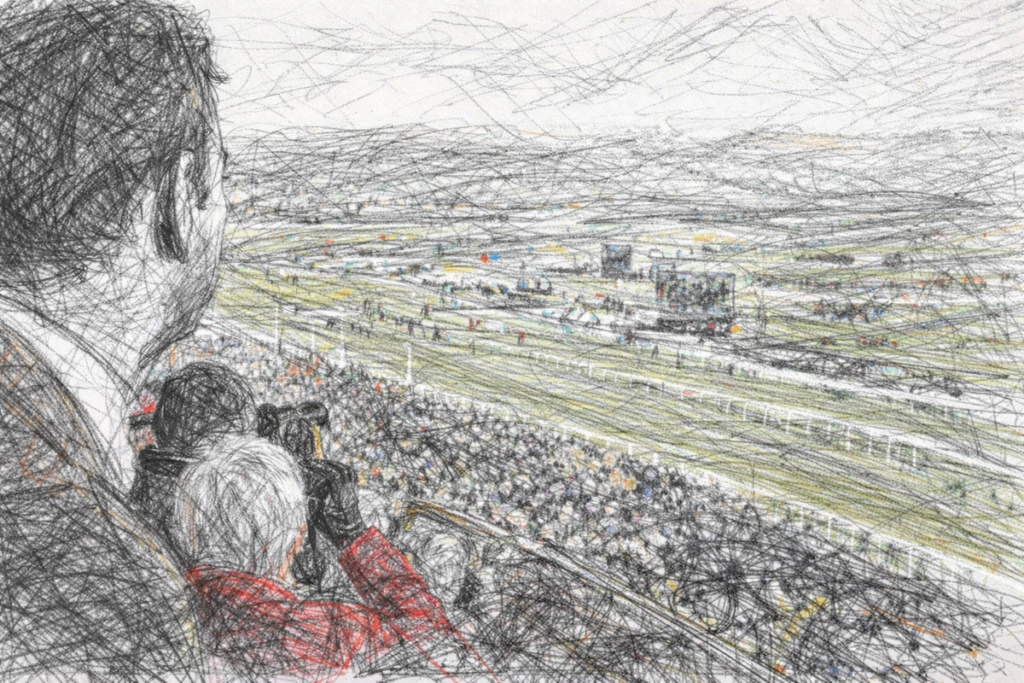
A horse finishes sixth of twelve, beaten eight lengths, at 33/1. The form book records the result. The Racing Post assigns a rating. The vast majority of punters glance at the line, dismiss the horse, and move on. What they never do — what almost nobody does — is watch the race.
I know this horse finished sixth because I tipped it two runs later at 14/1 and it won going away. I did not find that horse in the form figures. I found it in the replay of a race I had no financial interest in, by watching an animal who caught my eye for ten seconds of a two-minute contest. Those ten seconds were worth more than every number on the race card combined.
That is what trip notes do. They give you information the market has not priced in, because the market looks at results and you looked at the race.
A note is only worth what you do with it. Samson’s Reach was flagged on debut for the way he finished, backed on his second run, and then missed on the day he won at 100/1.
OR 72 | 33/1 SP
RPR 64 | TS 58
Draw 11. Held up rear. Never competitive. Jockey report: no explanation offered.
Two descriptions of the same run. One says nothing happened. The other says everything happened — and nobody noticed. The entire gap between those two readings is the edge.
Everybody Watches the Winner
The natural instinct when watching a race is to follow the leaders. The eye tracks the front of the field because that is where the action is — the battle, the finish, the winning moment. Television directors know this. The camera pans with the principals. The commentary narrates the fight for first. And by the time the post-race analysis begins, the only horse anyone discusses is the one that crossed the line in front.
This is a mistake so fundamental it might as well be tattooed on the back of every losing betting slip in Britain: you will never learn anything useful by watching the winner. The winner’s trip is already priced into the market. It won. Everyone saw it. The Timeform squiggle recorded it. The bookmakers shortened it for next time. There is nothing left to exploit.
The edge lives in the horses that finished fourth, fifth, eighth — the ones the camera barely finds, the commentary never mentions, and the result line writes off. Those are the horses whose next price will be wrong, because nobody bothered to study what actually happened to them.
That is the discipline. You are not watching a race to enjoy it. You are watching a race to find the next bet.
The Four Things That Matter
Trip handicapping sounds complicated. It is not. There are four observations you need to make about any horse you are studying in a replay, and if you nail all four, you will have better information than 95% of the betting market. The four are: the run, the trip, the finish, and the intent.
1. The Run
Where was the horse positioned, and was that position by design or by accident? A horse held up last off a slow pace is not the same as a horse held up last because it was outpaced from the gate. The first was a tactical choice — the jockey wanted to deliver the horse late. The second was a distress signal — the horse could not lay up.
Watch for the first two furlongs. A horse that jumps well and settles into a rhythm — even at the rear — is being placed there. A horse that is scrubbed along from the start and still cannot hold its position is being carried along by the pace and is almost certainly in trouble from the off.
The distinction matters because a horse that was held up by design in a race run at the wrong tempo has an excuse built into the trip. A horse that was outpaced from flag-fall does not.
That is a horse whose finishing position is a lie. The form book says “never dangerous.” The trip note says “would have been closer with any sort of run.” When it reappears next time at a similar price, you already know something the number does not tell you.
2. The Trip
This is the one most people think of when they hear “trip notes,” and it is the most mechanically straightforward. How much ground did the horse cover compared to the winner?
There are only a handful of questions. Was it raced wide with no cover? Was it shuffled back through no fault of its own? Did it get hampered or checked? Was it switched across the field and lose lengths in the process? Was there any traffic trouble that cost the horse a clear run at a critical stage?
Each of these costs ground, and ground is time, and time is lengths. A horse that races three-wide with no cover around a bend at Wolverhampton or Kempton loses two to three lengths in the process. That is the difference between sixth and second in most races at those tracks. The form line records the sixth. The trip note records the two or three lengths that were burned before the race even started in earnest.
You do not need a GPS tracker to see this. You just need to watch the replay from the head-on camera and count how many horses were between your subject and the rail. If the answer is three or four for most of the race, you are looking at a performance the bare result undervalues.
3. The Finish
This is where most punters get lazy. A horse gets beaten and they move on. But how it got beaten is the entire story.
A horse that hits a wall at two furlongs out — travelling smoothly and then suddenly emptying — is telling you something completely different to a horse that keeps plugging on but is outstayed in the final furlong. The first horse probably did not stay the trip, or the ground did not suit, or it is simply not good enough at that level. The second horse almost certainly wants a shorter distance, or a faster pace to aim at, or both. The two are opposite problems with opposite solutions, and the form line treats them identically.
Watch the closing stages with two specific questions. Did the horse’s stride shorten or lengthen in the final furlong? And was the jockey pushing, or sitting? A horse whose stride is lengthening while the jockey sits is a horse with more in the tank. A horse whose stride is shortening while the jockey is driving is a horse at its limit. The first is the notebook horse. The second is not.
That is a future winner at a longer distance, and the form book does not tell you that. Only the finish does.
4. The Intent
This is the one nobody talks about, and in many ways it is the most valuable of the four. Was the jockey riding the horse to win this race, or to learn something for next time?
There is a vast difference between a jockey who picks up the whip at two out and drives for the line, and a jockey who sits with hands and heels and lets the horse find its own way to the finish. The first is trying to win. The second is educating the horse — giving it a racecourse experience, letting it learn to settle, seeing how it handles the kickback, testing whether it stays. The trainer has sent this horse out to gain experience, not to win a race, and the jockey booking often confirms it.
Watch for the conditional jockeys on well-bred horses from powerful yards. If a Flat trainer books a 5lb claimer on a first- or second-time-out horse and the horse finishes mid-division without being knocked about, that is almost certainly an educational run. The horse is being prepared for a specific future target, and today was a stepping stone. When it reappears with a senior jockey booked, at a different distance, or on a different surface, the market may not connect the dots — but your trip note already has.
This applies equally over jumps. A horse given a quiet ride over fences for the first time, jumping carefully but never asked to quicken, is not a beaten horse — it is a horse being minded for later in the season. The result says beaten twelve lengths. The trip note says the trainer protected the horse and the jockey never moved a muscle. Those are completely different pieces of information.
When to Watch and What to Record
You do not need to watch every replay of every race in Britain. That would take six hours a day and you would drown in information. The trick is to be selective and to know what you are looking for before you press play.
The races worth watching are the ones where the result looks wrong. If a well-bred horse from a top yard finishes in the rear at a short price, watch it — the trip may explain everything. If a horse runs a massively improved race out of nowhere, watch the previous run — you may find the excuse that set up the improvement. If a horse you had in your notebook disappoints, watch it — either the trip went wrong or your assessment was wrong, and you need to know which.
Record what you see in a single line. You do not need an essay. A good trip note is one sentence that tells you, in three months’ time, exactly why this horse is worth backing at its next start. If you cannot say it in one sentence, you are overcomplicating it.
Trip Note Template
- Where was it positioned early? Front, midfield, rear?
- Was that position by design or forced on it?
- Did the pace suit? Too fast, too slow, uneven?
- How wide did it race? Any cover, or exposed?
- Any checks, bumps, or traffic trouble?
- How much extra ground did the trip cost in lengths?
- Did the stride shorten or lengthen in the final furlong?
- Did it hit a wall, get outstayed, or keep on?
- Was the run better or worse than the finishing position suggests?
- Was the jockey riding to win or to educate?
- Pushed out or hands and heels?
- Does the jockey booking suggest this was a prep run?
The Race Result Is an Opinion. The Race Itself Is Evidence.
Every number in the form book is someone else’s summary of what happened. The official finishing position, the Racing Post rating, the Timeform figure — these are interpretations. They are not wrong, exactly, but they are incomplete, and incomplete information is the source of every mispriced horse in every race in Britain.
The trip note is yours. It is not mediated through a ratings system or filtered by an algorithm or diluted by a headline. It is what you saw with your own eyes, written in your own words, and it captures the thing no number ever can: context. The horse that was hampered at a crucial stage. The horse that was never asked the question. The horse that closed from last under a motionless jockey. No rating captures these things. Only your notebook does.
And this is the point — the gap between the public record and the private observation is where value lives. The bookmaker prices the form. You are pricing the race. Put a number on what your eye saw and the closing read becomes a sectional time — the quick-reference data behind the deep watch this piece is about. When those two prices disagree, you have a bet.
Go back to the horse I opened with. Sixth of twelve, beaten eight lengths, 33/1. The form said nothing horse. The trip note said future winner. Two runs later, at 14/1, it bolted up. The market had not changed its mind because it never saw what I saw. The result looked ordinary. The race was anything but.
That is what a trip note is. It is the edge hiding in plain sight, available to anyone prepared to press play and actually watch.
The natural companion to this one is Distance: The Variable That Overrides Everything, which covers the other meaning of the word “trip” — the literal race distance, the stamina ceiling, the way a horse’s engine is matched to furlongs. Trip notes are the craft of watching; distance is the framework that tells you what you are watching for.
Be Lucky!

Common questions
A one-line, eyes-on record of how a horse actually ran — its early position, the ground it lost, how it finished and whether the jockey was riding to win — capturing the context the form figures and ratings leave out.
The run (was its position chosen or forced), the trip (how much extra ground it covered), the finish (did its stride shorten or lengthen, was the jockey pushing or sitting) and the intent (was the jockey riding to win or to educate the horse).
The winner's run is already in the market — everyone saw it and the price has shortened. The horses that finished fourth, fifth or eighth, whose trip went wrong, are the ones whose next price will be wrong, because almost nobody studies what happened to them.
Watch the first two furlongs. A horse that jumps well and settles at the rear is being placed there by design; a horse scrubbed along from the gate that still cannot hold its position is in trouble. Only the second has no excuse built into its trip.
Roughly two to three lengths for a horse three-wide with no cover around a bend at a tight track such as Wolverhampton or Kempton — often the difference between sixth and second, and a deficit the bare result hides.
The trip note is the manual, eyes-on front end; sectional times, stride data and speed figures are the numbers that measure the same thing. Watching tells you a horse's stride lengthened under no pressure; the data confirms by how much.
Bet logs, spreadsheets and course cheatsheets — built the same honest way as the tips.
Visit the Shop →Why are some bets win-only and others each-way?
Three things decide it: confidence, race shape, and the betting market.
If I think a horse has an outstanding win chance, I'll back it win-only to maximise the return — even at a bigger price, where each-way would normally be the safer call. If the win case is more speculative but the place case is strong, each-way carries the bet.
Concrete example: Almanack at Kempton, 2 July 2014. Advised at 22/1 win-only in the morning. The price shortened to 16/1 SP and he won by a short head on the line. Win-only on a confident shout at a generous price is where the real returns come from — when the case is right, you back it to win, not to hedge.
What happens if my horse is a non-runner?
If a horse is declared a non-runner before the race, your stake is returned in full on win or each-way singles.
If it's part of a multiple (accumulator, lucky-15, etc), the bet runs on without that leg and the remaining legs are recalculated. For ante-post bets the rules differ — usually no refund unless the bookmaker is offering NRNB ("Non-Runner No Bet") on the race. Full breakdown here.
Why no advised bet some days?
Because there isn't one. The cards don't always offer value, and the worst thing a tipster can do is force a selection just to fill a slot.
A "No Bet" day is the system working — it's the same discipline that produces the winners on the days the bets are right. Better to sit out a card cleanly than to bleed the bank on filler. The best days are usually the ones I've been patient before.
What do the stake points mean?
Stakes are sized in points, not pounds — that way the same plan works on any size of bankroll.
The Daily Dial uses a simple scale: 1pt is the minimum bet (or 0.5pt each-way), 2pt is a standard bet (or 1pt each-way), and 5pt is the maximum on the strongest fancies (or 2.5pt each-way). The whole thing runs off a 100pt bankroll, so a £100 bank means a point is £1 and a 2pt bet is £2; a £1,000 bank means a point is £10 and a 2pt bet is £20. Scale to whatever feels comfortable.
New to this? Read up on: Win-Only Betting · Handicap Races · Ante-Post Betting
Get tomorrow's pick before the off
Every selection posted before the race — the angle, the reasoning, the price. Free, no fluff.