Odds look simple. They are not. Once you understand what is actually happening behind that neat price, you start seeing betting for what it really is: not you versus the horse, not even you versus the bookmaker, but you versus a market that has been deliberately built to lean against you from the first second it opens.
Most punters are not wrong about horses. They are wrong about prices. That is why they lose. The difference between “I fancy this” and “this price is wrong” is the difference between gambling and betting. This piece covers the mechanics that separate the two.
How a Bookmaker Sees a Race
Most punters look at a race and think: who is the best horse, who is improving, who is well handicapped, who has the right jockey. The bookmaker is not solving that puzzle in the same way. A bookmaker looks at the same race and thinks: how do I price this so every likely outcome is paid for by the rest of the book, with a margin built in before a penny is laid.
The bookmaker’s product is not the odds. It is the overround. Everything else is packaging.The single most important thing to understand about betting markets
The Overround: The Edge That Is Already Against You
In a fair market, the implied probabilities of every runner would add up to exactly 100%. That would mean the prices reflect reality with no margin. It does not exist. Bookmakers price every race so the implied probabilities exceed 100%. That excess is the overround — the built-in house edge. It is why the game is hard even before you start making mistakes.
Here is what it looks like in practice:
Fair Book (100%)
Horse A 2/1 (33.3%)
Horse B 3/1 (25.0%)
Horse C 5/1 (16.7%)
Horse D 3/1 (25.0%)
Total 100%
Bookmaker Book (117%)
Horse A 6/4 (40.0%)
Horse B 5/2 (28.6%)
Horse C 4/1 (20.0%)
Horse D 5/2 (28.6%)
Total 117%
The horses are the same. The race is the same. But in the bookmaker’s book, every price is shorter than it should be. That 17% excess is the tax you pay for placing a bet. A quiet midweek race might be priced to 108%. A big televised handicap can hit 130% or higher. The point is not the exact number. The point is that you are paying a margin on every bet, and most punters do not even realise it exists.
They see 6/1 and think it is a nice price. The question is whether it is a fair price. Those are not the same thing.
Why Big Races Are Often the Worst Value
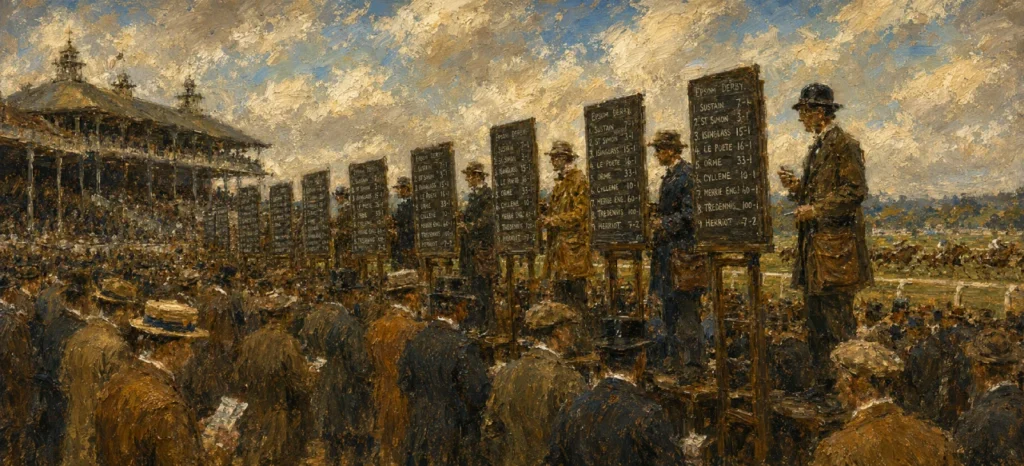
Most punters think the biggest races are the best opportunities because they feel important. The build-up, the previews, the coverage, the mates texting. It feels like you are meant to bet. And that is exactly why those races are often the worst value of the year.
Bookmakers do not need to entice you in. The money is coming anyway. The Grand National is the obvious example — forty runners, casual money, each-way punters, random name-pickers, people who have not had a bet since last year. Bookmakers can push the margin harder because demand is baked in. Punters are not shopping for value. They are buying involvement.
The assumption
Big race = big opportunity
The market is at its most expensive. The margin is widest. The prices are least fair. The room for error is smallest.
The reality
Quiet race = better market
Less automatic money means tighter margins. The bookmaker has to offer something competitive to attract interest. The tax is lower.
The practical edge: If you are serious about long-term profit, you stop thinking “big race equals big opportunity” and start thinking “what is this market costing me to be in?” The midweek card at Wolverhampton where the overround is 108% gives you more room to be right than the Grand National at 135%.
Early Markets and the Myth of Being Sharp
Punters love being early. Taking 8/1 when it goes off at 4/1 gets spoken about like proof of ability. Sometimes it is. Most of the time it is not. Beating SP is not the same as beating the market. And being early for the wrong reasons is just being wrong sooner.
Early markets are thin. They move easily. They are shaped by the first bits of money, and that early money is often emotional, noisy, and driven by things that have nothing to do with true probability. A big-name jockey gets booked and the price collapses. A well-known stable sends one and the market assumes intent. A tipster posts a selection and followers pile in, and the move itself becomes the reason more people pile in.
People mistake movement for information. Sometimes it is information. Often it is just the crowd copying itself. If your reason for being early is the same as everyone else’s reason, you are not early. You are just first in line for a bad price.The early market trap
What an Edge Actually Is
An edge is not a secret stat or a hidden angle. It is a specific, quantifiable situation: your assessment of a horse’s chance is more accurate than the probability implied by the price, after the bookmaker’s margin is already baked in.
Value in Practice
Your assessment of the horse’s chance 20%
The price offered 8/1
Implied probability at 8/1 11.1%
Your edge +8.9%
The horse is nearly twice as likely to win as the price suggests. That is value — regardless of whether this particular bet wins or loses.
Value is not “this wins.” Value is “this is bigger than it should be.” You will lose plenty of value bets. That is normal. Over a sufficient sample, backing selections where your assessed probability exceeds the implied probability produces profit — provided the assessment is genuine and not just optimism dressed as analysis.
Most punters never convert opinion into probability. They never ask whether the price is wrong. They just ask whether they fancy it. You can fancy horses forever and still lose.
When a Short Favourite Distorts Everything
In races with a very short favourite, the rest of the market often looks bigger than usual. Punters assume that means the outsiders are value. Not necessarily.
A short favourite takes a huge chunk of the market. If the favourite shortens from 6/4 to 5/4, the bookmaker reshapes the rest of the book to maintain the margin. The 10/1 shots drift to 14/1. It looks like opportunity. But the outsider has not suddenly become more likely to win. The market is reshaping to keep the overround intact.
The discipline: Understanding that a price moved does not mean a probability changed. Most market moves are mechanical — the book rebalancing itself. The question is always whether the price reflects the true chance, not whether it moved.
The Framework
Every bookmaker market is priced above 100%. The bigger and more hyped the race, the more expensive it usually becomes. Early markets are shaped by thin liquidity and emotional money. Short-priced favourites distort everything around them. Price movement is not proof of intelligence.
Without an edge, you are feeding a system designed to outlast you. With one — properly defined, applied in the right markets, and used with the staking discipline described in the Five Principles — you give yourself a realistic chance of beating it. The Betting Guide covers odds mechanics and probability in full. The racecourse guides quantify the structural edges at individual venues. This piece is the foundation they sit on: understand what the market is doing to your money before you decide where to put it.
See Value Hunting in Practice
Every Daily Dial selection identifies the price logic — why the odds are wrong, not just which horse is fancied.