Longshot Scott
Fifteen years reading form — the story behind FormDial and the Daily Dial.

I started posting my racing thoughts on Twitter around 2009, more as a record for myself than anything else. It built a following almost by accident, and within a few years I had a fair army of readers.
A study that rather took off
In September 2013 I was invited onto TwitTopTipsters — the brainchild of Niall O’Connor, who’d built it as a social-media study for his university degree, to see how much traction a tipping site could get with no paid advertising at all. Five tipsters, each putting up a NAP, a Next Best and an “In With a Chance” every day, all recorded and run as a monthly league. The answer to his experiment turned out to be: a lot. It reached close to a million unique visitors in about thirteen months.
The following summer, on 2nd July 2014, I landed a 5355/1 treble — Almanack at 20/1 and Tenor at 14/1 at Kempton on the all-weather, and Euroquip Boy at 16/1 at Chepstow. Three from three. I was at Kempton that night, and Tenor brought it home in the Lucky Last. The site rather exploded, and Twitter never quite felt the same again. I have been trying to repeat it ever since; I suspect it was once-in-a-lifetime stuff.
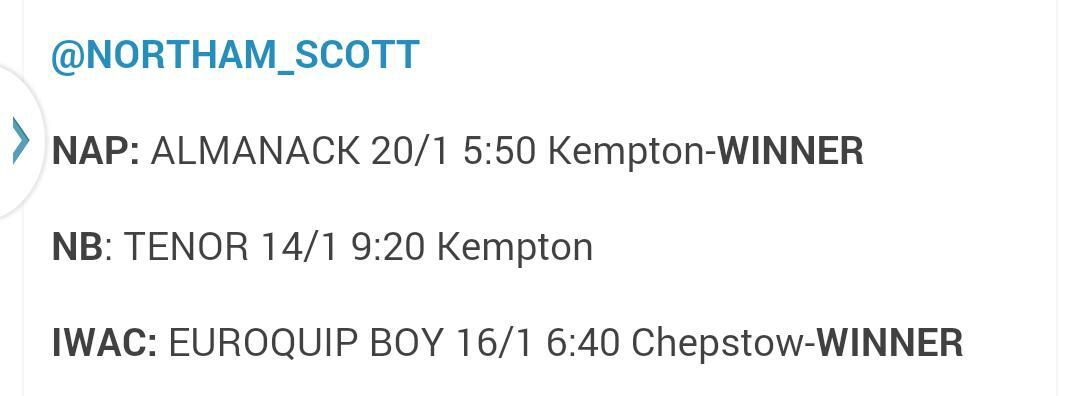
When Niall wrapped up his study, I took the site on — I had filled in whenever he was away, and running it rather tickled me. It was my first go at hosting a website. The change I liked best was a short piece I started writing before the day’s tips — The Bettors’ Brief — looking back at the previous day’s racing, going through any beaten tips with honest logic, and giving a bit of insight into the day’s selections and who they were up against. Until then the site had just been a list: the date, five tipsters, three picks each, prices and times.
Within a year it was past 15,000 followers across platforms, which put it among the bigger racing accounts on Twitter at the time. It eventually grew too big to keep running for free around a full-time job and a young family, and I met the choice every free tipster meets in the end: monetise it or fold it. Too proud to put #FreeTips behind a paywall, I folded it and walked away — not, I’ll admit, my finest decision.
A blog that wouldn’t stay casual
So I set up my own independent blog under the name Longshot Scott — promising nothing daily, no schedule, just whatever I could manage, when I could manage it. A good chunk of the old army came across. The interest was too big for the casual thing I had intended, so one night I put out a subscription offer: if enough people were in, I would give it a proper go. I woke up to 130 subscribers, and I was away.
It grew into a bit of everything racing — not just tips, but features and interviews from every corner of the sport: jockeys, trainers, data providers, presenters, even stable lads. I wanted readers to understand the game as broadly as possible. The subscriber list turned into an odd mix — footballers, a few well-known owners, a couple of signed musicians, and a great many everyday punters — and what they had in common was taking the way I broke a race down and building their own approach out of it. One reader who barely knew the sport when he started is now a serious owner, with horses of his own.
The years that came first
Then life intervened. From around 2018 I had to wind it down, and eventually stop altogether, to care for my father. He was battling alcoholism, and through some very hard years I became, in effect, his full-time carer — everything that wasn’t essential fell away, racing included. I lost him to it at the end of 2024.
For a good while afterwards I wasn’t much use to anyone. When I started to come back to myself, I knew I needed racing again — the studying, the replays, digging through a card for the one they’ve all overlooked.
The way back
In the summer of 2025 I started watching again, no betting, just getting my head back in. It was humbling: I had once been able to reel off strings of horses for half the yards in the country, and now there were trainers and jockeys I had never heard of. I had ground to make up — and I wanted to.
What I had missed most was the writing — the discipline of putting it down and showing the working. So, without a word to anyone who used to follow me, I launched FormDial.
Everything those years taught me is in one place now: a reasoned Daily Dial selection before every off, every result logged in public and searchable bet by bet, a staking plan holding it all together, a guide to the courses themselves, and the thinking shown throughout — because that was always the part that mattered.
None of this is about plaudits, or being called the best tipster going — there are louder voices chasing that, and it has never been my aim. Mine is simpler: to give anyone who fancies a bet a read they can genuinely trust — honest about the losers as much as the winners, and made to be enjoyed first, because racing should be entertainment before it is anything else. Beneath the enjoyment sits the part that matters most: a real insight into how a race is studied, how a bet is judged on its merits, and how the emotions are handled when it all plays out. Those are the things worth carrying away, and I hope they help you forge a study, and a betting future, of your own.
How a selection actually gets made
Most days start the same way: a scratch through the cards looking for a short-priced favourite I don’t believe in. Something very short that’s 0 from 15, or one with a history of caving in once the race turns into a fight to the line. A horse trading a good deal shorter than it ought to be has to be paid for by everything else in the race, and that’s where the juice is — in the prices of the ones it’s beating on paper.
That’s what makes me stop at a race at all: an evens or odds-on shot I think gets beaten. Everything else is a scan for flags, and I have a lot of them, but a vulnerable favourite is what earns a race proper work.
Once I’m into one, three things do most of the heavy lifting — the trainer’s record at that course, the jockey’s record round there, and the sire’s record at the track. Courses suit some yards and some pedigrees and not others, and the numbers on that are unsentimental. It’s why the racecourse guides here carry those tables: they’re the ones I’m actually reading.
The quickest way off my list is the same stat pointing the other way. If a sire is under about 5% at the track, I’ll leave the horse alone however well the rest of it reads.
The other half of it never shows up in a database. I watch a lot of replays — often three or more times through a race — with a few sheets of A4 and a pencil, scribbling away without taking my eyes off the screen, which means a fair part of the job is later working out what on earth I’ve written. The ones worth remembering go into my At The Races tracker, and they go in with the reason attached: unlucky in running, beaten by the pace, conceding first run and staying on past horses that had every chance. A name on its own is no use to anyone three months later.
Beyond that first look at the favourites, I try to ignore the market entirely. I’d rather work a race without knowing what’s on offer, put my own rough price on the runners, and only then see what the bookmakers make of them. If I’ve got one at 3/1 and they’re 5/1, that’s worth having. If I’ve got one at 3/1 and they’re 5/2, it isn’t — however much I like the horse.
I work every race that interests me, build a list, then whittle it down to what I’m going to war with. Most of what I look at doesn’t survive that — and some days nothing does.
That’s usually the calendar’s doing. It has settled into a bad habit: largely uncompetitive racing on Sundays and Mondays, something fairer midweek, then chaos on Friday and Saturday. The fair midweek stuff is what I’m aiming at. You’ll rarely catch me playing in the ultra-competitive weekend handicaps unless a genuinely capable Group horse has dropped into one, and even that often isn’t enough now. When the racing doesn’t offer a bet worth making, I say so and sit it out.
See the method at work
Fifteen years of reading form, applied to one reasoned selection a day — posted before the off, logged win or lose.
Or have it land in your inbox before racing each day.