The full post will go up mid-morning, but the four selections are up bright and early after a lengthy night of study. Thursday’s Aintree card did little to whet the appetite for a bet, but Friday’s card is a different animal — realistically, I could have played every race. Three from Aintree and one from Wolverhampton, who gets NAP treatment.
I was very keen on playing No Drama This End in the Sefton Novices’ Hurdle (16:40), but with Paul Nicholls’ form at the top end falling flat, I couldn’t take 7/2 about him against some sturdy sorts. They have rattled in winners everywhere else, but drew a blank at Cheltenham and none went particularly close at Aintree yesterday. He is probably their most likely winner of the Grand National Meeting, and it hasn’t put me off playing another of his at a far bigger price, but there wasn’t enough juice to overcome my reservations about the yard’s festival form — or lack of it.
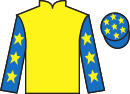
Didn’t always jump with fluency, towards rear, some headway on outer after 4 out, weakening when hit last
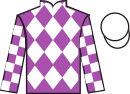
In touch with leaders, prominent when not fluent 10th (Bechers), slightly hampered 3 out, soon weakened

Held up in rear, some headway into midfield 3 out, kept on run-in
Raced in last, headway from over 1f out, nearest finish
The first bet of the day is Hot Fuss for Tom Dascombe and David Bass, who isn’t the biggest of horses but goes with some heart. He has continued to surprise his connections with what he has achieved, forcing them to rip up their plans in a bid for Cheltenham and Aintree success — and it looks by no means beyond him. The step forward came in December, when he ran a massive race at 33/1 behind eventual County Hurdle winner Wilful at Ascot, and he confirmed it when comfortably seeing off the same horse in a valuable Class 2 at Windsor in mid-January, albeit with a stone in hand. Up 5lbs for the privilege and original plans abandoned, they sent him to Cheltenham for the Martin Pipe, where he outran 25/1 to finish an impressive 2nd of 24 behind Air Of Entitlement. That was a supremely good run despite a messy finish, with some hideously well-handicapped sorts in behind — including Saint Lucie from Willie Mullins’ battalion, who has since come out and won a 19-runner handicap at Cork. With Hot Fuss up just 2lbs for the Cheltenham runner-up run, he remains well treated and with David Bass back aboard, I fancy him to run a huge one.
In the Topham we go with Paul Nicholls-trained Viroflay, who can hopefully put a bit of gloss on the yard’s form at festivals this year after a very quiet spell. The Topham tends to spring a surprise, with winners tending to be on an upward curve and positively ridden — two boxes this lightly-raced nine-year-old ticks comfortably. He is a front-runner and a slick jumper, which is exactly the combination you want over these fences; get into a rhythm out in front, ping the big obstacles, and make the others come and get you. This is a race that has long been a target too, since running 2nd to Barton Snow in a Hunter Chase at Stratford this time last year when rated just 118. Obviously very competitive, but this race is usually more about who handles it best, and Aintree should really see him to best effect. Many bookmakers are paying 6 places here, so pay attention where you bet.
Then goes The Mighty Celt, who looks an outstanding bet in the finale at Aintree, having been one of the eyecatchers of the festival at Cheltenham last month. He was very fresh there, overracing early doors and then hit a wall of trouble in-running. Both factors would have given him every right to fall out the back of the telly, but he plugged on to finish a very respectable 9½ lengths 6th of 22. He was dropped 3lbs for his run prior to Cheltenham, which was his first run in a handicap and appeared generous in itself, so I was even more surprised they kept him on the same mark following Cheltenham. Skelton is becoming a master of slipping one through the handicapper’s net, and I’m convinced they have one with pounds in hand here.
Lastly is one on the All-Weather, where I rate Whenthedealisdone as one of the bets of the day, despite drifting like a barge this morning (currently out to 8/1 at the time of writing). Never one to let a drift put me off, I’m going back in instead. I marked him down as still having room off his mark when running 3½ lengths 6th of 10 at Lingfield in December. Nothing got into the race from off the pace, with the front five all being those who went forward, but this one charged from dead last to close the gap to a respectable distance despite everything being against him. The handicapper again somehow saw logic in dropping him a pound for that run, a move I would love to hear the argument for, and he very nearly made it pay last time out when beaten a neck at Chelmsford. He now goes back to Wolverhampton, a track he is 2/2 at with both wins coming under George Wood, who takes over again today for the first time since those victories. He gets a rare NAP treatment.
Best of luck with your punting today,

Bet logs, spreadsheets and course cheatsheets — built the same honest way as the tips.
Visit the Shop →What does "each-way" mean?
An each-way bet is two bets in one — a Win bet and a Place bet, each for the same stake. So 1pt each-way means 1pt to win plus 1pt to place: 2pt total out of the bank.
The Place part pays out at a fraction of the win odds (usually 1/4 or 1/5) if the horse finishes in the places — typically the first 3 or 4 depending on the race. Each-way is the right call when the price is generous enough that the place return alone covers the stake. Full guide here.
How do I follow this bet?
Best route is Oddschecker. It pulls every UK bookmaker's price into one screen so you can grab the top of the market — and crucially it shows the place terms, which vary by firm. One bookmaker might offer 11/1 paying 3 places at 1/4 odds; another might offer the same 11/1 paying 4 places at 1/5. Maximum win return vs hedged each-way return — your call which serves the bet better.
If the price has shortened since I advised it, judge it on the case in the prose. Rule of thumb: I'm generally happy down to about two-thirds of the advised price — 14/1 down to 10/1, 8/1 down to 5/1. Below that it's marginal and probably worth passing. Keep an eye on the price in the last 20 minutes too — short prices often drift back out as the off approaches, especially on outsiders. Bet with bookmakers offering Best Odds Guaranteed and you're covered either way.
What if the price has shortened by the time I get to it?
Judge it bet by bet. The cleaner the case in the prose, the more decay I'll tolerate. Rule of thumb is about two-thirds of the advised price — 14/1 down to 10/1 is still in, 9/1 down to 6/1 still fine, anything below that is marginal.
Worth knowing: short prices often drift back out as the off approaches, especially on outsiders. Keep checking in the last 20 minutes — you may get back to the advised price or close to it. And always bet with bookmakers offering Best Odds Guaranteed so you're covered if the SP comes back bigger.
Why are some bets win-only and others each-way?
Three things decide it: confidence, race shape, and the betting market.
If I think a horse has an outstanding win chance, I'll back it win-only to maximise the return — even at a bigger price, where each-way would normally be the safer call. If the win case is more speculative but the place case is strong, each-way carries the bet.
Concrete example: Almanack at Kempton, 2 July 2014. Advised at 22/1 win-only in the morning. The price shortened to 16/1 SP and he won by a short head on the line. Win-only on a confident shout at a generous price is where the real returns come from — when the case is right, you back it to win, not to hedge.
New to this? Read up on: Win-Only Betting · Handicap Races · Best Odds Guaranteed

Be a founding member of a brand new UK syndicate.
“We don’t want to be on the perimeter, watching from the stands. We want to walk into the winners enclosure as owners and we want to bring a whole generation with us.”
- Shares from
- 1%
- Up front from
- £350
- Available now
- Two horses