Glorious Goodwood
Five days on the South Downs, three Group 1s, and the garden party King Edward VII said had racing tacked on — the ante-post market, the supplementary-entry drama that can blow it apart, reading a track built into the chalk, and where Goodwood form goes once the picnics are packed away.
No other British Flat festival is built into a hillside quite like this one. Goodwood sits on chalk downland above Chichester, and that geography shapes everything — the track’s odd gradients, the picnic-first culture, and a reputation for “easy elegance” that’s deliberately the opposite of Royal Ascot’s formality down the road.
The Five Days, Race by Race
The Qatar Goodwood Festival — universally known as Glorious Goodwood — runs Tuesday to Saturday every year in late July or early August. The 2026 renewal is confirmed for Tuesday 28 July to Saturday 1 August, with Ladies’ Day on Thursday 30 July. Each day carries 8 races, 40 across the week, including 13 Group races and 3 Group 1s. The day-of-week pattern is a fixed annual template.
Tuesday
Goodwood Cup DayThe Al Shaqab Goodwood Cup (Group 1, 2m) opens the week — a stamina test and the second leg of the informal Stayers’ Triple Crown. A cricket match between Lord March’s Racing XI and the Sussex Foundation XI follows in front of Goodwood House.
Wednesday
Sussex Stakes DayThe Visit Qatar Sussex Stakes (Group 1, 1m) — “the Duel on the Downs” — is the week’s showpiece mile, run for a £1 million prize fund, among the most valuable one-mile races anywhere in Europe.
Thursday
Ladies’ DayThe Qatar Nassau Stakes (Group 1, fillies & mares, 1m2f) headlines, alongside the Markel Magnolia Cup — a charity race for 12 female amateur riders that has raised over £3.5 million for the Education Above All Foundation.
Friday
King George DayThe meeting’s one day without a Group 1 — the Group 2 King George Qatar Stakes (5f sprint) is the feature, making it comparatively the “lightest” graded day of the week and, along with Tuesday, one of the calmer days to attend for a first-timer.
Saturday
Stewards’ Cup DayThe closing-day Coral Stewards’ Cup, a top-heavy 6f cavalry-charge handicap and the week’s marquee betting spectacle, run alongside the Group 2 Qatar Lillie Langtry Stakes.
2026 vs. the most recent completed renewal
Everything above describes the confirmed, upcoming 2026 dates. Where this guide cites results — Qirat’s 150/1 Sussex Stakes shock, Scandinavia’s Goodwood Cup win — those are from 2025 (run 29 July–2 August), the most recently completed Festival. Treat any of that as history, not a preview of what’s still to come.
Ante-Post: Sussex, Nassau and the Goodwood Cup
Goodwood’s three Group 1s each draw on a different trial picture, and getting the right one matters. For how ante-post betting works in general, see our Ante-Post Betting Explained guide.
The Sussex Stakes takes its form from Royal Ascot in mid-June — specifically the St James’s Palace Stakes and the Queen Anne Stakes, run five to six weeks earlier. The 2026 market is already shaping around a rematch: Bow Echo beat Aidan O’Brien’s Gstaad by a short head in the St James’s Palace, extending his unbeaten run to five, while the Queen Anne sprang a huge reminder not to over-trust that form — 59/1 shot Ten Bob Tony beat odds-on favourite Notable Speech, who “was never involved.” The Nassau Stakes (fillies and mares) draws on the Coronation Stakes and the Falmouth Stakes; 2026’s Coronation was won by odds-on Precise, who already holds Goodwood form via a juvenile win in the Group 3 Prestige Stakes there — exactly the “knows the track” angle ante-post bettors weight heavily. The Goodwood Cup, by contrast, draws on the Ascot Gold Cup specifically — not the King George or Coronation Cup, which is a common mix-up, since those feed middle-distance form rather than the pure two-mile stayers’ picture. The 2026 Gold Cup was a superb match, Scandinavia holding off Trawlerman by a head, and both are already entered for a Goodwood Cup rematch.
The supplementary-entry mechanic that blew up the 2025 Sussex Stakes
The Sussex Stakes has a graduated entry ladder: initial entry (around £4,500), confirmation (around £4,000), and a supplementary-entry route costing roughly £70,000 that stays open right up to declarations. In 2025, that supplementary door let stablemates Qirat and Docklands into the race late, with Qirat nominally there as a pacemaker — only for Qirat himself to lead throughout and hold on at 150/1, the biggest-priced Group 1 winner in British or Irish racing history, leaving 1/3 favourite (and fellow Gosden inmate) Field Of Gold down in fourth. It’s the sharpest illustration going of why a big supplementary fee is worth taking seriously rather than dismissing as a workmate entry.
NRNB and BOG are both heavily marketed around the Festival, following the same pattern as other British meetings — but the trade-off is real: locking in an ante-post NRNB price protects against a late defection (exactly what happened to 2024 favourite Rosallion, scratched with a respiratory infection on the eve of that year’s Sussex Stakes), but most bookmakers apply standard non-runner rules once 48-hour declarations are made regardless of any promotional period, so the genuinely valuable NRNB window is the weeks before declarations, not raceday itself.
Reading the Track: Built Into the Chalk
Goodwood is the only major British Flat course carved into genuine downland rather than laid across parkland, and that siting is the reason it behaves the way it does. It’s right-handed, with two distinct home-straight bends — a lower bend for races up to about 1m2f, and a separate top bend, further from the stands, for anything beyond 11 furlongs — fed by a right-handed triangular loop that carries the extra distance for the longer trips, including the Goodwood Cup’s two miles.
The gradient story varies by distance rather than running one way throughout. The straight 5f/6f sprint course climbs for the first furlong then runs downhill essentially the rest of the way — one of the fastest sprint tracks in the country. Step up to the Sussex Stakes trip and the profile flips: downhill for roughly the first seven furlongs, then a climb into the sharp top bend and the run to the line. The Goodwood Cup’s two miles add the loop’s tight turns on top — but contrary to a claim you’ll see repeated elsewhere, the closing stages aren’t an uphill slog: like the other trips, the home straight is uphill only for its first furlong before running downhill the rest of the way to the post. The Cup’s real examination is the turns and the two-mile trip itself, not a punishing uphill finish.
The bottom bend’s reputation
Goodwood’s most notorious trouble spot is the lower home-straight bend, where — in a phrase that turns up almost verbatim across independent course guides — “the ground runs away” from horses mid-turn. Combined with a sharp bend and fields still bunched entering the straight, this regularly produces traffic problems for anything held up for a late run or stuck on the rail.
All of this adds up to a clear personality bias: Goodwood favours the sharp, well-balanced, tactically alert “handy” horse who can act on the camber and race prominently, over the big galloper who wants delivering late. Frankel — the only horse to win the Sussex Stakes twice, in 2011 and 2012 — is the standard case study: his 2011 win was “moderately run and tactical,” made all the running rather than delivered late, exactly the M.O. the track rewards.
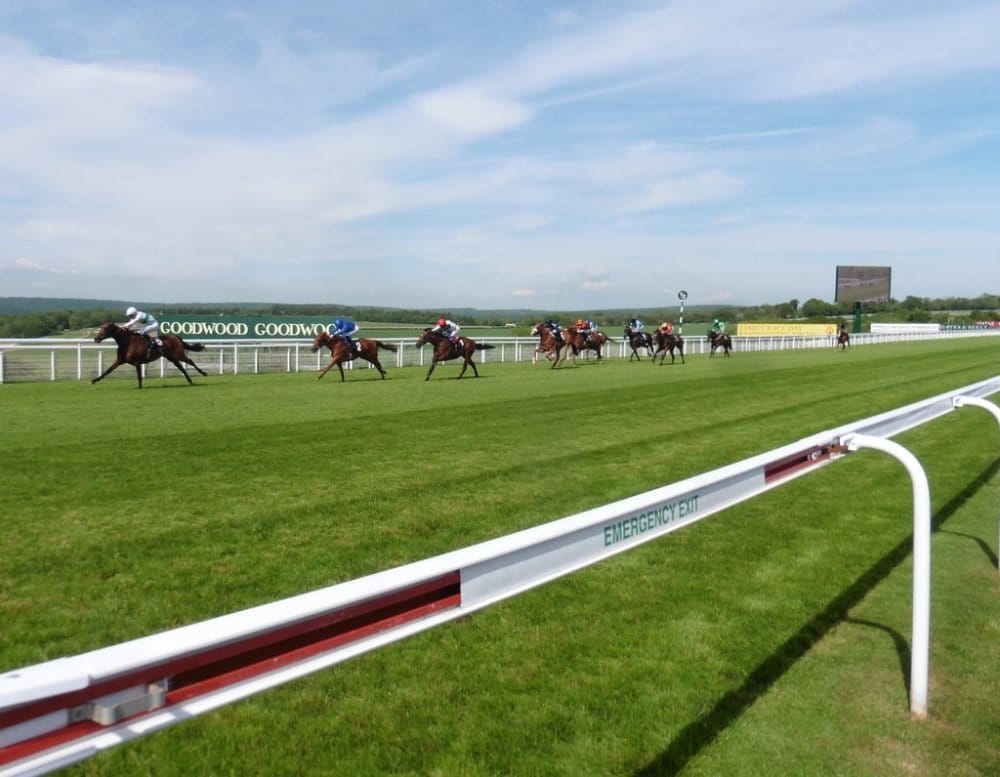
Draw bias is distance-dependent and has shifted over time. At 5f/6f there’s historically been a slight edge to low draws, though this has weakened as pace and tactics have overtaken fixed stall position; at 7f low draws hold a clearer edge in bigger fields; from a mile upward, the long home straight is generally judged long enough to neutralise any stall disadvantage. The Stewards’ Cup is the case study for how much this can move: older data shows low stalls historically dominant, but a read of the last 16 or so runnings shows the picture shifted toward double-figure stalls — 16 of the last 20 winners came from stalls 10 or higher — though with 24-28 runner fields, double-figure draws are simply more common to begin with, so treat the shift as directional rather than a hard rule.
Going interacts with these patterns rather than sitting apart from them. Late July at Goodwood typically produces good to good-to-firm ground, which sharpens the low-draw sprint bias described above; a wetter renewal compresses it. The 2025 Nassau Stakes, run on good-to-soft after rain, is a reminder that a shift in ground can move the draw and pace picture as much as the calendar date does — worth checking the going report on the day rather than assuming a dry-summer default.
Betting Strategy
Three things worth weighing before backing a runner at Glorious Goodwood:
Match the trial to the race
See the Ante-Post section above: it’s Gold Cup form that travels for the Goodwood Cup, not King George or Coronation Cup form. Getting this distinction right is worth more than most generic “Royal Ascot form” framing.
Don’t dismiss a big supplementary entry
A five-figure supplementary fee at the Sussex Stakes is only a rational move for genuine confidence. As Qirat proved at 150/1, a “pacemaker” tag doesn’t mean a horse isn’t actually fancied by its own connections.
Treat Nassau favourites with real caution
The Nassau Stakes routinely produces a short-priced favourite off strong Classic form, yet the market leader has won only around half of the last 20 runnings. Strong form doesn’t automatically survive the step up to fillies’-and-mares Group 1 company here.
Enclosures and the “Glorious Goodwood” Atmosphere
Racing at Goodwood began in 1801 as a private meeting for Sussex Militia officers, and it kept a house-party spirit ever since. King Edward VII, a devoted annual attendee, is credited with describing it as “a garden party with racing tacked on” — the exact original source of the quote is untraceable, though it’s consistently attributed to him across the racecourse’s own history and every independent account checked. Edward VII also relaxed Victorian formality by wearing a linen suit and Panama hat rather than a morning suit, the direct origin of Goodwood’s Panama-hat tradition and its lasting “easy elegance” reputation.
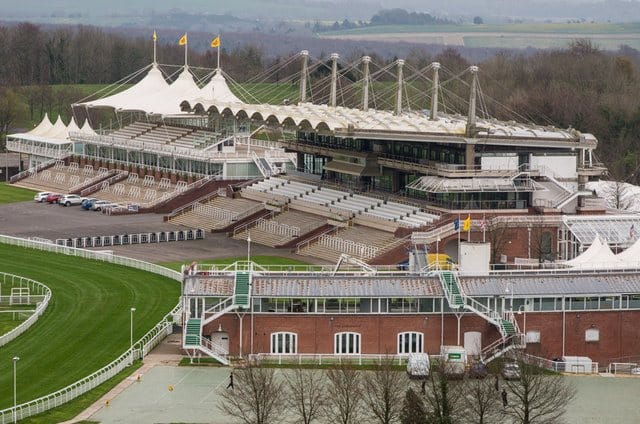
Richmond
The premier enclosure, named for the Dukes of Richmond. During Festival week it’s restricted to Goodwood Horseracing Club Members and guests — not sold as a standalone public ticket. Men 16+ need a suit jacket, collared shirt, tie and full-length trousers.
Gordon
The social hub — covered stand seating, live music, and (Festival-only) The Earl’s Lawn entertainment zone. “Smart yet relaxed”: a jacket is optional for men, but ripped denim, sportswear and trainers are out. From £47.
Lennox
The affordable, family-friendly enclosure — playground, picnic lawns, and the rail-side Picnic Car Park. No strict dress code at all. From £21.
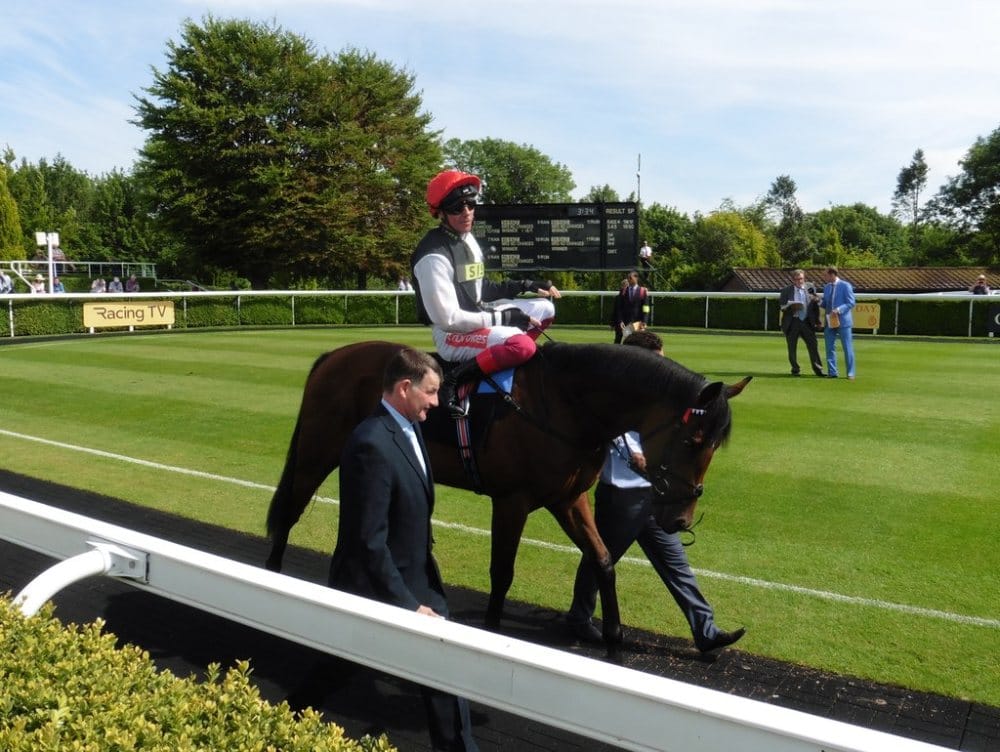
That three-tier structure is deliberately the least formal of Britain’s major Flat festivals: Richmond has no compulsory hat rule even for women, a genuine contrast with Royal Ascot’s Royal Enclosure. Above general admission sit two named hospitality packages for Festival week — The Secret Garden (a Richmond badge plus private garden dining, from around £492.50pp plus VAT) and The Final Furlong (Gordon Enclosure plus a private balcony over the final furlong, from around £372.50pp plus VAT) — though exact current-year pricing is best confirmed directly with the racecourse, since neither figure is published as a locked festival-wide rate. A 15% early-bird discount typically applies across all three enclosures ahead of a cut-off date.
The picnic culture is built into the infrastructure, not incidental — the rail-side Picnic Car Park (which includes Lennox admission for four) is a genuine point of difference from Royal Ascot’s more restrained lawns or Cheltenham’s cold-weather tailgating. Modern attendance across the five days tops 100,000, against a one-day record of 55,000 set in 1953.
Getting There
Chichester is the natural base and nearest railway station, roughly 4 miles from the racecourse. Goodwood runs its own complimentary raceday shuttle bus from Chichester Train Station (North Car Park), departing every 15/45 minutes past the hour from 10:15am to 1:15pm, with return buses from the Gordon Enclosure and the last one leaving 60 minutes after the final race — workable without a car if you’re staying centrally. A separate Stagecoach public bus service also runs specifically during Festival week, priced at £6 single/£10 return for adults and £4/£7 for children, with the last bus departing Goodwood at 8pm.
By road, the racecourse is signposted from the A27 near Chichester — treat any very specific turn-by-turn directions you find elsewhere with caution, since some circulating online actually describe the route to the separate Goodwood Hotel rather than the racecourse itself. Following official signage from the A27 is the reliable approach.
Racecourse vs. Festival of Speed — don’t confuse the dates
Goodwood’s motorsport event, the Festival of Speed, runs in early-to-mid July — before the horse racing Festival, on different dates, at a different part of the same estate. Several travel and accommodation sources online carelessly blend the two events’ advice. If you’re planning for Glorious Goodwood specifically, double-check any date you read against the confirmed 28 July–1 August 2026 window.
Staying Over
The only true on-estate option is The Goodwood Hotel, a 4-star, 91-room hotel roughly a 7-minute drive from the grandstands, alongside a handful of self-catering Goodwood Cottages. Beyond the estate, scattered rural B&Bs in villages like Charlton, East Dean and Singleton sell out earliest given how few beds sit close to the gates.
Chichester itself — a pleasant cathedral city with the widest hotel stock in the area — is the practical choice for most visitors, and is widely flagged as needing booking 6-9 months ahead for Festival week specifically. Beyond Chichester, Bognor Regis (around 20-24 minutes’ drive) and Worthing (a similar order of magnitude further) are realistic coastal alternatives, with Portsmouth (about 30 minutes) and Arundel as further options if those fill first.
London as a day-trip base is marginal, not ideal. The train run (London to Chichester, plus the transfer to the racecourse) totals roughly 2 to 2¼ hours door-to-gate each way. With the first race at 13:50 and gates shut in the early evening, that’s workable for a single quieter day — Tuesday’s Goodwood Cup Day is the sensible pick — but not a sound strategy for the whole week, especially Ladies’ Day with its evening events.
No official racing camping exists — and no one publishes a real price-surge figure
Goodwood does run genuine on-estate camping, but it’s exclusively for the motorsport calendar (Festival of Speed, Goodwood Revival, the Members’ Meeting) — the horseracing section’s own accommodation page lists only the hotel and cottages, nothing else. Several aggregator sites carelessly conflate “Goodwood camping” across all the estate’s events; there’s no bookable racing-specific campsite. Equally, no credible source publishes an actual quantified hotel price-surge percentage for Festival week — only consistent, qualitative “book early, rooms disappear” advice. Treat any specific “+40%”-style figure you see elsewhere with real scepticism.
Betting On The Day
Goodwood’s own materials are a little inconsistent on cash versus card, so it’s worth resolving plainly: the racecourse is a cashless venue with no on-site ATMs — official betting outlets (the on-course Tote, a betting shop) take debit cards only, and no banknotes are accepted at bars or food stalls. The independent on-course bookmakers are the exception and will take cash — and first-hand accounts from bookmakers working the ring describe cash as genuinely useful, since card terminals can struggle with mobile signal in a busy, open-air betting ring on a hot day. If you do run dry, the Tote and Britbet offer up to £50 cashback with a minimum £10 debit-card bet, filling the gap left by the absent cashpoints.
The SP you’re betting against isn’t what you might think
Best Odds Guaranteed is fundamentally an online/high-street bookmaker product, not something the bookmaker standing in front of you in the ring is personally offering. And since 2021 (revised again in 2022 and 2024), the official Starting Price your BOG bet actually settles against is calculated mainly from off-course prices, with no maximum panel size and a floor of just 3 bookmakers required — on-course betting is now under 2% of the total market. The price a Goodwood bookmaker quotes you in the ring is real and competitive, but it’s largely not what determines your BOG payout.
Placing a bet follows the standard etiquette: approach a pitch, state the racecard number and stake clearly (“£10 win, number 7”), have your money ready, and return to the same bookmaker to collect winnings with your ticket. Prices vary noticeably pitch to pitch across the ring, so it’s worth walking the line before committing to a fancied runner. One Goodwood-specific tip: the ring is typically quietest on Tuesday and Wednesday, building to its busiest on Ladies’ Day through the Stewards’ Cup finale — a useful expectation-setter for how crowded a given day will feel. For the Stewards’ Cup itself — a 24-28 runner cavalry charge where prices can move sharply in the final minutes — a betting exchange lets you back or lay a runner at a market-driven price and trade out before the off, a different tool from a fixed price taken with an on-course bookmaker or online account.
A distinctive wrinkle versus a routine British raceday: the Hong Kong Jockey Club has run World Pool commingled betting at Glorious Goodwood since 2021, across several days of the Festival, with HKJC naming rights on individual races and access to Win, Place, Quinella, Forecast, Tierce and Treble pools alongside the usual UK market. It doesn’t change how you personally place a bet, but it’s part of why liquidity on Goodwood’s biggest races runs deeper than at a routine Flat fixture.
Watching from home: ITV Racing covers Glorious Goodwood’s biggest races live and free-to-air, though not every one of the 40 races across the week makes the broadcast — Racing TV (subscription required) covers the fuller card, alongside Sky Sports Racing. Accessibility: all three enclosures have wheelchair viewing stands on the rails, with covered viewing from the Sussex Stand balcony (Gordon) and the March Grandstand (Richmond), and natural high-level viewing in Lennox. Blue Badge parking is available at the front of every public car park with no need to pre-book, a Changing Places bathroom is on site, and wheelchairs can be booked in advance through Shopmobility.
Goodwood’s picnic-and-garden-party culture draws a huge casual crowd alongside serious form students. Stake what you can afford to lose, and if it stops being fun, help is there — see our page on Responsible Gambling.
Where the Form Leads
Each of Goodwood’s three Group 1s has its own well-worn onward trail — and 2025 produced one of the most dramatic confirmations yet of how unpredictable that trail can be.
The Sussex Stakes’ mile winners traditionally head toward the Queen Elizabeth II Stakes on Ascot’s British Champions Day in October, sometimes via York’s Juddmonte International as an intermediate step. Frankel and Solow both completed the Sussex-QEII double in the same season; Baaeed did it in reverse order across two years; Notable Speech took the fully international route in 2024, all the way to the Breeders’ Cup Mile. Then 2025 blew the pattern apart: Qirat’s 150/1 Sussex shock came at the expense of hot favourite Field Of Gold, who was found lame afterward — and when Field Of Gold sought QEII redemption in October, he bombed again, finishing fifth. The QEII itself was ALSO won by a huge outsider that year, 100/1 shot Cicero’s Gift — two of Britain’s biggest mile championships, same season, both won by 100/1-plus shots.
The Nassau Stakes traditionally leads to the Yorkshire Oaks and, eventually, the Arc or Breeders’ Cup Filly & Mare Turf — Midday’s record three straight Nassau wins (2009-2011) is the gold-standard case. But 2025 winner Whirl supplies the cautionary tale: after a dominant 5-length Nassau romp, she went off favourite for the Prix Vermeille next time out and trailed in last.
Scandinavia’s live Stayers’ Triple Crown bid
The Ascot Gold Cup → Goodwood Cup → Doncaster Cup sequence has been completed just seven times ever — Stradivarius (2019 and 2021) is the only 21st-century horse to manage it, and the only one to do it twice. Scandinavia already holds two of the three legs heading into 2026 (the 2025 Goodwood Cup and the 2026 Ascot Gold Cup, achieved in reverse order) and is entered for a Goodwood Cup defence. Win that and September’s Doncaster Cup, and he’d become the first since Stradivarius to complete it. Worth watching, not betting as a formality: over the last 20 Goodwood Cup renewals, backing the winner on their very next start has returned just 7 winners from 20 — Goodwood Cup form is a notably risky thing to carry forward blind.
History and Prestige
The Goodwood estate has belonged to the Richmond family since 1697. Racing began there in 1801 after a social snub elsewhere: Sussex Militia officers had raced for years at nearby Petworth Park by invitation of the Earl of Egremont, until that invitation was withdrawn. Charles Lennox, 3rd Duke of Richmond, stepped in and let the officers race on “The Harroway,” a ridge on his own land — a private meeting successful enough that a public one followed in 1802, its highlight a match race won by Rebel, owned by the future King George IV, over the Duke’s own Cedar. The Goodwood Cup joined the card in 1808.
Stradivarius holds the Cup’s modern record with four straight wins (2017-2020) — the benchmark Scandinavia is now chasing, as the Aftermath section above describes. Frankel remains the only two-time Sussex Stakes winner, his 2012 renewal won at odds of 1/20.
On money, Goodwood is the smallest purse of Britain’s major summer Flat festivals in single-week cash terms — Royal Ascot’s five days run to roughly £10 million against Goodwood’s three Group 1s worth a combined £2.1 million-plus — though Goodwood’s full 19-raceday season (£8 million in 2023) actually outstrips York’s single-week Ebor total, a reminder that festival-week and full-season prize money aren’t the same comparison. What Goodwood trades on instead is setting and tone: a racecourse built into the Downs, run by the same family that also hosts the Festival of Speed and Goodwood Revival on the same estate — a different ownership model to Ascot’s Crown Estate or York’s independent trust, and the root of its enduring “garden party” identity.
FAQ
When is Glorious Goodwood 2026?
What’s the dress code?
Which day should I go if I can only pick one?
Is Glorious Goodwood the same event as the Festival of Speed?
Do I need cash or card?
See the reasoning, not just the result
FormDial posts every bet before the off, with the full case behind it — win or lose, logged either way.