Epsom Derby
The race that gave the world a word for its biggest event — the Blue Riband of the Turf, a switchback of a course that beats horses before the line does, the ante-post market, free viewing from the Hill, and where Derby form actually goes once Epsom’s done for another year.
No other race in the world has had its name borrowed so often — there are Derbys run on five continents, and “derby” has leaked into everyday English for any big local sporting occasion. The original still does things no other Classic does: free public viewing for anyone who turns up, and a course so demanding it has undone Group 1 winners who simply couldn’t get the switchback right.
New to Derby Day? Start here
The Hill is completely free with no ticket needed, and gives you the full festival atmosphere. Bring cash — almost everything on-course except the bookmakers is card-only. The train beats driving by a wide margin on the day itself. And if you can only make one day, Friday (Oaks Day) is calmer and a gentler introduction than Saturday’s crush.
The Two Days, Race by Race
The Derby Festival runs over two consecutive days in late May or early June — Ladies’ Day (also called Oaks Day) on the Friday, and Derby Day itself on the Saturday. The Jockey Club has already confirmed 2027’s dates as Friday 4 June and Saturday 5 June, both races off at 4.00pm. Each day carries eight races, 16 across the Festival.
Ladies’ Day
Friday · The OaksHeadlined by the Betfred Oaks, a Group 1 Classic for three-year-old fillies only, run over the Derby’s own course and distance. The Oaks is actually the older of the two races and the fillies’ equivalent of the Derby — one of British racing’s five Classics. The undercard builds through handicaps and the Diomed Stakes, named for the very first Derby winner in 1780.
Derby Day
Saturday · The Big OneThe Betfred Derby itself, a Group 1 for three-year-old colts and fillies over 1m4f10y. Since 2026 it’s shared the Saturday card with a second Group 1, the Coolmore Coronation Cup (older horses, same trip) — see below for why that matters.
What changed in 2026
For decades the Coronation Cup ran on the Friday. From 2026 it moved to Saturday, becoming the meeting’s second Group 1 on Derby Day, and its prize fund more than doubled to £1 million under new Coolmore sponsorship. A lot of older guides and previews still describe it as a Friday race — it isn’t anymore.
The Derby’s off-time moves around for broadcast reasons more than any other Classic — 2.25pm in 1996 to dodge a Euro ’96 kickoff, 1.30pm in 2023 to avoid a clash with the FA Cup final. Even the long-standing “norm” of 4.30pm has drifted recently: 2025 went off at 3.30pm, 2026 at 4.00pm, and 2027 is already locked in at 4.00pm for both the Oaks and the Derby. Treat “mid-to-late afternoon” as the safe assumption and check final declarations for the exact time nearer the day. The 2026 renewal ran to 14 runners, won by Aidan O’Brien’s Christmas Day.
Ante-Post Betting on the Derby
The Derby’s ante-post market starts earlier and moves further in advance than almost any other British race, because the conversation begins the previous autumn. For how ante-post betting works in general, see our Ante-Post Betting Explained guide.
The first markers are the Dewhurst Stakes (Newmarket, October) and the Racing Post Trophy (Doncaster, October/November) — a visually striking juvenile winner of either is typically installed among next year’s Derby favourites within minutes. Camelot (2011 Racing Post Trophy) and City Of Troy (Dewhurst) both went on to Derby glory. But this is a promissory note, not a guarantee: plenty of dazzling juveniles never reproduce it at three, and experienced Derby punters treat autumn form with real caution.
From March, the market rebuilds around the spring trial circuit: the Dante Stakes at York (the most significant of all, with eleven subsequent Epsom winners to its name), the Lingfield Derby Trial, the Chester Vase and the Sandown Classic Trial. A visually dominant trial win moves prices hard and fast — in 2026, Item was cut from 10/1 to 11/2 in-running in the Dante itself, then shorter again for Epsom.
Then there’s the Guineas dilemma: is the 2000 Guineas at Newmarket the best guide to the Derby, or is a horse fresh from a genuine stamina trial more trustworthy? The Rowley Mile is flat, straight and speed-favouring — traits that don’t always map onto Epsom’s gradient and camber. Auguste Rodin is the standard cautionary tale: beaten a well-below-form 12th in the 2023 Guineas, he drifted to 7/1 for the Derby, but Aidan O’Brien kept faith, the market snapped him back to 9/2 favourite, and he won by half a length. It’s the case racing writers reach for whenever the “Guineas form vs trial-fresh” argument resurfaces each spring.
NRNB and BOG don’t mean what you’d assume, this early
Non-Runner No Bet on the Derby typically only kicks in once final declarations are made in Derby week — an “all-in” ante-post bet placed in the autumn or early spring loses the stake outright if the horse doesn’t run. Best Odds Guaranteed is the mirror-image trap: it’s a raceday-only concession at every major bookmaker and explicitly does not apply to bets struck weeks or months out. Back a Dewhurst winner for next year’s Derby in November, and you get no protection if it drifts before the off.
One way to manage that exposure: a betting exchange lets a punter lay off some or all of an ante-post back before declarations, banking a profit or capping a loss regardless of whether the horse ultimately runs — something no fixed-odds bookmaker offers on an ante-post position. It’s a genuinely different tool from simply shopping around for the best fixed price, and worth knowing about before committing to an all-in stake months out.
Connections don’t always take the bait, either. Frankel, unbeaten in the 2011 Guineas and long-time ante-post Derby favourite, was kept away from Epsom entirely by trainer Sir Henry Cecil over stamina doubts and sent to Royal Ascot’s St James’s Palace Stakes instead — a decision now viewed as instrumental in preserving his unbeaten record.
Epsom’s own oracle: the Amato wishing well
Long before spring trial form existed, Epsom had its own tipping tradition — one built on folklore rather than form. The Amato, a pub in Chalk Lane about a mile from the racecourse and named after the 1838 Derby winner (whose Epsom victory was also his only ever race), has for decades had a fancied runner’s name mysteriously chalked above its wishing well the night before the race. Nobody claims official credit — legend points to a gypsy fortune-teller, others suspect the landlord — which fits Epsom’s own documented 19th-century fairground history of fortune-tellers, dancers and stilt-walkers who were as much a fixture of Victorian Derby Day as the racing itself. The pub’s own fortunes have wavered over the years (it later traded as The Grumpy Mole, and its closure was reported in 2016), but the well tradition itself was still being reported as recently as the 2026 Derby. A decade ago its picks were a genuine force, naming 8 of the previous 12 winners; the strike rate has cooled since. For 2026 the chalked name was Item — the same Dante form horse discussed above — though Aidan O’Brien’s Christmas Day was the one that actually won. Charming rather than reliable, but proof the Derby’s tipping culture has always had more than one kind of insider.
Reading the Track: Epsom’s Switchback
Epsom Downs isn’t really a “track” in the way Newmarket or Ascot are — it’s closer to a switchback carved into the side of the North Downs, a horseshoe rather than a true oval, left-handed, with a mix of left and right bends. And that geography is the single biggest handicapping factor in the Derby: it doesn’t just test speed and stamina, it actively filters out horses that are unbalanced or green, regardless of pedigree or form figures.
The course climbs around 150 feet in the first half-mile, cresting near the top of the hill, before a long, sweeping descent of a similar amount down to the finish — a profile unique among Group 1 tracks anywhere in the world. Tattenham Corner, a sweeping left-hander taken at close to full speed roughly four to five furlongs out, sits right where that downhill gradient bites hardest, tipping toward the inside rail. The home straight’s camber continues the theme, falling away toward the inside rail for most of its length before a stiff rise in the final furlong.
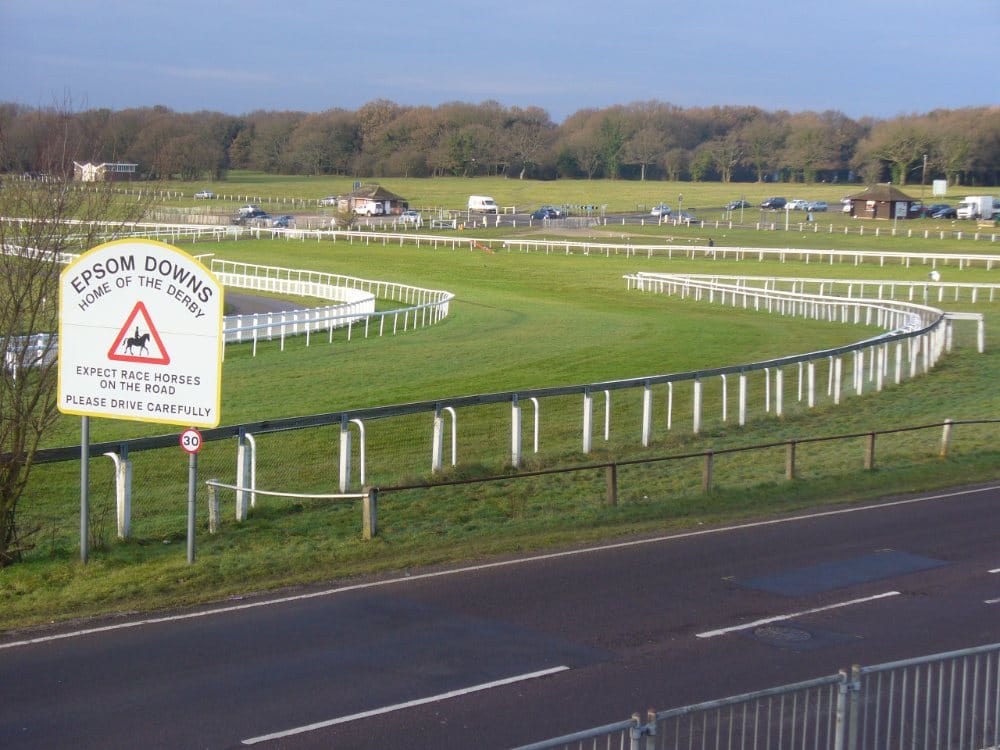
The textbook illustration is Dancing Brave in the 1986 Derby, widely rated one of the best horses never to win the race. He became so unbalanced approaching Tattenham Corner that he lost his stride entirely, dropped to almost last, then produced a stunning turn of foot in the straight to go down by just a short head to Shahrastani. In their later meetings that season he beat Shahrastani comfortably every time — strong evidence it was Epsom’s geography, not a lack of class, that beat him on the day. It’s why “handles Epsom” is treated as a genuinely separate, predictive qualifying test, not a cliché.
Draw bias here is distance-dependent, and worth stating precisely because the popular assumption is backwards. Over the Derby/Oaks trip (1m4f), stalls 1 and 2 have the worst recorded figures — low draws are a disadvantage because of the early right-hand kink runners must cross before the course swings back left. Over the straight 5f course it’s the opposite, a high draw tends to help; over 6f–7f, low numbers do better again. On pace, Epsom rewards prominent racing generally — front-runners have won at roughly 14.6% against 9.85% for held-up horses in handicaps — but the uphill first half-mile means a front-runner can also pay for its own early efforts, so genuine stamina still matters as much as gate speed over the full Derby trip.
Going is worth checking rather than assuming. Late May/early June typically brings good-to-firm ground, which sharpens the pace-forward profile described above; a wetter spring softens it, and on a track where balance already matters more than raw class, a stiffer, more testing surface tends to punish exactly the kind of horse the Dancing Brave case study describes — one that isn’t comfortably built for the track, not just the trip.
See our Epsom Downs racecourse guide for the track outside Derby week too.
The O’Brien factor
Aidan O’Brien is now the most successful trainer in the race’s 240-plus-year history. He equalled Lester Piggott’s long-standing record of nine wins in 2023 (Auguste Rodin), broke it with his tenth the following year (2024, City Of Troy), then stretched it further with Lambourn (2025) and Christmas Day (2026) — four consecutive Derby wins, a feat no trainer had managed before, and twelve in total. Ballydoyle’s method — working horses on gradient, weighting course form heavily in team selection — specifically targets Epsom’s demands rather than assuming raw Group 1 class elsewhere will simply transfer.
Betting Strategy
None of the data above is much use to a bettor until it’s applied. Three things worth weighing before backing a Derby runner:
Respect the trials
A visually dominant trial win (especially in the Dante) has repeatedly proven a stronger signal than Guineas form alone, as the Guineas dilemma above shows. Don’t write off a horse with a moderate Newmarket run if the trial form and the trainer’s confidence both point the other way.
Low draws are a yellow flag, not a green one
It’s instinctive to assume a low stall means an easy, rail-hugging run. At the Derby distance specifically, it’s the reverse — stalls 1 and 2 carry the weakest record of any grouping (see above). Treat a low draw as a question to answer, not an edge.
Early ante-post is a real stake, not a soft one
Until Derby week’s declarations, there’s no Non-Runner No Bet and no Best Odds Guaranteed protecting an ante-post bet. Backing a horse in the autumn or early spring means genuinely risking the stake if it doesn’t make the field — size it like the all-in bet it is.
The Hill and the Enclosures
Epsom has one feature no other British Classic can match: the Hill, the high open ground inside the horseshoe of the track, above and behind Tattenham Corner. It’s common land, not racecourse property, and has been free and open to the public for well over 200 years — predating the modern grandstands entirely. No other Classic has an equivalent.
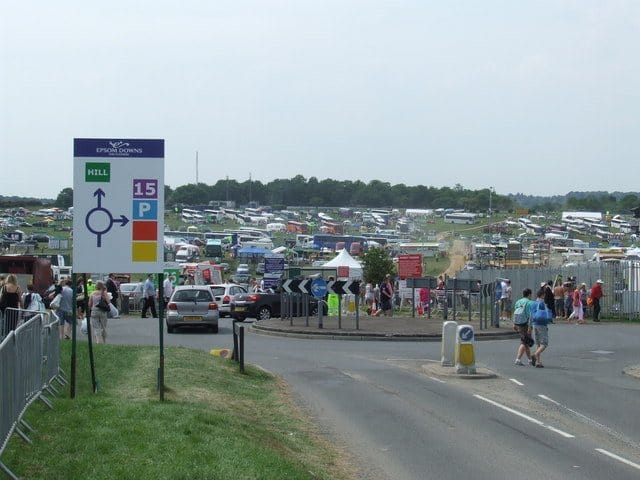
Watching from there is a genuine trackside experience, but an imperfect one by design: you’re on rising ground looking across the course rather than pressed against a rail with a clear view of the finish, which is why big screens are dotted around and why 2026 added new covered bleacher-style seating specifically to improve views of the final furlong. What you get in return is atmosphere the paid enclosures don’t have — a funfair (11am–7pm both days), a market, food stalls, on-course bookmakers taking cash bets, free parking, and a bring-your-own-picnic-and-gazebo culture closer to a festival than a grandstand.
Upper Tattenham Enclosure
Budget option, trackside at Tattenham Corner, bring-your-own-picnic, no parade ring access.
Grandstand Enclosure
Central, home-straight views, DJ after-party.
Duchess’s Stand
Reserved seating, a guaranteed individual seat.
Queen Elizabeth II Stand & Cedric’s
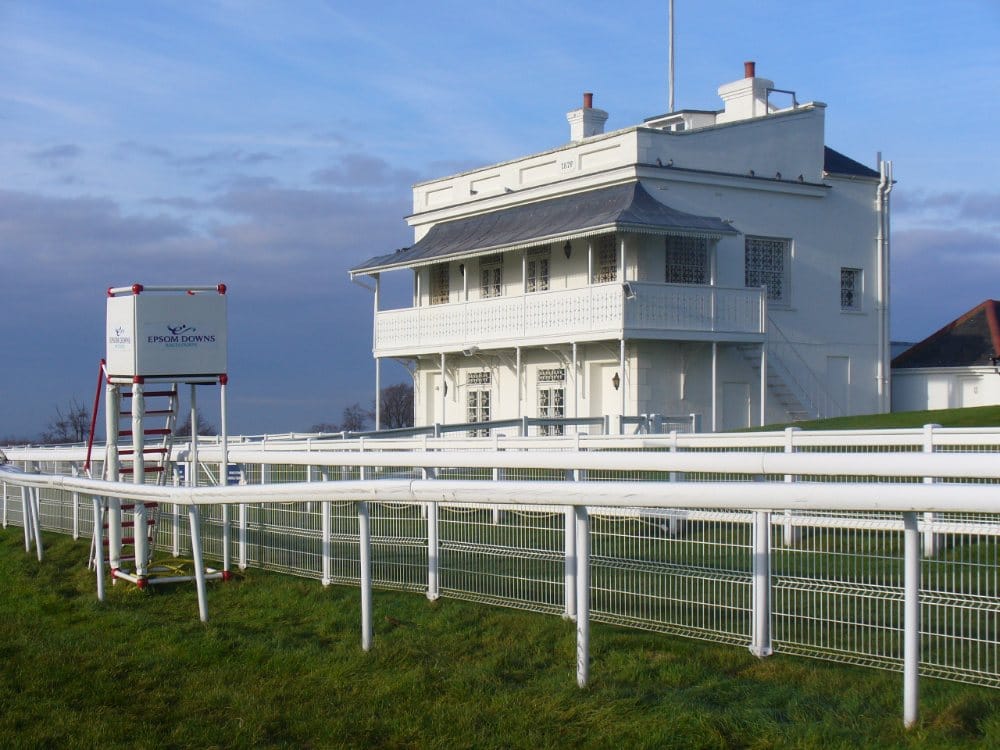
Front-row finish views with parade ring and winners’ circle access; Cedric’s is the premium marquee by the winning post. (Note the current official name — not “Queen’s Stand.”)
Dress code is where Epsom diverges sharply from a meeting like Royal Ascot. As of 2026 there’s no official dress code in Upper Tattenham, the Grandstand Enclosure, Duchess’s Stand or the Hill — racegoers are simply encouraged to dress to feel their best. The one exception is the Queen Elizabeth II Stand specifically on Derby Day (Saturday), which reverts to a formal code: morning dress and top hat for men, formal day dress with hat or fascinator for women. Fancy dress, sportswear and team kits are barred everywhere, on both days. So the honest summary is: relaxed almost everywhere, with one formal pocket that only applies on the Saturday.
Two genuine 2026 changes worth knowing: under-18s now get free general admission on both days across the standard enclosures — a reform introduced as part of the Jockey Club’s response to acknowledged declining attendance — and the Hill itself remains free for everyone, of any age, no ticket or registration needed. Book paid enclosures early regardless; some sell out, and early-bird pricing moves to a higher on-the-gate rate as the date nears. There’s no reliable published data on whether Ladies’ Day or Derby Day sells out faster — Saturday carries the bigger prize money and promotional weight, Friday has its own strong fashion-day following — so don’t trust a guide that asserts one confidently.
Getting There
Three stations serve the course, and none is quite at the gate. Tattenham Corner is closest, a 10-minute uphill walk to the Hill entrance; it began life in 1901 as a race-specials-only station before all-day service arrived in 1928. Epsom Downs station is about a mile out. Epsom itself, the main town station, is furthest but has by far the best everyday service. All three see significantly enhanced timetables specifically on Oaks Day and Derby Day, over and above their sparse normal schedules — the Jockey Club and Southern both flag the train as the most reliable way in.
By road: M25 Junction 9 onto the A24 then Park Lane/Langley Vale Road onto the B290, or Junction 8 via the A217 Brighton Road from the south (postcode KT18 5LQ for satnav). Expect roads around the Downs to clog from about 9am on both days, with two to three hours of heavy traffic after the last race.
Free parking — genuinely unusual for an event this size
On-course parking is free across all 24 numbered, colour-coded car parks on both Festival days, including blue badge parking in Car Park 10. The famous free option is parking directly on the Hill itself. Advance booking of a numbered car park is still worth doing, simply to guarantee a space and a shorter walk in.
Gatwick is the closer airport at around 18–19 miles, against Heathrow’s 27. National Express runs direct return coaches from around 18 towns and cities for the Festival. Oaks Day (Friday) is noticeably calmer on the roads and trains than Derby Day — a good choice for a first-timer or anyone travel-averse.
Staying Over
Epsom is a small town of around 80,000 people absorbing one of the busiest dates in British racing, so the accommodation squeeze is real. Every official and travel-trade source agrees on the same advice — book early, some ticket types and hospitality packages sell out — but unlike the Kentucky Derby, where Louisville-area rates have been reported rising over 260% in race week, there’s no equivalent published figure quantifying an Epsom-specific price surge. Treat any specific percentage you see elsewhere as anecdotal; the honest advice is to book as soon as dates are confirmed, since many hotels open Derby-weekend rates 9–12 months out.
The Holiday Inn Express Epsom Downs sits directly on the racecourse grounds — walking distance to the gates, free parking, breakfast included — and is usually first to fill given its uniqueness. Premier Inn Epsom Central and a scatter of small hotels in Ashtead and Kingswood are the next tier. Beyond that, Sutton (about 5 miles, its own rail links), Croydon (around 20 minutes, the deepest hotel stock of the three, plus tram and rail connectivity) and Kingston upon Thames (about 20 miles, a nicer evening-out setting with Thames-side options) are the realistic overflow towns.
London itself is a genuinely realistic day-trip base, not just a fallback — Epsom sits only around 15 miles south of the centre, with frequent Southern/London Overground services (roughly 55 minutes to just over an hour) and advance fares from under £10 each way in normal conditions. Derby-day fares and crowding will be materially worse, and driving in as a same-day round trip isn’t realistic given the congestion described above — the train is the only reliable way in and out on the day itself. Camping is thin locally: no purpose-built Derby campsite exists, just a small handful of general Surrey sites 20-plus minutes out, so campers should budget the extra travel time rather than expect anything on-site.
Betting On The Day
Contrary to what many first-timers assume, you don’t need a paid enclosure ticket to bet at the Derby. The Hill has its own line of bookmakers’ pitches and Tote access, entirely separate from the paid enclosures — the Jockey Club’s own page for the Hill confirms “track-side viewing, the Tote, bookmakers and racecards are all easily accessible” there.
Bring cash before you travel
Epsom Downs is otherwise a card-only racecourse on Derby Day — every food stall, bar and merchandise stand takes cards only, and cash is useful solely for betting with the bookmakers. On-site cash machines exist, but only inside the Duchess’s Stand and Queen Elizabeth II Stand paid enclosures, with warnings of long queues. If you’re on the free Hill, there’s no confirmed ATM within the free area itself — bring betting cash with you rather than planning to find a machine mid-afternoon.
Placing a bet is simple but has unwritten etiquette. Approach a pitch, state the horse’s racecard number, the bet type and the stake clearly — “£10 win, number 7” — and hand over cash; the bookmaker hand-writes a ticket showing the odds and stake, which is your only proof of the wager if it’s ever queried. Use round stakes, have your money ready before you reach the front, and step away promptly once you’ve bet rather than lingering at a busy pitch. Prices vary stand to stand, so regulars walk the line first to compare before committing, unlike the Tote’s pooled, dividend-based returns.
On Best Odds Guaranteed: Betfred, the Derby’s title sponsor, runs BOG on selected UK and Irish racing from 8am on race day — paid at the bigger of the price taken or the eventual Starting Price. It excludes ante-post bets, multiples like Lucky 15s, boosted-price specials, and races that revert to SP because of non-runners. Most major bookmakers run comparable standing policies, and Derby Day sign-up offers and price boosts change yearly, so check on the day rather than relying on last year’s terms.
Watching from home: ITV Racing covers Oaks Day and Derby Day live and free-to-air, with Sky Sports Racing (subscription required) and racecourse/bookmaker streams as alternatives, plus radio commentary. Accessibility: the racecourse partners with AccessAble on a dedicated access guide covering parking (blue badge bays in Car Park 10), viewing points and the carer-ticket process; accessible toilets on-course are limited to the Duchess’s Stand, so it’s worth planning routes and enclosure choice around that in advance rather than assuming provision is even across the site.
The Hill draws a huge, casual, once-a-year betting crowd, many of them having a flutter for the only time all year. Stake what you can afford to lose, and if it stops being fun, help is there — see our page on Responsible Gambling.
Where the Form Leads
Winning the Derby isn’t a finish line, it’s a fork in the road — and which path a horse takes tells you almost as much about its true merit as the form book does. The six months after Epsom are where Derby form gets properly stress-tested, and it’s an area most previews skip past.
For a colt staying in training, the first major test comes roughly seven weeks later in the King George VI and Queen Elizabeth Stakes, run at Ascot racecourse in late July (a separate meeting from Royal Ascot week itself) over almost the same trip against older Group 1 performers. It’s the single biggest test of whether a Derby form line is real. The Epsom-King George double reads like a list of the greatest horses of each era — Nijinsky and Mill Reef, Shergar and Nashwan, Generous and Lammtarra, Galileo in 2001 — but it’s a genuinely tough second test, not a formality: two decades passed between Galileo and the next colt to manage it, Nathaniel in 2011.
A common alternative is the Irish Derby at the Curragh, three to four weeks after Epsom — a lower bar against beaten form and fresh three-year-olds, but a good gauge of whether the Derby form was genuine. The Epsom-Irish Derby double has been completed 20 times since Orby first managed it in 1907, and has become common in the O’Brien era: Galileo, High Chaparral, Camelot and Australia among them, with Lambourn (2025) the most recent. For the very best who stay in training into autumn, the Prix de l’Arc de Triomphe at Longchamp in October is the ultimate target — Sea The Stars (2009) won six Group 1s in a row including the Arc, and Golden Horn (2015) completed the same Derby-Eclipse-Irish Champion-Arc sequence, interrupted only by a defeat at York in between.
The “bounce” trap
Not every campaign goes to plan, and it’s worth flagging to anyone following up Derby form. Camelot won the Guineas, Derby and Irish Derby in 2012 and looked a certainty for the Triple Crown, only to be run down by 25-1 shot Encke in the St Leger. Workforce, the 2010 Derby and Arc winner, returned favourite for the following year’s King George and hung markedly left in the straight to finish only second. A below-par run straight after a big Derby campaign shouldn’t automatically be read as a form collapse — sometimes it’s the ground, sometimes it’s a track that doesn’t suit, and sometimes, as with Nashwan’s flat effort before his immediate retirement in 1989, it’s simply the last run before a stud deal already arranged.
That points to the biggest structural difference from jumps racing, where retirement is overwhelmingly age- or injury-driven. A Derby win instantly creates one of the most valuable breeding assets in the sport, and commercial considerations can end a colt’s career overnight regardless of soundness: Minoru (1909), Call Boy and Benny the Dip (1997) all never raced again after Epsom. Fillies are treated differently — Oaks winners far more often stay in training, since a broodmare’s value is less urgently monetised than a stallion’s. Enable, the 2017 Oaks winner, raced on for four seasons, adding the King George, two Arcs, the Irish Oaks, Yorkshire Oaks and Eclipse Stakes before retiring in 2020 — an entirely different career shape to any Derby-winning colt in the same period.
History and Prestige
The story starts a year before the race it’s attached to. In 1779, Edward Smith-Stanley, the 12th Earl of Derby, devised a new race for fillies at a party held at The Oaks, his estate near Epsom — that race, won by his own filly Bridget, became the Oaks Stakes, and it’s technically the parent race, run two days before the Derby to this day. A year later, Lord Derby and his friend Sir Charles Bunbury conceived a companion race for colts. The two are said to have tossed a coin over whose name it would carry; Lord Derby won, and the result was the Derby Stakes, first run on 4 May 1780 over one mile and won, with pointed irony, by Diomed — a colt owned by Bunbury himself. The distance was extended to its now-famous mile-and-a-half in 1784, run since precisely as 1m4f10y (2,423 metres), a measurement only pinned down exactly in 1991.
What makes the Derby genuinely unique in world sport is what happened to its name afterward. In 1872, Meriwether Lewis Clark Jr, founder of Churchill Downs, visited Epsom, watched the race, and went home to model Louisville’s new showpiece directly on it — right down to the name: the Kentucky Derby. From there the naming convention spread worldwide — the Irish Derby, Australian Derby, Japanese Derby, France’s Prix du Jockey Club (“the French Derby”) — before leaking out of horse racing entirely into a football “local derby,” a demolition derby, a roller derby. It’s arguably one of the most consequential coin tosses in the history of the language of sport.
The race has produced some of racing’s most enduring, and darkest, moments. In 1913, suffragette Emily Davison ran onto the course and was struck by King George V’s horse Anmer, dying four days later — one of the defining images of the women’s suffrage movement. At the opposite emotional pole, 1981 produced Shergar’s ten-length win, still the largest winning margin in Derby history; less than two years later he was stolen at gunpoint from stud in County Kildare, reportedly in a botched IRA ransom operation, and was never recovered.
On the form book: Lester Piggott’s nine wins (1954–1983) stood as the record for decades — Aidan O’Brien has since gone past it, as the twelve wins noted above attest. The race’s sponsor has changed hands repeatedly over that time too: Ever Ready and Vodafone backed it in past decades, Investec’s 12-year title sponsorship ended abruptly in 2020, Cazoo held the naming rights briefly after, and Betfred has been title sponsor since 2023. On money, the Derby now carries a total prize fund of £2 million, with £1 million to the winner — among the richest Flat races run in Britain and rivalling Royal Ascot’s own showpiece contests, though no single Ascot race matches the Derby’s singular prestige as the race every Flat trainer and owner in the world wants to win.
FAQ
Do I need a ticket to watch the Derby?
What’s the dress code?
Which day should I go if I can only pick one?
Is the Derby always run at 4.30pm?
What’s the difference between the Derby and the Oaks?
See the reasoning, not just the result
FormDial posts every bet before the off, with the full case behind it — win or lose, logged either way.