Headgear, and what it actually tells you
Blinkers, visors, cheekpieces, hoods, eyeshields, eyecovers and the tongue tie — what each one does to the horse, what the rules say, and what the published evidence says it is worth to a punter.
A small piece of nylon, and a large amount of received wisdom
Headgear is the most-read signal in British racing that almost nobody has checked. A b or a p appears against a runner on the racecard, the punter reads intent — the trainer has spotted something, the horse is fancied — and the money follows. It is a reasonable inference. It is also, measured against the results, largely the wrong way round.
This page does two things. It shows you exactly what each item of headgear is and what it does to the horse — the shorter definitions live in the glossary. And it sets out what the published evidence says the information is actually worth, sample sizes and all, including the parts where the honest answer is that nobody knows.
Five letters, and the things they never tell you
Headgear gets one or two lowercase letters on a British or Irish racecard, printed with the runner’s details beside its weight. b is blinkers, v a visor, p cheekpieces, h a hood and t a tongue-tie. The Racing Post’s published abbreviations list adds e, e/c and e/s for the eye hood, eyecover and eyeshield, plus combinations such as Ht. Our racecard guide covers the five you meet most often.
The digit carries the information. That same list states that where blinkers are worn for a first or second time, a 1 or a 2 appears beside the letter — so b1 is first-time blinkers and p1 first-time cheekpieces. The 1 is what gets read, and what every study below is built on.
None of this is rare: Dave Renham recorded a 47% increase in horses running in headgear between 2010 and 2025, just under 18,000 runners in 2025, or 31% of all runners (UK Flat, geegeez, 17 March 2026). More useful is the gap between what a horse wears and what the card prints. Three common items leave no trace at all.
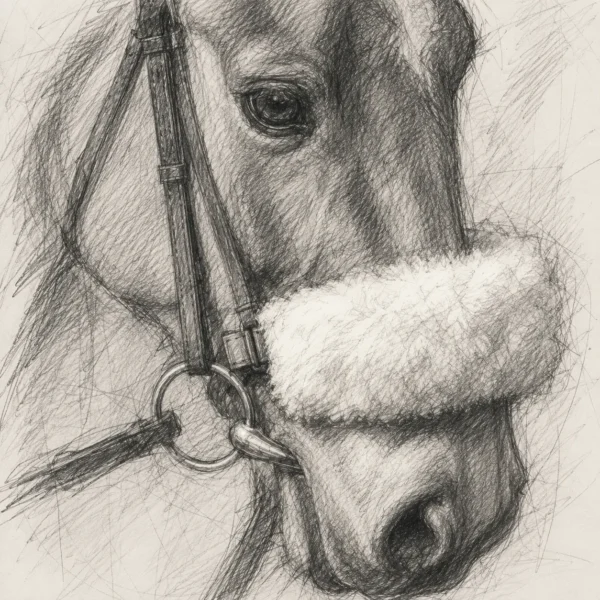
The sheepskin noseband
Not declarable in either jurisdiction. The BHA defines Headgear as a closed list — blinkers, cheek pieces, eye covers, eye shields, hoods and visors — and “noseband” appears nowhere in the current Rules of Racing, nor once in the IHRB’s 2026 rulebook. No code, no first-time flag, no field in any form database.
Earplugs
Lawful, used, and outside the Headgear definition in both jurisdictions — and the rule that actually bites is that a jockey may not remove ear plugs during a race. No notation for them exists on the Racing Post list, in the Great British Racing jargon buster or in the irishracing.com card key.
The red hood
The one item a horse may wear undeclared, and only in the preliminaries. Ireland requires it to be red. It comes off before loading, or before the starter calls them in, and may not be worn in the race. Paddock watchers see it; the card never does.
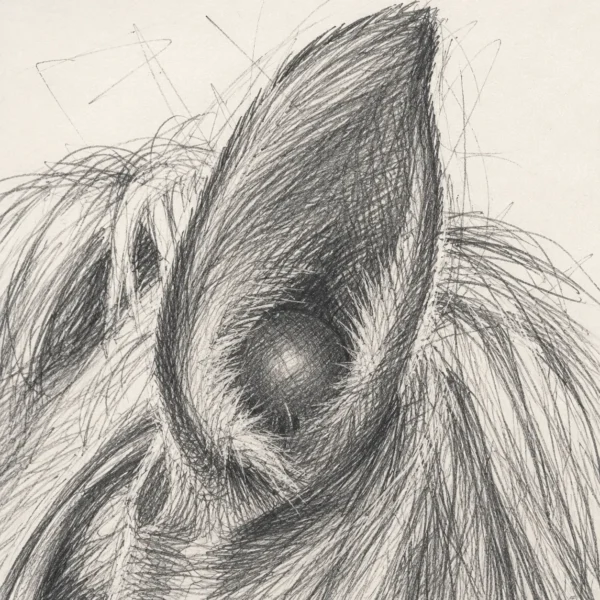
Blinkers remove what is behind, not what is ahead
A blinker does one job, and it is narrower than most descriptions suggest. The British rulebook defines blinkers as a garment fitted over the horse’s head with holes for the eyes and ears, “one or both eyeholes being fitted with cowls cutting out all vision to the rear but permitting full forward vision”. Read the second half again. Full forward vision. The cup takes nothing from what the horse sees in front of it.
That matters because of where a horse’s eyes sit. Set on the sides of the head, each eye sweeps a field averaging around 195 degrees and measured as wide as 228, and the two fields overlap in front by only 55 to 80 degrees depending on which study you read. That overlap is aimed down the nose rather than out at the horizon, which is why a horse lifts its head to look at something distant. Blinkers do not touch it. They amputate the rear and outer end of each eye’s sweep — the part that looks back past the shoulder — and how much they take is a choice, cups running from a full cup down to the barely-there “cheaters”.
The stated purpose is attention. Great British Racing says blinkers “limit a horse’s vision and reduce distractions, with the aim of making it concentrate”. Todd Pletcher puts it more bluntly: “Blinkers channel their vision, cut down on the scope of their sight.” The published trainer reasoning is almost always about orientation, not effort — spooking, panicking, bearing out, doing too much looking around.
Which is why they go wrong. Take the rear view off a horse that was using it to settle and you can get a different animal. Pletcher fitted first-time blinkers to Palace Malice for the 2013 Kentucky Derby; the colt went head-to-head through a quarter in 22.57 and a half in 45.33, one of the fastest Derby splits ever run, and finished twelfth. His jockey Mike Smith: “Around the first turn, that was the ‘oh no’ moment.” The blinkers came off, and five weeks later the same horse stalked the pace and won the Belmont Stakes.
Scandinavian racing builds that risk into paperwork: a rider’s post-race duties there include reporting whether the horse was negatively affected by blinkers. And taking them off is a move in its own right — Brian Ellison removed Solar Bentley’s blinkers at Pontefract in September 2025 on his jockey’s advice, “and it seemed to work”.
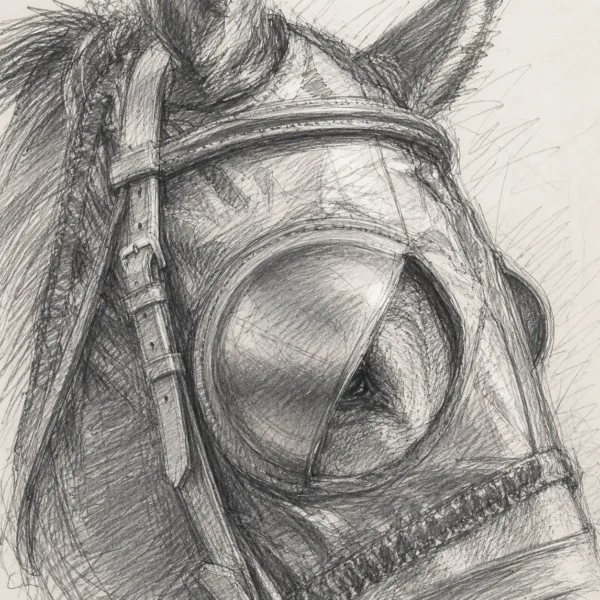
A visor is the lesser restriction, not the greater
This is the most inverted fact in betting copy, and the rulebook settles it in one line. A visor is “a garment similar to Blinkers in which one or both cowls have holes cut in them permitting limited side or rear vision”. Blinkers cut out all vision to the rear. A visor cuts a hole in that wall. The visor is the softer item of the two, not the escalation.
Physically it is the same kit — same hood, same cups — with an aperture cut through. Ireland requires the aperture in both cowls, but the mechanism is identical. And because the hole is the whole point, the British rules protect it: modifying a visor by covering the holes cut in the cowls is expressly prohibited. You may not tape a visor shut and run it as blinkers.
Why cut the hole at all? The clearest published explanation comes from ophthalmology rather than racing. Writing for the American Academy of Ophthalmology, W. Banks Anderson Jr. records that trainers cut holes in the back of full eye cups “in the hope that the horse might go faster if it could sense horses gaining on it from behind”. The visor is for the horse that needs the forward focus of blinkers but loses its bearings when it cannot tell where the field is.
Two cautions. No on-the-record British or Irish trainer testimony on choosing a visor could be sourced for this page, so treat that as what follows from the definitions. And a horse is never declared in blinkers and a visor together — the pairing is absent from Ireland’s list of permitted combinations, which makes sense once you accept that a visor is blinkers with holes in.
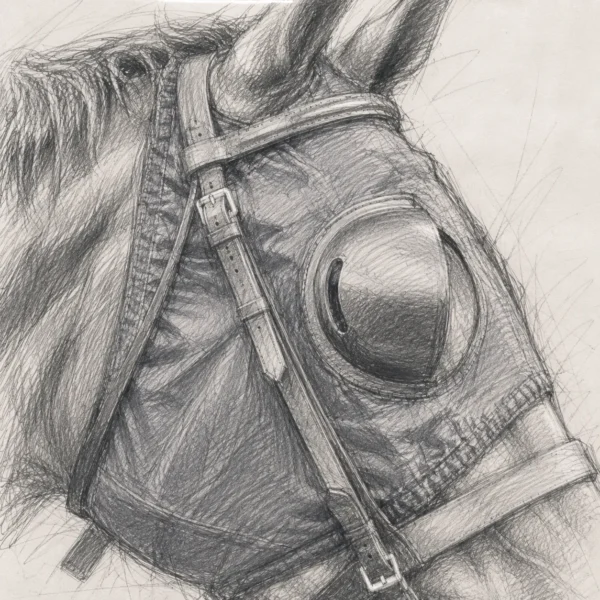
The one piece of headgear the rules do not define by vision
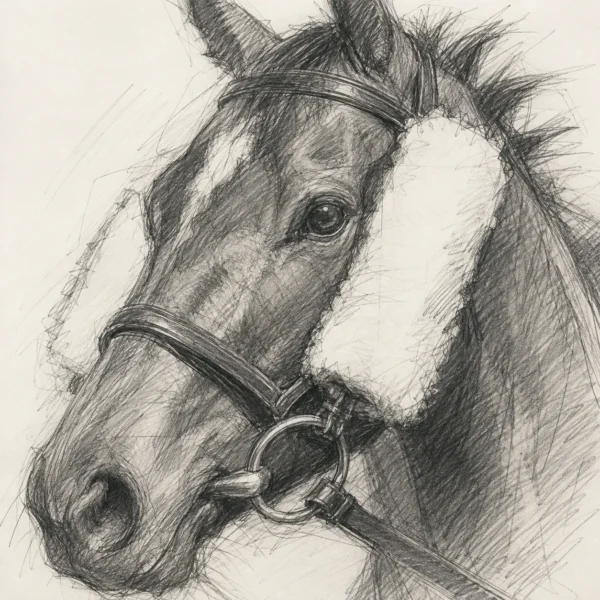
Every other item of British headgear is defined by what it does to the horse’s eyes. Cheekpieces are not. The BHA’s definition, in full, is “two strips of sheepskin of equal size (or any other similar material or device) which is attached to the cheek pieces of the bridle” — what the thing is and where it goes, with no vision effect stated at all. Blinkers cut out all rear vision by definition; a cheekpiece’s restriction is a by-product of a fluffy strip in the lower rear of the horse’s field, softening the back-quarter view rather than closing it. Note the attachment point, too: the cheek pieces of a bridle are the straps running from the headpiece to the bit, so the kit is named after the strap it clips onto.
The phrase “of equal size” is not decoration. It was added to the British rules with effect from 3 January 2017, and the National Trainers Federation’s briefing gives the reason: horses had been running in cheekpieces of different sizes, some “virtually non-existent” — trainers meeting the requirement to run in two by fitting one real one and one token one. A one-sided cheekpiece is not legal in Britain. Ireland’s 2026 definition still carries no equal-size qualifier.
A shade under 15% of British and Irish runners wore them in 2024 (Matt Russell, On Course Profits, 23 August 2025). The moment they went mainstream is datable: on 19 October 2002 Storming Home won the Champion Stakes at Newmarket by half a length from Moon Ballad, in cheekpieces Barry Hills had fitted to improve his concentration, and Michael Hills, who rode him, said they “made a big difference to him”. Eighteen years later William Haggas made the same case for Addeybb after the 2020 QIPCO Champion Stakes: “Since he won the Wolferton last year and we put the cheek-pieces on, he has just been so consistent.”
Consistency is the honest claim, and it is a different claim from improvement. Across seven British Flat seasons to 2022, first-time cheekpieces on favourites showed no positive difference: 910 favourites wearing them won 28.8% against 32.6% for favourites generally — a favourites-only cut, so it says nothing about the wider first-time population, and Renham’s all-runners jumps cut points the other way. The kit tells you what the yard thinks. It does not tell you what will happen.
A hood is an ear item, not an eye item
The definition is the whole story: a hood is “a garment similar to Blinkers, incorporating ear covers but without eye cowls”. Britain and Ireland word it the same way — the blinker hood minus the cups. It leaves the horse’s field of view exactly as it found it. Anything that goes further is a blinding hood, and those are expressly prohibited in Britain.
What a hood does instead is muffle. Writing in The Irish Field, Helen Sharp describes hoods carrying padded sections inside that block out sound, so horses made nervous and edgy by the noise of hooves and crowds are able to settle. That is the target: a nervous horse in a loud place, not a lazy one that will not concentrate. It is also why the hood combines with almost everything else — on Ireland’s closed list of permitted headgear combinations it appears in eight of the eleven, because it is not competing for the eye sockets.
Then there is the version that never reaches a racecard. On the trainer’s request, Britain and Ireland both allow a horse to wear a hood in the preliminaries that has not been declared for the race, provided it comes off before the horse is loaded into the stalls or before the starter calls the runners in. Ireland mandates the colour outright — it must be red, and “no Hood or other item of headgear which is red in colour may be worn during the Race”. Britain reserves a specified colour for the same purpose, so an official can tell at a glance which hoods come off. Any other undeclared headgear found at a British start has to be removed before the horse can run, and if it cannot be removed the starter withdraws it.
So a red hood is real evidence about a horse’s temperament that reaches the paddock and never reaches the card. You have to watch for it.
Eyeshield and eyecover are opposites, not variants
The names are close enough to get used interchangeably. The items have almost nothing in common.
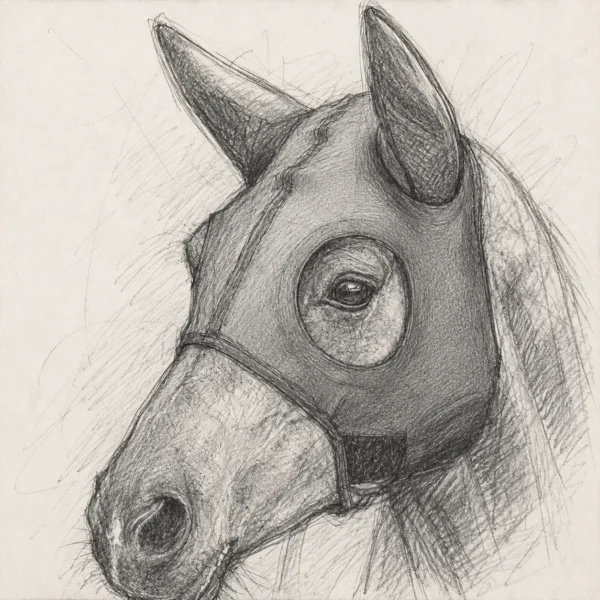
Eyeshield
“A garment similar to Blinkers except that in place of the eye cowls both eyes are covered with a mesh or other transparent material.”
Both eyes, see-through. Vision is diffused, not blocked. The accepted practical purpose — stated across the trade press, though not by any regulator — is protection from kickback, which is why it is disproportionately a British all-weather item. Australia calls the same idea a pacifier.
Eyecover
“A garment similar to Blinkers except that in place of the eye cowls one eye only is completely covered by an opaque cover.”
One eye, blanked. A specialist item rather than a milder blinker, and Ireland’s rules treat it as one: of eleven permitted headgear combinations the eyecover appears in exactly one, with a hood. You cannot stack further vision restriction on top of it.
The protective reading carries a caveat with a rulebook behind it: Britain’s older equipment instructions warned trainers about eyeshields on all-weather surfaces, where vision “has been reduced because the eyeshields have become either caked in wet sand”. The item fitted to solve a visibility problem can create one.
The notation is the genuinely unsettled part, and it is more honest to say so than to pick a letter. Formdial’s racecard guide publishes the five codes you will meet on almost every card — b, v, p, h and t. For this pair there is no regulator-set alphabet. Racing Post’s abbreviation list prints e/c for eyecover and e/s for eyeshield, plus an “e – eye hood” that matches no garment in either rulebook; irishracing.com’s card key prints ec and es; Great British Racing lists none of them. Three publishers, three answers, no governing body arbitrating.
The tongue-tie is the contested one
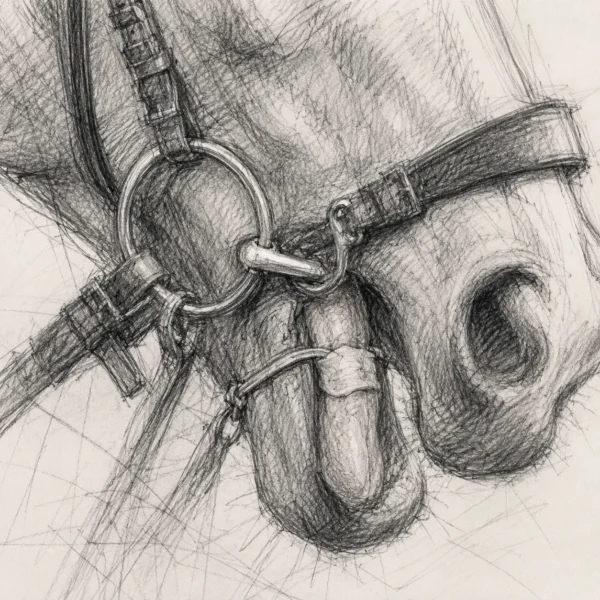
Britain’s rulebook defines a tongue strap as “a device used to tie down a horse’s tongue”, and that is the entire definition. It is not “headgear” in the technical sense — that term covers blinkers, cheekpieces, eye covers, eye shields, hoods and visors — but it is declared alongside headgear and carries the code t. Ireland draws the distinction sharply: a horse that cannot wear its declared headgear is not permitted to run, whereas if it cannot wear its declared tongue strap the raceday stewards may simply give permission to go without. Ireland also prescribes the fitting — looped but not tied, no restriction of blood flow, an effective width of at least 15mm “so as to avoid a tourniquet effect”, never secured to the bit or bridle. Britain asks only that the Veterinary Officer be satisfied with the material and the fitting.
Trainers usually describe the reason as breathing, and the survey data agrees: Weller and colleagues, surveying 112 racehorse trainers in Australia and New Zealand in 2021, found 62.5% used tongue-ties, and among Thoroughbred trainers the commonest stated reason was to prevent or reduce airway obstruction, at 72.3%. But the problem is not the one the folklore describes. Horses do not swallow their tongues — the tongue is anchored to the floor of the mouth by the lingual frenulum. What is happening is dorsal displacement of the soft palate, where the back edge of the palate displaces above the epiglottis and the horse “chokes down” at speed. The tie is meant to stop the tongue retracting.
What the evidence actually shows
The best-controlled study to date is Barton and colleagues, 2023 — 30 racehorses, overground endoscopy at full-intensity exercise, crossover and blinded. Tongue-ties did not significantly influence maximum laryngeal width or area, and the authors concluded that “the results of this study do not support the use of tongue ties to enhance upper airway function”. The study most often cited the other way, Barakzai 2009, found improved race earnings in horses that kept running in them — but it was retrospective, measured prize money rather than breathing, and confined its finding to “a selected population”.
The welfare argument deserves reporting just as straight. In that same 2021 survey, 51.4% of tongue-tie users reported complications, and horses fitted with them have been recorded showing more stress behaviours — gaping, ears back, head tossing — with raised salivary cortisol. RSPCA Australia “is opposed to the use of tongue ties because of the pain and distress they inflict on horses”. The jurisdictions have not moved together: the FEI banned tongue-ties across a range of equestrian sports in 2004, Switzerland’s animal protection law prohibits tongue tying, and Germany banned them in Thoroughbred racing in 2018, though not in Standardbred. Britain has not followed. Asked in 2018, the BHA said tongue ties “have been discussed on a number of occasions by our veterinary committee … but no proposal to ban them has ever been carried forward”.
Roughly one British starter in twenty wore a tongue-tie when that was last measured, in 2018, against more than one in five in Australia. That is where the argument sits: used sparingly here, banned across a range of equestrian sports since 2004, the strongest controlled study finding no airway benefit. A first-time t is the trainer’s diagnosis, not a verdict.
What a horse can see, and what a cup takes away
Every argument about headgear rests on a piece of anatomy most punters have never had explained. A horse’s eyes are set on the sides of its head, and the optic axes diverge by about 40°. Each eye carries a monocular field of roughly 190–195° — one recorded eye reached 228° — and between them they cover something in the region of 320–350°, depending on whose measurement you take. A grazing animal is built to see almost everything at once.
What it gives up for that is the middle. The two fields overlap in a binocular wedge most often put at 55–65°, and as wide as 80° by some authors, and here is the part that surprises people: that wedge points down the nose, running downward some 75°. It does not project forward from the forehead. Directly in front of a horse’s forehead is a blind spot. So is the ground immediately in front of its nose, out to somewhere between 1.2 and 2 metres. So is a wedge directly behind it — though how wide that rear blind arc is depends entirely on which total-field figure you start from, so no one number for it is worth quoting.
Two consequences follow, and they run against the folklore.
The part blinkers remove is the part that was poor anyway. Measured depth thresholds are about 14.8 minutes of arc using both eyes — roughly nine centimetres at two metres — against 40.8 and 83.0 minutes of arc for the same two horses tested with one eye covered. A cup does not touch the binocular wedge. It amputates the rearward and lateral monocular field, which was wide, and vague, and full of rivals.
Raising the head is aiming, not focusing. The old “ramp retina” explanation — that a horse tilts its head to bring an image into focus on a sloped retina — is dead, refuted first on anatomy in 1975 and again in 1999, when the axial length was found to differ by 9% in the opposite direction to the theory. Accommodation in a horse is under two dioptres; it is close to fixed focus from about a metre to infinity. When a horse lifts its head it is pointing its good vision at something, not adjusting a lens. That is also why a sheepskin noseband works at all: block the view of the ground and the head comes down, and with it the aim.
Sharpness
Behaviourally, about 23.3 cycles per degree — roughly 20/30 on a human chart. A horse sees the world less sharply than you do, and the sharpness it has is concentrated in a horizontal band of retina: counted anatomically, that streak resolves 16.5 cycles per degree against 2.7 in the periphery.
Colour
Two cone types, peaking at 428 and 539 nanometres, with a neutral point around 480. Blue show-jumping fences drew significantly more faults than green ones indoors — the same colour made no difference outdoors on grass.
The eyes roll
The pupil is a horizontal slit, and each eye counter-rotates by as much as 50° to keep that slit level as the head drops. It has been filmed. The horizon stays where it should be however the head is carried.
What the science does not say
It is often written that horses are especially sensitive to movement in the periphery. The standard veterinary text explicitly warns against that inference and says the question remains to be determined in horses. A horse has an unusually large field, which is not the same as a heightened sensitivity within it. We have left that claim off this page.
Nor is there any peer-reviewed work on whether blinkers improve racing performance. The only controlled trial of blinkers we could find used eight driving horses and produced a result nobody quotes: heart rate rose in response to unfamiliar sounds and fell in response to familiar sights. Ear covers, by contrast, have measurable evidence behind them — heart rate 46.3 against 50.1 beats per minute, and fewer behavioural responses, in an eighteen-horse trial.
Declared by the deadline — but not frozen after it
Headgear is paperwork before it is equipment. Under the BHA’s Equipment Code, any headgear or tongue strap to be worn in a race must be declared when the trainer submits the declaration to run. Nothing reaches the card that was not filed.
What happens next is the part most readers miss. Paragraph 6 lets a trainer add or remove headgear after declaration, provided the request comes within two hours of the deadline and the fee is paid. Paragraph 7 lets a trainer swap one declared piece for another right up to weighing out, on payment of the financial penalty. An overnight card states intent, not fact — so read a current one.
Then the rules bite. Declared headgear must be worn on the way to the start and during the race; if it is not worn to the start, the horse is withdrawn. Undeclared kit found at the start has to come off, and the horse may then run — if it cannot be removed, the starter withdraws it. The BHA’s November 2022 update confirmed the practice: the horse runs as long as the equipment is removed, with a Band B fine of £140, the item taken off by the starting team or stalls handlers, typically during girth checks.
Ireland runs the same idea with different levers — declaration to Horse Racing Ireland by the deadline, errors correctable by telephone up to 12 noon on declaration day, a €65 fine for wrong or missing equipment in the parade ring, and no run at all if the declared headgear cannot be worn.
The clearest illustration is a case the regulator got wrong. At Ffos Las on 16 April 2024, Peter Bowen declared cheekpieces on Pilgrims King, then asked to swap them for a tongue strap before the 3.05 novice handicap chase. The swap was allowed — but a tongue strap is not a permitted substitution for declared headgear under Paragraph 7. Pilgrims King won in kit he should not have been permitted to wear. The BHA said it had been permitted in error and apologised; Bowen was fined £140 for the original declaration error. Nothing was reversed. The result stood.
First-time blinkers win less often, not more
This is the finding that should reset how the digit is read. Horses in blinkers for the first time win at a lower rate than horses in no headgear at all, in both of the published cuts that print a bare-headed control — the other datasets in the table publish no control, so they can neither confirm nor deny it.
And the price side runs the other way from the strike rate: Power’s first-time blinkers lost under 3p in the £ against no-headgear’s 4p on the same basis, Bisogno found them “sent off at bigger odds than ought to be the case”, and Renham’s first-time cheekpieces — 10.7% strike, losses of only 1.2% — are the best return in this page’s whole evidence base. Fewer winners, better prices.
How to read these figures
Every number here is quoted from a named third-party analysis; Formdial has not recomputed any of them from raw data. Each carries its sample size, period, jurisdiction and price basis, and where a source published a percentage without a sample size, that gap is stated rather than hidden.
| Source | First-time blinkers | No headgear | Sample | Period & code |
|---|---|---|---|---|
| Bisogno, geegeez, 30 Aug 2017 | 9.53% | 11.76% | per-bucket n not published | UK, all racing, 2014–2016 |
| Bisogno, geegeez, 30 Aug 2017 | 9.56% | 11.15% | per-bucket n not published | UK, all racing, 2012–2013 |
| Renham, geegeez, 14 Nov 2023 | 8.5% | not given | 205 wins / 2,402 runs | UK National Hunt, from 1 Jan 2017 |
| “Steeplechasing”, The Racing Forum, 28 Feb 2011 | 6.5% | not given | 1,121 wins / 17,344 runs | GB Flat, jumps and all-weather, 1 Jan 1996 – 27 Feb 2011 |
The third run is where it turns. Bisogno’s ladder for UK racing in 2014–2016 runs 9.53% first time in blinkers, 10.96% second and 12.74% third, against a no-headgear control of 11.76% — so blinkered runners pass bare-headed ones only between the second and third application. UK handicaps across all codes 2012–2016 hold the shape: third run 12.29% against 11.18%. Sample sizes are not published for any of those buckets, so treat them as strike rates from a named analyst rather than verified counts.
Profit is the harder test, and headgear mostly fails it. Renham’s first-time blinkers over jumps returned –15.3% (a £367.95 loss) from 2,402 runs, UK National Hunt from 1 January 2017, Betfair SP less 5% commission. Darren Power’s Flat study — UK turf and all-weather, 2016 to 2022, over 100,000 runs, Betfair SP less 5% — found horses not in headgear won 11.3% for losses of 4p in the £, while all headgear combined lost 9p in the £.
One published window did make money, and burying it would be dishonest. Bisogno found that backing every UK first-time-blinkers runner from 2012 to 2016 returned +10.66% ROI — 675 points from 6,338 bets at Betfair SP, flagging at once that the figure is skewed by Morning Post’s 100/1 win in 2013, which returned 470 on the exchange. Restricting to handicaps removes that horse and still leaves +9.28%, 440 points from 4,743 bets, no winner bigger than 75.
But that result lives entirely in its units. Bisogno’s starting-price figure for first-time blinkers in 2012–2013 was –5.6%, sample size not published, against +10.66% at Betfair SP over the overlapping 2012–2016 window. Take the bookmakers’ starting price and there was no edge in the same years the exchange showed one.
When the market does get excited, the excitement has been over-done rather than under-done. Power isolated 910 runners that started favourite in first-time cheekpieces: 262 winners, 28.8% strike rate, losses of £122.50, ROI –13.5% (UK Flat, 2016–2022, Betfair SP less 5%). The counter-evidence belongs here too — Renham found first-time blinkers priced 9/4 or shorter over jumps returned +27.6% from just 104 runners, 49 winners, profit £28.75 (UK National Hunt, from 1 January 2017, Betfair SP less 5%). The two contradict each other and differ in code, headgear type and filter. At 104 bets, +27.6% sits inside what chance produces; the 910-runner figure is the one to lean on.
The sharpest published split in the whole body of evidence is sex and age.
| First-time blinkers | Wins / runs | Strike rate | P/L | ROI |
|---|---|---|---|---|
| Colts | 100 / 781 | 12.8% | +£1.55 | +0.2% |
| Mares | 11 / 194 | 5.7% | –£84.62 | –43.6% |
| Females aged 4+ | 25 / 575 | 4.3% | –£286.49 | –49.8% |
| Class 1 races | 14 / 222 | 6.3% | –£101.15 | –45.6% |
Darren Power, On Course Profits, 1 June 2023 — UK Flat, turf and all-weather, 2016 to 2022, Betfair SP less 5%. Colts roughly broke even over 781 runs; older fillies and mares lost half the stake over 575, on a stated A/E index of 0.58 — barely more than half as many winners as their odds implied. Power’s own age cut is the one positive line in the table’s source: two- and three-year-olds in first-time blinkers were profitable in five of the seven seasons — “a horse we should not dismiss”. And the better the race, the worse it got, in Class 1 company.
The horses in blinkers were already the problem
None of this means blinkers make horses run worse. It means the horses that end up in blinkers were selected for being disappointing, and a self-selected population of underperformers will underperform whatever is strapped to its head.
Simon Rowlands, writing for Timeform, put it plainly: it is “not necessarily, or even probably, the case that blinkers make horses run worse”. They are applied for a reason, and that reason is often that the horse is threatening to become disappointing, or already has. The correlation is real. The causal claim buried inside it is not proven.
The same reasoning cuts at the rising ladder, and it needs saying out loud because none of the sources control for it. A horse reaching a third start in blinkers is a horse whose trainer did not take them off; horses that ran badly first time frequently lose the headgear, so they never enter the third-run bucket. Survivorship alone could produce that 9.53% → 10.96% → 12.74% climb without the blinkers doing anything. That is our reading of the mechanism rather than a published finding — but it is the first question to ask of the most quotable number here.
Composition distorts cross-border comparisons too: Bisogno notes Irish blinkers data is skewed by the Mullins and O’Brien yards, which dominate Irish racing and rarely use blinkers — 300 blinkered runs between them against 5,122 no-headgear runs, 5.5% (Ireland, 2012–2013).
What nobody appears to have published
Several of the most confidently repeated headgear angles have no measured evidence behind them that we could find. Saying so is worth more than filling the space with a number.
Searched for, not found
- Headgear removal. “Blinkers off” is one of the most repeated angles in the sport, and we could not find one published strike rate, ROI or A/E for it in Britain or Ireland, at any sample size — only qualitative opinion with no data attached.
- Market movement. No published study isolating what prices do after a headgear declaration. Trading material discusses price movement generically and never separates headgear out.
- Second-time headgear returns. The strike-rate ladder exists. No source we found publishes an ROI or an A/E for the second run specifically.
- Class drops and trip changes. The classic combination angles have no published figures. Race-quality data exists — the Class 1 row above — the interaction does not.
- Form figures suggesting hanging or idling. The most intuitive use of headgear in racing, and no measured data at all.
- The sheepskin noseband. Undeclared, uncoded, unrecorded — so nobody can back-test it, ourselves included.
These are stated as what we could not find, not as proof that nothing exists. Either way: if you are quoted a percentage for “blinkers off”, ask out of how many.
One input, weighted honestly
Headgear is a note, not a bet. The one thing that replicates across every dataset above is that first-time blinkers win less often than bare-headed runners, which makes the declaration information about the trainer’s opinion of the horse rather than a reason to back it. Something was wrong; the yard is trying to fix it. Whether it works is the open question.
Trainer angles are where this gets abused, and the base rate is the antidote. Steve Carter’s review of UK Flat handicaps from 2017 to 2021 — restricted to yards with at least 25 first-time-headgear runners and at least five winners — found 46 qualifying yards, of which only 10 showed a profit at Betfair SP with an A/E above 1.00. About one in five, roughly what noise alone produces. The spread between yards is real enough — in Power’s Flat study (UK, 2016–2022, Betfair SP less 5%), Ralph Beckett struck at 26 wins from 123 first-time-blinkers runners against 3 from 72 for Keith Dalgleish — but a gap that size is a reason to ask a question, not an answer.
The traps worth naming
- Small samples. Renham publishes Gary Moore at 7 wins from 28 first-time-blinkers runners for +108.1% ROI (UK National Hunt, from 1 Jan 2017, Betfair SP less 5%) — responsibly, with the 28 attached. At that size two lucky prices make a legend, and the figure then travels without its denominator.
- Missing sample sizes. A Racing Post daily-stats piece (13 January 2023) carried a trainer’s “31 per cent strike-rate” with first-time cheekpieces, with no sample size and no period. As printed it cannot be checked, so it cannot be used.
- The anecdote. “It won last time in first-time blinkers” is one observation from a population winning 6.5% to 9.6% of the time. The winner is memorable. The eleven losers are not.
- Hindsight. Every study here is a backward-looking cut. The 2012–2016 profit did not repeat in 2016–2022, and the angle lost over 1996–2011 and over jumps from 2017.
- Conflation. A tongue-tie is not headgear in a British declaration — declared separately, sanctioned differently, and different again in the data.
What headgear is genuinely good for is confirming a story you already have. A yard fitting cheekpieces to a colt dropping in class, in a race whose pace map suits a horse being pushed forward, is a different proposition from a first-time visor on an older mare in Class 1. The published numbers cannot price that combination — nobody has measured it — but they can tell you which half of it is already in the odds. Judge afterwards on speed figures rather than the finishing position.
Casual readers walk past the digit. The market does not. Treat it as a clue to intent, stake it on the plan like any other bet, and let the rest of your reading carry the weight.
Headgear, in short
They are the headgear the trainer has declared. In Britain and Ireland: b is blinkers, v a visor, p sheepskin cheekpieces, h a hood and t a tongue-tie, with the Racing Post also publishing e-codes for the eyeshield and the eyecover. A digit follows the letter when the horse is wearing that item for the first or second time — b1 is first-time blinkers. What the letters do not tell you is just as important: a sheepskin noseband, earplugs and a red hood in the preliminaries are all worn without appearing on any racecard.
Not on the evidence. Horses in first-time blinkers win less often than horses in no headgear at all — 9.53% against 11.76% in a UK study covering 2014 to 2016, and the only other published cut with a no-headgear control shows the same direction. The reason is selection, not the equipment: headgear gets fitted because a horse has been disappointing, so the population wearing it is a weaker population to begin with. A first-time b tells you the trainer has diagnosed a problem, which is not the same as telling you the horse will win.
A visor is blinkers with holes cut in the cowls, permitting limited side or rear vision. It is therefore the lesser restriction, not the greater — which is the single most commonly inverted fact in betting copy. Blinkers cut out vision to the rear; the visor hands a strip of it back. Both leave the horse's forward binocular vision completely untouched.
Only by substitution, and only with permission. Headgear must be declared by 10:00am two days before the race, with a two-hour window to noon to add or remove it for a fee. After that a trainer may ask the BHA to substitute one item for another up to the point of weighing out, and that carries a penalty. What cannot be done on the day is simply adding headgear to a horse that was declared without it, or stripping it off entirely.
The rulebook does not say they do. The BHA defines cheekpieces as two strips of sheepskin of equal size attached to the cheek pieces of the bridle — and it is the only item of headgear the rules define without reference to the vision it removes. Every other item is defined by what the horse can no longer see. The sheepskin sits alongside the eye rather than across the line of sight, which is why cheekpieces are usually reached for before blinkers rather than after them.
Before you bet
Headgear is one line of evidence among many, and the strongest finding on this page is that it does not do what most people assume it does. Never stake more than you can afford to lose, and treat a first-time b as a question rather than an answer.
If betting has stopped being enjoyable, our responsible gambling page sets out where to get help — including the National Gambling Helpline on 0808 8020 133, free and open around the clock, and GAMSTOP if you want to self-exclude.
Read the rest of the guide
Headgear is one line on a racecard. The rest of the card — the class, the going, the draw, the weight — is covered the same way, one page at a time.