Good morning. It’s been a lengthy break consisting of both reflection and research, which I’m hopeful will lead to a more consistent approach. I have been painfully eager to get back to the posts, but also very aware that I should only do so when feeling ready, else any break would be rendered somewhat pointless. Whilst away, I’ve been working on a ratings system which will form a major factor in how selections are made going forward. I’m hopeful of having these in a shape to go public in time, but for now, in their raw state, they will just run in the background.
With the not-so-small matter of a South Coast Derby to attend early today, the post is a limited one, with just the selections going up, so do forgive a somewhat stunted return.

Raced far side, in touch in group, outpaced over 1f out, rallied inside final furlong, no impression, 5th of 9 in group
Took keen hold, soon pressed leader, ridden over 1f out, no extra towards finish
Onetingfornuttin (10/3, Chepstow 16:57).
Best of luck to all getting involved today.
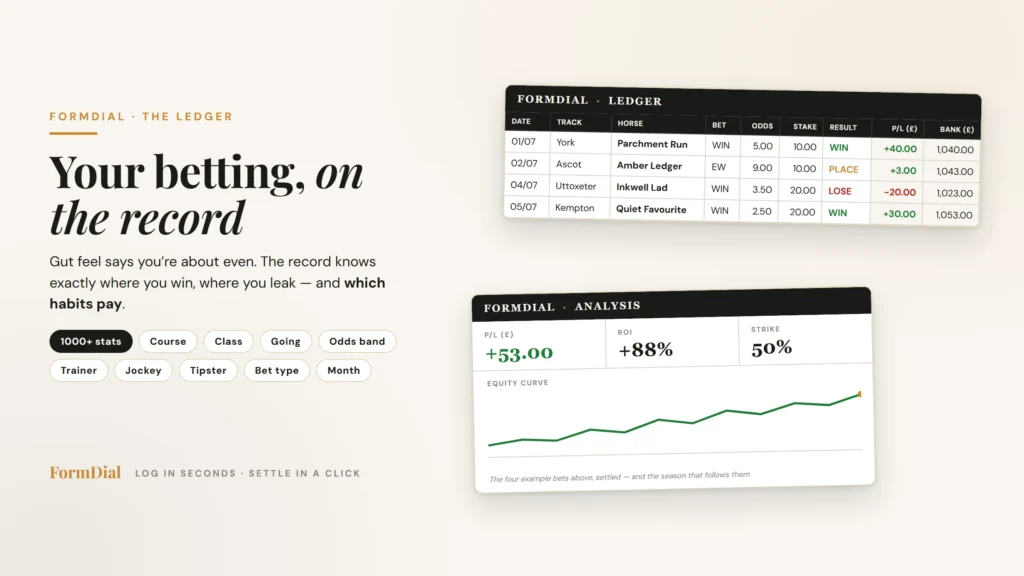
Every Daily Dial bet ends up in the public log, win or lose. The Formdial Ledger gives you the same engine for your own betting — log bets in seconds, settle them in a click, and see your real strike rate and ROI.
Get your Ledger£29.99 a year · cancel any timeWhy no advised bet some days?
Because there isn't one. The cards don't always offer value, and the worst thing a tipster can do is force a selection just to fill a slot.
A "No Bet" day is the system working — it's the same discipline that produces the winners on the days the bets are right. Better to sit out a card cleanly than to bleed the bank on filler. The best days are usually the ones I've been patient before.
What do the stake points mean?
Stakes are sized in points, not pounds — that way the same plan works on any size of bankroll.
The Daily Dial uses a simple scale: 1pt is the minimum bet (or 0.5pt each-way), 2pt is a standard bet (or 1pt each-way), and 5pt is the maximum on the strongest fancies (or 2.5pt each-way). The whole thing runs off a 100pt bankroll, so a £100 bank means a point is £1 and a 2pt bet is £2; a £1,000 bank means a point is £10 and a 2pt bet is £20. Scale to whatever feels comfortable.
What's a sensible bankroll?
Whatever you can genuinely afford to lose, full stop. Don't play with rent money. Don't chase last week.
For new starters, a sensible starting point is a £100 bank at £1 per point. From there, scale the unit up by 0.5pt for every 50% the bankroll grows — £150 bank → £1.50/pt, £200 → £2/pt, £250 → £2.50/pt, and so on. The inverse — cutting the unit when the bank drops — is good practice but personal preference; I don't do it myself but it's sound advice for most.
What does "each-way" mean?
An each-way bet is two bets in one — a Win bet and a Place bet, each for the same stake. So 1pt each-way means 1pt to win plus 1pt to place: 2pt total out of the bank.
The Place part pays out at a fraction of the win odds (usually 1/4 or 1/5) if the horse finishes in the places — typically the first 3 or 4 depending on the race. Each-way is the right call when the price is generous enough that the place return alone covers the stake. Full guide here.
New to this? Read up on: Pace Bias · Each-Way Betting · Betting Odds

Be a founding member of a brand new UK syndicate.
“We don’t want to be on the perimeter, watching from the stands. We want to walk into the winners enclosure as owners and we want to bring a whole generation with us.”
- Shares from
- 1%
- Up front from
- £350
- Available now
- Two horses