Aintree
National Hunt
Ormskirk Road, Liverpool · Home of the Grand National
Turf
Left-Handed
Flat
What is Aintree like as a jumps track?
Aintree is not one racecourse but three, and you need to be clear which one you are handicapping before you do anything else. The Grand National course — triangular, left-handed, roughly two miles two furlongs round, spruce fences — is a specialist test that most horses will never face; the National itself is two circuits of it, sixteen fences the first time and fourteen the second, and it finishes with a 494-yard run-in that bends at the Elbow, one of the longest and most punishing finishes in British jump racing — though not the longest, a distinction Cartmel claims with a four-furlong chase run-in. Inside it sits the Mildmay chase course, used for most of the chasing here: flat, sharp, left-handed, with conventional birch fences and a run-in of roughly 200 yards — a different finish entirely. Racing Post gives the Mildmay circuit as 1m3f; Wikipedia’s account of the layout when it opened in December 1953 makes it a little over 1m2f; Aintree publishes no official measurement of its own, so read the figure as approximate. And the hurdles are a third track again, a separate left-handed oval of about the same length with six flights to a circuit. Not every source counts three courses — the section below sets out where they part company, and why the going line settles it better than the label does. Conflating them is the most expensive mistake you can make at Aintree.
Flat does not mean easy here, and the best short description of why belongs to a rider. At The Races’ Aintree course guide carries Mick Fitzgerald’s view from the saddle: “Even though it’s flat, it can be very testing for a horse, so you need one that can travel. The winner is almost always still on the bridle leaving the back straight … and those that aren’t really struggle to get home.” That is a jockey’s read rather than a measurement, and this page offers it as exactly that. The Mildmay course is what the form analyst encounters on most visits: sharp bends at both ends, three fences in the home straight with a long run between the last two, and a short run-in after that. The sharpness is not cosmetic — it can inconvenience long-striding, galloping types that need time and space to wind up, and it rewards horses that are agile, travel fluently within their races, and jump without losing momentum on the turns. In the competitive Festival handicaps the pace is usually strong from the start, because a flat track and a big field leave nobody an incentive to dawdle; do not carry that assumption into a small-field Grade 1, a novice race or an ordinary fixture.
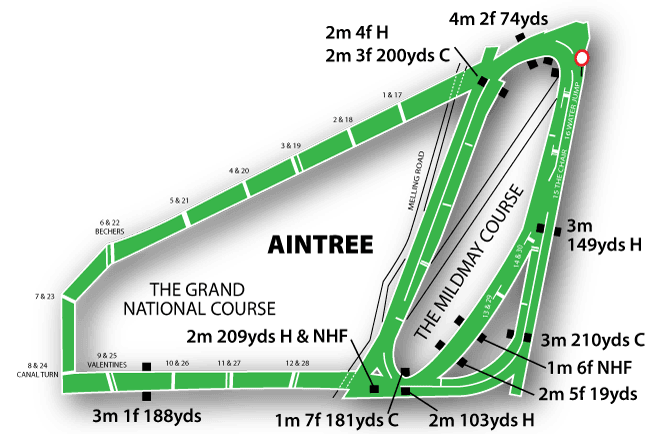
Mildmay Chase Track
- CircuitAbout 1m3f per Racing Post; no official measurement is published
- Fences8 per circuit, birch, conventional height
- Home Straight3 fences, long run between the last two
- Run-inApprox. 200 yards — short after the final fence
- BendsSharp at both ends; can inconvenience long-striding types
- GoingReported with the hurdle course, separately from the National course — see the going section below
Track & History
- Founded1829 as a flat course; jump racing from 1839
- OwnershipThe Jockey Club
- Mildmay CourseOpened December 1953, named for amateur champion Lord Mildmay
- Key MeetingsGrand National Festival (April); late October, headed by the Old Roan Chase; November, headed by the Molyneux Hurdle since 2026; December, with the Becher Chase and Grand Sefton on one card; and the Formby Novices’ Hurdle on Boxing Day
- ConfigurationsThree — Grand National, Mildmay chase and hurdle; some sources count two
- Similar TracksKempton (rhythm), Fontwell (sharp), Market Rasen
When does Aintree race?
The most famous steeplechase in the world, and from 2026 a 72-hour declaration race — final declarations are made on the Wednesday rather than the Thursday, so the field, the bookings and the reserves are all knowable a day earlier than they used to be. Run over two circuits of the National course with its spruce fences, including Becher’s Brook, the Canal Turn and The Chair. Stamina and jumping accuracy are still fundamental, but do not downgrade class. The 2024 changes were a package: the maximum field cut from 40 to 34, the first fence moved 60 yards nearer the start, a standing start for every race over these fences, fence 11 lowered by two inches with the landing side levelled off, foam and rubber toe boards throughout, and the minimum handicap rating raised from 125 to 130. Early evidence from that era says class and weight should no longer be treated as automatic negatives: I Am Maximus carried 11st 6lb to win in 2024, Nick Rockett 11st 8lb in 2025 and I Am Maximus 11st 12lb — the maximum, and a record for this century — when he regained it in 2026. Three runnings is three runnings; Willie Mullins put it as well as anyone afterwards, that it is still very hard to win off top weight, “but maybe the modern day National is changing and we have to look at it differently”. Trends drawn from the 40-runner era are not measuring the same examination. See our full Grand National guide for the fences, the betting, and what happens to the horses afterwards.
The championship staying chase of the festival. Attracts Gold Cup graduates stepping back in trip and proven three-milers. A strong pace on the Mildmay circuit sorts out those with any jumping weakness.
Run on the middle day of the festival, this is the intermediate-distance championship chase. Often attracts Queen Mother Champion Chase runners stepping up. Moscow Flyer, Sprinter Sacre and Viking Flagship have won here — Altior did not, despite the association: Nicky Henderson sent him to Sandown’s Celebration Chase in 2019 instead, and Min won the Melling that year.
The Festival’s flagship hurdle, and hurdle-course form rather than Mildmay form. The flat track gives Champion Hurdle horses every chance of staying the extra half-mile: on the trends published by The Stats Don’t Lie, updated after the 2026 running, seven of the last eleven winners came here straight from the Champion Hurdle, three of those seven having won it (the 2020 running was cancelled). That is a winner profile, not a strike rate. Constitution Hill won here in 2023.
New to Aintree from 2026 and the feature of the November meeting — the former Elite Hurdle, switched here from Wincanton and renamed as part of the autumn jumps programme reshuffle. A Grade 2 over 2m209y and nine flights — the same trip and the same flight count as the Formby on Boxing Day, which is the clearest illustration on this page of what the hurdle course actually is. Read it as hurdle-course form rather than anything to do with the spruce.
One of four handicaps run over the big spruce obstacles across the season, alongside the Grand Sefton — which moved back onto this same December card from 2026, giving one afternoon with two races over the National fences — the Topham in April and the National itself. This is the race where previous experience over the spruce is the common winner profile: in geegeez’s published 22-renewal trends, covering the runnings from 2002 to 2023, 14 winners had run over the National fences before and eight had not — and 2025’s winner Twig had run in that April’s Grand National. Read that as a description of who won, not as a measured edge: it counts winners only, and never counts how many runners had the experience. Do not carry it across to the National itself — see the betting angles below.
The intermediate-distance novice chase of the Festival, first run in 2009 — one of three novice chase championships here rather than the novice chase championship. Cheltenham novice chase form is the dominant trial; the key question is whether the horse can handle the Mildmay’s sharper bends after Prestbury Park.
The staying novice chase championship of the Festival, first run in 1981 and Grade 1 since 2014. Its first two winners, Bregawn and Burrough Hill Lad, both went on to win the Cheltenham Gold Cup — the strongest advertisement any Aintree novice race has for its own form.
The two-mile novice chase championship, completing Aintree’s set across the distance range with the Manifesto and the Mildmay. Arkle form is the obvious trial; the sharper track suits a slick jumper rather than a grinder.
The staying hurdle championship of the Festival, and the natural target for Stayers’ Hurdle horses. Judge it on the hurdle course rather than the chase-track read — the two are analysed separately here for a reason.
One circuit of the National course on the Friday of the Festival, first run in 1949 and known as the John Hughes Trophy from 1989 to 2001. Read it as National-fence form, not as Mildmay form at a similar trip — and note that this race and the Grand Sefton are the whole of the one published pace sample that favours front-runners at Aintree.
Eighteen of the spruce fences, for horses aged six and up. Back on the Becher Chase card from 2026 with the prize fund restored to £100,000, giving one December afternoon with two races over the National fences. With the Topham it makes up the published pace sample in which Aintree front-runners have done best.
The amateur riders’ race over the spruce, for horses aged six and up. With the Topham and the National it is one of only three races run over these fences at the April Festival.
A limited handicap over sixteen conventional fences and the feature of the autumn opener, established in 2004. The first serious Mildmay chase form of the season.
The Festival’s two-mile Mildmay handicap chase, 12 fences, run on the Thursday. It matters more than its grade suggests for anyone reading this page’s pace section: this is the configuration and the trip the 2018 study measured — Mildmay chases at 2m1½f or shorter, where Aintree front-runners returned an impact value of 0.90. That is the one Mildmay-only run-style sample on the page, and this is the Festival race it speaks to.
Nine scheduled flights for novice hurdlers — worth saying as scheduled, because Aintree omits obstacles for low sun often enough to matter, and the 2025 running was cut to five. It is the old Tolworth Hurdle, moved here from Sandown in December 2023 as part of the jumps pattern changes, and it is the strongest novice hurdle form Aintree produces before the spring.
Which course is this race on?
This is the first question to answer at Aintree, and the racecard heading does not answer it. The three configurations share a postcode and very little else. The table is the quick version.
Aintree by Configuration
| Configuration | Obstacles | Principal races |
|---|---|---|
| National course | Spruce fences — Becher’s Brook, the Canal Turn, The Chair | Grand National, Becher Chase, Topham Chase, Grand Sefton Chase, Foxhunters’ Chase |
| Mildmay course | Conventional birch fences | Aintree Bowl, Melling Chase, Manifesto, Mildmay and Maghull Novices’ Chases, Old Roan Chase, Red Rum Handicap Chase |
| Hurdle course | Hurdles | Aintree Hurdle, Liverpool Hurdle, Molyneux Hurdle, Formby Novices’ Hurdle, and the Festival’s Anniversary, Top Novices’, Mersey and Sefton Novices’ Hurdles |
Racing Post names the Topham, the Foxhunters’, the Grand Sefton and the Becher as the other races run over the Grand National fences, and Wikipedia’s Foxhunters’ entry puts it more sharply: with the Topham and the National itself, it is one of only three races over those fences at the April Festival. Across the whole season there are five: four handicaps — the National, the Becher, the Grand Sefton and the Topham — plus the Foxhunters’. Everything else at Aintree is Mildmay or hurdle-course form.
One honest caveat, because the sources do not all count three courses. Wikipedia describes a separate hurdles’ course — a left-handed oval of about 1m3f with sharp bends and six flights, three down the back straight and three in the home straight, the oldest of the three and Aintree’s Flat track until the last Flat race was run here in 1976. Racing Post and Racing TV describe Aintree as two courses and treat the hurdle races as Mildmay racing. What settles it for a punter is not the label but the ground: on the Friday of the 2026 Festival, Racing Post reported the Grand National course still good to soft while the chase and hurdle courses had quickened to good to soft, good in places. Two readings, one afternoon, one racecard.
Hurdle Course
- CircuitAbout 1m3f, left-handed oval, sharp bends
- FlightsSix a circuit — three down the back straight, three in the home straight
- HistoryThe oldest of Aintree’s courses; the Flat track until 1976
- GoingReported alongside the chase course, separately from the National course
- Reading itFestival hurdle form is hurdle-course form and says nothing about the spruce
Grand National Course
- CircuitTriangular, left-handed, roughly 2m2f round
- FencesSixteen spruce fences a circuit, including Becher’s Brook, the Canal Turn and The Chair
- Run-in494 yards, bending at the Elbow
- Used forFive races a season — the National, Becher, Topham and Grand Sefton handicaps, plus the Foxhunters’
- Since 2024A standing start applies to every race over these fences
How does the ground ride at Aintree?
Aintree waters to a target, and the target is on the record. The Jockey Club’s 2019 account of its £1.5 million investment in the turf says the irrigation system is used to regulate the water going onto the track so that the density of the soil is controlled “to ensure it is always at its safest for racing”, which the same page defines as ground on the softer side of Good. The grass is cut to four inches across the whole circuit for cushion, and the ground is de-compacted through the year. That is a groundstaff aim rather than a forecast. It tells you which way the clerk leans; it does not tell you how the ground has actually ridden, and this page has not measured that.
The practical point is that there is more than one reading, and they move at different rates. On the Friday of the 2026 Festival, Racing Post reported the Grand National course as good to soft while the chase and hurdle courses had gone to good to soft, good in places, after 5mm of water had been applied to both tracks overnight. Clerk of the course Sulekha Varma put the difference down to the weather rather than the watering: “there are a few bits on the Mildmay course which have a touch of good”, after a very windy night. Wind and sun shift a watered surface faster than the calendar does, and they do not shift all three configurations together.
Raceday Going Checks
- Read the going for the course your race is actually on. The National-course description and the chase and hurdle description can differ on the same afternoon, and did in April 2026.
- Track the watering, not only the rain. Aintree waters through a Festival, and watering between days is an established possibility rather than an emergency — the 5mm above is one recorded instance, not a frequency.
- Watch the wind. A dry, windy night has quickened this ground with water already on it.
- Take the going across all three days rather than from day one. Watered turf at a three-day meeting can move in either direction between Thursday and Saturday.
- Treat the going as a going question. The run-style studies on this page do not split Aintree by ground, so there is no going-based pace rule here to apply, and this page does not invent one.
The Number That Matters
The structural argument for pace at Aintree is easy to make: a flat surface lets horses sustain speed without the energy cost of climbing, sharp bends let a leader take the shortest line, and the short Mildmay run-in leaves little time to close. Three published studies have measured it, and they do not all point the same way — which is the finding here, not a nuisance to be averaged away. All three are handicap chases, so none of them speaks to hurdles. They do take in the National fences, though, and in one of them the whole Aintree sample is National-fence racing — which turns out to be the single most useful thing on this page about pace.
The oldest is the most negative. Dave Renham’s geegeez study of handicap chases at 2m1½f or shorter, published in September 2018 with no sample period stated, identified 43 Aintree front-runners and found four of them won — a 9.3% strike rate at an impact value of 0.90, one of only eight British courses in that study below 1.00. The same article’s race counts put the Aintree sample at 31 races, so 43 is leaders, not contests.
His companion piece on the staying trips is where this guide has been wrong. Published in January 2019 and covering 2014 to 2018, it identifies 33 Aintree front-runners at 2m7f to 3m3f, of whom four won: 12.1%, low enough to place Aintree in the article’s poorest strike-rate table. But the article then prints a second table of every course with a front-runner impact value below 1.20 — Fontwell 1.03, Bangor-on-Dee 1.01, Huntingdon 1.01, Sandown 0.95, Wetherby 0.92 — and Aintree is not on it. Renham writes that the remaining 36 courses all have an edge for front runners. The low strike rate is a field-size effect. Renham makes the point himself in the companion short-trip article, where Cheltenham sits 23rd on strike rate and 4th on impact value because, in his words, chases of that type there have many more runners on average than at other racecourses. An earlier version of this section quoted an impact value for Aintree’s staying leaders that the article never gives them — it is the dataset-wide figure for hold-up horses. It has been withdrawn, and so has every conclusion that rested on it. One more thing about that band: at 2m7f to 3m3f it takes in the Becher Chase, run over the National fences at 3m1f188y, alongside Aintree’s Mildmay staying handicaps. How much of the 33 is Becher runners is not published, and is not guessed at here.
The newest study is the most positive, and it is not about the Mildmay at all. Renham’s two-part update, covering 1 January 2017 to 6 October 2024 in handicap chases of seven or more runners, could not table Aintree at 2m5f to 2m6f for want of races, but says of it that four of the 14 races were won by front runners in fields averaging twenty, and that from limited data front runners at Aintree look to have an edge. Read that band against the programme: Aintree has no Mildmay chase at 2m5f to 2m6f. Its chase ladder runs 2m, 2m4f and 3m1f, and every 2m5f chase here — the Topham, the Grand Sefton and the Foxhunters’ — is run over the spruce. Two of those are handicaps, and matching the study window against Aintree’s programme accounts for all fourteen: the Topham was run seven times inside it (2020 was lost to Covid) and the Grand Sefton seven. That last step is our reconstruction rather than a label the study prints, and we would rather show the working than hide it. A twenty-runner average field says the same thing: no Mildmay handicap chase here draws twenty. So the one positive pace figure on this page is a National-fence figure — front-runners have won four of those fourteen, not some middle-distance result on the inner track. Note the narrowness of that: the study reports only the led group for Aintree, because the course did not make its run-style table, so nothing is published here about horses that merely raced prominently. The update’s summary across all four bands is blunter still: only two courses saw front runners at a disadvantage overall, and they were Bangor and Ffos Las.
So there is no track-wide Aintree pace rating worth carrying into a race, and the combined evidence does not support treating the place as generally hostile to front-runners across its courses and trips — though the 2018 short-trip figure above is real contrary evidence at that one trip on the Mildmay. Establish the course, the discipline and the trip first, then read the pace map.
Front-Runners in Aintree Handicap Chases: What Has Actually Been Measured
| Study | Filters | Denominator | Aintree result |
|---|---|---|---|
| geegeez, Sep 2018 2m1½f or shorter | Handicap chases, 6+ runners; no sample period stated | 43 identified front-runners, across 31 races | 4 wins, 9.3%, IV 0.90 |
| geegeez, Jan 2019 2m7f–3m3f | Handicap chases, 6+ runners, 2014–2018 | 33 identified front-runners | 4 wins, 12.1%. No Aintree IV published, and Aintree is absent from the article’s list of courses below 1.20 |
| geegeez, Oct 2024 2m5f–2m6f the Topham and Grand Sefton, over the National fences | Handicap chases, 7+ runners, Jan 2017 to Oct 2024 | 14 qualifying races — the Topham ran 7 times in the window and the Grand Sefton 7, and Aintree has no Mildmay chase at this trip | 4 won by front-runners, average field 20; the author calls it an edge from limited data |
| National course | See the 2m5f–2m6f row above, which is entirely National-fence racing; the Becher also sits inside the 2m7f–3m3f band | The same 14 races as the row above | Front-runners have won 4 of the 14. Only the led group is published for Aintree; nothing separate is published for the Grand National itself |
The practical read: there is no track-wide running-style rule to carry into an Aintree race, but there is a configuration one. The one clearly negative published figure is short-trip, is now eight years old and states no sample period; the newest study finds an edge over the National fences and lists Aintree nowhere among the courses where leaders were at a disadvantage. What does still hold is the mechanical point about the Mildmay finish — 200 yards after the last is not long, so a horse still detached at the second-last may simply have left itself too much to do — which is worth checking against its stamina, its jumping and its class before you credit it with an excuse. And remember what a run-style figure is: it classifies a horse as having led once the race has been run. It records what became of horses that got the lead, not the return on backing a horse you expect to lead — and no A/E or starting-price breakdown is published for Aintree in any of these samples. Judge it race by race, from the pace map.
Which trainers and jockeys win most at Aintree?
| Trainer | Runs | Wins | Win% | Places | Place% | A/E | P/L |
|---|---|---|---|---|---|---|---|
| 1 Henderson, N J | 443 | 77 | 17.38% | 141 | 31.83% | 1.05 | -64.74 |
| 2 Nicholls, P F | 445 | 55 | 12.36% | 127 | 28.54% | 0.84 | -132.21 |
| 3 Skelton, Daniel | 366 | 54 | 14.75% | 133 | 36.34% | 0.92 | +43.17 |
| 4 Twiston-Davies, N A | 319 | 37 | 11.60% | 89 | 27.90% | 0.94 | -112.93 |
| 5 Mullins, W P | 219 | 32 | 14.61% | 82 | 37.44% | 1.01 | -35.65 |
| 6 Bowen, Peter / Michael | 210 | 28 | 13.33% | 66 | 31.43% | 1.12 | +15.00 |
| 7 O’Neill, Jonjo and AJ | 260 | 26 | 10.00% | 64 | 24.62% | 0.84 | -90.70 |
| 8 Hobbs, P J / White, J | 230 | 26 | 11.30% | 71 | 30.87% | 0.87 | -78.98 |
| 9 King, A | 207 | 24 | 11.59% | 72 | 34.78% | 0.81 | -30.41 |
| 10 McCain Jnr, D | 367 | 23 | 6.27% | 73 | 19.89% | 0.62 | -200.66 |
| 11 Elliott, Gordon | 193 | 22 | 11.40% | 58 | 30.05% | 1.09 | -37.37 |
| 12 George, T R | 141 | 17 | 12.06% | 38 | 26.95% | 1.01 | -14.55 |
| 13 Pipe, D E | 195 | 16 | 8.21% | 40 | 20.51% | 0.73 | -66.22 |
| 14 Murphy, Olly | 137 | 15 | 10.95% | 41 | 29.93% | 0.67 | -48.45 |
| 15 Curtis, Miss Rebecca | 115 | 15 | 13.04% | 32 | 27.83% | 1.02 | -49.67 |
| 16 Russell, Miss Lucinda V | 144 | 12 | 8.33% | 38 | 26.39% | 0.81 | +2.46 |
| 17 O’Brien, Fergal | 130 | 12 | 9.23% | 36 | 27.69% | 0.75 | -23.71 |
| 18 Bromhead, Henry De | 112 | 11 | 9.82% | 27 | 24.11% | 1.00 | -1.50 |
| 19 Fry, Harry | 89 | 11 | 12.36% | 27 | 30.34% | 0.88 | -28.39 |
| 20 Williams, Ian | 88 | 10 | 11.36% | 16 | 18.18% | 1.07 | -7.92 |
aintree NH · Current trainers, since 2010
| Jockey | Runs | Wins | Win% | Places | Place% | A/E | P/L |
|---|---|---|---|---|---|---|---|
| 1 Skelton, Harry | 296 | 45 | 15.20% | 118 | 39.86% | 0.87 | +1.96 |
| 2 Twiston-Davies, Sam | 312 | 35 | 11.22% | 87 | 27.88% | 0.91 | -75.09 |
| 3 Hughes, Brian | 323 | 30 | 9.29% | 78 | 24.15% | 0.87 | -54.03 |
| 4 Boinville, Nico | 145 | 25 | 17.24% | 47 | 32.41% | 0.98 | -45.13 |
| 5 Bowen, Sean P | 221 | 23 | 10.41% | 59 | 26.70% | 0.73 | -96.87 |
| 6 Cobden, Harry | 138 | 22 | 15.94% | 48 | 34.78% | 1.06 | +19.10 |
| 7 Townend, P | 91 | 17 | 18.68% | 36 | 39.56% | 1.11 | -1.10 |
| 8 Burke, Jonathan | 112 | 11 | 9.82% | 31 | 27.68% | 0.96 | -32.79 |
| 9 Walsh, M P | 53 | 11 | 20.75% | 25 | 47.17% | 1.28 | +13.51 |
| 10 O’Neill, Jonjo (Jr) | 107 | 9 | 8.41% | 34 | 31.78% | 0.67 | -36.74 |
| 11 Kennedy, J W | 42 | 9 | 21.43% | 20 | 47.62% | 1.45 | +16.96 |
| 12 Sheehan, Gavin | 97 | 8 | 8.25% | 27 | 27.84% | 0.88 | -4.25 |
| 13 Bass, David | 85 | 7 | 8.24% | 13 | 15.29% | 0.90 | -13.25 |
| 14 Costello, Dougie | 65 | 7 | 10.77% | 16 | 24.62% | 1.07 | -19.62 |
| 15 Deutsch, Charlie | 80 | 6 | 7.50% | 15 | 18.75% | 0.70 | -47.97 |
| 16 Cannon, Tom J | 59 | 6 | 10.17% | 16 | 27.12% | 0.96 | -23.42 |
| 17 Fox, Derek R | 47 | 6 | 12.77% | 12 | 25.53% | 1.42 | +78.50 |
| 18 Mullins, Mr P W | 40 | 6 | 15.00% | 18 | 45.00% | 1.06 | +22.33 |
| 19 Tudor, Jack | 40 | 6 | 15.00% | 11 | 27.50% | 1.56 | +10.50 |
| 20 Bowen, James C | 93 | 5 | 5.38% | 20 | 21.51% | 0.52 | -43.25 |
aintree NH · Current riders, since 2010
Which sires do best at Aintree?
| Sire | Runs | Wins | Win% | Places | Place% | A/E | P/L |
|---|---|---|---|---|---|---|---|
| 1 Oscar (IRE) | 236 | 26 | 11.02% | 78 | 33.05% | 0.91 | -63.04 |
| 2 Milan | 187 | 23 | 12.30% | 65 | 34.76% | 1.08 | -5.00 |
| 3 Kayf Tara | 238 | 22 | 9.24% | 59 | 24.79% | 0.82 | -10.80 |
| 4 Flemensfirth (USA) | 240 | 20 | 8.33% | 71 | 29.58% | 0.76 | -74.54 |
| 5 King’s Theatre (IRE) | 218 | 20 | 9.17% | 60 | 27.52% | 0.79 | -119.28 |
| 6 Kapgarde (FR) | 85 | 18 | 21.18% | 33 | 38.82% | 1.68 | +96.24 |
| 7 Presenting | 276 | 16 | 5.80% | 52 | 18.84% | 0.60 | -112.82 |
| 8 Walk In The Park (IRE) | 102 | 16 | 15.69% | 41 | 40.20% | 0.95 | +79.68 |
| 9 Beneficial | 182 | 15 | 8.24% | 45 | 24.73% | 0.95 | -34.50 |
| 10 Saint Des Saints (FR) | 86 | 15 | 17.44% | 32 | 37.21% | 1.32 | +32.37 |
| 11 Midnight Legend | 129 | 14 | 10.85% | 41 | 31.78% | 0.92 | +23.13 |
| 12 Martaline | 101 | 12 | 11.88% | 24 | 23.76% | 1.00 | -48.84 |
| 13 Yeats (IRE) | 122 | 11 | 9.02% | 40 | 32.79% | 0.78 | +19.17 |
| 14 Old Vic | 103 | 10 | 9.71% | 26 | 25.24% | 1.18 | +45.75 |
| 15 Definite Article | 56 | 10 | 17.86% | 22 | 39.29% | 1.41 | +41.70 |
| 16 Jeremy (USA) | 55 | 10 | 18.18% | 18 | 32.73% | 1.71 | +36.25 |
| 17 Dom Alco (FR) | 48 | 10 | 20.83% | 16 | 33.33% | 1.35 | +20.20 |
| 18 Shirocco (GER) | 73 | 9 | 12.33% | 15 | 20.55% | 1.08 | -11.62 |
| 19 Malinas (GER) | 68 | 9 | 13.24% | 20 | 29.41% | 1.08 | -29.61 |
| 20 Scorpion (IRE) | 65 | 9 | 13.85% | 16 | 24.62% | 1.00 | -13.70 |
aintree NH · Since 2010
Betting Angles
Take the Trip Before You Take a Pace View
Three published studies have measured running style in Aintree handicap chases and they return different results, because they measure different distance bands, periods and configurations. The 2018 short-trip study has front-runners at 4 from 43 identified leaders, IV 0.90. The 2019 staying study has 4 from 33 — a low strike rate, but the same article’s impact-value table does not list Aintree among the courses below 1.20. The 2024 update, the newest, has 4 of 14 races at 2m5f–2m6f won by leaders in fields averaging twenty and calls that an edge — and that band is not Mildmay racing at all, because Aintree has no Mildmay chase at the trip. Those fourteen races are the Topham and the Grand Sefton, over the National fences. So there is no track-wide rating to carry in, but there is a configuration one: outright front-runners have won four of the fourteen over the spruce. All three studies are handicap chases, so none of them speaks to hurdles.
Know Which Course
Before anything else, establish which of the three you are looking at: the Grand National course, the Mildmay chase course or the hurdle course. Form from one does not automatically transfer to another — the obstacles, the distances and the demands are different tests. Then check the going line rather than the label. Aintree’s National-course ground is reported separately from the chase and hurdle courses, and on the Friday of the 2026 Festival the two descriptions were different.
Champion Hurdle Pointer
For the Aintree Hurdle, the Champion Hurdle is the dominant form guide: the flat track removes Cheltenham’s stamina attrition and lets two-milers see out the extra half-mile. On the trends published by The Stats Don’t Lie, updated after the 2026 running, seven of the last eleven winners came here straight from the Champion Hurdle — three of the seven had won it and two had been placed. Note the criterion: that is last time out, not at any point in the season, and the eleven exclude 2020, which was not run. It is a winner profile, so it says nothing about how many Champion Hurdle runners came here and lost.
Cheltenham Form — Use It Carefully
Aintree normally follows Cheltenham by about three to four weeks — three in 2025, four in 2026 — and the form link is real but not automatic. Horses beaten at Cheltenham by the uphill finish, or by an unsuitably undulating track, often reverse that form on the flat Mildmay circuit. Look for the horse that was going best turning in at Cheltenham and emptied on the climb, and treat it as a prompt to re-watch the race rather than as a reversal system.
Irish Yards at Festival Time
Irish-trained runners, and Mullins and Elliott horses arriving off Cheltenham runs in particular, are a standing feature of the Grade 1 races at the April Festival. Know which yards travel, and know which of their horses were being aimed here rather than at Cheltenham — the second question is usually the more useful one. Use it to build a shortlist, not to price a race.
National Fence Experience: A Becher Profile, Not a National Filter
The two races point opposite ways, and getting them the wrong way round is expensive. In the Becher Chase, geegeez’s published 22-renewal trends (2002–2023) have 14 winners who had run over the spruce before and eight who had not; 2025’s winner Twig had run in that April’s Grand National. In the Grand National itself the same source’s 22-year trends have only eight winners who had experienced the fences — and its own prose in the same article calls prior fence form a big advantage, so the count is the checkable half, not the commentary. Note what both numbers are: winners only. Neither counts how many runners had the experience, so neither is a strike rate, an impact value or an edge. Treat National-fence form as evidence a horse handles the visual test, not as a filter in either race.
Common Mistakes to Avoid
Where Punters Go Wrong at Aintree
- Treating Mildmay and National course form as interchangeable. They are not the same track and not the same test.
- Reading a pace bias off the short run-in. Two hundred yards after the last is not long, and a horse still detached there has nowhere to go — but that is a warning about being detached, not a pace rule. The three published studies of Aintree handicap chases return different results across different distance bands, periods and configurations; judge the race by its pace map.
- Quoting an impact value without checking which group it belongs to. In the staying-chase study this guide cites, the headline table’s impact values are for leaders, prominent racers, mid-division and hold-up runners across every course in the sample — not for any one track. Attaching a dataset figure to a racecourse is the easiest error in pace research to make.
- Ignoring Cheltenham form. The two meetings are closely linked — but look for horses that were travelling well before the hill beat them, not horses that were beaten for pace.
- Reading a winners-only trend as an edge. “14 of 22 Becher winners had jumped the spruce before” describes who won; it does not say how many runners had, so it is not a strike rate and not a price angle. The same applies to the Grand National figure that points the other way.
Aintree Racecourse FAQs
What are Aintree’s different courses?
Does Aintree favour front-runners?
How important is Grand National fence experience?
How does Cheltenham form translate to Aintree?
Which way does Aintree race, and how testing is it?
Other Jumps Tracks
Ayr
Galloping jumps track — the Scottish Grand National.
Kempton Park
Sharp, flat right-hander — home of the King George.
Lingfield Park
Sharp, undulating winter jumps track.
Ready to use this?
Today’s Dial applies this analysis to what’s actually running.
The Trackside Companion is your day at the races, written to order — every race on your meeting’s card broken down, plus this track’s pace, angles and people distilled from the guide you’ve just read. Order at least a week before your raceday.
Plan your raceday →