Ayr
National Hunt
Whitletts Road, South Ayrshire · home of the Coral Scottish Grand National
Turf
Left-Handed
Galloping, Fair
Ayr also stages Flat turf racing. Read the Flat racecourse guide →
What is Ayr like as a jumps track?
Track Character
Ayr’s jumps configuration is a roughly mile-and-a-half left-handed circuit with well-graduated turns, a steady downhill run to the home turn, and a gentle uphill rise to the line. Nine fences sit in the chase course; the hurdle track shares the same shape with proportionate obstacles. The run-in is short — around 210 yards — so a horse still well adrift at the final fence has very little time to retrieve the position.
It is a fair test, with no bogey fences and no quirks of geography that catch out an unlucky horse. Two variables set it up, in order: the trip, then the going. On firm or good ground the surface rides quick, the bends are sharper than they look, and a horse that gets away from the field can dictate from the front. On soft, patience becomes more viable — the climbing finish multiplies the cost of early extravagance and, as Mick Fitzgerald puts it, the field tends to come back to you. Read the trip first, then the going, and only then the form card.
- Location
- Whitletts Road, Ayr, South Ayrshire
- Postcode
- KA8 0JE
- Established
- 1907 (current site)
- Capacity
- ~15,000
- Signature Race
- Coral Scottish Grand National (3m 7f 176y, 27 fences)
- Nearest Station
- Ayr (~1 mile)
- Parking
- Free on-course
- Meetings / year
- ~12 NH (of ~25 dual-purpose)
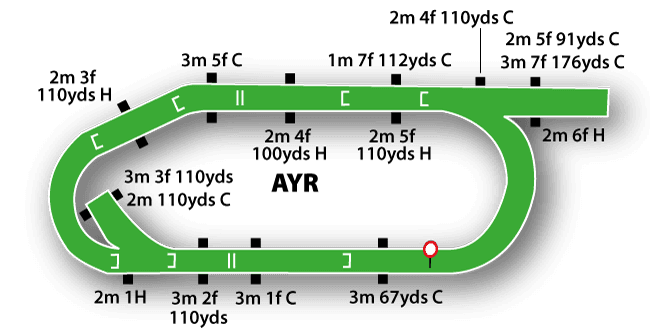
The Chase Course
- Circuit Roughly 1m 4f, left-handed.
- Fences Nine per circuit, two open ditches — conventional size, neither soft nor formidable, well distributed around the loop.
- Run-in The downhill run from the back straight lets pace-builders gain momentum, but the climbing run-in tests whether that was bought too cheaply.
- Trip range 2m to about 4m.
The Hurdle Course
- Circuit Inside the chase track, sharing the same shape and gradient profile.
- Flights Six per circuit, three on either side of the bend.
- Distances 2m, 2m 4f, 2m 5f and 3m are the standard contemporary distances.
- Marquee race The G2 Coral Scottish Champion Hurdle (2m) at the spring fixture; juvenile and novice business fills out the autumn-to-spring season.
- Trip range 2m to 3m.
Surface & History
- Surface Turf only — no all-weather, no cambered hybrid.
- Founded Standing at Whitletts Road since 1907, modelled on Newbury’s layout but with a six-furlong straight in place of the mile; moved from an earlier town site at Seafield.
- Jumps added 1950.
- Scottish Grand National Transferred to Ayr from the now-defunct Bogside Racecourse in 1966.
- Going Drainage is good for a Scottish coastal track, but conditions can vary materially across a single fixture if rain is forecast — always check the going stick and the day’s weather before backing a confirmed front-runner.
Key Betting Angles
- Trip, then going Distance sets the pace baseline here — front-runners underperform in the short handicap chases and thrive in the staying ones. Mick Fitzgerald’s rule (soft favours waiters, quick favours pace) then modifies it; it does not override it.
- Course form Worth noting at the spring fixture, though we have not measured it — the published Scottish National trends put far more weight on current form, a workable weight and racing handily than on previous Ayr runs.
- Trainer specialists Lucinda Russell and N W Alexander are the genuinely local yards; Nicky Richards trains at Greystoke in Cumbria and Stuart Crawford in Co Antrim. All four run heavy here, but volume is not value — only Alexander (A/E 1.06) beats his price among them. D W Whillans is the standout on the table at A/E 1.31 from 168 runners.
When does Ayr race?
Spring Festival — the headline meeting
The two-day Coral Scottish Grand National fixture in mid-April is by some distance the year’s biggest event at the course and one of the most valuable jumps meetings in the British calendar outside Cheltenham and Aintree. The headline race itself — the Coral Scottish Grand National, a 3m 7f 176y (about 4 miles) Premier Handicap chase over 27 fences — is the defining marathon for staying chasers north of Cheltenham, and a frequent spring target for horses coming out of the Cheltenham Festival — Racing Post’s 2026 trends study found 14 winners in the previous 43 years had been beaten at that season’s Festival. The Aintree Grand National is a different matter: it is run only a week earlier, and the trends work is clear that last week’s National has no great bearing on this one.
The supporting card is unusually strong. The Coral Scottish Champion Hurdle (Grade 2, 2m) is the meeting’s principal hurdle race and a genuine end-of-season target for two-mile hurdlers that have not made the Champion Hurdle frame. The Scotty Brand Handicap Chase (2m ½f, Premier Handicap) is one of the most competitive northern handicaps of the season. Beyond those three, the supporting card is genuinely substantial. The CPMS Novices’ Champion Handicap Chase (Class 2, 3m) is the staying-novice highlight of the card, a valuable end-of-season handicap that can turn up a progressive chaser worth following — Nicky Henderson’s Dusart and Tom Lacey’s Pounding Poet among recent winners. The Jordan Electrics Ltd Seafield Trophy Mares’ Handicap Hurdle (Class 2, 3m ½f) is a quality staying mares’ handicap with a strong recent honour roll. The Coral Handicap Hurdle on the Friday card and the Stagecoach Novices’ Hurdle on the Saturday close out a fixture that punches well above the casual perception of “Scottish jumps racing.
The Number That Matters
Pace position at Ayr moves with the going, but going is not the whole story and it is not true that the track has no tendencies of its own. Trip sets the baseline. In handicap chases of 2m1½f or shorter, Ayr front-runners have won just 7 of 55 at an impact value of 0.91 — slightly below par, so the minimum trip does not reward dictating. Step up to the staying handicap chases between 2m7f and 3m2f and Ayr appears on the list of tracks with the strongest front-running biases in Britain. Read it as trip first, going second: the ground sharpens or softens a tendency that the distance has already set.
On firm or good-to-firm ground the picture tilts to prominent and front-running types: the surface rides quick, the home turn is sharp enough that horses on or near the lead carry less ground, and the climbing run-in is more easily handled by a horse that has not been asked to make up lengths late. Held-up runners can struggle to get involved if the leader is brave on quick ground.
On soft or heavy ground patience becomes more viable. The climbing run-in becomes punishing, the cost of being asked to dictate from the front is multiplied across every furlong, and — in Fitzgerald’s own words — the field tends to come back to you, so waiting costs less than it does on quick ground. That is a softening of the aggressive-pace advantage rather than a reversal into a hold-up bias: we have no ground-split Ayr dataset, and the trip remains the baseline. The Scottish Grand National over 3m 7f 176y is the exception people get backwards. It is a marathon, so stamina is the entry ticket — but Racing Post’s trends work on the race is blunt that it is one staying handicap in which it is difficult to win from off the pace, and its winners have tended to race handily. Do not confuse needing to stay with needing to be held up.
The bars below summarise good-to-soft ground — the closest single setting to “default Ayr” across the season’s volume of meetings. Any race where the going reads firmer or softer than that should be re-weighted accordingly.
Pace Bias — Ayr (good-to-soft default)
On soft or heavy, reduce the penalty for waiting — do not infer a hold-up bias. On good or firm, raise the importance of holding a position. Trip sets the baseline these adjustments apply to.
Which trainers win most at Ayr over jumps?
| Trainer | Runs | Wins | Win% | Places | Place% | A/E | P/L |
|---|---|---|---|---|---|---|---|
| 1 Russell, Miss Lucinda V | 966 | 135 | 13.98% | 330 | 34.16% | 0.89 | -211.17 |
| 2 Richards, N G | 523 | 98 | 18.74% | 216 | 41.30% | 0.88 | -93.55 |
| 3 Alexander, N W | 693 | 95 | 13.71% | 223 | 32.18% | 1.06 | -27.10 |
| 4 McCain Jnr, D | 300 | 59 | 19.67% | 102 | 34.00% | 0.89 | -88.16 |
| 5 Crawford, S R B | 369 | 53 | 14.36% | 127 | 34.42% | 0.87 | -93.96 |
| 6 Goldie, J S | 296 | 34 | 11.49% | 86 | 29.05% | 0.95 | -40.45 |
| 7 Thomson, A M | 248 | 32 | 12.90% | 79 | 31.85% | 0.83 | -103.06 |
| 8 Elliott, Gordon | 126 | 32 | 25.40% | 64 | 50.79% | 0.95 | -27.43 |
| 9 Skelton, Daniel | 128 | 31 | 24.22% | 57 | 44.53% | 1.08 | +10.37 |
| 10 Whillans, D W | 168 | 28 | 16.67% | 57 | 33.93% | 1.31 | +79.91 |
| 11 Nicholls, P F | 142 | 27 | 19.01% | 45 | 31.69% | 1.10 | +8.39 |
| 12 Duncan, I A | 308 | 24 | 7.79% | 73 | 23.70% | 0.96 | -52.99 |
| 13 Jardine, I | 192 | 23 | 11.98% | 58 | 30.21% | 0.95 | -64.44 |
| 14 Henderson, N J | 120 | 20 | 16.67% | 44 | 36.67% | 0.86 | -36.84 |
| 15 Murphy, Olly | 105 | 20 | 19.05% | 44 | 41.90% | 0.70 | -33.89 |
| 16 Smith, R Michael | 368 | 19 | 5.16% | 69 | 18.75% | 0.73 | -197.27 |
| 17 Coltherd, W S | 183 | 17 | 9.29% | 45 | 24.59% | 0.86 | -70.35 |
| 18 Todhunter, M | 177 | 16 | 9.04% | 47 | 26.55% | 0.66 | -76.52 |
| 19 O’Brien, Fergal | 36 | 13 | 36.11% | 18 | 50.00% | 1.49 | +40.81 |
ayr NH · Current trainers, since 2010
Which jockeys win most at Ayr over jumps?
| Jockey | Runs | Wins | Win% | Places | Place% | A/E | P/L |
|---|---|---|---|---|---|---|---|
| 1 Hughes, Brian | 689 | 113 | 16.40% | 249 | 36.14% | 0.86 | -134.84 |
| 2 Fox, Derek R | 421 | 54 | 12.83% | 131 | 31.12% | 0.89 | -70.21 |
| 3 Nichol, Craig | 361 | 43 | 11.91% | 97 | 26.87% | 0.93 | -28.30 |
| 4 Quinlan, Sean | 319 | 39 | 12.23% | 102 | 31.97% | 0.91 | -20.03 |
| 5 McMenamin, Daniel | 247 | 35 | 14.17% | 93 | 37.65% | 0.86 | -46.79 |
| 6 Bowen, Sean P | 141 | 33 | 23.40% | 60 | 42.55% | 1.02 | +15.35 |
| 7 Lynn, Bruce | 192 | 28 | 14.58% | 67 | 34.90% | 1.18 | +19.84 |
| 8 Mania, Ryan | 257 | 27 | 10.51% | 68 | 26.46% | 0.83 | -114.80 |
| 9 Skelton, Harry | 112 | 26 | 23.21% | 51 | 45.54% | 1.05 | -21.46 |
| 10 O’Farrell, C | 214 | 22 | 10.28% | 62 | 28.97% | 0.94 | -69.59 |
| 11 Chapman, Ross | 133 | 21 | 15.79% | 42 | 31.58% | 1.28 | -14.69 |
| 12 Bewley, Callum | 228 | 19 | 8.33% | 54 | 23.68% | 1.04 | -53.59 |
| 13 Mulqueen, S | 218 | 17 | 7.80% | 53 | 24.31% | 0.72 | -142.34 |
| 14 Wadge, P | 123 | 17 | 13.82% | 47 | 38.21% | 0.95 | -32.28 |
| 15 Reveley, James | 149 | 16 | 10.74% | 55 | 36.91% | 0.73 | -58.58 |
| 16 Coltherd, Sam W | 168 | 15 | 8.93% | 33 | 19.64% | 0.93 | -44.75 |
| 17 Hamilton, Jamie | 163 | 15 | 9.20% | 37 | 22.70% | 0.84 | -83.62 |
| 18 Twiston-Davies, Sam | 74 | 11 | 14.86% | 21 | 28.38% | 1.17 | +8.25 |
| 19 Slevin, J J | 62 | 10 | 16.13% | 27 | 43.55% | 0.99 | -2.50 |
| 20 Cobden, Harry | 58 | 10 | 17.24% | 17 | 29.31% | 1.08 | -6.29 |
ayr NH · Current riders, since 2010
Which sires do best at Ayr over jumps?
| Sire | Runs | Wins | Win% | Places | Place% | A/E | P/L |
|---|---|---|---|---|---|---|---|
| 1 Milan | 268 | 38 | 14.18% | 94 | 35.07% | 0.81 | -81.86 |
| 2 Flemensfirth (USA) | 255 | 34 | 13.33% | 69 | 27.06% | 0.85 | -35.63 |
| 3 Presenting | 218 | 30 | 13.76% | 72 | 33.03% | 0.92 | -19.67 |
| 4 Westerner | 166 | 30 | 18.07% | 60 | 36.14% | 1.04 | -3.24 |
| 5 Gold Well | 150 | 28 | 18.67% | 58 | 38.67% | 1.19 | +78.15 |
| 6 Getaway (GER) | 163 | 23 | 14.11% | 42 | 25.77% | 1.14 | +6.76 |
| 7 Kayf Tara | 154 | 23 | 14.94% | 48 | 31.17% | 1.02 | -18.42 |
| 8 Beneficial | 184 | 21 | 11.41% | 56 | 30.43% | 0.74 | -44.19 |
| 9 Shantou (USA) | 115 | 21 | 18.26% | 40 | 34.78% | 1.32 | +30.28 |
| 10 Yeats (IRE) | 136 | 19 | 13.97% | 41 | 30.15% | 1.03 | -29.60 |
| 11 Midnight Legend | 108 | 18 | 16.67% | 47 | 43.52% | 0.93 | -2.01 |
| 12 Oscar (IRE) | 144 | 17 | 11.81% | 40 | 27.78% | 0.79 | -52.61 |
| 13 Fame And Glory | 126 | 17 | 13.49% | 40 | 31.75% | 0.83 | -64.08 |
| 14 Winged Love (IRE) | 113 | 15 | 13.27% | 33 | 29.20% | 1.03 | -27.54 |
| 15 Walk In The Park (IRE) | 103 | 15 | 14.56% | 40 | 38.84% | 0.72 | -52.80 |
| 16 Shirocco (GER) | 92 | 15 | 16.30% | 32 | 34.78% | 1.09 | -24.77 |
| 17 Doyen (IRE) | 76 | 15 | 19.74% | 28 | 36.84% | 1.23 | +6.32 |
| 18 Jeremy (USA) | 55 | 13 | 23.64% | 24 | 43.64% | 1.52 | +22.69 |
| 19 Mahler | 105 | 12 | 11.43% | 31 | 29.52% | 0.83 | -31.20 |
| 20 Stowaway | 69 | 12 | 17.39% | 20 | 28.99% | 1.04 | -14.85 |
ayr NH · Since 2010
Betting Angles That Actually Work
1. Trip sets the baseline, the going adjusts it
Take the distance first: front-runners have won only 7 of 55 handicap chases here up to 2m1½f, while Ayr is among the strongest front-running tracks in Britain in staying handicap chases. Then read the ground. Mick Fitzgerald’s rule travels — quick ground rewards pace, soft ground makes waiting more viable because the field comes back — but it modifies the trip’s baseline rather than replacing it. Check the going stick early; do not let it override the distance-specific evidence.
2. Know which yards are local — and that volume is not value
Lucinda Russell and N W Alexander are the Scottish yards; Nicky Richards trains at Greystoke in Cumbria and Stuart Crawford in Co Antrim, so “local” is doing some work there. Between them they take a disproportionate share of the winners, but the table on this page has Russell at A/E 0.89, Richards 0.88 and Crawford 0.87 — only Alexander clears his price, at 1.06. If you want the yard that has beaten the market here, it is D W Whillans: A/E 1.31 from 168 runners for +£79.91.
3. Previous Ayr form is worth noting
The configuration is distinctive enough that a horse with prior course wins or strong placed efforts here has answered a question others have not, so check past Ayr runs before backing in the staying handicap chases. We have not measured whether the market underprices it, and the published Scottish National trends lean far more heavily on current form, weight and racing position than on course experience — so treat it as a tiebreak rather than an edge.
4. Demand staying evidence — but don’t demand marathon form
The Scottish Grand National (3m 7f 176y, 27 fences) is won by horses that genuinely stay, and the historical bar is lower than it looks. Entering the 2026 renewal, Racing Post found 13 of the previous 14 winners had already won over at least three miles, Captain Cody the exception. Kap Vert then became the second — the 2026 running was his first attempt beyond three miles at all — which makes it 13 of the latest 15. Winning form around three miles is the common profile, not a prerequisite, and it is certainly not proven 3m5f or four-mile form. Insisting on marathon experience would have ruled out a run of winners, because this race has an unusually good record for novices and lightly raced chasers — eight novices won inside one twenty-year span, with Vicente, Joe Farrell, Mighty Thunder and Macdermott following since. Macdermott took it as a six-year-old on his sixth start over fences.
4b. The Scottish National shortlist, in order
Current form first: Racing Post’s 2026 trends study had 12 of the previous 16 winners finishing in the top five last time out, 10 of those 12 in the top three, and Kap Vert arrived off a win to continue it. Then position: it is hard to win this from off the pace, and the winners have tended to race handily — do not shortlist a hold-up horse simply because the trip is long. Then stamina, at the three-mile-winner bar above. Cheltenham defeats are no bar at all; the Aintree National a week earlier is close to irrelevant to it.
5. Price the climbing finish
The run-in is short (≈210 yards) but it climbs. A horse asked to dictate on soft ground has the climb to pay for at the end of it, which is why waiting costs less here when the ground goes. Weigh that against the trip: in a staying handicap chase, being handy is still where the winners have come from.
6. The Scottish Champion Hurdle is the two-milers’ refuge
The G2 (2m) at the spring fixture pulls in two-mile hurdlers that didn’t make the Champion Hurdle frame at Cheltenham, and it is a stronger, more valuable end-of-season handicap than its grade suggests. Whether its form works out over the summer is a claim we have not tested, so treat the race as a good one rather than a proven form line to follow.
7. Conditional-jockey races are worth reading closely
The fixture carries conditional-jockey races, where a claim comes off a horse the senior weighing room would otherwise carry at full weight — which changes the handicapping arithmetic and is worth working through. We have not tested whether those races price up any better than the rest of the card, so we are not going to call it a value context until we have.
8. Avoid backing horses that need to make up ground late
With only around 210 yards after the last, and rising, a horse still well adrift at the final fence has very little time to retrieve it. That is the course geometry talking, not a bias — factor likely track position into any habitual hold-up horse rather than opposing the running style outright.
9. Watch for unlucky-run flags from the spring fixture
The Scottish Grand National meeting is competitive and traffic incidents are common in its handicap chases, so it is a card worth reviewing for horses whose finishing position understates the run. Note the interference, the jumping error or the badly timed challenge rather than the position alone — and note it again if the horse returns to the same fixture twelve months later.
Common Mistakes to Avoid
- Reading the Scottish Grand National as a hold-up race because it is a marathon. It is one of the staying handicaps in which it is hardest to win from off the pace, and its winners have tended to race handily. Stamina is the entry ticket, not an instruction to drop a horse out.
- Demanding proven marathon form for it. The historical bar is lower than the trip suggests — winning form around three miles is the common profile rather than a prerequisite, and Captain Cody and Kap Vert have both won it without a three-mile victory to their name — and the race has an unusually strong record for novices and lightly raced chasers. Insisting on previous 3m5f or four-mile form would have ruled out a long list of winners.
- Reading across from the Aintree Grand National. The two are run a week apart, which is why last week’s National has little bearing here. Cheltenham Festival form is the pointer that has actually travelled.
- Making the going the only pace variable. Mick Fitzgerald’s read is sound and quick ground does reward pace — but trip sets the baseline first. Front-runners have won only 7 of 55 handicap chases up to 2m1½f here, while Ayr is among the strongest front-running tracks in Britain in staying handicap chases.
- Backing a local yard because it is local. Scottish and northern stables take most of the winners and almost none of the money: Lucinda Russell runs at A/E 0.89, Nicky Richards 0.88 and Stuart Crawford 0.87, with only N W Alexander clearing his price at 1.06. Note too that Richards trains at Greystoke in Cumbria and Crawford in Co Antrim, so “local” is doing some work.
Ayr Racecourse FAQs
Is there a pace or front-running bias at Ayr over jumps?
Which way does Ayr race and what kind of jumps track is it?
How much does the going matter at Ayr?
Which trainers do best at Ayr’s jumps fixtures?
What is the key angle for the Scottish Grand National at Ayr?
Other Jumps Tracks
Aintree
Home of the Grand National — Mildmay and National courses.
Kempton Park
Sharp, flat right-hander — home of the King George.
Lingfield Park
Sharp, undulating winter jumps track.
Today’s Dial
Ayr running today? Our daily selection covers every UK and Irish meeting with the reasoning written out in full.
The Trackside Companion is your day at the races, written to order — every race on your meeting’s card broken down, plus this track’s pace, angles and people distilled from the guide you’ve just read. Order at least a week before your raceday.
Plan your raceday →