Kempton Park
National Hunt
Sunbury-on-Thames, Surrey · 16 miles south-west of central London
Turf
Right-Handed
Flat
Kempton also races on Polytrack year-round under floodlights. Read the All-Weather guide →
What is Kempton Park like as a jumps track?
Track Character
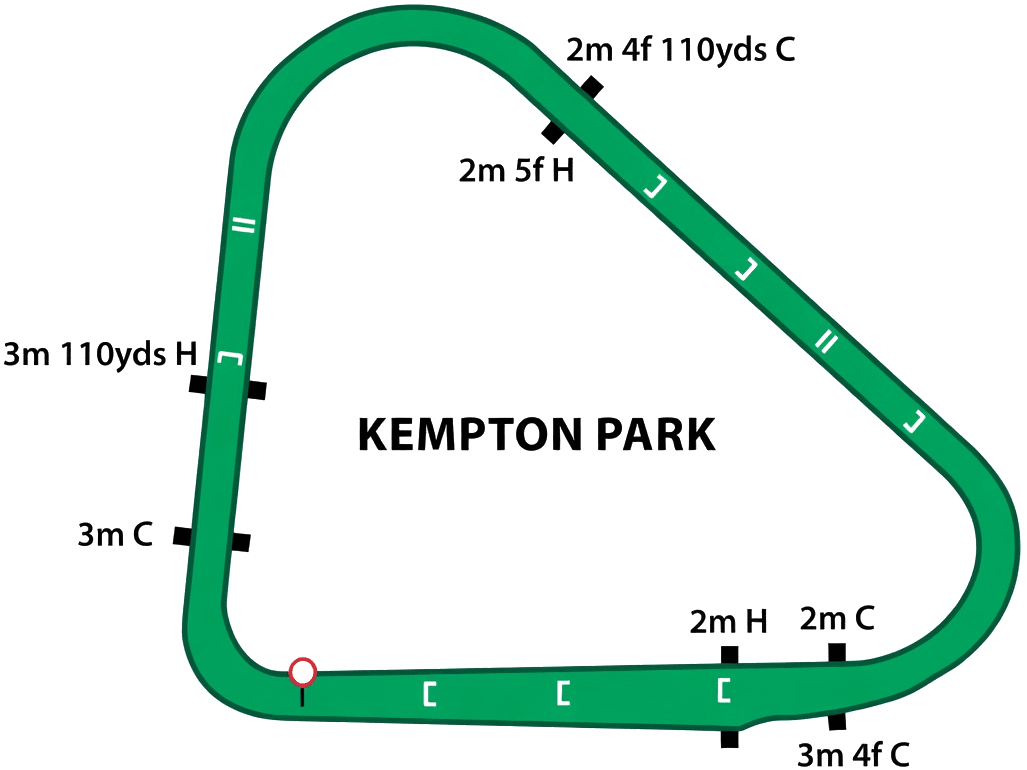
Strip away the shorthand and what you have at Kempton is a speed-and-rhythm track. Flat, right-handed, triangular — about a mile and five furlongs round — with nine fences per circuit, three of them in the home straight, and a 220-yard run-in after the last. Flat does not mean non-staying, though: over three miles an end-to-end gallop can make this a serious stamina examination even on sound ground, because the stamina is imposed by sustained pace rather than by climbing. The fences were redesigned during the 2005/06 redevelopment specifically to create more even spacing and encourage a fluent jumping rhythm.
What the Track Asks
That design philosophy tells you something important about what the track is actually testing. Kempton does not destroy horses through awkward jumping or brutal climbing finishes. It exposes horses that cannot travel, cannot hold a position, or cannot jump cleanly at pace. The distinction matters enormously at the form-reading stage. A horse can appear to have “not stayed” at Kempton when the real problem was that it couldn’t maintain speed and fluency around a quick, relentless circuit. Mick Fitzgerald put it simply:
— Mick Fitzgerald, former top jump jockey
That is the key to reading Kempton form. The horses that get strung out between the home turn and the last fence were not necessarily beaten by the trip — look first at the track’s demand for sustained speed and efficiency, because that is often the explanation the form book will not hand you.
The Flat That Isn’t Quite Flat
The fences are not traps. The track is.
Bryony Frost, who has ridden here extensively, adds a detail that cuts against the universal “pan-flat” description: she describes a small incline in the run to the line that rides stiffer than it looks. Most course guides call Kempton dead flat, and the official mapping confirms it as “practically flat.” Take Frost’s observation as a jockey’s feel rather than a hard gradient — but it helps explain why a well-balanced, organised horse outperforms its paper form here.
The French Connection
One specialist course guide has likened Kempton’s jumps track to easier French provincial courses in style — a reading worth knowing rather than an established consensus. The fences encourage getting up and over rather than diving in and grinding through, which can make Kempton a mechanically familiar test for a French-raced or French-schooled recruit on its first British start. Treat it as a form-reading clue rather than a measured edge.
The Hurdle Track
Kempton’s hurdle course runs the same flat, sharp, right-handed circuit as the chase track, and it asks the same question at a higher speed. Hurdling here is quick. The obstacles come up fast, the bends give a horse nowhere to make up ground gradually, and the short run from the home turn to the last leaves very little time to change the shape of a race.
That compresses the margin for error rather than widening it. A horse that meets a hurdle wrong at Kempton does not usually fall — it loses momentum, and on a circuit this sharp there is little chance to get it back. Fluency matters here in a way it does not on a galloping track where a mistake can be absorbed over the next half-mile.
The practical reading is to watch where a horse was, not just where it finished. Going back through a race, note whether a horse was travelling within itself at the top of the straight and whether a jumping error broke its momentum, rather than judging it on the finishing distance alone. Treat that as a question worth asking rather than a rule to apply. Bryony Frost marks the limit plainly: “For hurdles, winners come from anywhere.”
The Chase Track
- Circuit1m5f triangular, right-handed and practically flat — Bryony Frost notes only a subtle rise to the line
- Fences9 per circuit, all permanent — seven plain fences and two open ditches, no water jump. Even spacing post-2006 redesign to encourage rhythm
- Home Straight3 fences, 220-yard run-in — short enough that position, momentum and a clean jump at the last matter unusually much
- BendsFlat right-handed turns — agile, balanced horses handle them cleanly; horses that hang or drift lose ground
- Run StyleFront-runners and prominent racers hold a clear edge in the handicap chases, most clearly at 2m2f. Hold-up horses are at a disadvantage unless the race is run hard enough to bring the leaders back
Track & History
- FoundedSamuel H. Hyde bought Kempton Manor and Park in 1872; the first race was run on 18 July 1878
- WWIICourse used as a prisoner-of-war camp; racing suspended for the duration
- 2005/06Turf flat course removed, replaced by Polytrack. Jumps fences redesigned with more even spacing
- King George VI ChaseFirst run February 1937, named in honour of the new king. Moved to Boxing Day in 1947 and has stayed there ever since
- Full race guideSee our complete King George VI Chase guide for the ante-post market, Boxing Day travel warnings and the Gold Cup pathway
- Kauto StarWon the King George five times — 2006, 2007, 2008, 2009, 2011 — the defining record in the race’s history. Lost in 2010 to Long Run, then came back to claim the record at age 11
- Desert OrchidWon it four times (1986, 1988, 1989, 1990). Both he and Kauto Star have statues in the Kempton parade ring
When does Kempton Park race?
The Number That Matters
The clearest published course-specific betting angle at Kempton over jumps is pace in chases, and the hardest Kempton-specific evidence sits at one trip. In handicap chases at 2m2f with seven or more runners, published work covering 2017–2024 described Kempton as by far the best performing front-running venue of the five qualifying tracks. Separately, a pace study published in 2021, covering a Class 3 Kempton handicap chase around two and a half miles, put leaders on a 20% strike rate and prominent racers on 16.13%, with held-up runners the worst group by a distance.
Those are two samples pointing the same way, not one continuous rule, and the difference matters. The broader front-running bias reported across the 2m3f–2m4f band in that same 2017–2024 work was driven by other courses — Cheltenham, Doncaster, Sedgefield, Southwell and Plumpton among the strongest — and Kempton is not one of the tracks named in that band.
The conclusion is not subtle. In Kempton handicap chases you should be actively favouring horses likely to lead or race prominently — most confidently at 2m2f, where the Kempton-specific finding is strongest — and you should be sceptical of hold-up horses unless there is a compelling reason to believe the race will collapse up front. What the evidence does not license is assuming the same magnitude at every chase trip from two miles to three-and-a-quarter — check the individual race rather than applying one number to the card. One scope warning: all of that is chase evidence. Kempton also stages the Christmas Hurdle, the Lanzarote, the Adonis and the Dovecote, and none of the work behind these figures covers hurdle races — read those on their own field size, trip and likely tempo rather than importing the chase numbers.
Run Style Bias — Handicap Chases
▲ Strong
─ Moderate
▼ Weak
The caveat matters more here than at most tracks, because Kempton’s fences were deliberately respaced in the 2005/06 redevelopment to reward fluent, rhythmical jumping rather than raw stamina. Note what the published figures do and do not cover — the 2017–2024 handicap-chase work ran on all going, with no ground split, so the front-running edge it reports is an average across every surface Kempton offers rather than a sound-ground result. The physical reason it so often stays raceable is the soil — Kempton’s clerk Barney Clifford puts the track’s quick drainage down to “its sandy loam”, and says that where other courses go soft, at Kempton you would “all but guarantee the slow side of Good for Boxing Day”. What soft or heavy ground changes is the physical demand: the surface stops giving anything back, the stamina requirement climbs, and holding a forward position costs far more to do. That is course knowledge, not a second dataset — read the going and the likely race shape together before deciding how hard to lean on early position.
Punters who apply the “sharp, pacey Kempton” shorthand regardless of conditions come unstuck when the going turns testing — read the going report before leaning on this angle, not just the track’s reputation.
Which trainers and jockeys win most at Kempton Park?
| Trainer | Runs | Wins | Win% | Places | Place% | A/E | P/L |
|---|---|---|---|---|---|---|---|
| 1 Henderson, N J | 745 | 202 | 27.11% | 347 | 46.58% | 1.02 | +28.11 |
| 2 Nicholls, P F | 667 | 126 | 18.89% | 271 | 40.63% | 0.84 | -147.82 |
| 3 King, A | 516 | 71 | 13.76% | 188 | 36.43% | 0.77 | -199.27 |
| 4 Skelton, Daniel | 356 | 39 | 10.96% | 116 | 32.58% | 0.71 | -133.32 |
| 5 Hobbs, P J / White, J | 293 | 38 | 12.97% | 104 | 35.49% | 0.79 | -123.24 |
| 6 Lavelle, Miss E C | 226 | 33 | 14.60% | 85 | 37.61% | 0.85 | +80.23 |
| 7 Gordon, C | 226 | 31 | 13.72% | 74 | 32.74% | 1.09 | -10.14 |
| 8 Fry, Harry | 131 | 31 | 23.66% | 53 | 40.46% | 1.24 | +52.40 |
| 9 Moore, Gary and Josh | 464 | 28 | 6.03% | 108 | 23.28% | 0.56 | -221.84 |
| 10 Pauling, Ben | 151 | 27 | 17.88% | 58 | 38.41% | 1.25 | +24.24 |
| 11 O’Neill, Jonjo and AJ | 239 | 25 | 10.46% | 60 | 25.10% | 0.79 | -118.16 |
| 12 Twiston-Davies, N A | 216 | 25 | 11.57% | 58 | 26.85% | 0.83 | -21.26 |
| 13 George, T R | 159 | 23 | 14.47% | 54 | 33.96% | 1.07 | -15.75 |
| 14 O’Brien, Fergal | 161 | 22 | 13.66% | 48 | 29.81% | 1.02 | -38.49 |
| 15 Longsdon, C E | 182 | 21 | 11.54% | 50 | 27.47% | 0.92 | -48.50 |
| 16 Bailey, K C | 137 | 16 | 11.68% | 46 | 33.58% | 0.78 | -3.26 |
| 17 Greatrex, W J | 133 | 15 | 11.28% | 35 | 26.32% | 0.98 | -11.00 |
| 18 Pipe, D E | 150 | 13 | 8.67% | 49 | 32.67% | 0.60 | -86.54 |
| 19 Wadham, Mrs L | 79 | 12 | 15.19% | 27 | 34.18% | 1.17 | -24.75 |
| 20 Williams, Ian | 80 | 11 | 13.75% | 27 | 33.75% | 1.06 | -29.84 |
kempton NH · Current trainers, since 2010 Method: Kempton NH records since 1 January 2010, pulled 9 July 2026. P/L is level stakes to starting price; A/E compares actual winners with the number those runners’ starting prices implied over the same sample, so above 1.00 means they won more often than the market expected.
| Jockey | Runs | Wins | Win% | Places | Place% | A/E | P/L |
|---|---|---|---|---|---|---|---|
| 1 Boinville, Nico | 323 | 84 | 26.01% | 137 | 42.41% | 0.98 | -40.02 |
| 2 Cobden, Harry | 321 | 53 | 16.51% | 120 | 37.38% | 0.77 | -89.48 |
| 3 Twiston-Davies, Sam | 320 | 48 | 15.00% | 111 | 34.69% | 0.84 | -88.00 |
| 4 Cannon, Tom J | 290 | 41 | 14.14% | 84 | 28.97% | 1.08 | +41.10 |
| 5 Skelton, Harry | 262 | 31 | 11.83% | 101 | 38.55% | 0.71 | -103.70 |
| 6 Bass, David | 136 | 21 | 15.44% | 53 | 38.97% | 1.03 | +22.30 |
| 7 Sheehan, Gavin | 155 | 20 | 12.90% | 47 | 30.32% | 1.05 | +7.50 |
| 8 Burke, Jonathan | 148 | 20 | 13.51% | 45 | 30.41% | 1.09 | -41.25 |
| 9 Bellamy, Tom | 143 | 19 | 13.29% | 50 | 34.97% | 0.95 | +3.97 |
| 10 Quinlan, Jack | 101 | 18 | 17.82% | 32 | 31.68% | 1.84 | +140.84 |
| 11 Powell, Brendan | 183 | 16 | 8.74% | 44 | 24.04% | 0.80 | -109.87 |
| 12 Jones, Ben R | 63 | 16 | 25.40% | 32 | 50.79% | 1.50 | +89.30 |
| 13 Bowen, Sean P | 101 | 15 | 14.85% | 31 | 30.69% | 1.02 | -13.28 |
| 14 Frost, Bryony | 73 | 15 | 20.55% | 25 | 34.25% | 1.30 | +36.36 |
| 15 Bowen, James C | 84 | 12 | 14.29% | 32 | 38.10% | 0.99 | +6.26 |
| 16 Obrien, P V | 79 | 11 | 13.92% | 28 | 35.44% | 0.82 | -41.38 |
| 17 O’Neill, Jonjo (Jr) | 73 | 11 | 15.07% | 22 | 30.14% | 0.85 | +9.23 |
| 18 Wedge, Adam | 67 | 11 | 16.42% | 23 | 34.33% | 1.33 | +55.55 |
| 19 Sheppard, Stan | 45 | 11 | 24.44% | 17 | 37.78% | 1.35 | +28.70 |
| 20 McLernon, R P | 105 | 8 | 7.62% | 16 | 15.24% | 0.92 | -57.57 |
kempton NH · Current riders, since 2010 Method: Kempton NH records since 1 January 2010, pulled 9 July 2026. P/L is level stakes to starting price; A/E compares actual winners with the number those runners’ starting prices implied over the same sample, so above 1.00 means they won more often than the market expected.
Which sires do best at Kempton Park?
| Sire | Runs | Wins | Win% | Places | Place% | A/E | P/L |
|---|---|---|---|---|---|---|---|
| 1 King’s Theatre (IRE) | 231 | 43 | 18.61% | 81 | 35.06% | 1.06 | +2.88 |
| 2 Presenting | 289 | 41 | 14.19% | 92 | 31.83% | 0.96 | -62.63 |
| 3 Kayf Tara | 243 | 37 | 15.23% | 80 | 32.92% | 0.95 | -76.45 |
| 4 Oscar (IRE) | 191 | 34 | 17.80% | 67 | 35.08% | 1.05 | +0.89 |
| 5 Midnight Legend | 195 | 26 | 13.33% | 65 | 33.33% | 0.97 | +14.13 |
| 6 Milan | 227 | 23 | 10.13% | 78 | 34.36% | 0.67 | -114.48 |
| 7 Getaway (GER) | 149 | 21 | 14.09% | 44 | 29.53% | 0.84 | -45.37 |
| 8 Beneficial | 177 | 19 | 10.73% | 50 | 28.25% | 0.77 | -28.15 |
| 9 Stowaway | 98 | 16 | 16.33% | 35 | 35.71% | 1.01 | +3.99 |
| 10 Westerner | 134 | 15 | 11.19% | 39 | 29.10% | 0.81 | -73.41 |
| 11 Yeats (IRE) | 117 | 15 | 12.82% | 34 | 29.06% | 0.90 | -31.84 |
| 12 Martaline | 103 | 15 | 14.56% | 37 | 35.92% | 0.84 | -24.60 |
| 13 Saint Des Saints (FR) | 65 | 15 | 23.08% | 27 | 41.54% | 1.10 | -23.14 |
| 14 Flemensfirth (USA) | 135 | 13 | 9.63% | 48 | 35.56% | 0.68 | -50.99 |
| 15 Shirocco (GER) | 97 | 13 | 13.40% | 39 | 40.21% | 0.91 | -16.41 |
| 16 Mahler | 84 | 13 | 15.48% | 26 | 30.95% | 1.01 | -31.18 |
| 17 Kapgarde (FR) | 90 | 12 | 13.33% | 29 | 32.22% | 0.88 | -24.40 |
| 18 Fame And Glory | 66 | 12 | 18.18% | 24 | 36.36% | 1.10 | +21.33 |
| 19 Shantou (USA) | 91 | 11 | 12.09% | 27 | 29.67% | 0.87 | -6.00 |
| 20 Califet (FR) | 50 | 11 | 22.00% | 19 | 38.00% | 1.12 | -10.08 |
kempton NH · Since 2010 Method: Kempton NH records since 1 January 2010, pulled 9 July 2026. P/L is level stakes to starting price; A/E compares actual winners with the number those runners’ starting prices implied over the same sample, so above 1.00 means they won more often than the market expected.
Betting Tips for Kempton Park National Hunt
The short answer at Kempton is speed and jumping rhythm. The track exposes horses that cannot travel or cannot jump cleanly at pace rather than horses that cannot climb a hill, so in handicap chases favour runners likely to lead or race prominently — most confidently at 2m2f, where the Kempton-specific evidence is strongest — and treat hold-up types as tactically vulnerable unless the pace looks certain to collapse. Read the hurdle races on their own shape rather than importing the chase figures, give proven Kempton form a premium, and check the going before leaning on any of it. The angles below set out how each of those works in practice.
Back the pace — especially in handicap chases
Hold-up horses are tactically vulnerable here, most clearly where the evidence is strongest: 2m2f handicap chases with seven or more runners, where published 2017–2024 work rated Kempton the best front-running venue of its qualifying group; a separate 2021 study of a Class 3 handicap chase around two and a half miles put leaders on 20% and prominent racers on 16.13%. All else equal, early position deserves positive weight — most of all in the race types the published work actually covers.
Do not carry the chase read into hurdles
The Kempton pace evidence is chase evidence. The track stages serious hurdle races — the Christmas Hurdle, the Lanzarote, the Adonis, the Dovecote — and none of the published chase work speaks to them. Read a Kempton hurdle on its own field size, trip and likely tempo rather than assuming the same front-running edge applies.
Check directional preference and jumping tendency
Some horses are markedly better going one way round, often through conformation or a habit of jumping left. Before a Kempton NH debut, look at what a horse has done right-handed — Ascot and Sandown are the obvious reference points, without treating the tracks as interchangeable. Kempton is exactly the kind of clean, fast circuit where a directional or jumping flaw gets exposed.
Flat track — a different exam to the gradient courses
Ask what a horse’s best form actually depends on. A profile built at Cheltenham, Sandown or Exeter rests on a climbing, attritional finish that Kempton never asks for, and the reverse applies to a flat-track type beaten on a stiff course. Course suitability should change how literally you read the previous line, in both directions.
Proven Kempton form is worth extra weight
Kempton asks a distinctive combination — sustained speed, jumping rhythm and a right-handed turn of foot — so a horse that has already won here has demonstrated the whole package rather than one part of it. Give proven course form a premium when the horse returns in similar or better shape, and check the going first: a soft-ground Kempton is a very different examination to the sharper test the course is normally associated with.
Watch French-schooled types on their British debut
One specialist course analysis likens Kempton’s jumps course to the easier French provincial tracks — flat, rhythmic, with fences meant to be jumped rather than scrambled. A French-raced or French-schooled horse arriving for a first British start may therefore find aspects of the test relatively familiar — it is the schooling that transfers, not the passport — which is a reason to look twice rather than let an unexposed profile put you off.
Common Mistakes to Avoid
- “Easy fences” does not mean bad jumpers get away with it. Kempton’s pace punishes inefficiency more than stiff fences would. An untidy jumper loses momentum at the exact track where momentum matters most.
- Do not read “not stayed” too literally. At Kempton, a horse that fades between the home turn and the last may have been beaten by speed and rhythm demands rather than by the distance. Check whether it was still travelling at the home turn before writing it off over trips.
- Cheltenham form is still good form. A horse can be excellent at Cheltenham and less effective here — the exams are different. Downgrade slightly for Kempton debut when the horse’s profile screams “needs a hill.”
- When it goes soft or heavy, the speed-only angle stops being enough. Kempton can become a proper stamina test, and punters who apply the flat-track shorthand regardless of conditions come unstuck when the ground turns testing.
Kempton Park Racecourse FAQs
Is there a pace or front-running bias at Kempton over jumps?
Which way does Kempton race and what kind of jumps track is it?
How does going affect Kempton’s jumps track?
Which trainers and jockeys do best at Kempton over jumps?
What is the biggest mistake punters make at Kempton over jumps?
Other Jumps Tracks
Aintree
Home of the Grand National — Mildmay and National courses.
Ayr
Galloping jumps track — the Scottish Grand National.
Lingfield Park
Sharp, undulating winter jumps track.
Sandown Park
Right-handed, home of the Betfair Tingle Creek Chase and the Railway Fences.
Ascot
Right-handed and stiff, with an uphill finish — home of the Long Walk Hurdle.
Windsor
Thames-side jumps track — figure-of-eight since November 2025, mostly left-handed.
Want the thinking behind National Hunt bets?
FormDial posts every selection before the off with its full reasoning: the angle, the price, the logic. See how course analysis feeds into real selections.
The Trackside Companion is your day at the races, written to order — every race on your meeting’s card broken down, plus this track’s pace, angles and people distilled from the guide you’ve just read. Order at least a week before your raceday.
Plan your raceday →