Lingfield Park
All Weather
Lingfield, Surrey · 25 miles south of central London
Polytrack
Left-Handed
Floodlit
Lingfield Park also stages National Hunt and Flat turf racing. Read the National Hunt racecourse guide → · Read the Flat racecourse guide →
What is Lingfield Park like as an all-weather track?
Track Character
Lingfield’s all-weather Polytrack sits on the inside of the turf circuit — a left-handed, triangular loop of 1m2f that is one of the sharpest all-weather tracks in Britain. The surface is a notably quick one, a product of its lighter consistency and the way the track flows — generally reckoned faster than Kempton’s deeper Polytrack. For nearly half its length the course is essentially flat, then rises gently to a slight hill at the start of the back straight before running downhill around the bottom corner and levelling off into the home straight. That downhill section — broadly from the 4f pole to the 2f pole — is the defining feature of the track. It is where races are shaped, where jockeys make their moves, and where horses that don’t handle the camber visibly shorten their stride and fade.
The home straight is only around 2f, which means the race is largely decided before the final bend. Horses that travel well through the race and can quicken off that downhill turn are consistently favoured; those that need a strong gallop to get into a race rarely find it materialising. The Polytrack’s kickback is mild — among the lightest of any all-weather circuit in Britain, and lighter than Kempton’s deeper surface — which means horses that are sensitive to dirt in their face are worth finding here.
The 5f and 6f starts both demand quick positioning, though the draw itself does less than the track’s reputation suggests. The 5f begins in a small chute on the crown of the bend; the 6f starts just before the bend on the main track. Across 124 five-furlong and 180 six-furlong handicaps from 2017 the win splits by draw are close to even, with only a small edge to the low stalls on place and beaten-rivals measures. What the horse does out of the stall matters far more: over 5f, held-up horses drawn high won under 5% of the time between 2021 and 2025 and lost 55p in the pound, while front-runners score from middle and high draws as readily as from low ones. Over 7f the draw fades further still. The picture reverses at 1m2f, where the short run to the first turn makes stalls 5–7 the place to be and the widest stalls a genuine negative. David Probert’s advice holds: over a mile or more, third or fourth one off the rail is the sweet spot — close enough to be in the race, free enough to avoid being bottled up on the tight final bend.
The pace data reinforces an important nuance: Lingfield’s reputation as a hold-up track is badly overstated at the shorter trips. Over 5f, front-runners have won around 23% of handicaps in every sample measured since 2012, and a 2020–24 study rates the trip the strongest front-running course and distance on the British all-weather — while 6f and 7f both favour the front half of the field, and over 7f held-up horses in 12-runner-plus handicaps win under 3% of the time. The bias levels out at a mile and then turns over: from 1m2f up, prominent and midfield runners beat both the outright leader and the closer. The honest instruction is not “back the pace” but “back the right position for the trip” — and across every trip measured, the horse anchored at the back is the least rewarded profile here. The “third wave” pattern described by jockeys — where a horse sits handy, angles off the bend, and attacks inside the final furlong — reflects the track’s geometry rather than any advantage to hold-up horses per se.
Lingfield staged Britain’s first ever all-weather fixture in 1989 and has remained one of the country’s most important all-weather venues ever since. It hosts the Winter Derby on Polytrack in February — a prestigious 1m2f trial — and is one of the six British tracks that make up the All-Weather Championships. Finals Day itself moved from Lingfield to Newcastle in 2022, and Lingfield now stages the All-Weather Championships Vase on the same Good Friday. The course is also the only UK venue to stage Flat turf, All-Weather and National Hunt racing, and its turf Derby and Oaks Trials in mid-May carry genuine Classic form clues given the similarity to Epsom’s profile.
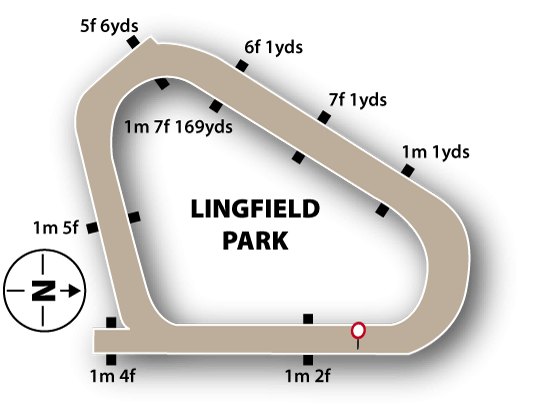
Lingfield AW Course
- Distances 5f, 6f, 7f, 1m, 1m2f, 1m3f, 1m4f, 2m
- Home straight ~2f — short run-in; races are largely decided before the final bend
- Bends Two left-handed bends on every trip including 5f and 6f — there is no straight course on the AW
- Run style Front-runners are strong at 5f, 6f and 7f — the 5f is the best front-running course and distance on the British all-weather; the bias levels out at a mile and turns over by 1m2f, where prominent and midfield runners beat both leaders and closers
- Draw bias Only a slight low edge at 5f and 6f; broadly fair at 7f, 1m and from 1m3f up — but a real middle-draw advantage over 1m2f, where the run to the first turn is short
Surface & History
- Surface Polytrack — the UK’s first, originally laid in 2001 and relaid in October 2012
- First AW fixture Lingfield staged Britain’s first ever all-weather race meeting in 1989
- Triple discipline The only UK venue to host Flat Turf, All-Weather and National Hunt racing
- AW Championships One of six British tracks in the All-Weather Championships; Lingfield stages the Championships Vase on Good Friday, Finals Day having moved to Newcastle in 2022
- vs other tracks Generally considered faster than Kempton’s deeper surface; similar to Chelmsford
Major All-Weather Races
- Winter Derby Group 3, 1m2f — the headline all-weather race, run in February
- Hever Sprint Stakes Listed, 5f 6y — run on Winter Derby day; it was staged at Southwell in 2024 and 2025 and returned to Lingfield in 2026
- Kachy Stakes Listed, 6f 1y — the track’s other Listed sprint, first run in 2007
- Quebec Stakes Listed, 1m2f — a late-December feature, first run in 2007
- Winter Oaks Class 2 fillies’ handicap, 1m2f — the January highlight for fillies and mares
- Championships Vase Good Friday — six Vase races mirroring Finals Day’s categories, for horses rated below Finals Day level
Key Betting Angles
- 5f & 6f Both start on or just before a bend — there is no straight course here. Early speed is the edge rather than the stall: a low draw is a small help, front-runners score from middle and high stalls too, and a held-up horse from a wide draw is one of the poorest draw-and-run-style combinations on the track.
- Direction One of two left-handed Polytracks in the UK alongside Chelmsford — but the sharper, more undulating layout means the two ride differently, so previous form on a sharp, turning left-handed track tells you more here than the Chelmsford line alone.
- Front pace Be strongly pace-conscious from 5f to 7f — Lingfield’s five furlongs has the strongest front-running record of any all-weather course and distance in Britain. From a mile upwards the ideal position shifts to a prominent or midfield stalk rather than outright leadership.
- AW form Chelmsford and Kempton form transfers reasonably well, though Lingfield’s tighter bends suit a different profile.
- 1m 2f start The one trip where the draw really bites. The run to the first turn is short, and in 2018–24 handicaps stalls 5–7 struck at 13.4% for an A/E of 1.03 against 11% (0.82) from stalls 1–4 and 7.3% (0.71) from stall 8 out. Middle is where you want to be; wide is what you want to avoid.
Do front-runners win at Lingfield Park?
One feature decides how Lingfield’s all-weather races are run: the descent from the 4f pole to the 2f pole, feeding a home straight of only about two furlongs. With that little left after the turn, races are largely settled before the field straightens, and the horse already travelling off the bend is the one holding the advantage. That is why the answer changes with the trip: raw early speed wins the sprints, a handy or prominent sit wins from a mile upwards, and pure patience wins very little at any of them.
The published figures are emphatic about which way that geometry cuts, and it is not the same answer at every trip. Over the sprint and intermediate distances the leader is the horse to be on: the 5f is rated the strongest front-running course and distance on the British all-weather, the 6f sits in the same top ten, and over 7f the whole front half of the field outperforms. From a mile upwards it turns over — the downhill run lets a field close on a leader that has gone too hard — and by 1m2f a prominent or midfield sit beats both the leader and the closer. Held-up horses are the one profile that struggles across every trip measured, because barely two furlongs of straight is not much room in which to recover. The 5f starts in a chute on the crown of the bend and the 6f just before it, so both sprint trips demand instant position.
Front-Running Bias by Distance
Strongest 5f in Britain
20%+ · in profit
Front half preferred
Levelling out
Prominent/midfield best
Front-runner records in all-weather handicaps, and the samples behind them. Over 5f a 2012–15 sample recorded a 23.42% front-running strike rate at an A/E of 1.60 and an impact value of 2.11, a 2016–21 sample virtually mirrored it, and a separate 2020–24 study then ranked Lingfield’s five furlongs the strongest front-running course and distance on the British all-weather. The 6f and 7f readings come from the same body of work — over 7f, held-up horses in 12-runner-plus handicaps win under 3% of the time. The 1m2f reading is from a 2018–24 handicap sample. The 6f figure has moved about season to season — strong to 2017, flatter from 2018 to 2021, back above 20% and in profit since 2020 — so treat it as a positive on a watching brief rather than a constant.
Does the draw matter at Lingfield Park?
Strong bias — material handicapping factor
Moderate lean — worth noting
Broadly fair — not a primary factor
Which trainers and jockeys win most at Lingfield Park?
| Trainer | Runs | Wins | Win% | Places | Place% | A/E | P/L |
|---|---|---|---|---|---|---|---|
| 1 Gosden, J H M | 685 | 164 | 23.94% | 367 | 53.58% | 0.88 | -77.72 |
| 2 Balding, A M | 862 | 153 | 17.75% | 328 | 38.05% | 0.95 | -84.18 |
| 3 Hannon (Jnr), Richard | 966 | 147 | 15.22% | 333 | 34.47% | 0.93 | -73.59 |
| 4 Evans, P D | 1221 | 146 | 11.96% | 379 | 31.04% | 0.80 | -394.97 |
| 5 Moore, Gary and Josh | 1166 | 135 | 11.58% | 335 | 28.73% | 0.82 | -292.52 |
| 6 Carroll, A W | 1209 | 125 | 10.34% | 360 | 29.78% | 0.82 | -377.11 |
| 7 Haggas, W J | 454 | 105 | 23.13% | 226 | 49.78% | 0.90 | -81.65 |
| 8 Dow, S | 984 | 104 | 10.57% | 306 | 31.10% | 0.84 | -163.97 |
| 9 Watson, Archie | 545 | 102 | 18.72% | 201 | 36.88% | 1.05 | -61.12 |
| 10 Williams, S C | 611 | 101 | 16.53% | 226 | 36.99% | 0.94 | -42.00 |
| 11 Simcock, D M | 604 | 101 | 16.72% | 226 | 37.42% | 0.95 | -31.91 |
| 12 Varian, Roger | 408 | 92 | 22.55% | 205 | 50.25% | 0.92 | -35.64 |
| 13 Beckett, R M | 464 | 86 | 18.53% | 175 | 37.72% | 0.90 | -71.04 |
| 14 Attwater, M J | 1241 | 83 | 6.69% | 270 | 21.76% | 0.82 | -364.24 |
| 15 Appleby, Charlie | 255 | 82 | 32.16% | 141 | 55.29% | 0.97 | +15.29 |
| 16 Osborne, J A | 662 | 77 | 11.63% | 206 | 31.12% | 0.82 | -164.86 |
| 17 Prescott, Sir Mark | 407 | 75 | 18.43% | 155 | 38.08% | 0.97 | -79.45 |
| 18 Hughes, Richard | 546 | 74 | 13.55% | 214 | 39.19% | 0.81 | -173.74 |
| 19 Perrett, Mrs A J | 498 | 70 | 14.06% | 173 | 34.74% | 1.01 | -32.13 |
| 20 Moore, J S | 695 | 69 | 9.93% | 195 | 28.06% | 0.91 | -145.99 |
Lingfield AW · Current trainers, since 2010
| Jockey | Runs | Wins | Win% | Places | Place% | A/E | P/L |
|---|---|---|---|---|---|---|---|
| 1 Morris, Luke | 2932 | 342 | 11.66% | 919 | 31.34% | 0.85 | -674.14 |
| 2 Probert, David | 1560 | 201 | 12.88% | 493 | 31.60% | 0.97 | -148.56 |
| 3 Havlin, Robert | 1197 | 145 | 12.11% | 431 | 36.01% | 0.78 | -485.49 |
| 4 Moore, Ryan | 479 | 140 | 29.23% | 269 | 56.16% | 1.00 | -23.11 |
| 5 Murphy, Oisin | 698 | 134 | 19.20% | 299 | 42.84% | 0.90 | -84.06 |
| 6 Kingscote, Richard | 808 | 131 | 16.21% | 302 | 37.38% | 0.92 | -169.16 |
| 7 Mitchell, Jack | 700 | 123 | 17.57% | 266 | 38.00% | 1.01 | -63.69 |
| 8 Doyle, Hollie | 824 | 122 | 14.81% | 289 | 35.07% | 0.89 | -123.10 |
| 9 Keniry, L P | 1262 | 119 | 9.43% | 327 | 25.91% | 0.90 | -331.02 |
| 10 Carson, William | 1335 | 115 | 8.61% | 331 | 24.79% | 0.83 | -477.79 |
| 11 Ryan, Rossa | 613 | 111 | 18.11% | 252 | 41.11% | 1.00 | -16.65 |
| 12 Marquand, Tom | 732 | 105 | 14.34% | 253 | 34.56% | 0.90 | -32.67 |
| 13 Doyle, James | 503 | 105 | 20.87% | 255 | 50.70% | 0.97 | -26.11 |
| 14 Levey, S M | 723 | 101 | 13.97% | 250 | 34.58% | 0.95 | -38.24 |
| 15 Atzeni, Andrea | 510 | 99 | 19.41% | 210 | 41.18% | 1.09 | +64.23 |
| 16 Spencer, Jamie | 499 | 94 | 18.84% | 207 | 41.48% | 0.88 | -41.75 |
| 17 O’Neill, K T | 985 | 83 | 8.43% | 213 | 21.62% | 0.81 | -343.68 |
| 18 Buick, William | 430 | 82 | 19.07% | 196 | 45.58% | 0.79 | -138.47 |
| 19 Muscutt, D | 634 | 78 | 12.30% | 222 | 35.02% | 0.86 | -235.54 |
| 20 Sousa, Silvestre De | 509 | 75 | 14.73% | 192 | 37.72% | 0.80 | -158.77 |
Lingfield AW · Current riders, since 2010
Which sires do best at Lingfield Park?
| Sire | Runs | Wins | Win% | Places | Place% | A/E | P/L |
|---|---|---|---|---|---|---|---|
| 1 Exceed And Excel (AUS) | 939 | 149 | 15.87% | 330 | 35.14% | 0.99 | -83.84 |
| 2 Oasis Dream | 990 | 142 | 14.34% | 342 | 34.55% | 0.91 | -299.80 |
| 3 Dark Angel (IRE) | 931 | 135 | 14.50% | 343 | 36.84% | 0.91 | -167.23 |
| 4 Kodiac | 1129 | 133 | 11.78% | 369 | 32.68% | 0.84 | -227.90 |
| 5 Invincible Spirit (IRE) | 871 | 126 | 14.47% | 308 | 35.36% | 0.92 | -67.80 |
| 6 Cape Cross (IRE) | 681 | 122 | 17.91% | 261 | 38.33% | 1.05 | +1.84 |
| 7 Acclamation | 833 | 102 | 12.24% | 244 | 29.29% | 0.86 | -177.40 |
| 8 Dansili | 535 | 99 | 18.50% | 203 | 37.94% | 1.09 | +46.01 |
| 9 Kyllachy | 717 | 93 | 12.97% | 231 | 32.22% | 0.94 | -109.14 |
| 10 Shamardal (USA) | 495 | 91 | 18.38% | 214 | 43.23% | 0.95 | -116.27 |
| 11 Dubawi (IRE) | 485 | 89 | 18.35% | 187 | 38.56% | 0.89 | -125.24 |
| 12 Iffraaj | 616 | 76 | 12.34% | 173 | 28.08% | 0.86 | -154.87 |
| 13 Pivotal | 509 | 71 | 13.95% | 175 | 34.38% | 0.88 | -152.61 |
| 14 Dandy Man (IRE) | 551 | 62 | 11.25% | 158 | 28.68% | 0.89 | -28.09 |
| 15 Footstepsinthesand | 508 | 60 | 11.81% | 166 | 32.68% | 0.84 | -169.26 |
| 16 Galileo (IRE) | 338 | 57 | 16.86% | 119 | 35.21% | 1.04 | -8.94 |
| 17 Holy Roman Emperor (IRE) | 496 | 55 | 11.09% | 162 | 32.66% | 0.77 | -135.31 |
| 18 Bahamian Bounty | 493 | 54 | 10.95% | 141 | 28.60% | 0.91 | -125.63 |
| 19 Showcasing | 539 | 53 | 9.83% | 135 | 25.05% | 0.85 | -147.01 |
| 20 Lope De Vega (IRE) | 353 | 53 | 15.01% | 128 | 36.26% | 0.77 | -120.82 |
Lingfield AW · Since 2010
Betting Tips for Lingfield AW
Pace is key — but not blindly
Lingfield rewards handy horses, but making the running over 1m+ is very hard to sustain — the downhill run to the straight takes the lead horse’s advantage away quickly. The ideal position over a mile or more is 3rd or 4th, one off the rail — close enough to be in the race, wide enough to avoid being bottled up on the bend. From 5f to 7f, pace from the gate is non-negotiable — the front half of the field outperforms at all three trips, and the five furlongs is the best front-running course and distance on the British all-weather.
Left-handed track specialists
One of only two left-handed Polytracks in Britain, alongside Chelmsford — but the two tracks ride very differently. Lingfield is sharper, more undulating, and the downhill turn sorts horses in a way Chelmsford’s sweeping oval does not. Form at other sharp, turning tracks — Chester, Windsor, Epsom — is useful evidence that a horse will handle Lingfield’s bends and changing gradients. That is the read worth having here.
5f & 6f — run style beats the draw
These are tricky starts. The 5f begins in a chute on the crown of the bend; the 6f just before the bend on the main track. But the draw is not where the edge is: across 124 5f and 180 6f handicaps from 2017 the win splits are close to even, with only a small lean to the low stalls. What the horse does out of the gate is what counts. Front-runners win from middle and high stalls as readily as from low ones, while a held-up horse drawn high over 5f is one of the poorest draw-and-run-style combinations on the track — 4.88% winners from 123 runs between 2021 and 2025, and 55p in the pound lost. Read the pace map first and the stall numbers second.
Evening midweek cards
Lingfield hosts large volumes of evening AW racing, much of it low-grade handicaps with exposed form and familiar names. That is where the prep work pays: small fields of horses you have watched round here before, running to the recurring patterns this track sets.
Kempton form transfers — with caveats
Form from Kempton’s outer course translates reasonably well to Lingfield, but the key difference is direction and bend tightness. Kempton form is useful context, but the left-handed direction, tighter bends and downhill turn make a different tactical test, so a horse outpaced there is not necessarily exposed here.
The “third wave” — position, not patience, over 1m+
Lingfield over a mile tends to split into three distinct groups: the pace horses who kick with 5f to go, a second wave that hits the home straight, and a third wave that attacks at the 1f pole. But don’t misread this as a hold-up track. The third wave succeeds because those horses were travelling well through the race and timed their run — not because they were anchored at the back. The ideal shape is handy, one off the rail, with the ability to quicken off the downhill bend. Panic-free, but not passive.
Turn of foot over stamina
Lingfield’s sharp circuit and undulating profile mean stamina is rarely the decisive factor. Horses that travel strongly through their races and quicken off a bend consistently outperform those that grind — even over 1m4f. In handicaps, favour the slick traveller over the relentless galloper.
The hill — it sorts horses out
The descent from 4f to 2f is the most important part of the track. Horses that don’t handle it visibly shorten their stride and fade; those that flow down it naturally pick up rhythm into the straight. If a horse has run at Lingfield before, how it travelled down that hill tells you more than the bare form figure. It’s a genuine ability filter.
Check the trainer
Course records vary far more than a glance at the runner counts suggests. Use the table on this page as a course-history check rather than assuming familiarity with Lingfield creates an edge on its own: several of the highest-volume regulars here sit well below market expectation, and only Archie Watson (1.05) and Amanda Perrett (1.01) are above an A/E of 1.00 in the top 20.
Common Mistakes to Avoid
- Treating Lingfield as a hold-up track because third-wave runners often prevail. The horses that succeed from off the pace were travelling strongly and timing their run — not sitting passively at the back. A truly anchored closer is the least rewarded profile at every trip measured here.
- Backing proven stayers over milers with a turn of foot in staying handicaps. Lingfield’s sharp, undulating circuit rewards a horse that can quicken off the downhill bend far more than one that simply grinds out a true gallop — even at 1m4f.
- Assuming Chelmsford City form transfers directly because both are left-handed Polytracks — the only two in Britain. Lingfield is sharper and far more undulating, and the downhill turn from 4f to 2f sorts horses in a way Chelmsford’s sweeping oval never does.
- Backing a sprinter on its low draw alone. Lingfield’s low-draw reputation runs well ahead of its record: over 5f and 6f the win splits are close to even and run style decides far more than the stall. The trip where the draw does bite is 1m2f, and there the sweet spot is the middle of the field, not the inside.
- Backing a confirmed front-runner to lead throughout beyond a mile. The downhill run into the straight erodes any early advantage, and pure pace horses without a change of gear routinely get swallowed up late.
Lingfield Park Racecourse FAQs
Is there a draw bias at Lingfield on the all-weather?
Which way does Lingfield race, and what kind of track is it?
Does Lingfield reward front-runners, and how does its form transfer to other AW tracks?
Which trainers and jockeys do best at Lingfield’s all-weather?
What is the biggest mistake punters make at Lingfield?
Other All-Weather Tracks
Kempton Park
Polytrack — prominent racers and a handy draw.
Chelmsford City
Tight Polytrack — pace and a low draw.
Newcastle
Tapeta — galloping straight mile, sharp round track.
Southwell
Tapeta (ex-Fibresand) — a speed-favouring surface.
Wolverhampton
Tight Tapeta — speed from a low draw.
Want the thinking behind Lingfield bets?
FormDial posts every selection before the off with its full reasoning: the angle, the price, the logic. See how course knowledge feeds into real tips.
The Trackside Companion is your day at the races, written to order — every race on your meeting’s card broken down, plus this track’s draw, angles and people distilled from the guide you’ve just read. Order at least a week before your raceday.
Plan your raceday →