Newcastle
All Weather
High Gosforth Park, Newcastle · Britain’s only all-weather floodlit straight mile
Newcastle also stages National Hunt racing. Read the National Hunt racecourse guide →
What is Newcastle like as an all-weather track?
Track Character
Newcastle is the only all-weather course in Britain with a floodlit straight mile, and that single fact changes how the place rides. The straight runs uphill for the final four furlongs. Over the longer straight trips, horses sent to the front too early fold late, and horses held together for a finish can mow down apparently well-placed leaders. Effective stamina over the straight mile here is a stiffer question than a flat mile elsewhere. The climb bites less over the sprint trips: five and six furlongs give a field no time to organise, and leaders still win their share.
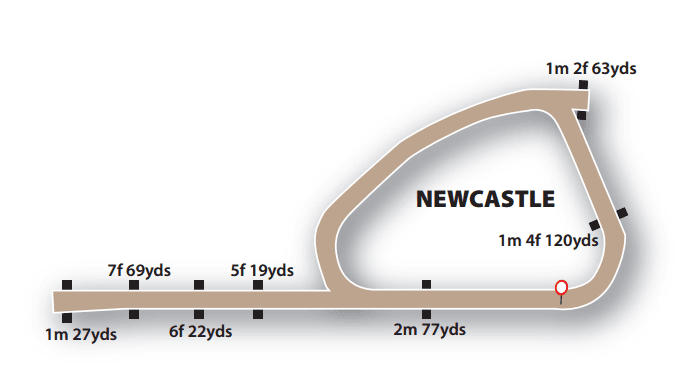
The rest of the Tapeta runs on a left-handed oval of about a mile and five furlongs — the track length published by the All-Weather Championships — with a run-in of about three and a half furlongs from the final bend. That is a big circuit by all-weather standards. Width is Newcastle’s other defining feature: wide enough for jockeys to choose a line rather than have one forced on them, and wide enough that big fields spread across the course rather than stacking up on the rail. That width changes what the draw means here rather than switching it off: from a mile upwards the track is mostly fair, but on the straight sprints the high third of the draw has consistently outrun the low.
The surface itself was installed in winter 2015/16, replacing the old turf flat track. It is a blend of silica sand, synthetic fibres and wax; the official description sits permanently at standard or standard-to-slow. That removes the swings a turf card lives with — rain does not turn this heavy — but it does not make the place weather-proof: Newcastle lost both weekend fixtures in December 2022 when the Tapeta failed its inspections in prolonged cold. Volume is high — 70 fixtures in 2026, all-weather and jumps together — the going is far steadier than turf, and patterns show up clearly in the data if the work is done.
- Location
- High Gosforth Park, Newcastle upon Tyne
- Postcode
- NE3 5HP
- Opened
- 1882 · Tapeta installed 2016
- Capacity
- 25,000
- Signature Races
- Northumberland Plate · AW Championships Finals Day
- Nearest Station
- Newcastle Central · Metro: Regent Centre
- Parking
- Free on most racedays
- Meetings / year
- 70 in 2026 · Tapeta & turf
The Long Run Home
The round course gets less attention than the straight mile, and it should not. From the final bend there is about three and a half furlongs to run, which is a long way by British standards and long enough to change what a rider can get away with.
Two things follow. The first is arithmetic. The straight’s final four furlongs are the uphill section, and the round course joins it inside them — so a horse turning in at Newcastle is already climbing, or meets the rise within a stride or two. There is no level stretch in which to recover from a fast bend, and no point at which a leader gets a breather. Whatever a horse has left at the top of the straight is what it finishes on.
The second is tactical. Three and a half furlongs is too far to steal a race off the home turn: a rider who kicks for home there has committed to a long, rising run, which is a great deal to ask of anything. It is also far enough that a horse in mid-division has time to organise a challenge rather than having to snatch at one. Put that together with the width of the track and the excuses shrink — the long run home and the room to use it remove most of the positional trouble that costs horses races on tighter all-weather tracks, which is the best reason on this page for taking Newcastle form at face value.
How the Tapeta Rides
The Tapeta went down in the winter of 2015/16 in place of the old turf Flat course — a blend of silica sand, synthetic fibres and wax — and the official going sits permanently at standard or standard-to-slow. Rain does not turn it heavy, which is why Newcastle keeps racing through the months when turf fixtures are being lost. It is not immune to the weather, though: the Tapeta failed its inspections in the hard frost of December 2022 and the course lost that Saturday and Sunday, and snow and frozen ground cost another fixture in March 2023.
The consequence for form reading is larger than it first appears. On turf the going is the variable that swamps everything else; it is the reason two runs by the same horse a fortnight apart can look like two different animals. Take it away and the remaining variables have to carry the whole explanation — pace, trip, class and, on the straight sprints, the draw. That is why a Newcastle performance means more from one run to the next than the same performance on changing ground, and why it deserves more weight when you are deciding whether a handicap mark is fair.
Volume compounds it. Newcastle is down for 70 fixtures in 2026 across its two courses, so form here accumulates far faster than at a track a horse visits once or twice a season — a horse can build a genuine Newcastle record inside a single winter rather than across three summers. That is part of why a repeat winner on this surface is worth taking seriously rather than filing as coincidence.
Standard does not mean identical, and the rider who knows the place best says so. Paul Mulrennan, who has ridden more winners here than anyone, told Racing TV in November 2024 that “Newcastle really tightens up and rides quick when it’s wet”, while “for the Northumberland Plate fixture in June it’s usually tough, testing and not overly pleasant”. He singles the track out for wind too: “that’s a wide-open track — the biggest circuit of all — where conditions can change from race to race. You can easily be facing a stiff crosswind before a sharp change into a headwind.” He had made the same point about the cold a year earlier, in his December 2023 column: all-weather surfaces ride “faster (and better) with rain and colder temperatures”, because the racing surface “becomes more compact and tight”. So watch the weather and the early races before you lean on a time: rain and cold tighten the surface, a dry summer leaves it deeper, and on an exposed straight mile the wind decides how much a front-runner has to spend.
The one thing all that consistency does not settle is whether a particular horse wants the surface at all. Some plainly do not, and the evidence is in the replay rather than the figures: a horse racing with its head high, or declining to go into a gap with sand coming back in its face, has given you a clue about why it finished where it did. Give a horse one run on the Tapeta before drawing a conclusion, and make a note of the ones that were visibly happier second time.
The Northumberland Plate
Newcastle’s biggest afternoon belongs to the Northumberland Plate, a two-mile handicap first run in 1833 and known for most of its life as the Pitmen’s Derby — it was staged on a Wednesday so the local mining communities could get to it, and the name outlived the pits. It is run in late June or early July.
The Plate has been decided on the Tapeta since 2016, and that change matters more to a punter than a surface note usually does. For its first 183 years this was a turf handicap, which meant the going was the first question anybody asked: a wet Newcastle June turned the race into a slog and rewrote the market overnight. Most of that variable is gone: the surface reads standard or standard-to-slow whatever the weather is doing, so a wet June no longer turns the race into a different contest overnight. It has not vanished altogether — Mulrennan’s account of Plate week is that it rides “tough, testing and not overly pleasant”, so the June meeting can be a deeper test than a winter card. What is left is the handicapper’s assessment, the pace and the trip.
Which puts the weight exactly where this track’s own figures put it. At two miles our own sample is too thin to call the draw either way — and the Plate is not an ordinary Newcastle staying handicap in any case. A twenty-runner Heritage field is its own population, so no course-wide draw conclusion should simply be inherited into it. What the track’s figures do speak to is position rather than the stall. A big field going two miles round the oval covers a long way before the final bend and then meets the same uphill straight that catches out hard-ridden leaders over the longer trips. A horse ridden to conserve arrives at that climb with something left; one used up getting a position does not.
It is also worth remembering what the prize money does to the field. The Plate draws entries from well beyond the yards that make up Newcastle’s ordinary programme, so a Newcastle record that counts for a lot on a midweek card counts for less on the day. Read it as a staying handicap first and an occasion second: proven form at or beyond the trip counts, evidence a horse can still quicken after two miles counts for more, and a profile that rests entirely on a soft-ground turf performance has been asked a different question here.
The Races That Matter
All-Weather Championships Finals Day is one of Newcastle’s two flagship Flat fixtures, and the racecourse bills it as the richest all-weather card staged in Europe. Newcastle took it over from Lingfield in 2022 and has staged it every Good Friday since: six Championship Finals — the Sprint, the Mile, the Middle Distance, the Fillies & Mares, the 3-Year-Old and the Marathon, whose two-mile final has been run as the Easter Plate since the 2025/26 season — for a total prize fund of £1 million, alongside the Listed Burradon Stakes over a mile for three-year-olds. It is the one day of the year when the whole synthetic programme points at Gosforth Park.
The Northumberland Plate Festival in late June is the other, and the racecourse calls Plate day the highlight of its year. The Plate itself is the headline — a Heritage Handicap over 2m 56y — with the consolation Northumberland Vase run over the same trip on the same card, and two Group 3s in support: the Chipchase Stakes over 6f for three-year-olds and up, and the Hoppings Stakes over 1m 2f 42y for fillies and mares.
One piece of history is worth carrying because of what it says about the surface. When Doncaster was waterlogged in November 2019 the Group 1 Vertem Futurity Trophy was moved here at short notice, making it the first top-level race ever run on an all-weather track in Britain. Kameko won it for Andrew Balding and Oisin Murphy.
Two Racecourses, One Name
One practical caution before you read any Newcastle form line: there are two racecourses on this site. The 2016 conversion replaced the turf Flat course with Tapeta, but the separate National Hunt turf course was left alone and still runs right through the jumps season — the Fighting Fifth Hurdle, a Grade 1, is staged on that turf course and never on the synthetic.
So “Newcastle” on a racecard tells you the venue, not the test. The two share a postcode and almost nothing else: a jumps run at Gosforth Park says nothing about whether a horse handles the Tapeta, and a strong Tapeta record says nothing about the turf. Check the code before you count a course win, and be especially careful with course-and-distance flags on form sites, which do not always make the distinction for you.
The jumps track is covered separately in our Newcastle National Hunt racecourse guide.
The Straight Mile
- Distances: 5f · 6f · 7f 14y · 1m 5y
- Gradient: uphill for the final four furlongs
- Unique: only straight mile on British all-weather
- Tactical edge: leaders at 5f and 6f, hold-up horses at a mile
- Caveat: the leader’s edge has largely gone by 7f
The Round Course
- Circuit: wide, galloping left-handed oval, about 1m 5f round
- Distances: 1m 2f 42y · 1m 4f 98y · 2m 56y
- Run-in: ~3½f from the final turn
- Character: wide, galloping, long sweeping bends
- Draw: mostly fair; a mild high lean over 1m 4f
Surface & History
- Opened: 1882 at Gosforth Park
- Tapeta installed: winter 2015/16
- Composition: silica sand, synthetic fibre and wax
- Turf retained: the separate National Hunt turf course, untouched by the 2016 conversion, runs through the jumps season
- Fighting Fifth: G1 hurdle staged on the separate turf National Hunt course, not the Tapeta
Key Betting Angles
- Uphill finish: the leader’s edge fades by 7f, reverses at a mile
- Course specialists: a distinctive test — repeat winners rate
- Effective mile: a stiff mile, not a flat one
- Sprint draw: the high third leads at 5f, 6f and 7f
- Form transfer: Newcastle ≠ Wolverhampton despite shared surface
Do front-runners win at Newcastle?
Newcastle is the exception among the all-weather tracks, and the reason is the hill. Its Tapeta straight mile — the longest straight all-weather course in Britain — finishes uphill, and that climb undoes exactly the horses a flat synthetic track rewards. Sprinters can still lead and last, because five furlongs gives a field no time to organise. Stretch the trip and the picture turns over.
By a mile on the straight course the advantage has passed to horses held together for a finish: a leader that has committed early is stopping into the rise while the closers arrive with something left. Paul Mulrennan puts it plainly: Newcastle is “probably the track where it’s easiest to ride a nice, patient waiting race”. From a mile and two furlongs upwards races switch to the round course and take in the home bend, where a prominent position — close up but not in front — is the profile. That is not the same as opposing the leader there. Mulrennan told Racing TV in November 2024 that where it was once “almost impossible to win from the front over 1m2f, 1m4f, or two miles”, “nowadays, if you can get your fractions right, good, and even, you’re in business”.
Run Style Bias by Trip
Best at 5f and 6f
Best at 1m 2f and 1m 4f
Best at a mile
Weakest at 7f
The bars are directional, but they are not unsupported: Dave Renham’s geegeez run-style study of Newcastle (published 30 November 2021, handicaps of eight or more runners run between 17 May 2016 and 30 September 2021) reaches the same order — front-runners hold “a very decent edge” over 5f and fare best over 6f, the front-running edge has “all but disappeared” by 7f where mid-division is the weakest style, hold-up horses “have the call in mile races”, and prominent racers have the advantage at 1m 2f and 1m 4f on the round course. It publishes no two-mile split. The strongest single value figure in it is at the mile: in 13- and 14-runner handicaps hold-up horses returned an A/E of 1.21 against 0.56 to 0.60 for the other three run styles.
Does the draw matter at Newcastle?
Strong bias — material handicapping factor
Moderate lean — worth noting
Broadly fair — not a primary factor
Measured properly, Newcastle is not the draw-neutral track it is usually described as. Cut the draw into thirds within each field size — so that every stall is judged against the number of chances it actually gets — and restrict it to handicaps of eight or more runners, and the three shortest trips on the straight all lean the same way. Over 5f the high third of the draw runs at an impact value of 1.22 against 0.88 for the low, across 403 races; over 6f it is 1.17 against 0.88 across 561; over 7f 1.13 against 0.81 across 541. The lean persists across the smaller and larger field-size bands alike — with one maximum-field exception at 5f, below — and it survives unchanged when the same query is run by raw stall number instead of by stalls alignment.
The value side is narrower than the strike rate. Over the straight 5f the highest quarter of the draw wins 12.3% of its races at an A/E of 1.05, against a course baseline of 0.84 — the only quarter at any trip here that has beaten its own market. Everywhere else the direction is right and the price is not: the high third wins more often than the low, at odds that have already taken most of it. Read the sprint draw as a tie-breaker between two horses you already like, not as a price edge in its own right.
Two honest qualifications. The first is that this is a stands-side effect on a straight course, not a ground-saving one: there is no bend here, so the low-draw logic punters bring from Wolverhampton or Lingfield is not merely weaker at Newcastle, it points the wrong way. The second is that maximum fields are the exception. In 5f handicaps of fourteen runners, stalls 1–4 have won 23 of 58 races, 40% against an expected 29% — the one field size where the low numbers hit back, and worth respecting when a big sprint field comes up.
From a mile upwards the picture flattens without going flat. The straight mile reads 0.93 / 1.03 / 1.03 across 509 races and only leans high once fields pass eleven; the round-course mile and a quarter is fair across 271. The mile and a half leans high on 220 races, and although our own two field-size bands disagree with each other, an independent sample points the same way: Renham found high draws beating low by roughly double on wins over 1m 4f across 119 handicaps since 2017, with the percentage of rivals beaten agreeing and high ahead of low in every individual year — while noting honestly that he has no explanation for it, since the low numbers are the ones drawn against the inside rail. Call it a mild high lean rather than a settled bias. Two miles is too thin at 125 races to call at all. At those trips the uphill finish, stamina and the pace map matter more than the stall, which is the part of Newcastle’s reputation that survives.
Two independent readings say the same thing, and one supplies the mechanism our figures cannot. Dave Renham’s geegeez study of Newcastle — published October 2022, handicaps of eight or more runners run between January 2017 and August 2022 — found high draws best on win percentage at 5f, 6f, 7f and the mile, with the low third worst at every one of them, and the two lowest stalls on the straight course beating 0.46 and 0.47 of their rivals against 0.51 and 0.52 for the two highest. His conclusion is the sober one, and worth quoting because it is the brake on ours: low draws are at a slight disadvantage on the straight, and “it is going to be tough though to make this pay”. Paul Mulrennan, writing for Racing TV in December 2023, describes the same shape from the saddle: “there is a clear mid-to-stands’ side track bias… Newcastle is a breezy, open expanse and the strong crosswinds kind of blow you inward towards that stands’ side rail. I can’t remember the last time I saw a horse win down the far rail at Newcastle.” He puts part of it down to the harrowing pattern and part to the weather — which is the argument for reading the stall alongside the wind and the likely pace on the day, rather than on its own. He also supplies the qualification: on the straight track, a horse that misses the break “even from a moderate draw (low)” still has time to tack across and recover.
None of that makes it a law, though. Racing Post’s raceday analysis of the 2026 Plate meeting (Harry Wilson, 27 June 2026) sets the long run against a live departure from it, and the long run agrees with us: over the previous ten years Newcastle’s favoured draw, normalised as stall number divided by field size, has “rarely wavered from around 0.6” — roughly stalls eight or nine in a field of fourteen, which is the high third. Yet across the meeting’s first two days the average winning draw on the straight was 6.2, and seven of the twelve straight-course races went to a horse drawn five or lower, because “the runners are challenging down the middle of the track, rather than heading towards the often favoured stands’ side rail”. The conditions were the explanation offered: barely any wind, and hot weather softening the waxy component of the Tapeta into a more testing surface. Position told the same story — none of the fifteen races over those two days was won from further back than midfield, and only five of the forty-four places went to horses coming from behind. Then the wind got up on Plate day itself, and the same analysis expected “the stands’ side bias back in full effect”. Twelve races is a meeting, not a study. It is a clean demonstration of the point, though: the stall is where you start at Newcastle, and the wind, the surface and the line the field actually takes are what settle it.
Which trainers and jockeys win most at Newcastle?
| Trainer | Runs | Wins | Win% | Places | Place% | A/E | P/L |
|---|---|---|---|---|---|---|---|
| 1 Fahey, R A | 1463 | 169 | 11.55% | 460 | 31.44% | 0.91 | -213.07 |
| 2 Goldie, J S | 1073 | 121 | 11.28% | 312 | 29.08% | 0.97 | -95.98 |
| 3 O’Meara, D | 889 | 102 | 11.47% | 289 | 32.51% | 0.88 | -175.46 |
| 4 Burke, K R | 746 | 95 | 12.73% | 259 | 34.72% | 0.82 | -16.91 |
| 5 Gosden, J H M | 286 | 94 | 32.87% | 179 | 62.59% | 0.95 | -27.56 |
| 6 Varian, Roger | 368 | 88 | 23.91% | 215 | 58.42% | 0.86 | -47.74 |
| 7 Haggas, W J | 297 | 88 | 29.63% | 159 | 53.54% | 1.03 | +7.94 |
| 8 Ryan, K A | 623 | 86 | 13.80% | 227 | 36.44% | 0.92 | -61.85 |
| 9 Jardine, I | 986 | 83 | 8.42% | 245 | 24.85% | 0.83 | -70.61 |
| 10 Brittain, Antony | 963 | 83 | 8.62% | 265 | 27.52% | 0.83 | -279.02 |
| 11 Haslam, B M R | 567 | 78 | 13.76% | 164 | 28.92% | 1.14 | +32.60 |
| 12 Ellison, B | 889 | 77 | 8.66% | 248 | 27.90% | 0.80 | -275.48 |
| 13 Balding, A M | 281 | 74 | 26.33% | 130 | 46.26% | 1.17 | +82.24 |
| 14 Dods, M | 698 | 65 | 9.31% | 172 | 24.64% | 0.84 | -240.94 |
| 15 Watson, Archie | 334 | 64 | 19.16% | 124 | 37.13% | 1.06 | -35.16 |
| 16 Carr, Mrs R A | 719 | 63 | 8.76% | 166 | 23.09% | 0.96 | -146.34 |
| 17 Easterby, M W | 549 | 61 | 11.11% | 146 | 26.59% | 0.94 | +47.87 |
| 18 Tinkler, N | 669 | 60 | 8.97% | 179 | 26.76% | 0.91 | -26.08 |
| 19 Smart, B | 517 | 60 | 11.61% | 168 | 32.50% | 0.95 | -52.07 |
| 20 Camacho, Miss J A | 641 | 58 | 9.05% | 184 | 28.71% | 0.76 | -272.70 |
Newcastle AW · Current trainers, since 2010
| Jockey | Runs | Wins | Win% | Places | Place% | A/E | P/L |
|---|---|---|---|---|---|---|---|
| 1 Mulrennan, Paul | 1563 | 184 | 11.77% | 469 | 30.01% | 0.87 | -417.78 |
| 2 McDonald, P J | 1113 | 150 | 13.48% | 383 | 34.41% | 0.90 | -116.93 |
| 3 Hart, Jason | 1265 | 145 | 11.46% | 359 | 28.38% | 0.98 | -148.50 |
| 4 Curtis, B A | 716 | 120 | 16.76% | 271 | 37.85% | 1.05 | +38.35 |
| 5 Tudhope, Daniel | 605 | 114 | 18.84% | 244 | 40.33% | 0.99 | -87.55 |
| 6 Mullen, Andrew | 1291 | 108 | 8.37% | 297 | 23.01% | 0.90 | -301.36 |
| 7 Rodriguez, Callum | 627 | 98 | 15.63% | 230 | 36.68% | 0.98 | +15.48 |
| 8 Eaves, Tom | 1135 | 84 | 7.40% | 259 | 22.82% | 0.86 | -396.12 |
| 9 Stott, Kevin | 570 | 84 | 14.74% | 213 | 37.37% | 0.92 | -43.52 |
| 10 Hardie, Cameron | 1512 | 77 | 5.09% | 291 | 19.25% | 0.69 | -659.66 |
| 11 Nolan, D | 645 | 77 | 11.94% | 208 | 32.25% | 0.98 | -107.97 |
| 12 Robinson, Ben | 773 | 76 | 9.83% | 219 | 28.33% | 0.93 | -131.04 |
| 13 Morris, Luke | 766 | 75 | 9.79% | 238 | 31.07% | 0.67 | -306.73 |
| 14 Doyle, Hollie | 423 | 72 | 17.02% | 149 | 35.22% | 0.95 | -70.84 |
| 15 Mitchell, Jack | 399 | 71 | 17.79% | 190 | 47.62% | 0.75 | -104.61 |
| 16 Lee, Clifford | 527 | 64 | 12.14% | 169 | 32.07% | 0.84 | -101.99 |
| 17 Havlin, Robert | 226 | 59 | 26.11% | 119 | 52.65% | 0.92 | -55.01 |
| 18 Beasley, Connor | 640 | 58 | 9.06% | 196 | 30.63% | 0.74 | -229.42 |
| 19 Sullivan, James P | 921 | 56 | 6.08% | 174 | 18.89% | 0.88 | -301.95 |
| 20 James, S H | 717 | 54 | 7.53% | 201 | 28.03% | 0.71 | -226.48 |
Newcastle AW · Current riders, since 2010
Which sires do best at Newcastle?
| Sire | Runs | Wins | Win% | Places | Place% | A/E | P/L |
|---|---|---|---|---|---|---|---|
| 1 Dark Angel (IRE) | 861 | 108 | 12.54% | 294 | 34.15% | 0.86 | -204.96 |
| 2 Dandy Man (IRE) | 983 | 105 | 10.68% | 294 | 29.91% | 0.96 | -12.75 |
| 3 Kodiac | 1053 | 90 | 8.55% | 287 | 27.26% | 0.74 | -366.56 |
| 4 Lope De Vega (IRE) | 507 | 70 | 13.81% | 180 | 35.50% | 0.86 | -39.77 |
| 5 Showcasing | 625 | 69 | 11.04% | 178 | 28.48% | 0.86 | -67.35 |
| 6 Acclamation | 609 | 69 | 11.33% | 177 | 29.06% | 0.97 | -79.97 |
| 7 Sea The Stars (IRE) | 282 | 66 | 23.40% | 128 | 45.39% | 1.09 | +48.19 |
| 8 Exceed And Excel (AUS) | 557 | 65 | 11.67% | 159 | 28.55% | 0.94 | -114.52 |
| 9 Invincible Spirit (IRE) | 507 | 61 | 12.03% | 156 | 30.77% | 0.89 | -95.19 |
| 10 Iffraaj | 485 | 58 | 11.96% | 137 | 28.25% | 0.91 | -134.21 |
| 11 Frankel | 270 | 52 | 19.26% | 132 | 48.89% | 0.92 | -50.94 |
| 12 Kingman | 345 | 50 | 14.49% | 128 | 37.10% | 0.78 | -129.33 |
| 13 Dutch Art | 332 | 50 | 15.06% | 114 | 34.34% | 1.14 | -12.62 |
| 14 Dubawi (IRE) | 236 | 47 | 19.92% | 104 | 44.07% | 0.85 | -62.26 |
| 15 Oasis Dream | 419 | 45 | 10.74% | 99 | 23.63% | 0.97 | +27.00 |
| 16 Starspangledbanner (AUS) | 301 | 45 | 14.95% | 107 | 35.55% | 1.06 | -6.92 |
| 17 Zoffany (IRE) | 376 | 44 | 11.70% | 107 | 28.46% | 0.94 | +21.30 |
| 18 Bated Breath | 421 | 43 | 10.21% | 127 | 30.17% | 0.80 | -101.63 |
| 19 Mehmas (IRE) | 392 | 39 | 9.95% | 107 | 27.30% | 0.73 | -153.96 |
| 20 Mayson | 462 | 38 | 8.23% | 133 | 28.79% | 0.66 | -168.98 |
Newcastle AW · Since 2010
Betting Tips for Newcastle All Weather
Respect the uphill finish
Final four furlongs of the straight are uphill. Leaders still win the sprints — by seven furlongs their edge has gone, and by a mile it is the closers’ race. Treat bold front-running figures imported from tight AW tracks with scepticism over the longer straight trips.
Proven Newcastle form counts
Newcastle asks a question most synthetic tracks do not — a straight uphill mile on a big, galloping circuit — so a horse that has already won here more than once has shown you it handles that test. Treat it as evidence of suitability, and prefer it to a rival whose synthetic form was all built on tight, turning tracks.
Read the straight mile as a stiff one
Stamina over 1m 5y here is a harder question than a flat mile elsewhere: Timeform calls the straight uphill for its final four furlongs and says an ability to see out the trip is essential. Treat proven nine-furlong form as a positive; be wary of barely-staying milers stepping up.
Reverse the sprint draw logic
Because 5f and 6f are on the straight, there is no bend to save ground on — so the stall-position logic imported from Wolverhampton or Chester does not just fade here, it reverses. The high third of the draw outscores the low at 5f, 6f and 7f.
Mulrennan on the straight
Paul Mulrennan rides more Newcastle winners than anyone — 184 from 1,563 — and says himself that he rides Newcastle more often than anywhere. His record here has historically been overbet, though: at A/E 0.87 and a level-stakes loss of over £417, the volume flatters the value.
Newcastle ≠ Wolverhampton
Shared surface, opposite tracks. Wolves is tight, turning and testing in a different way. Direct form read-across between the two can mislead badly in either direction.
Balding when he travels
Andrew Balding sends runners sparingly — 281 across the sample — but at a 26.33% strike rate and the biggest level-stakes profit in the trainer table (A/E 1.17, +£82.24). It was Balding who won the 2019 Vertem Futurity Trophy here with Kameko, the first Group 1 ever run on an all-weather surface in Britain. A Kingsclere runner at Gosforth Park is worth a second look.
Common Mistakes to Avoid
- Trusting bold front-runners at every trip. Over 5f and 6f leaders still hold an edge here; by seven furlongs their edge has gone, and at a mile the hold-up horse is the one to be on. Pace figures earned at tighter all-weather tracks like Southwell or Chelmsford need reinterpreting here rather than carrying across unchanged.
- Importing sprint draw biases — and assuming that because the low-draw rule fails here, no rule applies. Newcastle’s 5f, 6f and 7f are on the straight mile and there is no ground-saving bend, so stalls-1-to-4 logic from other all-weather tracks does not apply. What the figures show instead is a persistent edge to the HIGH numbers at all three trips, worth an impact value of about 1.2 against 0.85 for the low third. Backing a low draw here on general all-weather instinct is the mistake, not backing the draw at all.
- Treating Wolves and Newcastle Tapeta as the same form line. The tracks could not be more different in character. A horse that runs a stinker at Wolves can show well here, and the other way round.
- Underestimating course specialists. A synthetic record built on tight, turning tracks is not the same evidence as one built over a straight uphill mile, so a horse with course form here has answered a question the visitor has not.
Newcastle Racecourse FAQs
Is there a draw bias on Newcastle’s all-weather track?
What kind of track is Newcastle’s all-weather course?
Do front-runners struggle at Newcastle?
Does Newcastle form transfer to Wolverhampton?
Which angles work best at Newcastle?
Other All-Weather Tracks
Kempton Park
Polytrack — prominent racers and a handy draw.
Lingfield Park
Polytrack — one of the strongest low-draw biases.
Chelmsford City
Tight Polytrack — pace and a low draw.
Southwell
Tapeta (ex-Fibresand) — a speed-favouring surface.
Wolverhampton
Tight Tapeta — speed from a low draw.
Dundalk
Ireland’s only floodlit all-weather track — Polytrack, tight and turning.
Backing a runner at Newcastle?
Daily selections, live-stakes analysis and honest P&L — every meeting, every day.
The Trackside Companion is your day at the races, written to order — every race on your meeting’s card broken down, plus this track’s draw, angles and people distilled from the guide you’ve just read. Order at least a week before your raceday.
Plan your raceday →