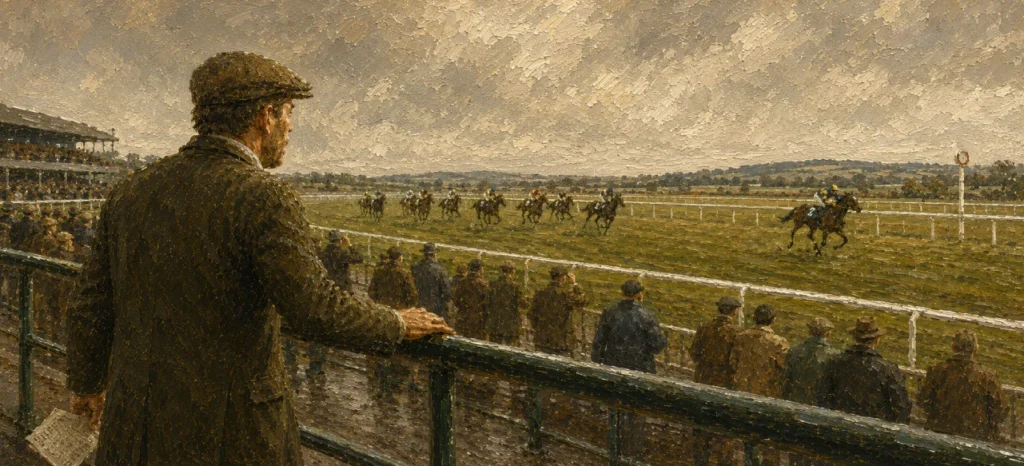
Stand in any betting shop on a Saturday and you’ll hear a punter describe their own betting with total confidence. Good on the Flat, hopeless over jumps. Each-way is where I make my money. Ask how they know, and the answer is usually some version of the same thing: they can feel it. Here’s the uncomfortable truth underneath: nearly everyone has a story about their betting, and almost nobody has a record to check it against. And when it comes to gambling, memory is not a neutral witness — it is a defence lawyer.
This piece is about replacing the story with a record: a settled, filterable account of every bet you strike. It costs minutes a day, and it will tell you things about your betting you cannot learn any other way. I know, because I’ve kept one for years — and some of what it told me I did not enjoy learning. More on Newcastle shortly.
Born out of a spreadsheet I built for myself
A confession first: the Ledger was never designed as a product. It started life as my own crude P/L sheet — one line per bet, a running total, nothing cleverer. Then it grew legs: the track, the trainer, the jockey, class, going — more out of OCD than any grand plan. I broke that spreadsheet more times than I can count and rebuilt it every time, because by then I couldn’t handicap without it. The Ledger and the Bet Log spreadsheet are that sheet, rebuilt properly. Everything in this piece happened to me first.
The story you tell yourself vs the number
Why can’t you just remember how you’re doing? Because memory was never built for honest bookkeeping. Wins are rare, vivid and loud — the 20/1 Cheltenham winner replays for years. The quiet losers work the other way: a fiver here, a tenner there, easily spent and even more easily unexamined — you can go a long time carefully not looking your bank statement in the eye, and most of us have been there.
Then the near-misses. A favourite touched off by a head gets filed under “unlucky”, not “wrong” — and a judgement error, repeated weekly, never gets looked at. Stakes drift — a fiver becomes twenty on the strength of a feeling — and after a red afternoon comes the oldest instinct in the game: one more, to get level, struck at exactly the moment judgement is worst. Add recency bias and the great standing delusion of the losing punter — I’m about even — and the books are cooked before you’ve opened them.
None of this makes you a mug. It makes you a human being. The only fix is a set of books that doesn’t care how the story goes.
What happened when I checked my own
Formdial’s published record settles in public — every selection, win or lose, on the results page and sliced open in the Edge Explorer. My own book is blunter still. Filtered by course, one line stood out a mile.
Sixty-three bets at one track is not a disaster you notice happening. It’s a tenner at a time, spread across years, each loss individually forgettable. Memory filed Newcastle under “nothing much”; the record filed it under two winners in sixty-three. That’s the clean choice a record forces: avoid the track, or go back to school on it. What you can no longer do is drift on.
The same pass over jockeys and trainers turned up a pairing that makes the case even better, because half of it is good news.
Thirteen of the fifteen were confident two-point win bets; six went off at 6/1 or shorter. Not one obliged. Probert rides at a healthy strike rate north of 11% — the misfire was mine, not his. Do I think twice now when he’s aboard one I fancy? Damn right I do.
Three winners from seven — form figures 3111203, an ROI of +138.1% — across seven different tracks and four different jockeys, with one common angle: maidens. Spotting his record with runners on their second career start was one thing; seeing the raw data of how I’d bet them was quite another.
Notice what the record did there. It separated two feelings that were identical from the inside — two vague impressions, one worth 22 points at +138%, the other fifteen straight losers at short prices that never once announced themselves. You cannot tell those apart by feel. That is the whole argument, in one pair of numbers.
The excuses — and why they don’t hold up
“Too much faff”
True in the era of the notebook and biro; not true any more. Logging a bet is one line. In the Ledger, settling it is one click — win, place, lose or void — with each-way terms, Rule 4 deductions and even dead-heats worked out properly (the free bet calculator is there for pricing a bet before you strike it). Follow our tips and the day’s Daily Dial picks import and settle themselves. The honest time cost of a season’s record is minutes a week — less than you’d spend studying one race you don’t bet in.
“I already know how I’m doing”
Almost everybody believes this, which is precisely the problem: the feeling of knowing is close to universal, and it is uncorrelated with actually knowing. I thought I knew my record too. Then Newcastle hit me clean in the face. Sixty-three bets of not knowing.
“My sample’s too small to matter”
The most honest objection, and here’s the honest answer: at twenty bets your record proves very little — and it doesn’t need to. Its job at twenty bets is early warning, not proof. My Probert run said little about David Probert and plenty about how I read his rides — worth acting on long before it could pass a statistics exam. And the objection contains its own rebuttal: the only way to ever have a sample that means something is to have started. Every week you don’t log is evidence about your own betting, gone for good.
What a record actually shows you
A running profit-and-loss total is the least of it. A proper record is a mirror, not bookkeeping — serious bettors keep one out of self-interest, because it answers the only question that matters: where does my money actually go? The Ledger filters your record by course, class, race type, going, distance, odds band, trainer, jockey, tipster, bookmaker, bet type, month, day and country — fourteen dimensions, stackable, over a thousand distinct cuts of your own betting. The ones that most often change how people bet:
By course. The Newcastle finding. Most punters have tracks that suit their eye and tracks that don’t; few know which is which. One click, and the answer is frequently not the track you’d have guessed.
By odds band. Is your money made at the sensible end of the market and given back chasing 16/1 romance — or are the short-priced “bankers” the leak? Either answer is useful; not knowing is the only losing position. Read strike rate and ROI as a pair while you’re there — judging a longshot style by a chalky yardstick is how punters talk themselves off sound methods.
By bet type. Each-way in big-field handicaps feels safe. Collected-more-often and profitable are different things, and the by-type table is where the difference stops hiding — a tax for some punters, an entire edge for others.
By tipster. Log the bets by source and you get each tipster’s record as you actually played it — your prices, your stakes. It is the kill-or-keep signal, and it applies to us as much as anyone selling tips: we’d rather you followed the Dial because your own ledger says it pays.
By trainer and jockey. The Probert–Channon split, above. Loyalties and grudges, audited.
Then stack them. “Bad at Kempton” might really be “bad in Kempton’s big-field Class 5 handicaps and fine elsewhere”. My Channon angle, stacked, turned out to be Channon maidens, second time out — a sharper, smaller, better bet than the loyalty it started as.
One honest warning about slicing: cut any record thinly enough and something will look spectacular by pure chance. A three-bet bucket at a 100% strike rate is noise wearing a suit. The Ledger shows the bet count beside every breakdown for exactly this reason — wherever you slice, read the count before the percentage.
The number almost nobody talks about: beating the SP
Serious bettors watch one number more closely than profit, because it answers a better question — not did the bet win? but was it a good bet at the price? By the off, the market has settled a final price for every runner; in British racing the Betfair Starting Price is the cleanest version. Took 5/1 about one that went off 7/2? You beat the closing market. Took 5/1 about one that drifted to 8/1? The market says you paid over the odds — whatever the result. Done on every bet, that comparison is closing line value: the most honest measure there is of whether you can actually price a horse race.
Why it matters more than P&L: results are mostly variance in the short run, but the price comparison scores every bet, winner or loser, so the signal accumulates fast. Beat the SP consistently through a losing month and the arithmetic is on your side — profit tends to follow. Win for a month while taking worse prices than the close, and the market is quietly telling you it’s weather, not judgement. The Ledger works it out automatically on any bet with a BSP recorded — per bet, overall, and by tipster; the Excel edition carries a Beat-the-BSP gauge on its dashboard.
The tipster’s record is not your record
A point no tips site has much incentive to make, so we will: a tipster’s published profit — ours included — is not your profit. You took a different price. You went each-way where the advice was win-only, or doubled the stake on the one that felt right. Slippage compounds, which means the only P&L that describes your betting is the one built from your own slips. Our record on the Explorer is what we did at the prices we published; your ledger is what you did at the prices you took. Keeping the second is the only way to know whether following anyone is working for you. That is not small print — it is the way this site is built.
Where the DIY spreadsheet quietly goes wrong
Punters who already keep a home-made record are one habit ahead of the field — I was one of them for years. But racing settlement is deceptively fiddly, and a record with quietly wrong numbers is worse than no record: it manufactures confidence. The usual failure points: each-way place terms, Rule 4 deductions after late non-runners, and the slow drift of mixing pound stakes with points. None of these errors is random — each biases the record in a consistent direction, so it compounds instead of washing out. Get the each-way maths habitually wrong and it’s precisely your each-way analysis that ends up lying to you.
This is why both of our tools automate settlement with the same arithmetic that settles Formdial’s own published record. The Bet Log Excel edition is a one-off purchase, owned outright: log the bet in white cells and the sheet settles it — correct terms, Rule 4 and dead-heats applied — runs your bank, and breaks the whole record down, every factor from class to day of week, with per-track, trainer and jockey sheets ranking your best and worst five automatically. The Ledger is the live version: fourteen stacked filters, the equity curve, closing-line value, one-click settling, on any device — 14-day free trial, £5 a month after. Two doors into the same discipline.
What changes when the record exists
Leaks found, edges confirmed — that’s obvious by now. The stranger change is what it does to the betting itself. Every bet has to go on the page, no exceptions — and the fiver you’d have thrown at the 3.40 “for interest” starts dying on the way to the slip, because you know it has to be written down. You start betting like someone who knows it will be.
The equity curve is an education too: once you’ve seen the true depth of your own worst drawdown survived, the next one stops feeling like an emergency. The low-grade anxiety of not really knowing how you’re doing simply ends — the number is there, current, every day. And when the losing run comes — it always comes; I’m in one as I type — you check whether you’re still beating the SP while results go against you. If yes, hold. If you never were, stop and rethink before the damage deepens. Either way the record has told you the truth at the exact moment it was most expensive to ignore.
What a record won’t do: it will not turn bad picks into good ones, and it cannot make you act on what it shows you. It is a mirror, not a will. What it does — reliably, cheaply, permanently — is end the era of not knowing.
Building the habit
Three rules keep a record alive past the first fortnight. Log the bet when you strike it — a bet you’d be slightly embarrassed to write down is usually a bet you shouldn’t strike. Settle same-day; one click, no guilty backlog. Automate the rest — Daily Dial followers get picks imported and settled hands-free, and an existing spreadsheet walks in through CSV import. Then give each bet its five minutes: fill in the going, the class, the trainer, the price taken — the more you give the record, the more it gives back, until it becomes a working model of your own betting brain. Think in points rather than pounds when you review, alongside a proper staking plan — and review weekly, not mid-session. The record serves the betting, not the other way round.
Common questions
Am I actually winning? How many bets before my record can tell me?
Under about twenty bets is a diary, twenty to a hundred an early-warning system, beyond that evidence — with the proviso that bigger typical prices need more bets at every tier, and any single slice of the record needs proportionally more again. The record is useful long before it is statistically decisive: my Probert flag was worth acting on well before it could pass an exam — treated as a flag, not a verdict.
What’s the real difference between the spreadsheet and the Ledger?
The same settlement engine, delivered two ways. The Excel edition is a one-off purchase you own forever, with every factor broken down (track, class, race type, distance, day, country, stake) plus Courses, Trainers and Jockeys sheets ranking your best and worst five by P/L. The Ledger is a live app: fourteen stacked filters, closing-line value computed for you, Daily Dial picks auto-imported, on your phone at the track. Spreadsheet people should have the spreadsheet; most others will get more from the Ledger.
What is closing line value, in plain English?
The difference between the price you took and the price the market settled on at the off — the Betfair SP is the usual benchmark in British racing. Beat it consistently and you are judging races better than the closing market; profit tends to follow, even when short-term results say otherwise. It is the fastest honest signal of whether your betting is judgement or weather.
Do I need to log the losing bets too?
The losing bets are the record. A log of your winners is just the highlights reel your memory was already keeping — the entire value lives in the bets you’d rather forget, because that is where the leaks are. Fifteen Probert losers taught me more than most of my winners ever have.
Can I track bets from different bookmakers and tipsters in one place?
Yes — both tools log the source and the bookmaker on every bet, and break your record down by each. Bookmaker-level closing-line value has a bonus use: a book where your bets persistently fail to beat the SP is a book whose prices you should trust less — move your business.
Is my betting record private?
Completely. Your Ledger is tied to your account, visible to nobody else, and exportable in full as CSV whenever you like — it leaves with you. The Excel edition never goes anywhere at all: it is a file on your own machine.
Three ways in
See it working, free
The Edge Explorer is Formdial’s entire published record, open to anyone, with the same filters pointed at our bets instead of yours.
Start your own Ledger
The live engine: fourteen stacked filters, closing-line value, one-click settling, Daily Dial auto-import. 14-day free trial, £5 a month after.
Own the spreadsheet
The Bet Log Excel edition: proper racing settlement, running bank, full breakdowns, yours forever for a one-off price. No subscription.
However you keep it, keep one. The most expensive habit in betting is not the losing bet — those come with the game. It is not knowing which of your bets are the losing ones. It took me sixty-three bets at one racetrack to learn that. Gut feel has had a long enough run: put your betting on the record, and find out — possibly for the first time — exactly what kind of punter you actually are.
Bet logs, spreadsheets and course cheatsheets — built the same honest way as the tips.
Visit the Shop →Why are some bets win-only and others each-way?
Three things decide it: confidence, race shape, and the betting market.
If I think a horse has an outstanding win chance, I'll back it win-only to maximise the return — even at a bigger price, where each-way would normally be the safer call. If the win case is more speculative but the place case is strong, each-way carries the bet.
Concrete example: Almanack at Kempton, 2 July 2014. Advised at 22/1 win-only in the morning. The price shortened to 16/1 SP and he won by a short head on the line. Win-only on a confident shout at a generous price is where the real returns come from — when the case is right, you back it to win, not to hedge.
What happens if my horse is a non-runner?
If a horse is declared a non-runner before the race, your stake is returned in full on win or each-way singles.
If it's part of a multiple (accumulator, lucky-15, etc), the bet runs on without that leg and the remaining legs are recalculated. For ante-post bets the rules differ — usually no refund unless the bookmaker is offering NRNB ("Non-Runner No Bet") on the race. Full breakdown here.
Why no advised bet some days?
Because there isn't one. The cards don't always offer value, and the worst thing a tipster can do is force a selection just to fill a slot.
A "No Bet" day is the system working — it's the same discipline that produces the winners on the days the bets are right. Better to sit out a card cleanly than to bleed the bank on filler. The best days are usually the ones I've been patient before.
What do the stake points mean?
Stakes are sized in points, not pounds — that way the same plan works on any size of bankroll.
The Daily Dial uses a simple scale: 1pt is the minimum bet (or 0.5pt each-way), 2pt is a standard bet (or 1pt each-way), and 5pt is the maximum on the strongest fancies (or 2.5pt each-way). The whole thing runs off a 100pt bankroll, so a £100 bank means a point is £1 and a 2pt bet is £2; a £1,000 bank means a point is £10 and a 2pt bet is £20. Scale to whatever feels comfortable.
New to this? Read up on: Betting Odds · Going Descriptions · National Hunt Racing
Get tomorrow's pick before the off
Every selection posted before the race — the angle, the reasoning, the price. Free, no fluff.