Nottingham
Flat
Colwick Park, Nottinghamshire · 2 miles east of Nottingham city centre
Turf
Left-Handed
Galloping Oval
Robin Hood Stakes
What is Nottingham racecourse like?
Track Character
Nottingham is a flat left-handed oval at Colwick Park, two miles east of the city centre. It measures roughly a mile and a half around with a four-and-a-half-furlong home straight. The track is essentially flat — there is one minor undulation two furlongs from home and it is irrelevant to all but the most badly balanced horse. The turn into the home straight is sharp, but the length of the straight that follows is generous enough that big galloping types are not punished in the way they would be at a tighter track like Chester or Catterick.
What is unusual about Nottingham is that there are two separate circuits running in parallel. The inner — which features a five-furlong straight chute — is used in spring and autumn. The outer, with a six-furlong straight, takes the summer fixtures. Rotating between them protects the ground and keeps the racing surface honest across an April-to-November season of around 20 fixtures. Sprint races are run on the straight course; everything from a mile up takes the round.
The most important thing to understand about Nottingham, however, has very little to do with its physical shape. It has to do with what the top stables use it for. When National Hunt racing ceased here in February 1996, the Jockey Club reconfigured the course with explicit policy: build two tracks, keep the ground fresh, attract the best horses. Three decades later that policy still works. Nottingham is one of the courses that the major Newmarket and Lambourn yards use to introduce their best two-year-olds. Slip Anchor, Oh So Sharp, Oath, Golden Horn, Adayar, Desert Crown and Eldar Eldarov all broke their maidens here. That changes how you should read the maiden form coming out of this track — and is the basis of the single strongest form-reading angle the course offers.
The straight course has a documented draw bias, but it is not the one most casual guides describe. The headline insight — high draws favoured towards the stands rail — is only half right. The actual variable is which side the stalls are placed on at each meeting, and the bias runs to whichever group is closest to the running rail. The front-runner edge in 5f handicaps is among the strongest in British racing — and it is a straight-course effect, with no bend involved. Coming from behind in a 5f handicap here is measurably hard work; over six furlongs the same handy-speed preference applies as coursecraft rather than as a figure.
Pace matters at Nottingham, but through two separate mechanisms that are worth keeping apart. On the round course the relatively sharp turn into the straight slows the early fractions, which lets prominent runners dictate and then kick clear once they straighten up — though the four-and-a-half-furlong run-in gives closers time to answer, so a premature move can still be punished. The straight five and six are a different case entirely: no bend is involved at all, and the front-running edge there is a measured handicap finding rather than a consequence of track shape. Over a mile on the round the draw effect is milder than the ground-saving argument suggests and it does not run the intuitive way — the middle third has led overall at 1.11, and in fields of eleven or more it is the high third that comes through at 1.13. Do not assume an outside berth is automatically a disadvantage here. Over a mile and a quarter and beyond, the draw becomes immaterial and class wins out.
The headline angle, though, is the maiden form. The late-October fixture here is an unusually productive juvenile race for its class. Seven named Classic winners in forty years have come through this track’s autumn maidens. The race now called the Golden Horn Maiden Stakes — over a mile and seventy-five yards in late October — is the spiritual home of the angle. Maiden winners from this fixture, and well-bred runner-ups behind them, are worth following closely when they reappear off a first handicap mark. We have not measured their next-start prices, so treat this as a form-reading principle rather than a measured market edge.
Jason Weaver, former jockey — At The Races
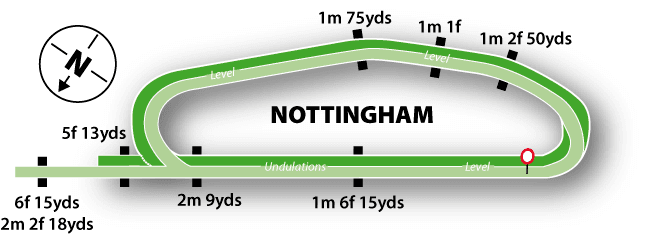
Course Facts
- Round course 1m4f, left-handed, flat oval — sharp final turn into a 4½f home straight
- Straight course 5f (inner) or 6f (outer) — separate chute joining at the top of the home straight
- Two circuits Inner used spring/autumn, outer used summer — protects ground across the season
- Draw bias Straight course: rail-side group favoured in fields of eleven or more. Round 1m: a mild middle lean, with the high third best in the biggest fields. 1m2f+: broadly fair
- Run style Front-runners in 5f handicaps win at 21.9% — Impact Value 2.32. Hold-up types punished over sprint trips
- Maiden angle Top stables use the late-October fixture for classic prospects. Seven named Classic winners since 1985
The Straight Course
- Distances 5f, 6f (inner straight = 5f only)
- Key bias Rail-side group plus early pace
- 5f handicaps Front-runner SR 21.9%, IV 2.32 — one of the strongest pace edges in UK racing
- Soft ground Bias to high-draw / stands-rail strengthens as the going eases
- Large fields fields of eleven or more are where the rail bias bites hardest
- Stalls position Varies meeting to meeting — always check before applying the bias
The Round Course
- Distances 1m, 1m½f, 1m2f, 1m6f, 2m+
- 1m drawMiddle draws marginally best; low draws get committed early on the sharp turn
- 1m2f+ Draw broadly fair — long straight neutralises stall position
- Pace pattern Steady early fractions favour prominent runners — but the long straight gives closers time to recover
- Big fieldsMiddle draws marginally best over 1m; low draws get committed early on the sharp turn
- Final bend Sharp but the 4½f straight gives gallopers time to recover
Track History & Stakes
- First raced 1892, Colwick Park
- NH ceased February 1996 — flat-only since
- Ownership Nottingham City Council has owned the freehold since 1965; the Jockey Club operates under a lease running to 2029. In February 2026 the council said it was considering a sale of the site, with Arena Racing Company reported as a potential buyer. No closure has been proposed and the 2026 programme of 20 meetings is unaffected
- Robin Hood Stakes Listed, 1m75y, late October — renamed from the Ben Marshall Stakes in 2024
- Nottinghamshire Oaks Listed, 1m2f50y, fillies and mares 4yo+, late April
- Departed black type The Further Flight moved to Musselburgh in 2026 as the Goliath Cup; the Kilvington went to Newmarket in 2022 and is now the Ellen Chaloner Stakes
- Maiden graduates Slip Anchor, Oh So Sharp, Oath, Golden Horn, Adayar, Desert Crown, Eldar Eldarov — all broke their maidens here
Do front-runners win at Nottingham?
Nottingham looks like a fair track and largely rides like one, but the home turn is sharper than the rest of the circuit suggests, and that is where its races are settled. Fields tend to go an even rather than a frantic gallop here, which lets a prominent horse control the race, take the bend on the inside and then use a run-in of around four and a half furlongs to hold what it has.
The consequence is that hold-up horses need the pace in front of them to be genuinely unsustainable, and on an even gallop it rarely is. That is the round-course story, and it eases through the middle distances, where the extra ground and the length of the run-in give a closer something to work with.
The straight course is a separate story with a separate mechanism. Over five and six furlongs no bend is involved at all, so nothing here follows from the shape of the turn: the field runs flat and straight, and the front-running edge is a measured handicap finding in its own right — 48 of 219 early leaders won in 5f handicaps, an Impact Value of 2.32. Keep the two apart when you read a card.
Run Style Bias — Qualitative Only
Controls an even gallop
Strongest in the sprints
Between the two
Needs the pace to collapse
Treat these bars as directional — a reading of how the track rides rather than a statistical measurement. The edge eases over middle distances, where the extra ground gives closers a target.
Does the draw matter at Nottingham?
Strong bias — material handicapping factor
Moderate lean — worth noting
Broadly fair — not a primary factor
Real data: Nottingham draw thirds cut inside each field size, handicaps of 8+ runners, all going, sourced from FormDial’s draw bias engine. 5f sample: 236 races. 6f: 175. 1m½f: 276. 1m2f: 301. 1m6f: 100. 2m: 32.
The pace edge at Nottingham is more decisive than the draw. On the round course the sharp final bend tends to slow the gallop, which lets prominent runners control fractions and kick; over the straight five there is no bend at all, and the edge is simply that nothing gets a chance to come back at a fast starter. Front-runners in 5f handicaps win at 21.9%, Impact Value 2.32 — one of the strongest pace biases on the UK calendar. Coming from behind in a Nottingham sprint handicap is hard work. Over a mile and beyond, position around the bottom bend matters, particularly off steady fractions, but the long straight gives closers time to recover and a premature move can leave a prominent racer vulnerable late.
Why Nottingham Maidens Matter
Nottingham’s value to punters is not in its shape but in its calendar position. The late-October fixture is a deliberate testing ground for next year’s classic prospects. The major Newmarket and Lambourn yards — Gosden, Haggas, Appleby, Suroor — routinely use it to school their best lightly-raced juveniles. The track knows it, the trainers use it, and the form book has decades of evidence.
When the Jockey Club reconfigured the course after dropping National Hunt in 1996, it did so with explicit intent. Build two circuits, protect the ground, attract the best horses. The race now run as the Golden Horn Maiden Stakes, over a mile and 75 yards in late October, is the spiritual home of the angle — winners go on to win Group 1s with unusual frequency for what is, on paper, a Class 4 contest.
Documented Nottingham Maiden Graduates
- Slip Anchor — won maiden at Nottingham → 1985 Epsom Derby
- Oh So Sharp — won maiden at Nottingham under Sir Henry Cecil → 1985 Fillies’ Triple Crown (1000 Guineas, Oaks, St Leger)
- Oath — won maiden at Nottingham → 1999 Epsom Derby
- Golden Horn — won the 32Red EBF Oath Maiden Stakes on 29 October 2014 by a head in a juvenile course record → 2015 Dante, Derby, Eclipse, Irish Champion Stakes, Arc. European Horse of the Year
- Adayar — fourth on debut at Nottingham in October 2020, then won the Golden Horn Maiden at the same track later that month → 2021 Epsom Derby and King George VI & Queen Elizabeth Stakes
- Desert Crown — won on debut in a Nottingham maiden, November 2021 → 2022 Epsom Derby
- Eldar Eldarov — won a Nottingham maiden, October 2021 → 2022 St Leger
The pattern is structural, not anecdotal. Godolphin’s own profile of Adayar confirms the route: a green run, then a win at the same track to set up a Derby campaign. John Gosden used the Nottingham maiden as Golden Horn’s only two-year-old start, and the colt won by a head in a juvenile course record before taking the Feilden, the Dante, the Derby and the Eclipse. Arabian Queen then beat him in the Juddmonte International — his only European defeat — before he won the Irish Champion and the Arc. The same yards — Gosden, Haggas, Appleby, Suroor — keep sending well-bred late-developing types to the autumn fixture, year after year.
The punting angle has two edges. First, the winners are worth following, particularly when the runner-up was well-bred and shaped with promise — multiple smart performers out of the same race is the Nottingham signature. Second, a Nottingham maiden winner dropping into handicaps off its first official rating deserves closer examination, because the nominal Class 4 label can understate the depth of the race it contested — assess the collateral form rather than the class label alone.
The angle in one line: read maiden form from the autumn Nottingham fixture as better than its class suggests, and note the well-bred runner-ups as well as the winners.
The course is a deliberate testing ground for the best two-year-olds in training. The form has produced seven named Classic winners in forty years. How much of that is already in the price on a reappearance we have not measured, so this is a form-reading edge rather than a demonstrated market one on the UK Flat calendar.
Which trainers and jockeys win most at Nottingham?
Real data: Nottingham flat turf, since 2010 (top 20 displayed). Min 15 runs. A/E above 1.0 means runners won more often than their prices implied over the sample; below 0.8 means substantial historical underperformance against market expectation.
| Trainer | Runs | Wins | Win% | Places | Place% | A/E | P/L |
|---|---|---|---|---|---|---|---|
| 1 Appleby, M | 618 | 94 | 15.21% | 183 | 29.61% | 1.24 | +150.08 |
| 2 Fahey, R A | 439 | 58 | 13.21% | 136 | 30.98% | 0.94 | -50.74 |
| 3 Varian, Roger | 269 | 52 | 19.33% | 123 | 45.72% | 0.91 | -17.33 |
| 4 Gosden, J H M | 286 | 51 | 17.83% | 121 | 42.31% | 0.77 | -35.00 |
| 5 Beckett, R M | 267 | 49 | 18.35% | 107 | 40.07% | 0.88 | -30.94 |
| 6 Hannon (Jnr), Richard | 349 | 48 | 13.75% | 122 | 34.96% | 0.91 | -45.54 |
| 7 Haggas, W J | 252 | 46 | 18.25% | 110 | 43.65% | 0.82 | -63.39 |
| 8 Burke, K R | 233 | 40 | 17.17% | 87 | 37.34% | 0.99 | -6.81 |
| 9 Suroor, Saeed Bin | 135 | 38 | 28.15% | 69 | 51.11% | 1.07 | +10.74 |
| 10 Cox, C G | 235 | 37 | 15.74% | 91 | 38.72% | 1.00 | -19.24 |
| 11 Easterby, T D | 387 | 34 | 8.79% | 112 | 28.94% | 0.76 | -145.90 |
| 12 Midgley, P T | 199 | 29 | 14.57% | 77 | 38.69% | 0.98 | -29.79 |
| 13 Fanshawe, J R | 192 | 26 | 13.54% | 76 | 39.58% | 0.87 | -52.43 |
| 14 Balding, A M | 187 | 25 | 13.37% | 63 | 33.69% | 0.92 | -60.77 |
| 15 Walker, Ed | 151 | 25 | 16.56% | 48 | 31.79% | 1.17 | +14.03 |
| 16 Bell, M L W | 232 | 24 | 10.34% | 73 | 31.47% | 0.77 | -120.08 |
| 17 Bowring, S R | 210 | 24 | 11.43% | 56 | 26.67% | 1.17 | +4.38 |
| 18 Appleby, Charlie | 107 | 24 | 22.43% | 53 | 49.53% | 0.86 | -32.96 |
| 19 Williams, Ian | 205 | 23 | 11.22% | 60 | 29.27% | 0.91 | -56.00 |
| 20 Evans, P D | 205 | 22 | 10.73% | 57 | 27.80% | 0.94 | +48.66 |
Nottingham Flat · Current trainers, since 2010
| Jockey | Runs | Wins | Win% | Places | Place% | A/E | P/L |
|---|---|---|---|---|---|---|---|
| 1 Doyle, James | 275 | 63 | 22.91% | 124 | 45.09% | 1.02 | -26.89 |
| 2 Sousa, Silvestre De | 375 | 61 | 16.27% | 132 | 35.20% | 0.91 | -39.16 |
| 3 Atzeni, Andrea | 258 | 47 | 18.22% | 113 | 43.80% | 0.98 | +3.91 |
| 4 Buick, William | 190 | 46 | 24.21% | 82 | 43.16% | 1.02 | +20.58 |
| 5 Murphy, Oisin | 206 | 39 | 18.93% | 78 | 37.86% | 1.02 | +10.37 |
| 6 Morris, Luke | 365 | 35 | 9.59% | 89 | 24.38% | 0.85 | -100.54 |
| 7 Tudhope, Daniel | 214 | 34 | 15.89% | 90 | 42.06% | 0.90 | -43.65 |
| 8 Kingscote, Richard | 308 | 31 | 10.06% | 96 | 31.17% | 0.69 | -122.06 |
| 9 Havlin, Robert | 210 | 30 | 14.29% | 87 | 41.43% | 0.81 | -57.27 |
| 10 Mullen, Andrew | 213 | 29 | 13.62% | 49 | 23.00% | 1.31 | +33.90 |
| 11 Hornby, Rob | 192 | 29 | 15.10% | 67 | 34.90% | 1.07 | +61.89 |
| 12 Curtis, B A | 183 | 28 | 15.30% | 57 | 31.15% | 1.09 | -17.40 |
| 13 Hart, Jason | 179 | 27 | 15.08% | 62 | 34.64% | 1.20 | +20.25 |
| 14 Levey, S M | 162 | 27 | 16.67% | 55 | 33.95% | 1.24 | +12.06 |
| 15 Egan, David | 186 | 26 | 13.98% | 68 | 36.56% | 0.89 | -10.78 |
| 16 Queally, T P | 201 | 25 | 12.44% | 53 | 26.37% | 1.07 | +102.99 |
| 17 Fallon, Cieren | 151 | 25 | 16.56% | 53 | 35.10% | 1.02 | -15.50 |
| 18 Marquand, Tom | 214 | 24 | 11.22% | 72 | 33.64% | 0.78 | +40.86 |
| 19 Spencer, Jamie | 170 | 23 | 13.53% | 63 | 37.06% | 0.72 | -87.06 |
Nottingham Flat · Current riders, since 2010
Which sires do best at Nottingham?
Real data: Nottingham flat turf sire records, since 2010 (top 20 displayed). Min 15 runs. A/E values track market valuation of progeny.
| Sire | Runs | Wins | Win% | Places | Place% | A/E | P/L |
|---|---|---|---|---|---|---|---|
| 1 Dark Angel (IRE) | 335 | 40 | 11.94% | 88 | 26.27% | 0.87 | -100.05 |
| 2 Dubawi (IRE) | 232 | 39 | 16.81% | 95 | 40.95% | 0.77 | -58.56 |
| 3 Invincible Spirit (IRE) | 250 | 35 | 14.00% | 92 | 36.80% | 0.95 | +30.03 |
| 4 Kodiac | 367 | 34 | 9.26% | 107 | 29.16% | 0.78 | -73.78 |
| 5 Oasis Dream | 281 | 33 | 11.74% | 78 | 27.76% | 0.84 | -121.76 |
| 6 Iffraaj | 221 | 33 | 14.93% | 77 | 34.84% | 1.04 | -6.21 |
| 7 Acclamation | 294 | 32 | 10.88% | 107 | 36.39% | 0.77 | -68.42 |
| 8 Pivotal | 213 | 28 | 13.15% | 75 | 35.21% | 0.91 | +22.90 |
| 9 Dandy Man (IRE) | 206 | 28 | 13.59% | 75 | 36.41% | 1.02 | -46.14 |
| 10 Showcasing | 218 | 26 | 11.93% | 70 | 32.11% | 0.88 | -5.30 |
| 11 Cape Cross (IRE) | 164 | 26 | 15.85% | 54 | 32.93% | 1.15 | -29.10 |
| 12 Kingman | 104 | 26 | 25.00% | 47 | 45.19% | 1.28 | +45.44 |
| 13 Sea The Stars (IRE) | 146 | 25 | 17.12% | 67 | 45.89% | 0.84 | -40.68 |
| 14 Kyllachy | 219 | 24 | 10.96% | 61 | 27.85% | 0.84 | -58.07 |
| 15 Mayson | 172 | 24 | 13.95% | 54 | 31.40% | 0.94 | -28.17 |
| 16 Royal Applause | 198 | 23 | 11.62% | 54 | 27.27% | 1.02 | -17.72 |
| 17 Dutch Art | 178 | 23 | 12.92% | 62 | 34.83% | 0.98 | +30.49 |
| 18 Lope De Vega (IRE) | 174 | 23 | 13.22% | 66 | 37.93% | 0.70 | -88.30 |
| 19 Shamardal (USA) | 138 | 23 | 16.67% | 50 | 36.23% | 0.93 | +1.26 |
| 20 Exceed And Excel (AUS) | 267 | 22 | 8.24% | 70 | 26.22% | 0.61 | -92.14 |
Nottingham Flat · Since 2010
Betting Tips for Nottingham Flat Turf
Maiden winners from autumn fixtures are worth more than their class suggests
Nottingham maidens have produced Slip Anchor, Oh So Sharp, Oath, Golden Horn, Adayar, Desert Crown and Eldar Eldarov in forty years. A maiden winner reappearing in handicaps off its first official mark came out of a race better than its class implies, which is worth knowing before you read the mark.
Front-runners have a strong measured run-style advantage in 5f handicaps
Sample of 219 produced 48 winners — 21.9% strike rate, Impact Value 2.32. That is a straight-course figure — no bend is involved. That is a handicap sample, so read it as a handicap finding: coming from behind in a Nottingham sprint handicap is hard work.
Check the stalls position before applying any draw bias
The straight-course bias is rail-side, not absolute high-side. Stalls are placed stands-side, far-side or in the centre depending on the meeting. Read which rail the stalls are against before you decide whether low or high is the favoured group.
The late-October fixture is a different animal
The Golden Horn Maiden Stakes — 1m 75y, late October — is one of Britain’s most notably productive late-season two-year-old maidens. Top yards school their classic prospects here, so read the depth of the form rather than the Class 4 label.
The riders who have most outperformed their prices here
Andrew Mullen: 29 wins from 213 rides — A/E 1.31 and +£33.90, the strongest A/E among the riders listed. Sean Levey (A/E 1.24) and Jason Hart (A/E 1.20) have also historically performed above market expectation here, and Tom Queally has returned the biggest profit on the page (+£102.99 from 201), while James Doyle is fair value at best (63 from 275, A/E 1.02, a small level-stakes loss).
Big yards that have historically underperformed market expectation
The biggest names run below their Nottingham prices: John Gosden (51 from 286, A/E 0.77), William Haggas (46 from 252, A/E 0.82) and Tim Easterby (34 from 387, A/E 0.76) all return a level-stakes loss. Strong reputations and strike rates have not translated into above-market historical returns here.
Watch the well-bred runner-ups from autumn maidens
The 2014 Golden Horn race produced Storm The Stars in second — subsequently placed in two Derbys. Multiple smart performers out of the same race is the Nottingham signature. Map the placings, not just the winners.
The Robin Hood Stakes is the black-type form-line to follow
Nottingham’s late-season Listed race — 1m75y in late October, renamed from the Ben Marshall Stakes in 2024 — is the one on the card worth treating as a serious form-line. The Further Flight, long the course’s staying feature and won twice by Alcazar before his Prix Royal Oak, moved to Musselburgh in 2026 and is now the Goliath Cup, so that form-line no longer belongs to Nottingham.
Common Mistakes to Avoid
- Applying the high-draw bias blindly. The straight-course bias runs to whichever side the stalls are against the rail. Check the meeting before deciding low or high — getting it backwards is the single biggest unforced error here.
- Trusting older guides on Fahey or Williams. Both still appear as Nottingham specialists in legacy course profiles. Both sit below market expectation on this page — Fahey A/E 0.94 for a £50.74 loss, Ian Williams 0.91 for £56.00 — but neither is the collapse older profiles imply. The narrative is stale.
- Backing held-up sprinters at 5f. Front-runner Impact Value is 2.32 on the straight five — nothing to do with the bend, which those runners never reach. The track punishes patience over the minimum trip. Class is not enough — running style matters more here than at most flat tracks.
- Treating Nottingham maiden winners as ordinary form. Do not dismiss these races because of the Class 4 label. Strong renewals can contain considerably more ability than the official class suggests, so examine the depth of the form before you assess a subsequent handicap mark.
- Fading Frankel progeny on the assumption they are over-bet superstars. At Nottingham the opposite holds — 43 winners from 181 runners (A/E 1.09) for a level-stakes profit make them one of the better sire angles here, not a trap.
- Ignoring field size when applying draw bias. Measured in handicaps of eight or more runners, the straight-course thirds finish level in fields of eight to ten; the edge only bites once fields reach eleven and beyond, where the high third pulls clear at 1.19 against 0.87. No overall bias shows in the pooled eight-to-ten runner sample. The related error is trusting raw stall win counts: at 5f a fixed split makes the low half look like it takes 77% of the races, when splitting each race at its own midpoint gives exactly 50/50. Low stalls run in every race; high stalls only turn up when the field is big.
Nottingham Racecourse FAQs
Is there a draw bias at Nottingham, and is it really a high-draw track?
Which way does Nottingham race, and what kind of track is it?
What is the pace bias at Nottingham?
Why does Nottingham maiden form matter so much?
Which trainers and jockeys do best at Nottingham, and what is the biggest mistake?
Nearby Tracks
Doncaster
Galloping and fair — straight course and round track.
Pontefract
Undulating — one of Britain’s stiffest finishes.
York
Wide, galloping, fair — draw shifts on soft ground.
Newmarket
Wide, galloping straights — the Rowley Mile and July.
Great Yarmouth
Flat, fair left-hander on the Norfolk coast.
Beverley
Stiff uphill finish — strong 5f low-draw bias.
Want the thinking behind Nottingham turf bets?
FormDial posts every selection before the off with its full reasoning: the angle, the price, the logic. See how course knowledge feeds into real tips.
The Trackside Companion is your day at the races, written to order — every race on your meeting’s card broken down, plus this track’s draw, angles and people distilled from the guide you’ve just read. Order at least a week before your raceday.
Plan your raceday →