Doncaster
Flat
Leger Way, Doncaster · home of the world’s oldest Classic
Turf
Left-Handed
Galloping
St Leger Gr.1
Doncaster also stages National Hunt racing. Read the National Hunt racecourse guide →
What is Doncaster racecourse like?
Track Character
Doncaster racecourse sits on Leger Way on the eastern edge of the town of Doncaster in South Yorkshire. Its principal claim in racing history is unrivalled: it is the home of the St Leger Stakes, first run in 1776 and the world’s oldest Classic race. Doncaster also stages the Lincoln Handicap in March — the traditional opener to the British turf Flat season — and the Futurity Trophy (Group 1, currently the William Hill Futurity Trophy Stakes) in October, frequently the season’s strongest pointer to the following year’s Classic generation. Racing in the area dates to the 17th century; the Corporation of Doncaster drew up plans for the current course in 1614 and ran it for over 300 years before Arena Leisure took over the day-to-day running in 2004, taking a long lease in 2007 when the course reopened after the £34 million rebuild of the grandstand.
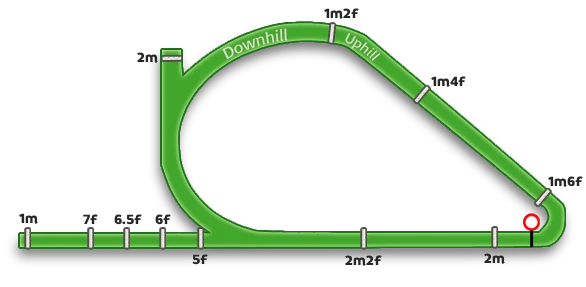
The track is a left-handed pear-shaped circuit measuring 1 mile 7½ furlongs in circumference. It is almost entirely flat with one exception: Rose Hill, an incline approximately 10 furlongs from the winning post, followed by a descent back to the level. The effect is minor and the overwhelming character of the course is genuinely galloping and fair. The home straight is 4½ furlongs long and unusually wide — wide enough that races are routinely won on either the stands side or the far side. Races from 5f to 1m are run on that straight course, and there is a separate round-mile start on an off-shoot of the round course, so a mile at Doncaster is either a straight-course or a round-course test, and the two ask different questions. Jason Weaver, in the At The Races View From the Saddle Doncaster guide, articulates the riding character as well as anyone:
— Jason Weaver, former jockey (At The Races View From the Saddle)
Weaver’s formulation — “either side is fine, just as long as you’re not far off a rail” — is the most honest summary of Doncaster draw dynamics available. The stall analysis data (8 distance configurations, 2,590 races) confirms this in detail while revealing the exceptions to the broadly-fair rule: high draws are a meaningful edge on the 6f and 7f straight courses in big fields, with a milder lean the same way at 5f, and — crucially — low draws show a marked historical tendency on the 1m straight in fields of ten or more. The Lincoln Handicap, run on the 1m straight, routinely attracts twenty or more runners: this is exactly the field-size and configuration where the stalls data shows the biggest low-draw advantage (40.2% low in 10+r). The received wisdom that “high draws” are best on the Doncaster straight does not hold at the full mile; it belongs to the 6f and 7f sprint trips in large fields, with a milder version of the same lean at 5f. The broad galloping nature of the track rewards confirmed gallopers and stayers more than quick-action sprinters over longer trips, and the jockeyship factor that Weaver flags on the round course is real: with the straight running for 4½ furlongs, hard-luck stories in big round-course fields can include runners forced wide or caught in traffic around the final bend.
Course Facts
- Configuration Left-handed pear-shaped oval, 1m7½f circumference; home straight 4½f; essentially flat except for Rose Hill at the 10f mark
- Straight course Races from 5f to 1m on the straight; a separate round-mile start sits on an off-shoot of the round course
- St Leger heritage World’s oldest Classic (1776); also hosts Lincoln Handicap (season opener, March) and the Futurity Trophy Gr.1 (October)
- Drainage Free-draining course; soft/heavy conditions are uncommon, enabling year-round racing including winter jumps fixtures
- Redevelopment £34m grandstand rebuild completed 2007; Arena Leisure has run the course since 2004. Corporation of Doncaster ran it from 1614
Pace & Run Style
- True galloping test Wide, flat, 4½f run-in rewards confirmed long-striding gallopers; quick-action sprint types are disadvantaged at middle and staying distances
- Either rail fine Weaver: “I liked to be on the stands’ side but either side is fine, just as long as you’re not far off a rail” — this applies especially to sprint and mile straight trips
- Round course jockeyship Hard-luck stories cluster in big round-course fields around the final bend; Weaver flags the risk on the round course when plenty are still in contention late
- Soft ground changes the picture When going turns soft, stamina and pace-setting take over and the favoured strip becomes a race-day read rather than a stored rule
- Lincoln Handicap draw Run on 1m straight in a big field (21 runners in 2026): The stall data shows low draws win 40.2% in 10+ runner fields — the most important draw angle at the course
Draw Bias Summary
- 5f straight Broadly fair overall; high edge in big fields (35.7% high vs 29.5% low in 10+r)
- 6f straight High edge: 36.4% overall, 38.1% in 12+r fields — the clearest sprint bias
- 7f straight High edge: 35.7% overall, 37.4% in 12+r fields — consistent with 6f pattern
- 1m straight (Lincoln config) Broadly fair overall; but low draws 40.2% in 10+r — counter-conventional and material for Lincoln analysis
- Round course (1m2f-1m6f) Broadly fair; 1m4f mid-draw edge (40.6% in 8+r); 1m6f genuinely fair
Calendar & Group Races
- St Leger Festival (Sep) Group 1 St Leger (1m6f115y) + Doncaster Cup, Park Stakes (7f), Champagne Stakes, Park Hill, May Hill and Flying Childers (5f, all Gr.2), Sceptre Stakes (Gr.3), Portland Handicap
- Futurity Trophy (Oct) Group 1 over 1m for 2yos — last Group 1 of the turf Flat season, key Classic trial
- Lincoln Meeting (Mar) Lincoln Handicap (Class 2, 1m straight) — traditional season opener; draw analysis critical in large fields
- November Handicap (Nov) Traditional season closer on the round course — staying handicap, historically significant
- Fixtures Year-round Flat and jumps racing; typically around 37 fixtures per year, the busiest dual-purpose programme in Britain
Do front-runners win at Doncaster?
Doncaster is a genuinely fair track, and the honest read is that its geometry does not hand the race to any running style. The round course is nearly two miles round with sweeping bends and a run-in of just over four furlongs, which is ample room for a closer to get organised and deliver.
Where a race starts matters more than how it is ridden. Everything up to a mile can be run on the dead-straight course, with no bends at all to lose ground on, and over the shorter of those trips early position pays best. At seven furlongs the run-style picture is about as even as British racing gets, and as the trip stretches the long straight gives a patiently ridden horse more time to get organised. On the round course, position still matters, because traffic into the final bend can interrupt a late run.
Run Style Bias — Qualitative Only
Solid at every trip
Gains from 7f upwards
Best on the straight sprints
No lean either way
Treat these bars as directional — a reading of how the track rides rather than a statistical measurement. A fair track is a real finding, not a missing one — spend your effort on the pace map of the individual race rather than a course rule.
Does the draw matter at Doncaster?
Strong bias — material handicapping factor
Moderate lean — worth noting
Broadly fair — not a primary factor
Source: Stall-level draw analysis for Doncaster — the share of winners coming from the low, middle and high third of the stalls, across all going, all age groups and all race types since 2010. 258 races at 5f straight, 516 at 6f straight, 620 at 7f straight, 278 at 1m straight, 120 at 1m round, 394 at 1m2f round, 271 at 1m4f round, 133 at 1m6f round. ⚠ Winner share tells you which part of the draw has produced winners. It is not a price: it does not show whether those winners were profitable to back, and a third of the stalls winning more than its share can simply mean the better horses were drawn there. Doncaster is one of the fairest courses in the library, with one material exception — low draws hold a clear edge on the 1m straight in fields of ten or more.
Doncaster is one of the fairest tracks in Britain, which is why the exceptions matter so much. The key angles: high draws in 6f and 7f straight sprint races with 12+ runners (38% and 37% respectively); low draws in 1m straight races with 10+ runners (40.2%, the reverse of the sprint pattern); middle draws at 1m4f in bigger fields (40.6%); and broadly fair conditions at almost every other configuration. On testing ground the draw question changes rather than resolves: published softer-ground work on the straight course reads close to flat, and the favoured strip has switched between one meeting and the next. Read the earlier races on the card rather than a stored rule, and treat soft ground as a stamina and pace question first.
Two things sit between any of these figures and a bet. The first is where the stalls and the rail are set for the meeting, which decides which physical strip a stall number actually buys; a long-run average cannot know that, and the favoured side has reversed between one Doncaster fixture and the next. The second is where the pace is drawn. A stall on the favoured side with nothing to track can be worth less than a neutral stall alongside the main speed, which is why the large-field straight-course handicaps — the Lincoln and the Portland especially — repay reading the pace map across the draw before treating a stall number as an advantage. Take the figures below as the starting position, then let the racecard move you off it.
Which trainers and jockeys win most at Doncaster?
Source: FormDial data (multi-year Doncaster flat aggregate). All columns available: Runs, Wins, Win%, A/E, P/L(SP). Rows 11-20 hidden by default.
| Trainer | Runs | Wins | Win% | Places | Place% | A/E | P/L |
|---|---|---|---|---|---|---|---|
| 1 Fahey, R A | 1196 | 113 | 9.45% | 333 | 27.84% | 0.87 | -274.72 |
| 2 Gosden, J H M | 493 | 107 | 21.70% | 232 | 47.06% | 0.96 | -18.06 |
| 3 Varian, Roger | 399 | 93 | 23.31% | 194 | 48.62% | 1.00 | +11.38 |
| 4 Hannon (Jnr), Richard | 647 | 85 | 13.14% | 214 | 33.08% | 0.88 | -72.14 |
| 5 O’Meara, D | 782 | 71 | 9.08% | 207 | 26.47% | 0.76 | -280.63 |
| 6 Haggas, W J | 385 | 70 | 18.18% | 179 | 46.49% | 0.85 | +2.17 |
| 7 Balding, A M | 350 | 56 | 16.00% | 126 | 36.00% | 1.06 | +77.83 |
| 8 Beckett, R M | 355 | 55 | 15.49% | 138 | 38.87% | 0.87 | +0.75 |
| 9 Appleby, Charlie | 239 | 54 | 22.59% | 113 | 47.28% | 0.90 | -5.81 |
| 10 Suroor, Saeed Bin | 220 | 51 | 23.18% | 99 | 45.00% | 1.07 | -17.36 |
| 11 Easterby, T D | 893 | 46 | 5.15% | 179 | 20.04% | 0.61 | -434.25 |
| 12 Fanshawe, J R | 275 | 45 | 16.36% | 110 | 40.00% | 0.99 | +26.26 |
| 13 Ryan, K A | 586 | 43 | 7.34% | 147 | 25.09% | 0.72 | -82.43 |
| 14 Hills, Charles | 354 | 43 | 12.15% | 105 | 29.66% | 0.87 | -18.24 |
| 15 Burke, K R | 382 | 41 | 10.73% | 114 | 29.84% | 0.86 | -69.62 |
| 16 Simcock, D M | 206 | 38 | 18.45% | 76 | 36.89% | 1.24 | +21.04 |
| 17 Appleby, M | 368 | 35 | 9.51% | 104 | 28.26% | 0.97 | -17.90 |
| 18 Botti, M | 274 | 32 | 11.68% | 86 | 31.39% | 0.91 | -43.43 |
| 19 Williams, Ian | 231 | 30 | 12.99% | 61 | 26.41% | 1.14 | -37.75 |
| 20 Tinkler, N | 385 | 29 | 7.53% | 84 | 21.82% | 0.90 | -67.17 |
Doncaster Flat · Current trainers, since 2010
| Jockey | Runs | Wins | Win% | Places | Place% | A/E | P/L |
|---|---|---|---|---|---|---|---|
| 1 Buick, William | 456 | 100 | 21.93% | 199 | 43.64% | 1.06 | +37.44 |
| 2 Atzeni, Andrea | 413 | 80 | 19.37% | 159 | 38.50% | 1.08 | -3.87 |
| 3 Spencer, Jamie | 427 | 73 | 17.10% | 165 | 38.64% | 1.03 | +32.54 |
| 4 Tudhope, Daniel | 529 | 67 | 12.67% | 172 | 32.51% | 0.86 | -51.92 |
| 5 Moore, Ryan | 336 | 63 | 18.75% | 143 | 42.56% | 0.84 | -97.47 |
| 6 Sousa, Silvestre De | 422 | 53 | 12.56% | 127 | 30.09% | 0.86 | -83.73 |
| 7 Murphy, Oisin | 308 | 49 | 15.91% | 113 | 36.69% | 0.91 | -33.36 |
| 8 Doyle, James | 321 | 48 | 14.95% | 124 | 38.63% | 0.77 | -133.52 |
| 9 McDonald, P J | 466 | 46 | 9.87% | 115 | 24.68% | 0.88 | -93.12 |
| 10 Havlin, Robert | 240 | 41 | 17.08% | 100 | 41.67% | 0.98 | -20.80 |
| 11 Mulrennan, Paul | 482 | 35 | 7.26% | 113 | 23.44% | 0.75 | -74.09 |
| 12 Allan, David | 410 | 35 | 8.54% | 97 | 23.66% | 0.92 | -58.00 |
| 13 Egan, David | 194 | 33 | 17.01% | 66 | 34.02% | 1.16 | +24.54 |
| 14 Levey, S M | 284 | 32 | 11.27% | 90 | 31.69% | 0.82 | -79.74 |
| 15 Stott, Kevin | 262 | 31 | 11.83% | 87 | 33.21% | 0.96 | -10.83 |
| 16 Muscutt, D | 207 | 31 | 14.98% | 70 | 33.82% | 1.03 | -0.78 |
| 17 Marquand, Tom | 223 | 30 | 13.45% | 79 | 35.43% | 1.00 | -29.51 |
| 18 Eaves, Tom | 460 | 28 | 6.09% | 81 | 17.61% | 0.87 | -174.72 |
| 19 Ryan, Rossa | 210 | 28 | 13.33% | 72 | 34.29% | 0.91 | -19.09 |
| 20 Mitchell, Jack | 197 | 27 | 13.71% | 79 | 40.10% | 0.80 | -4.34 |
Doncaster Flat · Current riders, since 2010
Which sires do best at Doncaster?
Source: FormDial data (multi-year Doncaster flat aggregate).
| Sire | Runs | Wins | Win% | Places | Place% | A/E | P/L |
|---|---|---|---|---|---|---|---|
| 1 Dark Angel (IRE) | 547 | 64 | 11.70% | 148 | 27.06% | 0.89 | -79.74 |
| 2 Dubawi (IRE) | 380 | 62 | 16.32% | 140 | 36.84% | 0.82 | -79.69 |
| 3 Invincible Spirit (IRE) | 468 | 53 | 11.32% | 144 | 30.77% | 0.90 | -69.34 |
| 4 Kodiac | 507 | 51 | 10.06% | 136 | 26.82% | 0.85 | -118.26 |
| 5 Oasis Dream | 394 | 49 | 12.44% | 126 | 31.98% | 0.95 | -1.87 |
| 6 Lope De Vega (IRE) | 308 | 48 | 15.58% | 116 | 37.66% | 0.99 | -33.97 |
| 7 Pivotal | 372 | 47 | 12.63% | 119 | 31.99% | 1.02 | -53.69 |
| 8 Acclamation | 492 | 45 | 9.15% | 136 | 27.64% | 0.82 | +8.07 |
| 9 Exceed And Excel (AUS) | 396 | 45 | 11.36% | 136 | 34.34% | 0.87 | -74.26 |
| 10 Frankel | 185 | 38 | 20.54% | 72 | 38.92% | 0.90 | -36.97 |
| 11 Shamardal (USA) | 285 | 36 | 12.63% | 101 | 35.44% | 0.86 | -110.64 |
| 12 Sea The Stars (IRE) | 201 | 34 | 16.92% | 80 | 39.80% | 0.84 | -5.05 |
| 13 Galileo (IRE) | 275 | 33 | 12.00% | 108 | 39.27% | 0.84 | -55.62 |
| 14 Bahamian Bounty | 225 | 33 | 14.67% | 75 | 33.33% | 1.28 | +32.50 |
| 15 Iffraaj | 346 | 32 | 9.25% | 79 | 22.83% | 0.81 | -152.50 |
| 16 Cape Cross (IRE) | 214 | 32 | 14.95% | 76 | 35.51% | 1.12 | -22.62 |
| 17 Dandy Man (IRE) | 299 | 29 | 9.70% | 80 | 26.76% | 0.92 | -32.55 |
| 18 Mehmas (IRE) | 201 | 29 | 14.43% | 70 | 34.83% | 1.07 | -39.51 |
| 19 Dansili | 194 | 29 | 14.95% | 63 | 32.47% | 0.91 | -12.13 |
| 20 Mastercraftsman (IRE) | 183 | 27 | 14.75% | 52 | 28.42% | 1.07 | -36.61 |
Doncaster Flat · Since 2010
The Lincoln Handicap
The Lincoln Handicap is the traditional opener to the British turf Flat season, run on the 1m straight at Doncaster in March in a field that routinely fills to twenty or more. It is one of the most heavily traded handicaps of the year and one of the most frequently misanalysed on draw. The race is named for Lincoln racecourse, where it was run until that course closed in 1964; its story, and four more, is in Britain’s Lost Racecourses. Stall-level data across 278 races on the 1m straight at Doncaster shows that in 10+ runner fields, low draws win 40.2% vs high 27.0% — the largest draw-distance gap of any Doncaster configuration. That is the reverse of the pattern the same course sets over 6f and 7f, which is why the two are easy to confuse: the high-draw reading belongs to the sprints, not to the mile.
The trainer data (career records at the race) identifies the plays and fades with unusual clarity. Charlie Appleby leads on win percentage (40%, 2 from 5, A/E 2.22) — on five runners, which is a note rather than a system. William Haggas has the strongest volume-adjusted record among established trainers: 4 wins from 14 entries (28.6%), P/L +£14.50, A/E 2.05. Either yard would add a second favourable historical factor to a low-drawn contender, though nothing here tests the two together. J J Quinn has beaten his prices by the widest margin of the smaller entries: 2 from 12 (16.7%), P/L +£32, A/E 3.51 — striking, but on twelve runners. The two yards to avoid are stark in the data: Richard Fahey has 2 wins from 43 entries (4.7%), P/L -£4, A/E 0.79 — the worst return of any major yard with meaningful entries; Richard Hannon (Jnr) has 0 from 10. Both send large numbers to Doncaster generally; neither record at this race justifies following them into it.
| Trainer | Entries | Wins | Win% | P/L(SP) | A/E |
|---|---|---|---|---|---|
| C Appleby | 5 | 2 | 40.0% | +11.50 | 2.22 |
| P F I Cole | 9 | 3 | 33.3% | +16.50 | 4.41 |
| W J Haggas | 14 | 4 | 28.6% | +14.50 | 2.05 |
| J H M Gosden | 10 | 2 | 20.0% | -0.17 | 1.82 |
| J J Quinn | 12 | 2 | 16.7% | +32.00 | 3.51 |
| D Menuisier | 5 | 1 | 20.0% | +14.00 | 4.00 |
| D O’Meara | 20 | 1 | 5.0% — oppose | +1.00 | 0.95 |
| R A Fahey | 43 | 2 | 4.7% — oppose | -4.00 | 0.79 |
| R Hannon (Jnr) | 10 | 0 | 0% — oppose | -10.00 | 0.00 |
Source: Lincoln Handicap historical trainer records (career aggregate at the race).
The Lincoln framework in four rules: (1) Start from the low draws — 40.2% in 10+ runner 1m straight fields, the clearest distance-specific pattern at the course, read alongside the pace map and the stalls position; (2) Note Appleby and Haggas — both above 28% at the race, though on five and fourteen runners respectively; (3) Look twice at Quinn on price — A/E 3.51, again on a small book; (4) Oppose Fahey and Hannon — 2 wins from 43 and 0 from 10, the two weakest market-adjusted records among the named yards (A/E 0.79 and 0.00). A low-drawn Haggas or Appleby runner in the Lincoln at a fair price is the play this page would start from.
Betting Tips for Doncaster Flat Turf
The 1m straight is the one Doncaster trip where the sprint draw pattern reverses
Stalls data across 278 races: in 10+ runner fields, low draws win 40.2% vs mid 32.8% and high 27.0%. The Lincoln — run at this distance in a big field — is where it matters most. The received wisdom says “high draws” or “stands side” at Doncaster without distinguishing distance, and at the full mile our own figures run the other way. Treat it as an input rather than a rule: it is a winner share rather than a price, published work on the Lincoln itself reads flatter than this, and the stalls position for the day still decides which strip a low number actually buys.
High draws in 6f and 7f straight sprints in big fields — where the conventional view holds up
At 6f straight in 12+ runner fields, high draws win 38.1% vs low 30.7% (516 races). At 7f straight in 12+ runner fields, high 37.4% vs low 30.0% (620 races). Both are large-field figures. Read them as a stall-number tendency rather than a verdict on a particular rail: Weaver liked the stands’ side himself but said either side is fine so long as a horse is not stranded off a rail, and where the stalls are set decides which strip a high number actually buys.
William Buick is the Doncaster jockey — 21.9% strike rate, A/E 1.06, P/L +£37.44
Buick has the best strike rate of any high-volume rider at Doncaster and still turns a level-stakes profit — 100 winners from 456 rides (21.93%), A/E 1.06, +£37.44. He typically rides for Gosden and Charlie Appleby. Contrast with Daniel Tudhope (A/E 0.86, P/L -£51.92) and Ryan Moore (A/E 0.84, P/L -£97.47), both over-bet at the course.
Rowan Scott: A/E 1.16, P/L +£63.75 — the most profitable jockey at the course with 100+ rides
Scott has 17 wins from 173 rides (9.83%) but an A/E of 1.16 and a P/L of +£63.75 — the best level-stakes return of any rider with 100-plus mounts here. He has historically returned well above market expectation here, riding mainly for northern yards and rarely taking the eye on a racecard. One of the best under-the-radar jockey angles in the whole FormDial library.
Simcock and Balding have beaten their prices; Varian leads the high-volume yards on strike rate
Roger Varian is the best of the high-volume yards on strike rate — 93 winners at 23.3% for a small level-stakes profit, though an A/E of exactly 1.00 means he has matched his prices rather than beaten them — while the sharpest value angle is David Simcock (A/E 1.24, +£21.04), with Andrew Balding (A/E 1.06, +£77.83) and Ian Williams (A/E 1.14) also ahead of their prices. By contrast the market fully backs John Gosden here: 107 winners but A/E 0.96 for a small level-stakes loss.
Wootton Bassett, Muhaarar and Bahamian Bounty are the sires that beat their prices here
Muhaarar has the strongest figure of the three (A/E 1.31, +£37.86 from 110), with Wootton Bassett close behind on a smaller book (19 wins from 93, 20.4%, A/E 1.28, +£12.43) and Bahamian Bounty the pick of the top-20 table (A/E 1.28, +£32.50). Bahamian Bounty stood his last season at stud in 2015, so treat that record as history rather than a live 2026 angle; Wootton Bassett died in September 2025 but has several crops still racing, and Muhaarar is still at stud. Ones to oppose: Kingman (A/E 0.71, -£67.91) and Dark Angel (A/E 0.89, -£79.74), both over-bet.
The St Leger draw analysis: jockeyship beats draw position over 1m6f115y
The St Leger trip (1m6f round) shows broadly fair draw data across 133 races — no meaningful bias. In typical St Leger fields of 8-14 runners Weaver’s point about round-course jockeyship applies most acutely: a wide or badly positioned trip into the final bend can be costly when plenty are still in contention. Look for proven round-course winners and riders who have won at the trip before, not draw position.
The Lincoln is the biggest annual test of the Doncaster mile draw
The Lincoln is run on the 1m straight in March in a big field — twenty-one lined up in 2026. Stalls data: low draws win 40.2% in 10+ runner 1m straight fields at Doncaster, the reverse of the pattern the same course sets over 6f and 7f. Favour low-drawn confirmed gallopers, then check where the pace and the stalls are before committing to a side.
The November Handicap staying angle: middle draws and confirmed stamina
The November Handicap closes the turf Flat season at Doncaster (1m4f round). stalls data: middle draws win 40.6% in 8+ runner fields at 1m4f. The race is a handicap over a staying distance on a genuinely galloping track in late-season conditions — confirmed stayers with middle draws are the starting point, and the course records of the stronger stables are worth a look on top — though those are Doncaster-wide records, not November Handicap ones.
Common Mistakes to Avoid
- Applying “high draw = good” to every Doncaster distance. That rule applies to the 6f and 7f sprints in big fields, and more weakly at 5f. It does not apply to the 1m straight in fields of ten or more (where low draws win 40.2%) or to the round course at any distance. Generic “high draw at Doncaster” reasoning ignores how sharply the pattern changes with distance.
- Backing D O’Meara, T D Easterby, or R A Fahey at Doncaster. The three worst P/L performers in the trainer list: Easterby -£434.25, O’Meara -£280.63, Fahey -£274.72. All are northern yards who run large books here but whose runners have returned well below market expectation here (A/E 0.61 to 0.87).
- Treating Daniel Tudhope as a value play at Doncaster. Tudhope has 67 wins from 529 rides at Doncaster but returns an A/E of 0.86 and P/L of -£51.92. Those 67 winners have come at a price the record has not justified here. Ryan Moore (A/E 0.84) and Jack Mitchell (A/E 0.80) show the same pattern at this track.
- Ignoring how badly Kingman performs here. Kingman is one of the highest-profile sires and is well-supported in the market. At Doncaster he returns an A/E of 0.71 and P/L of -£67.91 from 204 runs — one of the weakest returns of any major stallion on the page. Iffraaj is the other clear one to oppose (A/E 0.81, -£152.50). Acclamation is also below expectation on A/E at 0.82, though unlike those two he has held a small level-stakes profit here (+£8.07 from 492 runners).
- Under-betting Rowan Scott. A/E 1.16 and P/L +£63.75 from 173 rides is exceptional for a rider at this level. He is not one of the highest-profile riders in the weighing room. On this record he has been worth a second look whenever the price stays generous.
- Applying round-course draw analysis to the St Leger. The St Leger draws broadly fair results across 133 races at 1m6f. In a typical 10-14 runner field the draw position is not a meaningful handicapping factor. What matters is jockeyship into the final bend, stamina on a galloping track, and avoiding a needlessly wide trip — which is a question of where a horse is RIDDEN, not where it is drawn. Generic draw-selection at the St Leger is the wrong tool.
Doncaster Racecourse FAQs
Is there a draw bias at Doncaster?
Which way does Doncaster race, and what kind of track is it?
Does the going affect racing at Doncaster?
Which trainers and jockeys do best at Doncaster?
What is the most reliable angle at Doncaster, and the biggest mistake?
Nearby Tracks
York
Wide, galloping, fair — draw shifts on soft ground.
Pontefract
Undulating — one of Britain’s stiffest finishes.
Beverley
Stiff uphill finish — strong 5f low-draw bias.
Ripon
Sharp, undulating right-hander — pace matters more than the draw.
Nottingham
Flat, fair, galloping left-hander at Colwick Park.
Thirsk
Sharp, flat left-hander — high-draw sprint bias.
Want the thinking behind Doncaster turf bets?
FormDial posts every selection before the off with its full reasoning: the angle, the price, the logic. See how course knowledge feeds into real tips.
The Trackside Companion is your day at the races, written to order — every race on your meeting’s card broken down, plus this track’s draw, angles and people distilled from the guide you’ve just read. Order at least a week before your raceday.
Plan your raceday →