Beverley
Flat
Beverley, East Riding of Yorkshire · about 10 miles from Hull
Turf
Right-Handed
Oval
Beverley Bullet
What is Beverley racecourse like?
Track Character
Beverley is one of England’s oldest racecourses, a right-handed oval of a mile and three furlongs set on Westwood Pasture on the western edge of the town. Racing on the Westwood dates back to 1690, with annual meetings held since the mid-eighteenth century. In the modern era the track has settled into a single-code rhythm — flat turf only, April to September, with 19 fixtures allocated for the 2026 season.
The shape of every race here is dictated by two pieces of geography. The back straight runs on a downhill gradient, which lets horses gather momentum as they descend. Then the ground rises through the final three furlongs to the line, with a climb steep enough to punish anything that has over-raced on the way down. The run-in itself is short — just two and a half furlongs — and it is all uphill. That climb is not, however, a stamina test in its own right: At The Races and Timeform both read the round course as “not particularly stiff despite the uphill finish”, because the downhill turn into the straight and the shortness of the run-in offset it. The testing strip at Beverley is the separate five-furlong chute, which rises throughout.
The five-furlong track is a separate straight chute with a pronounced dog-leg to the right part-way up. That kink, plus the camber of the ground, is the engine of the Beverley draw bias: low numbers sit on the shortest line through the dog-leg. The chute also rises for its whole length, which is why At The Races and Timeform call it “on the testing side even in normal conditions, whilst in soft it takes some getting, particularly for two-year-olds early in the season”. What nobody publishes is a measured going split for the draw here — the widely-repeated line that soft ground reverses the bias stands-side traces to no measurement we can find at Beverley.
The common land’s grazing rights, which predate the racecourse itself, mean cattle still use the pasture between meetings. You can see Beverley Minster from the grandstand: a monastery was founded on the site early in the eighth century, and the present Gothic church is principally medieval. It is a setting with few parallels in British racing.
The underlying geometry of the five-furlong course is simple, and the low-draw bias it produces is the best-documented thing about the track — though how much of it survives in modern racing is now genuinely disputed:
— Jason Weaver, View from the Saddle (At The Races)
The practical implication is narrower than it used to be. On five-furlong sprints the inside rail still plays like a bonus handicap weight for any horse drawn outside it, and very high stalls remain a real negative. On softer days the climb itself takes far more getting, which is a stamina question rather than a draw one.
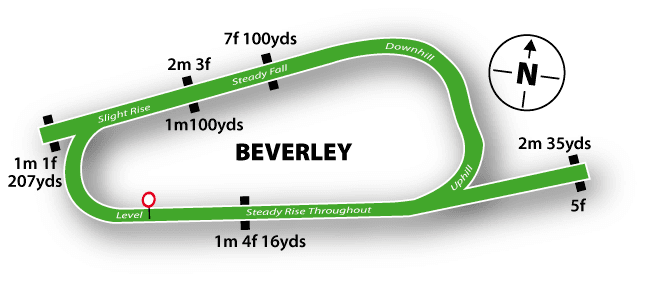
Course Facts
- Round course 1m3f, right-handed, oval — downhill back straight, climbing run-in
- Straight course 5f with a dog-leg to the right — separate chute for sprints
- Run-in 2½ furlongs, entirely uphill to the line
- Draw bias Low draws hold a real advantage over 5f and very high stalls are a negative; no measured going split is published
- Run style Early speed and a prominent position are favoured, most clearly from 7f to 1m1f; hold-up rides have the hardest task
The Straight Course
- Distance 5f
- Feature Dog-leg to the right part-way up — shortest line is the inside rail
- Key bias Low draws favoured; stalls 11 and wider have a poor record. No measured going split is published for the Beverley draw
- Gradient Rises for its whole length — testing even on good ground, and much more so in soft (At The Races, Timeform)
- Bullet race The Listed Beverley Bullet is run here in late summer — 30 August in 2026
The Round Course
- Distances 7f 75y, 1m 100y, 1m 1f 207y, 1m 4f 23y, 2m 32y — the 7f start was moved forward after remedial work in July 2026, so races there are now advertised at 7f 75y where older form was run over 7f 96y
- Draw Not measured by us on the round course — see the draw section below for what is and is not published
- Charlie Wood Stakes Listed, 1m4f — transferred from Newmarket, where it ran as the Fred Archer Stakes, and first run here in July 2025. Beverley’s second Listed race
- Hilary Needler Class 2 conditions race for two-year-old fillies over 5f. It held Listed status from 2001 until it was downgraded in 2011 — the era in which Attraction won it, in 2003, the year before her 1,000 Guineas
- Staying trips 2m32y rare but a genuine test of stamina
Ground & History
- Ground Turf only. We can source no published subsoil or drainage profile for the course, so take the going from the raceday report rather than a three-day forecast
- July 2026 A patch of shallow-rooted turf at the 7f start ended a meeting after three races on 20 July. The clerk of the course said it was not drainage-related
- Opened 1690. Racing stopped in the First World War, when the Royal Flying Corps used the course as an aerodrome and the uphill finish as a runway
- Setting Westwood Pasture, ancient common land; grazing rights predate the racecourse and cattle still use the pasture between meetings
Do front-runners win at Beverley?
Beverley rewards a prominent position, and it does it with two features working together. The turn into the straight is tight, so a horse held up is forced to come off the bend wide and give away ground it cannot afford. Then it meets a stiff, sustained climb all the way to the line.
The climb is also the trap. It looks severe enough from the stands that riders take a pull to conserve something for it, which hands the initiative to whoever has been allowed to set a sensible gallop in front. The published figures put that effect at its strongest around seven furlongs to a mile and a furlong rather than at the minimum trip: Timeform’s own study of the track calls the five-furlong front-running figure “nothing special”, while finding the numbers from seven and a half furlongs to nine and nine-tenths “especially impressive”. Over five furlongs the start and the ability to secure a position matter more than a generic front-running label.
Run Style Bias — Qualitative Only
Strongest around 7f to 1m1f
Shares the pace advantage
Ground lost wide off the turn
The weakest profile here
Treat these bars as directional — a reading of how the track rides rather than a statistical measurement. Beverley’s low-draw sprint bias is a separate effect, produced by the dog-leg on the sprint chute rather than by the round-course bend; read them together but do not compound them. The two published studies that examine draw and run style together point opposite ways here, so a low draw and early speed are best treated as two separate positives rather than one angle.
Does the draw matter at Beverley?
Strong bias — material handicapping factor
Moderate lean — worth noting
Broadly fair — not a primary factor
Beverley’s draw is the best-known thing about the track and the most over-simplified. We hold one first-party stalls pull, at the five furlongs, and it is a large one — 1,183 races. It confirms the direction everyone quotes: low is the side to be, and very high stalls are a real negative. What it cannot settle is whether the bias is still what it was, and the published studies disagree sharply about that. On the round course we hold no pull at all, and what is published there is thin and points in more than one direction. The map below is one measured trip and four we have not measured.
Method. The five-furlong figures are our own pull from the Horseracebase Stalls Analyser, taken on 28 July 2026: every race at Beverley from 1 January 1997, on a stall-alignment basis, wins, all age brackets. The draw is cut into thirds within each race, so field size is handled before the results are aggregated, and the numbers shown are impact values — 1.00 is a fair share, above 1.00 is more winners than the stalls in that third should produce. Handicaps and non-handicaps are both included, which is a wider scope than the handicap-only studies quoted alongside it. No first-party pull exists for the round-course trips, and the star ratings above describe the strength of a directional bias, not our confidence in it.
So: respect the low draw over five furlongs, treat very high stalls as a real negative, and stop there. The round-course trips are not a draw puzzle we have solved. And drawbias.com’s own verdict on the sprint bias is worth reading before treating it as a way to make money — that because “everybody knows it … this fact will already be built into the price of a specific horse and so its very hard for knowledge of this particular draw bias to make you any money.”
Which trainers and jockeys win most at Beverley?
Source: Beverley, Flat, every runner since 1 January 2010, minimum 10 runs. A/E compares actual winners against the number the runners’ starting prices implied, so above 1.00 means the group won more often than its prices suggested and below 1.00 means it won less often — values above 1.20 are worth flagging. P/L is to £1 level stakes at industry SP.
| Trainer | Runs | Wins | Win% | Places | Place% | A/E | P/L |
|---|---|---|---|---|---|---|---|
| 1 Easterby, T D | 1411 | 134 | 9.50% | 393 | 27.85% | 0.81 | -542.25 |
| 2 Fahey, R A | 980 | 133 | 13.57% | 353 | 36.02% | 0.82 | -320.22 |
| 3 OMeara, D | 675 | 98 | 14.52% | 254 | 37.63% | 0.92 | -63.35 |
| 4 Ryan, K A | 515 | 73 | 14.17% | 190 | 36.89% | 0.94 | -22.91 |
| 5 Easterby, M W | 623 | 60 | 9.63% | 169 | 27.13% | 0.86 | -154.59 |
| 6 Midgley, P T | 507 | 51 | 10.06% | 145 | 28.60% | 0.89 | -148.98 |
| 7 Tinkler, N | 544 | 48 | 8.82% | 131 | 24.08% | 0.97 | -151.92 |
| 8 Ellison, B | 416 | 38 | 9.13% | 112 | 26.92% | 0.87 | -4.91 |
| 9 Carr, Mrs R A | 402 | 36 | 8.96% | 102 | 25.37% | 0.75 | -169.41 |
| 10 Burke, K R | 198 | 36 | 18.18% | 77 | 38.89% | 0.90 | -45.90 |
| 11 Dods, M | 330 | 34 | 10.30% | 101 | 30.61% | 0.76 | -99.18 |
| 12 Smart, B | 329 | 34 | 10.33% | 105 | 31.91% | 0.86 | -74.19 |
| 13 Quinn, J J | 354 | 32 | 9.04% | 112 | 31.64% | 0.71 | -116.49 |
| 14 Haggas, W J | 88 | 30 | 34.09% | 53 | 60.23% | 1.10 | +5.12 |
| 15 Pears, Ollie | 421 | 29 | 6.89% | 109 | 25.89% | 0.67 | -79.00 |
| 16 Camacho, Miss J A | 151 | 26 | 17.22% | 51 | 33.77% | 1.30 | +24.52 |
| 17 Appleby, M | 191 | 24 | 12.57% | 53 | 27.75% | 1.04 | -27.84 |
| 18 Johnston, Charlie | 148 | 24 | 16.22% | 53 | 35.81% | 0.93 | +0.00 |
Beverley Flat · Current trainers, since 2010
| Jockey | Runs | Wins | Win% | Places | Place% | A/E | P/L |
|---|---|---|---|---|---|---|---|
| 1 Allan, David | 835 | 95 | 11.38% | 270 | 32.34% | 0.82 | -320.13 |
| 2 Tudhope, Daniel | 475 | 94 | 19.79% | 217 | 45.68% | 1.03 | -19.55 |
| 3 Sousa, Silvestre De | 295 | 65 | 22.03% | 132 | 44.75% | 1.10 | +9.60 |
| 4 Mulrennan, Paul | 540 | 62 | 11.48% | 178 | 32.96% | 0.81 | -175.84 |
| 5 Curtis, B A | 324 | 62 | 19.14% | 120 | 37.04% | 1.06 | -27.05 |
| 6 McDonald, P J | 485 | 61 | 12.58% | 163 | 33.61% | 0.89 | -143.53 |
| 7 Stott, Kevin | 295 | 50 | 16.95% | 115 | 38.98% | 1.04 | -55.97 |
| 8 Beasley, Connor | 334 | 43 | 12.87% | 117 | 35.03% | 0.93 | -73.63 |
| 9 Eaves, Tom | 608 | 41 | 6.74% | 134 | 22.04% | 0.66 | -254.19 |
| 10 Hart, Jason | 395 | 40 | 10.13% | 109 | 27.59% | 0.76 | -141.74 |
| 11 Sullivan, James P | 566 | 37 | 6.54% | 110 | 19.43% | 0.69 | -271.87 |
| 12 Mason, Joanna | 225 | 34 | 15.11% | 75 | 33.33% | 1.12 | +21.61 |
| 13 Fentiman, Duran | 435 | 28 | 6.44% | 105 | 24.14% | 0.81 | -116.26 |
| 14 McHugh, B | 341 | 27 | 7.92% | 87 | 25.51% | 0.82 | -43.45 |
| 15 Scott, Rowan | 257 | 27 | 10.51% | 70 | 27.24% | 1.04 | +10.76 |
| 16 Lee, Clifford | 119 | 25 | 21.01% | 47 | 39.50% | 1.08 | -19.92 |
| 17 Orr, Oisin | 122 | 23 | 18.85% | 48 | 39.34% | 1.05 | -20.47 |
| 18 James, S H | 192 | 22 | 11.46% | 53 | 27.60% | 0.83 | -53.19 |
| 19 Rodriguez, Callum | 123 | 22 | 17.89% | 45 | 36.59% | 1.02 | +5.25 |
Beverley Flat · Current riders, since 2010
Which sires do best at Beverley?
A/E over 1.20 is where a sire’s runners have won materially more often than their starting prices implied. This is a course-wide table with no split by trip, going or race type, so it tells you which sires have outperformed their prices at Beverley — not why.
| Sire | Runs | Wins | Win% | Places | Place% | A/E | P/L |
|---|---|---|---|---|---|---|---|
| 1 Kodiac | 363 | 52 | 14.33% | 108 | 29.75% | 1.10 | -87.07 |
| 2 Dandy Man (IRE) | 323 | 38 | 11.76% | 96 | 29.72% | 1.02 | -35.49 |
| 3 Acclamation | 282 | 36 | 12.77% | 96 | 34.04% | 0.99 | -75.33 |
| 4 Dark Angel (IRE) | 248 | 36 | 14.52% | 92 | 37.10% | 0.92 | -36.74 |
| 5 Kyllachy | 241 | 31 | 12.86% | 81 | 33.61% | 1.02 | -52.16 |
| 6 Exceed And Excel (AUS) | 223 | 28 | 12.56% | 74 | 33.18% | 0.88 | +21.33 |
| 7 Oasis Dream | 192 | 28 | 14.58% | 69 | 35.94% | 1.09 | +21.67 |
| 8 Monsieur Bond (IRE) | 242 | 27 | 11.16% | 68 | 28.10% | 1.15 | -52.60 |
| 9 Iffraaj | 219 | 21 | 9.59% | 57 | 26.03% | 0.67 | -122.61 |
| 10 Sea The Stars (IRE) | 70 | 21 | 30.00% | 36 | 51.43% | 1.30 | +25.20 |
| 11 Invincible Spirit (IRE) | 225 | 20 | 8.89% | 71 | 31.56% | 0.65 | -91.60 |
| 12 Poets Voice | 133 | 20 | 15.04% | 47 | 35.34% | 0.98 | -32.80 |
| 13 Haafhd | 125 | 20 | 16.00% | 49 | 39.20% | 1.10 | -3.26 |
| 14 Zoffany (IRE) | 116 | 20 | 17.24% | 43 | 37.07% | 1.09 | -21.48 |
| 15 Arcano (IRE) | 103 | 20 | 19.42% | 37 | 35.92% | 1.27 | +45.01 |
| 16 Mehmas (IRE) | 172 | 19 | 11.05% | 65 | 37.79% | 0.79 | +44.86 |
| 17 Dutch Art | 149 | 19 | 12.75% | 46 | 30.87% | 0.91 | -20.19 |
| 18 Bahamian Bounty | 187 | 18 | 9.63% | 56 | 29.95% | 0.71 | -83.18 |
| 19 Equiano (FR) | 138 | 18 | 13.04% | 49 | 35.51% | 0.97 | -26.50 |
| 20 Shamardal (USA) | 109 | 18 | 16.51% | 42 | 38.53% | 0.92 | -25.44 |
Beverley Flat · Since 2010
Betting Tips for Beverley Flat Turf
Low is the right side over 5f — but the old rule has softened
Our own 1,183-race stalls pull has the low third of the draw at an impact value of 1.29 against 0.71 for the high third, and stalls 11 and wider have a poor record on every sample we have seen. What has changed is the size of the edge: geegeez’s run of eight-plus-runner handicaps has the low third falling from 63.3% of winners in 1998–2003 to 40.8% in 2016–21, while the high third rose from 10% to 26.5%. Use the draw as a tiebreaker between horses you already like, not as the selection.
The round-course draw is not a solved question
We hold no first-party stalls pull at 7f, a mile, 1m1f207y or 1m4f, and the little that is published disagrees with itself — drawbias.com’s 2024–25 samples read 7f strongly low and the mile slightly high. Carrying the sprint rule round the bend is the mistake to avoid; read the round course on pace, ground and class.
The climb is real, but the round course is not a stamina track
The run-in is short and all uphill, so a leader who goes too hard down the back straight can empty. But At The Races and Timeform both read the round course as not particularly stiff despite the uphill finish — the downhill turn into the straight and the shortness of the run-in offset the climb. The genuinely testing strip is the separate five-furlong chute, which rises for its whole length and takes real getting once there is rain in the ground.
Camacho stands out on A/E, Burke on strike rate
Julie Camacho’s Beverley runners have historically outperformed their prices — 26 wins from 151 (17.22%), A/E 1.30, +£24.52 since 2010, and the only yard in the table clear of A/E 1.20. Karl Burke has the better raw strike rate (36 from 198, 18.18%), but at A/E 0.90 and −£45.90 his runners have not beaten their prices here. Two small books by Beverley standards: a reason to look, not a price.
David Allan is the volume name — but not the value one
David Allan rides more Beverley winners than anyone (95 from 835) but at A/E 0.82 and a level-stakes loss (−£320.13), so the winner count flatters the betting record. Nine of the nineteen riders in the table have an A/E above 1.00 and four are in profit: Silvestre De Sousa (1.10, +£9.60), Joanna Mason (1.12, +£21.61), Rowan Scott (1.04, +£10.76) and Callum Rodriguez (1.02, +£5.25).
The Yorkshire regulars: big samples need context
Fahey, the Easterbys and Kevin Ryan are regular Beverley visitors with very large samples here. Those samples cover a broad mix of runners, classes and prices, so a raw strike rate is the wrong column to judge them on — it is not depressed by the size of the book, it simply averages a much wider range of chances. A/E is the more useful read, and we have not split these yards by price bracket or by previous course form.
Early speed is favoured — most clearly around seven furlongs
Gate speed is the key on the sprint chute, as Weaver says: miss the kick there and all you can do is ride for luck. But the published figures put the front-running advantage at its strongest from about seven furlongs to a mile and a furlong, not at the minimum trip — Timeform’s own study of the track calls the five-furlong figure nothing special. Favour early speed, and do not write off a hold-up horse over 5f on the track alone.
Take the going from the raceday report
We can source no published subsoil or drainage profile for Beverley, and no measured going split for its draw, so a three-day declaration is doing less work here than it looks. Read the official going report on the morning of racing — and remember that on soft the five-furlong chute becomes a far stiffer test, which is a stamina point rather than a draw one.
Previous Beverley form is worth respecting
The specific physical demands — the descent, the home bend and the short uphill run-in — ask a question that a horse either answers or does not, and one that has already answered it has told you something an unexposed rival has not. Treat that as informed judgement rather than a measured tendency: we have not tested whether previous Beverley winners go on to outperform here, nor what they return at their prices.
Common Mistakes to Avoid
- Carrying the sprint draw rule round the bend. Beverley’s low-draw reputation is built on the five-furlong chute. We hold no stalls pull at all on the round course, and drawbias.com’s 2024–25 samples read 7f strongly low but the mile slightly high — the opposite way. Read the round course on pace, ground and class.
- Treating the 5f draw as a rule rather than a lean. Low is still the side to be, and stalls 11 and wider have a poor record. But geegeez’s eight-plus-runner handicap series has the low third falling from 63.3% of winners in 1998–2003 to 40.8% in 2016–21, and drawbias.com’s own verdict is that the bias is so well known it is already in the price.
- Reading “prominent” as “go hard from the gate”. The short uphill run-in punishes horses that over-commit on the descent. The Beverley shape is a horse with the speed to take a good position, not one asked to burn its finish to lead at all costs — and the two published studies that examine draw and run style together disagree about whether low-drawn leaders actually convert.
- Treating Beverley as a level track. Yard-specific form transfers poorly. A horse going well at Ripon or Haydock is not automatically suited to Westwood Pasture. Course form here is its own signal — though we have not measured what it returns at market prices.
- Trusting a three-day going report. No drainage profile for the course is published that we can source, so read the morning-of-racing going rather than a forecast — particularly for the five-furlong chute, which takes far more getting once there is rain in the ground.
None of these angles guarantees winners. They are ways of reading a Beverley card that hold up against the evidence we can trace — and where that evidence runs out, we have said so rather than filled the gap. Reading the course as a specific thing, not a generic one, is where the edge lives.
Beverley Racecourse FAQs
Is there a draw bias at Beverley?
Which way does Beverley race, and what kind of track is it?
Are front-runners or hold-up horses favoured at Beverley?
Which trainers and jockeys do best at Beverley?
What is the most reliable angle, and the biggest mistake, at Beverley?
Nearby Tracks
York
Wide, galloping, fair — draw shifts on soft ground.
Ripon
Sharp, undulating right-hander — pace matters more than the draw.
Thirsk
Sharp, flat left-hander — high-draw sprint bias.
Doncaster
Galloping and fair — straight course and round track.
Pontefract
Undulating — one of Britain’s stiffest finishes.
Catterick
Sharp and undulating — speed and a low draw.
Want the thinking behind Beverley turf bets?
FormDial posts every selection before the off with its full reasoning: the angle, the price, the logic. See how course knowledge feeds into real tips.
The Trackside Companion is your day at the races, written to order — every race on your meeting’s card broken down, plus this track’s draw, angles and people distilled from the guide you’ve just read. Order at least a week before your raceday.
Plan your raceday →