The pub post-mortem after the last has three stock lines. There was no pace to aim at. They went too hard up front. It got first run. If you’ve ever reached for one of them, you already know more about how to read pace in horse racing than you might think — those lines are real pace analysis. They just arrive after the race, when they’re worth nothing. This piece is about doing the same read before the off, when it’s worth plenty — and the free tool that turns it into a picture: the Formdial Pace Analyser.
You already read pace — just backwards
Why does almost nobody do it before the race? Because the racecard hides the evidence. Ratings, form figures, weight, headgear — a column for everything except how anyone actually runs. That lives in the in-running comments: one line per past race, written by a professional race-reader, sitting in public view and mostly unread.
Watching doesn’t fill the gap either. The camera follows the leaders; your eye follows your money. What were the horses finishing sixth through twelfth doing at halfway? Chances are: no idea. And that’s the half of the race where tomorrow’s pace evidence lives.
One honest boundary before the method. Raw ability is priced within an inch of its life, by ratings anyone can see. But pace has to be hand-assembled from twenty form pages before it can price anything — and on a wet Tuesday at a midweek meeting, the people who bothered make a short list. Not a cheat code. A knowledge gap that costs minutes to close. (This is the race-level read, by the way — the track-level half, pace bias, why some courses reward prominent racers year after year, has its own guide. The two stack.)
What a race shape is made of
Four running styles. The front-runner wants the lead. The prominent racer presses it. The mid-division horse takes a lane in the pack. The hold-up horse saves everything for one late run. None is better than the others — each is a bet on a certain kind of race developing.
The race those styles produce comes from the collision. One front-runner and no rivals? A soft, uncontested lead — an armchair ride and a head start. The same horse plus two more with the same idea? A war up front, honest fractions, and suddenly the patient horse with the turn of foot gets exactly the race it needs. Same horses. Different race. Decided before the stalls open, by nothing more than who else turned up.
That’s why the hard-luck lines repeat. The hold-up horse “with no pace to aim at” was never unlucky — the evidence was on its rivals’ form pages all along.
Scoring pace from the comments
My method is deliberately blunt. Take each runner’s last five Racing Post in-running comments, read the opening words, and score where it raced: Led 4 · Prominent 3 · Mid-division 2 · Held up 1. Average the runs you scored. That’s one number between 1 and 4 for how the horse habitually races: 3.25 and up is a confirmed front-runner, under 1.75 a hold-up type.
The scale isn’t our invention — that’s rather the point. Geegeez Gold scores run style on the same 4-3-2-1. Timeform’s pace maps draw leaders to the right, the same way ours do. The ancestor of the lot is Bill Quirin’s speed points, published in 1979 and read from races out of a horse’s last five starts. What the Pace Analyser adds is the price: free, by hand, working shown.
Reading the comment is quick, because the position word leads the line. “Made all”, “led”, “soon led” — that’s a 4. “Prominent”, “tracked leaders”, “chased leaders” — 3. “Midfield”, “in touch” — 2. “Held up”, “in rear” — 1. Score the position, ignore the drama: “keen early” is temperament, “slowly away” is one second of the race, “raced wide” is the ground it covered. No position word at all? Leave that run blank — the average forgives a blank; it doesn’t forgive a guess. Blanks are also why the headline figure is the average, not the total: a horse with two career starts gets judged on its two, not punished for the missing three. One caveat carried openly: these comments are one race-reader’s honest shorthand, not laboratory data. Five of them beat one.
A worked example
Six invented runners, so the arithmetic is visible — the sums are exactly what you’d do with a real card. Comments run most recent first.
| Runner | Last five comment openers | Pts | Runs | Avg | Style |
|---|---|---|---|---|---|
| Brass Bell | made all · led · led, headed late · pressed leader · made most | 19 | 5 | 3.80 | Front-runner |
| First Edition | led · prominent (two career runs) | 7 | 2 | 3.50 | Front-runner |
| Harbour Light | prominent · tracked leaders · soon led · close up · pressed leader | 16 | 5 | 3.20 | Prominent |
| Velvet Curtain | tracked leaders · midfield · prominent · in touch · chased leaders | 13 | 5 | 2.60 | Prominent |
| Quiet Word | midfield · in touch · mid-division · held up · midfield | 9 | 5 | 1.80 | Mid-division |
| Late Shift | held up · held up in rear · in rear · midfield · held up | 6 | 5 | 1.20 | Hold-up |
Read the last column and the race announces itself. Two want the front: Brass Bell has led in four of its five, and First Edition has raced forward in both career starts. Notice what the average did there — on raw points First Edition’s 7 ranks second-bottom; per run, it sits second on the map, which is the truth. Two confirmed front-runners is the shape the analyser files, verbatim, under “Contested pace”: an honest, end-to-end gallop — and good news for Late Shift, the field’s one closer, which finally gets a pace to attack.
Now take First Edition out at declaration time. The verdict flips to “One on the front end”. Brass Bell inherits a cheap lead, first run on everybody — and Late Shift’s race evaporates, without either horse changing a hair. Pace is a property of the field, not the horse. Redo the read when the non-runners land.
The Pace Analyser: your pace map, drawn for you
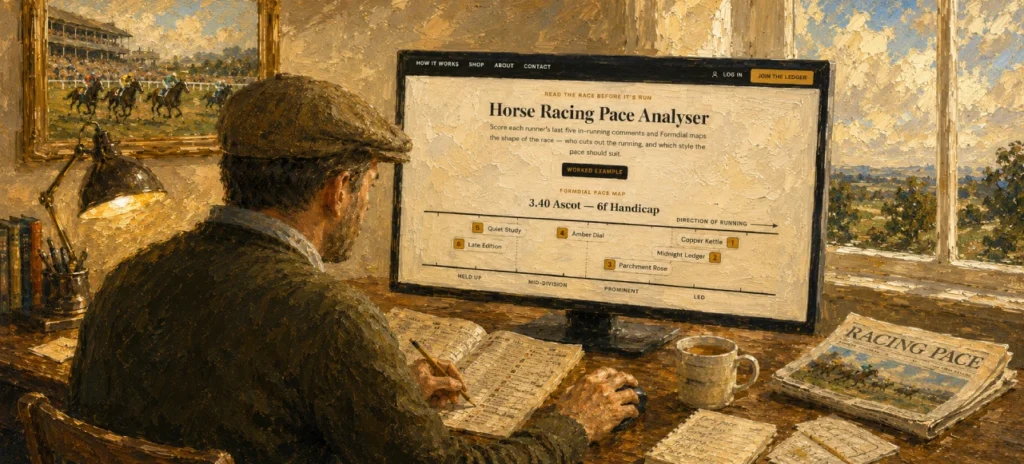
Everything above works with a biro — I did it that way for years. The Pace Analyser exists because the reading is the valuable part and the arithmetic isn’t. You read each runner’s comments and tap one of four buttons per run; it does the sums, then draws the whole field on one axis — held-up on the left, leaders on the right — with a ranked table and a written verdict on the likely shape.
What each verdict means for the bet
“A strong, contested gallop” — three or more want the front
They can’t all have it. Expect a truly run race — the set-up for strong-travelling, patient sorts. And don’t assume any one speed horse “just leads”: that’s the other two’s plan as well.
“Contested pace” — two on the speed
Honest race likely; the closers get something to aim at. But with only one rival for the front, the better of the two leaders can still simply outlast the duel.
“One on the front end” — a lone leader
The sharpest flag the map produces. An uncontested lead is a head start; anything that needs a strong pace just lost its race before the off. If the market’s fancy is the field’s only hold-up horse, consider yourself warned.
“No confirmed front-runner” — and quieter still
A muddling, tactical race, usually inherited by the prominent racers — and a lone prominent type over a field of waiting horses can be gifted the lead outright. When the map finds no pace at all, expect a crawl and a sprint, decided by track position and the boldest jockey. Knowing a race is a tactical lottery is itself useful: it’s the ones you think you’ve solved that cost real money.
Notice what none of those say: back this horse. The verdict sets the picture; your form reading happens inside it. Often it changes the bet’s shape rather than the selection — a closer needing a pace collapse in a big field is a classic each-way shape; a lone leader you fancy is a win bet’s best friend.
What the map can’t tell you
The big one: the map shows habit, not intent. A yard can send a hold-up horse forward first time in blinkers; a new jockey can carry new orders; and only one horse can have the front, however many want it. Treat every map as the likeliest shape, held loosely — and let the first two furlongs tell you if today breaks the pattern. It is a habit sheet, not a script.
“Isn’t this all priced in?”
Partly — pretending otherwise would be dishonest. In the big televised races, pace opinion is in the price by the off. But this work doesn’t arrive done: pace has to be assembled from a hundred lines of small print, by hand or by subscription, before it can price anything. In a midweek handicap, the punter who spent four minutes on the field’s comments is one of very few who did. Not free money — you just stop being the punter the pace-readers bet against.
“It’s one line of prose, not data.” Correct, and the method is built for it. One comment is an opinion; five, scored bluntly on position words, is a pattern with the noise averaged down. The runs-scored count sits beside every average so you can weight your own confidence. Blunt inputs, honestly averaged, no false precision.
The rest of the limits, plainly: the map knows nothing about today’s ground, the draw, trip changes or first-time headgear. Over jumps the read still works — an uncontested lead is potent in a chase — but stamina and jumping do more of the deciding. And in five-runner fields, “no pace” is common and less damning. One instrument on the panel. It just happens to be the one almost nobody else is reading.
The track underneath
Every shape then lands on a racecourse, and courses are not neutral. Tight, turning tracks protect a leader; long straights and stiff finishes give closers the room to make a strong pace count. Side by side:
31 winners from 88 early leaders in the Geegeez 5f study (2009 onwards) — and in small fields of 6–8 it rose to 50%. Chester’s tight circuit is the closest thing British racing has to a moving walkway for the horse on the front.
6 winners from 90 in the same study, over the same trip, in the same country. A flat, galloping, dead-fair straight five where the early leader is a target rather than a thief. Same running style, opposite consequences.
Same trip, five-fold difference in what an early lead is worth. So read the map with the course in the other hand: our racecourse guides carry every track’s character — Chester’s turns, Epsom’s gradients — and the draw bias guide covers the third leg: a front-runner drawn on the wrong side may never get the front it wants. Field, course, draw — when all three point the same way, you’ve found the bet the form book alone never shows. (The deepest layer is sectional times; the map is the free front door to it.)
Make it a two-minute habit
Pick the one or two races you actually care about — scoring a full card is penance, not study. Score the field when you first read the race. Check the map against your fancy before you look at prices: the most useful thing it will ever do is disagree with you. Redo it when the non-runners land — First Edition, above, shows why. Then close the loop: ten seconds against the map after the race teaches more than an hour of theory before one, and if you keep a betting record, a one-word note of the shape you expected turns your own bets into a private pace-reading course. The shape of the race is one of the first things weighed in how this site reads races, and always has been. After a season of scoring, you’ll spot no-pace races on a raw card before you’ve tapped a button. The tool is training wheels for an instinct, and the instinct is the prize — because that, in the end, is how to read pace in horse racing: five comments, four buttons, one map, two minutes.
Common questions
What does “held up” mean in horse racing?
A horse ridden patiently at the back early on, saving its energy for one late run — the opposite of a front-runner. In comments: “held up”, “in rear”, “towards rear”. It scores 1 on our scale, and it’s most effective when a strong pace up front tires the leaders out for it.
How do you read Racing Post in-running comments?
Start at the front of the line: the opening words give the early position — “made all”, “prominent”, “midfield”, “held up” — before the story of the finish. Score the position and ignore the drama: “keen”, “slowly away” and “raced wide” describe temperament, the start and the ground covered, not the running position.
What is a pace map in horse racing?
A picture of a race before it happens: every runner placed on one axis from held-up to leading, based on how each has raced recently. Professional services build them from proprietary figures; the Formdial Pace Analyser draws the same picture free, from scores you tap in yourself.
How do I know if a horse is a front-runner?
Its recent comments keep opening with “led”, “made all” or “soon led”. On our scale, an average of 3.25 or higher over its scored runs (up to five) is a confirmed front-runner; 2.50–3.24 is a prominent racer that presses rather than leads. The difference matters most when a race contains exactly one of the first kind — that horse may get the front for free.
Does a strong pace suit hold-up horses?
Yes — it’s precisely the race they’re built for. A contested gallop burns the leaders and brings a closer’s finishing speed into play; a slowly run race strands it with nothing to aim at. The same hold-up horse can be a serious bet one week and a bad one the next without changing a hair — the field around it changed.
Is the Formdial Pace Analyser free?
Yes — free, no account, no sign-up, up to forty runners per race. Scored races save to your own device only (up to fifty); nothing you enter is uploaded. You do the reading; it does the arithmetic, the map and the verdict.
Three ways in
Map a race now
Two minutes a field: tap the last five comments, get the map and the verdict. Start with a race you already fancy something in.
Learn the track layer
Race shape is half the picture; the course’s own bias is the other half — how tempo shapes results, track by track.
Put it on the record
Score the race, strike the bet, then find out whether your pace reads actually pay. 14-day free trial, £5 a month after.
18+. Please bet responsibly — support and tools are on our responsible gambling page. No tool makes a race predictable; this one just makes sure you’ve read it.
The next time your fancy gets done by something that pinched a soft lead, you won’t need the line in the pub — you’ll have said it before the off, with a map in your hand. Read the race before it’s run — it’s on the analyser’s masthead because it’s the whole method in six words.
Bet logs, spreadsheets and course cheatsheets — built the same honest way as the tips.
Visit the Shop →Why are some bets win-only and others each-way?
Three things decide it: confidence, race shape, and the betting market.
If I think a horse has an outstanding win chance, I'll back it win-only to maximise the return — even at a bigger price, where each-way would normally be the safer call. If the win case is more speculative but the place case is strong, each-way carries the bet.
Concrete example: Almanack at Kempton, 2 July 2014. Advised at 22/1 win-only in the morning. The price shortened to 16/1 SP and he won by a short head on the line. Win-only on a confident shout at a generous price is where the real returns come from — when the case is right, you back it to win, not to hedge.
What happens if my horse is a non-runner?
If a horse is declared a non-runner before the race, your stake is returned in full on win or each-way singles.
If it's part of a multiple (accumulator, lucky-15, etc), the bet runs on without that leg and the remaining legs are recalculated. For ante-post bets the rules differ — usually no refund unless the bookmaker is offering NRNB ("Non-Runner No Bet") on the race. Full breakdown here.
Why no advised bet some days?
Because there isn't one. The cards don't always offer value, and the worst thing a tipster can do is force a selection just to fill a slot.
A "No Bet" day is the system working — it's the same discipline that produces the winners on the days the bets are right. Better to sit out a card cleanly than to bleed the bank on filler. The best days are usually the ones I've been patient before.
What do the stake points mean?
Stakes are sized in points, not pounds — that way the same plan works on any size of bankroll.
The Daily Dial uses a simple scale: 1pt is the minimum bet (or 0.5pt each-way), 2pt is a standard bet (or 1pt each-way), and 5pt is the maximum on the strongest fancies (or 2.5pt each-way). The whole thing runs off a 100pt bankroll, so a £100 bank means a point is £1 and a 2pt bet is £2; a £1,000 bank means a point is £10 and a 2pt bet is £20. Scale to whatever feels comfortable.
New to this? Read up on: How to Read a Racecard · National Hunt Racing · Non-Runner Rules
Get tomorrow's pick before the off
Every selection posted before the race — the angle, the reasoning, the price. Free, no fluff.