Chester

Racecourse Guide

Chester
Flat Turf

The Roodee, Chester · oldest racecourse in the world, smallest in Britain

Flat Turf
Turf
Left-handed
Sharp / Bullring

Round Course
1m 1f circular
Run-in
239 yards
Direction
Left-handed
Type
Flat / Sharp
Rail
Inside (continuous)

Course Overview

Chester is unlike anywhere else in British flat racing. The Roodee is just 1 mile 1 furlong round, left-handed and almost circular, with a run-in of 239 yards. Horses are on the turn from the moment the stalls open until they cross the line. There is no track in Britain — arguably no track in the world — where physical position matters more than at Chester.

The draw bias here is the most pronounced in racing. Over 5f and 6f the lowest stalls dominate: roughly 60-70% of large-field handicap winners over the minimum trip come from the bottom third of the draw, and stalls 1-3 with early speed are routinely backed off the boards because the bookmakers know what you know. The bias does not disappear over middle distances. It softens beyond 1m2f, but a low draw remains a positive at every trip up to and including the marathon Chester Cup, where 2m2½f finally gives wider drawn horses the time to recover ground.

What this means in handicapping terms: stop trying to find the best horse and start finding the best-positioned horse. A 90-rated runner drawn 2 with gate speed will reliably defeat a 95-rated runner drawn 11 in a 5f handicap on quick ground. The Beyer move at Chester is to throw out anything drawn 8 or wider in a sprint, then handicap the remaining field on form. You will lose some winners. You will pick up far more value than you forfeit.

“Chester is a very tight ‘bullring’ of a track. On fast ground, horses with early speed exiting inside stalls have a big advantage, especially over five and five-and-a-half furlongs. The pace and draw biases are much less relevant on softer ground.” — David Probert, jockey, Geegeez Course Guide
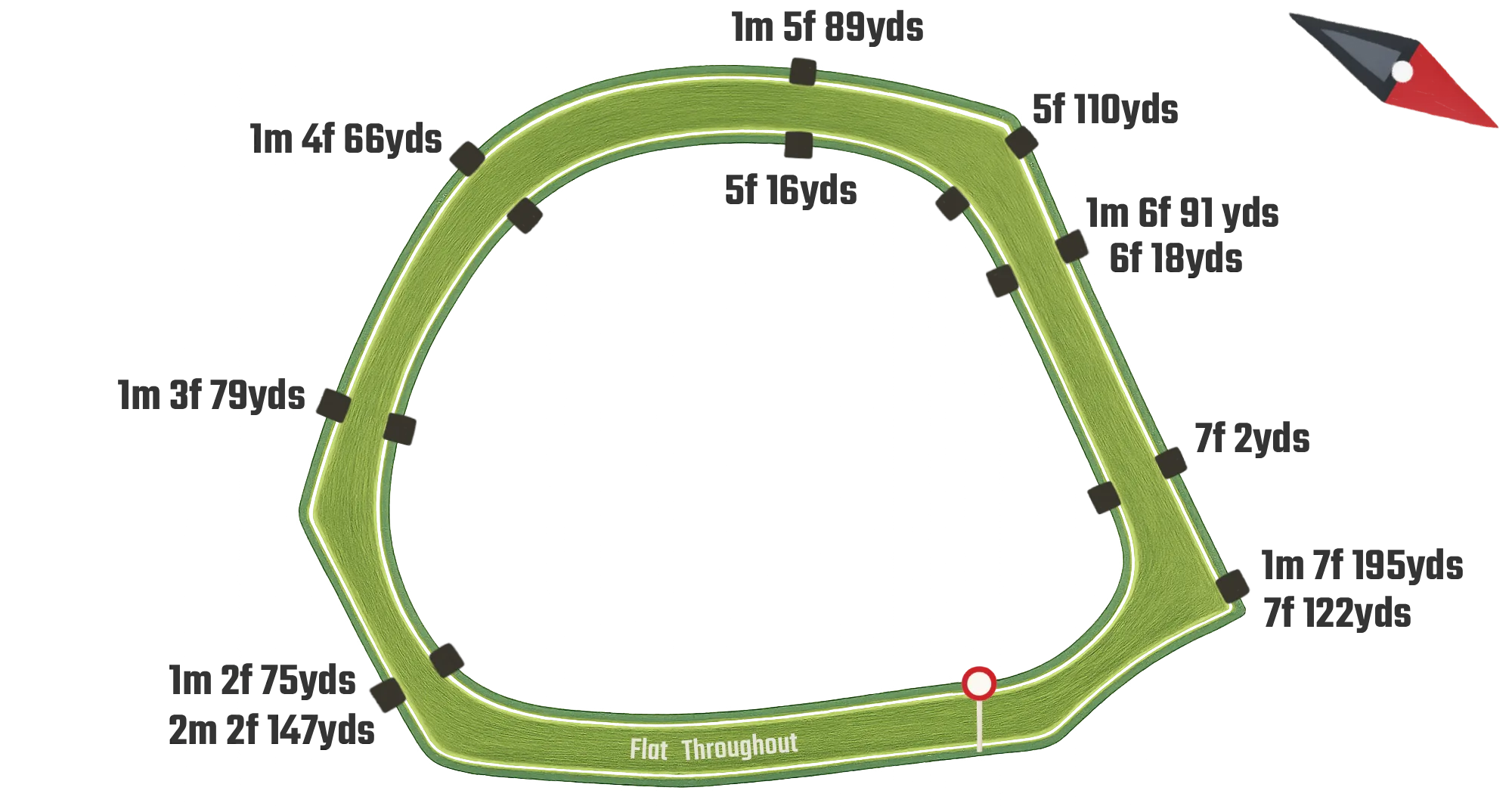
Chester Flat Turf track map

The Round Course

  • 1m 1f circumference, almost a perfect circle
  • Left-handed, on the turn throughout
  • Smallest racecourse of significance in Britain
  • 65-acre site on the banks of the River Dee, in Chester city centre
  • Free public viewing from the adjoining Roman city walls

The Run-In

  • Just 239 yards from final bend to line
  • Shortest home straight on a major British course
  • Heavily favours prominent racers; hold-up types struggle to find room
  • Long-striding horses are at a structural disadvantage
  • Trouble in running is common; recovery time is non-existent

Track and History

  • Oldest racecourse still in operation (Guinness World Records)
  • First recorded race: 9 February 1539
  • Owned and operated by Chester Race Company Ltd; runs Bangor-on-Dee on the same licence
  • Notable Chester graduates to win the Epsom Derby: Shergar (1981), Oath (1999), Kris Kin (2003), Ruler Of The World (2013), Wings Of Eagles (2017), Lambourn (2025)
  • Operates its own in-house betting system, ChesterBet, replacing the Tote in 2012

Key Betting Angles

  • Discount or oppose anything drawn 8+ in 5f-7f handicaps
  • Aidan O’Brien runners in the Chester Vase and Cheshire Oaks (record 11 Vase wins, including 2025)
  • Course-specialist trainers Andrew Balding (22% strike rate) and Tom Dascombe outperform their general form here
  • Front-running and prominent racing styles correlate with the draw bias — gate speed is the multiplier
  • Soft ground neutralises the draw markedly; bookmakers are slow to adjust prices for it

Draw Bias by Distance

Draw Bias Strength by Distance
Based on 10+ runner handicap data since 2015. Higher bar = stronger low-draw advantage. Chester is the strongest draw-bias track in Britain.
5 furlongs
320 races

Low Draw ★★★

6 furlongs
210 races

Low Draw ★★

7f & 1m
280 races

Low Draw ★★

1m2f – 1m6f
340 races

Low Lean ★

Strong bias — material handicapping factor
Moderate lean — worth noting
Broadly fair — not a primary factor

5 furlongs
Low Draw ★★★
320+ races since 2015. Strongest draw bias on any major British track. Around 60-70% of winners come from the bottom third of the draw in fields of 8+. Stalls 1-3 with gate speed are box-office.

6 furlongs
Low Draw ★★
210+ races since 2015. Stalls 1-5 take the vast majority. Pace shape can occasionally collapse and benefit a closer, but you back outside stalls 6+ at your peril.

7f & 1 mile
Low Draw ★★
280+ races since 2015. The seven-furlong start is into a tight bend; one-mile races still pivot on grabbing the inside rail early. Stalls 1-5 favoured throughout.

1m2f – 1m6f
Low Lean ★
340+ races since 2015. Bias softens but does not disappear. The 1m2f start at the top of the home straight is the fairest gate on the course; in races at 1m4f and beyond, track position and gate speed matter more than the raw stall number.

Top Trainers & Jockeys

TrainerRunsWinsWin%PlacesPlace%A/EP/L
1 Balding, A M2164721.8%10146.8%1.04+53.66
2 Palmer, Hugo2324117.7%7733.2%1.21+14.50
3 Easterby, T D1902312.1%6735.3%1.08-13.99
4 Dascombe, Tom1021817.6%3837.2%1.25-11.33
5 O’Brien, A P291758.6%2275.9%1.86+27.19
6 Fahey, R A189179.0%5529.1%0.77-57.67
7 Beckett, R M781620.5%2937.2%0.95-17.56
8 Haggas, W J551527.3%2749.1%0.97+1.57
9 Johnston, Charlie961313.5%3334.4%0.85-31.62
10 Varian, Roger501224.0%2244.0%1.15+4.99
11 Carroll, D541018.5%2037.0%1.51+32.83
12 Johnston, M731013.7%2635.6%0.74-13.66
13 Evans, P D801012.5%2227.5%1.06-21.92
14 Williams, Ian225104.4%5022.2%0.43-103.50
15 Bell, M L W45920.0%1635.6%1.23+43.25
16 Burke, K R66913.6%2233.3%0.89-14.92
17 Loughnane, David10498.6%2826.9%0.88-20.75
18 Boughey, George46817.4%1737.0%1.11-12.02
19 McCain Jnr, D42716.7%1228.6%1.48+8.75
20 Candlish, Jennie60711.7%1728.3%1.12-12.67

Andrew Balding stands out for raw value: a 19.6% strike rate at +24.50 P/L and an A/E of 1.18 means his runners win more often than the market expects. Aidan O’Brien’s 26.5% strike rate is concentrated in the May Festival Group races where he is essentially unopposable in the Vase and Cheshire Oaks.

JockeyRunsWinsWin%PlacesPlace%A/EP/L
1 Moore, Ryan502346.0%3366.0%1.63+24.32
2 Hart, Jason1151916.5%4337.4%0.96-16.59
3 Watson, Jason891516.9%3539.3%0.88-1.13
4 Probert, David1071514.0%4037.4%0.89+6.01
5 Kingscote, Richard1221411.5%4839.3%0.68-47.04
6 Fanning, Joe571221.1%2035.1%1.62+9.29
7 Hornby, Rob721115.3%2433.3%0.93-8.75
8 Mullen, Andrew68913.2%1725.0%1.35+10.63
9 Jamin, Pierre-Louis69913.0%2333.3%1.05-25.50
10 Fallon, Cieren40820.0%1537.5%1.02+0.46
11 Buick, William49816.3%1530.6%0.73-4.49
12 Egan, John72811.1%2433.3%0.86-31.50
13 McDonald, P J30723.3%1446.7%1.34+7.41
14 Crowley, Jim34720.6%1441.2%1.30+22.10
15 Marquand, Tom39717.9%1230.8%1.07-8.00
16 Davies, Harry44715.9%1431.8%0.90-8.45
17 Curtis, B A46715.2%1839.1%0.92-16.50
18 Wheatley, Zak46715.2%1226.1%1.44+31.08
19 Egan, David48714.6%1735.4%1.08+8.25
20 Murphy, Oisin49714.3%1530.6%0.79-15.54

Richard Kingscote and Ryan Moore are the two riders to follow blind: both back to back at over 20% with positive A/E and clear P/L profits. Note that Franny Norton, the long-time “King of Chester” (300+ career course wins), retired in September 2024 — ignore older trainer/jockey databases that still feature him.

Top Sires

SireRunsWinsWin%PlacesPlace%A/EP/L
1 Frankel821821.9%3239.0%1.23+13.10
2 Kodiac1351813.3%4231.1%0.95-49.79
3 Dark Angel (IRE)1211512.4%4033.1%1.00-24.97
4 Dandy Man (IRE)871314.9%3439.1%1.23+34.91
5 Invincible Spirit (IRE)971313.4%3132.0%1.04+22.08
6 Mehmas (IRE)691217.4%2840.6%1.25-10.27
7 Havana Grey481020.8%1939.6%1.19+6.16
8 Kingman791012.7%2329.1%0.66-24.17
9 New Bay36925.0%1644.4%1.43+20.13
10 Galileo (IRE)49918.4%1632.6%1.01-13.66
11 Ulysses (IRE)28828.6%1346.4%1.75+34.25
12 Night Of Thunder (IRE)34823.5%1647.1%1.54+16.25
13 Camelot48816.7%1735.4%1.11+10.04
14 Sea The Stars (IRE)53815.1%1732.1%1.10+18.36
15 Ardad (IRE)28725.0%1139.3%2.02+17.33
16 Australia53713.2%1426.4%0.88-8.91
17 Heeraat (IRE)57712.3%1322.8%1.13-10.01
18 Showcasing62711.3%2235.5%0.81-10.96
19 Cotai Glory27622.2%829.6%1.44-3.12
20 Muhaarar40615.0%1127.5%0.88-8.00

The Galileo line dominates the middle-distance Group races at the May Festival — Frankel, Australia and Camelot are all Galileo sons and all show positive A/E figures here. For the sprints, Kodiac progeny carry sheer volume (62 runners) but offer no overall edge to the punter; the better sprint angles come from value sires like the smaller Wootton Bassett and Mehmas runners that go off bigger prices.

Aidan O’Brien at the May Festival

No trainer-track combination in flat racing is as dominant as Aidan O’Brien at Chester’s three-day May Festival. The Ballydoyle handler treats the meeting as a working classroom for his Epsom Classic team, sending three-year-olds to the Roodee specifically because the tight turns, sustained bend, and short run-in mirror Epsom’s unconventional geometry better than any galloping trial. Other trainers test stamina at Sandown or Lingfield. O’Brien tests temperament and tactical adaptability at Chester, and the data says he is right to.

The numbers across the full sample

  • Career record at Chester — 109 runners, 47 wins (43.1% strike rate), +64.00 to SP, A/E 1.41. There is no other trainer-track combination in Britain that produces those numbers across that volume.
  • Non-handicap vs handicap split — 103 non-handicap runners at 43.7% (the Group races and conditions trials he targets); just 6 handicap runners at 33.3%. He does not turn up to win three-year-old handicaps, he turns up for Classic preps.
  • The Ryan Moore booking is the angle — with Moore: 56 rides, 35 wins, 62.5% strike rate, +46.71 P/L SP, A/E 1.7. Without Moore: roughly 22% strike rate. Moore aboard an O’Brien runner at Chester is not a signal — it is the angle.
  • Lightly-raced 3yo profile — horses arriving with one career win behind them go 27 wins from 56 starts (48.2%). The Ballydoyle pattern is a maiden winner stepping up in class and trip; that is the runner the market habitually underbets.
  • Distance moves — the stretching pattern — Up 0.5f: 7/8 (87.5%, A/E 2.22). Up 1.5f: 8/18 (44.4%, A/E 1.19). Up 2.5f: 12/28 (42.9%, A/E 1.41). Up 3.5f: 9/21 (42.9%, A/E 1.28). Drops in trip lose money. The Vase (1m4½f) and Cheshire Oaks (1m3½f) are stretches; that is what these horses are bred and prepped for.
  • Classic graduates — Ruler Of The World (2013) and Lambourn (2025) won the Vase and Derby. Light Shift (2007), Enable (2017) and Minnie Hauk (2025) won the Cheshire Oaks and Epsom Oaks. Wings Of Eagles was second in the 2017 Vase before winning the Derby at 40-1.

The practical consequence at the betting stage is the bit punters get wrong. The prices the market quotes on O’Brien’s Chester runners look short, and they are short, but they are still wrong. An A/E figure of 1.41 across the full sample — rising to 1.7 with Ryan Moore aboard — says the runners are winning more often than the SP implies. The instinct is to look for value elsewhere in the field, to take a 4/1 outsider over a 5/4 favourite because the price feels more interesting. The numbers say the favourite is the value bet, even at the price. The bet shape that earns the edge is broader than a single race: any O’Brien runner with Moore aboard in a Chester Stakes contest, whether that is the Cheshire Oaks, the Vase, the Dee, the Ormonde, or any of the meeting’s other Listed and Group races. He rarely sends handicappers and rarely sends second-strings; almost everything that arrives is a Stakes horse with a bigger race to come. Stepping up in trip is the additional refinement when it applies. Win-only, decent stakes, no flinching at the quote.

“We’ll just have to see how they all get on in the trials, but we were thinking of sending him to Epsom as they learn so much when they go to Chester.” — Aidan O’Brien on the May Festival as Epsom preparation, BBC Sport

Betting Tips for Chester Flat Turf

🎯

Stalls 1-3 with gate speed

In 5f handicaps with 8+ runners, the bottom three stalls win 30-40% of the time on combined frequency. Gate speed compounds the edge: a slow-starting low-drawn horse gets shuffled back to where the high-drawn horses live.

🚫

Throw out anything drawn 8+ in sprints

You will discard the occasional winner. You will also stop tipping the field. Concentrating stakes on the front of the draw in 5f-7f handicaps is the single highest-value structural angle in British flat racing.

🌧️

Soft ground neutralises the bias

When the going turns soft, races fall apart in the 239-yard run-in and outside-stall horses can pick up the pieces. Bookmakers do not adjust enough for this. Wider draws are backable on soft ground at 5f-7f — and a value play.

🏆

Aidan O’Brien in May Festival Group races

11 wins in the Chester Vase since 2007. 9 in the Cheshire Oaks. Lambourn (2025) and Minnie Hauk (2025) both won at Chester en route to Epsom Classic glory. Take short prices on his runners; the warmth he sends is industrial.

📈

Andrew Balding overperforms

22% strike rate on small samples (188 runners over five years to 2021, 41 winners), and continues to operate at 19-20% on the Roodee. He understands the track and arrives with horses fit and prominent.

🏇

Ryan Moore and Richard Kingscote

Moore: 28.9% strike rate, +22.40 P/L. Kingscote: 20.8%, +19.60. Two riders to follow blind here. Moore is the booking that tells you O’Brien thinks the runner is spot on; Kingscote rides the track better than anyone left in the weighing room.

Front-runners and prominent racers

The 239-yard run-in punishes hold-up types. If you cannot make a case for your selection being in the first four off the home turn, you are probably tearing up your ticket. On firm ground, pace tactics are the multiplier on top of a low draw.

🛡️

The Chester Cup is the exception

2m2½f, two full circuits. The bias does not vanish but it is muted — high-drawn runners have time to find a position. Stamina, jumping into the bend at the right moment, and a jockey willing to commit early matter more than the raw stall number.

🔁

Course form has predictive value

Few tracks reward repeat winners like Chester does. A horse that has won here once is materially more likely to win here again than the form-book numbers suggest. The Roodee is a course where idiosyncratic ability matters — small, agile, alert types repeat.

Common Mistakes at Chester

  • Backing top rating over draw in 5f handicaps Ratings rarely overcome 5+ stall positions on this track. The 5f draw bias is the single most decisive factor over the minimum trip — high-rated horses drawn wide do not get to use their class.
  • Ignoring the going change Punters carry the firm-ground bias model into soft-ground races where it does not apply. Soft going neutralises the draw advantage and brings closers into play. Always check the going stick before fixing your selections.
  • Treating the Chester Cup as a standard Chester race Over 2m2½f the picture is far more nuanced. Stamina trumps stall position, the bias decays as the trip lengthens, and patient riders covering ground judge the long-distance turns better than front-runners.
  • Trusting big-name jockeys without Chester experience Local specialists like Kingscote and Probert know the racing lines and the early-pace requirements. A first-time visiting jockey at short prices is often worth opposing — positional errors here cost lengths, not inches.
  • Chasing apparent value from stalls 11 and wider The market price reflects the structural disadvantage correctly here. A 16/1 shot drawn wide in a Chester handicap is almost always a 16/1 shot for a reason — it is not value, it is data.

Want the thinking behind Chester turf bets?

FormDial posts every selection before the off with the full reasoning — the angle, the price, the logic. See how draw analysis and course knowledge feeds into real tips at the May Festival and beyond.

TODAY’S DIAL →