Bath
Flat
Lansdown Hill, Somerset · 780ft above sea level — Britain’s highest Flat course
Left-Handed
Undulating, Galloping
What is Bath racecourse like?
Track Character
Bath is a left-handed kidney-shaped oval of one mile, four furlongs and 25 yards, perched 780 feet up Lansdown Hill. It has the highest elevation of any Flat racecourse in Britain and is the only one without a fixed irrigation system. Bowsers and a rain gun can be worked hard — the groundstaff watered overnight through the dry July of 2026 — but that is not full-course irrigation and it cannot offset a long dry spell. The home straight runs nearly half a mile, climbs steadily to the line, and bends gently left. Sprint races start from a chute that joins the round course at the head of the home straight.
The combination of elevation, no fixed irrigation and free-draining ground produces conditions firmer than at tracks that can irrigate their way through a dry spell. Good to firm is the default; genuinely firm crops up regularly between June and September; soft is uncommon. That alone changes how form imports — a horse that handles fast turf has a structural edge here that figures from softer tracks won’t capture.
The track is undulating throughout. The back straight falls gently away towards the home turn; the home turn is sharp and sits on a camber that pushes runners off the inside rail; the run-in then climbs all the way to the post. Horses that commit too early up that long uphill straight tend to get collared late. Specialist form is real here — previous Bath form deserves extra weight because it proves a horse can handle an unusually specific physical and tactical test, and form earned on sharper, level tracks does not answer the same question.
Jason Weaver’s view from the saddle is that Bath races “are usually run at a true gallop and, sometimes, horses start getting a bit too competitive a long way out”. The sharp home turn makes this close to a specialist’s track: plenty of horses struggle around it, but one that rails and is fleet of foot can steal a length there that nothing gives back up the straight.
- Location
- Lansdown Hill, Bath, Somerset
- Postcode
- BA1 9BU
- Opened
- 1728 on Claverton Down; Lansdown from 1784; present course since 1831
- Capacity
- ~7,000
- Signature Races
- Lansdown Stakes (Listed, 5f, April) · Beckford Stakes (Listed, 1m6f, October)
- Nearest Station
- Bath Spa · ~3.5 miles
- Parking
- Free on-site
- Meetings / year
- 20 scheduled for 2026 (19 in 2025), April to October — transfers have gone both ways, with a Brighton card gained in May and the 15 August fixture lost to Lingfield in the dry spell
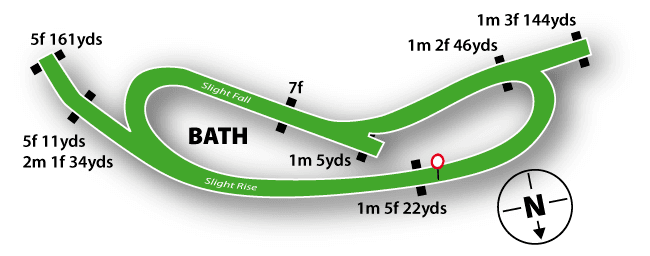
The Round Course
- Distance 1m4f 25y, left-handed, kidney-shaped — never properly straight, runners spend much of the trip on the turn
- Home turn Sharp and cambered — pushes horses off the rail late, often makes the difference
- Run-in ~4f — nearly half a mile — climbing the entire way to the post; those that commit for home early in the straight are often vulnerable late
- Trips A mile, then a spread of middle and staying trips from 1m 2f up to 2m 1f — including the 1m 6f of the Beckford Stakes — all run on the round course with varying first-bend dynamics
- Mile start Feeds into the long left-hander with plenty of time to settle — over 441 races the wider half of the draw has shown no systematic penalty here
The Sprint Chute
- Distance 5f 10y and 5f 160y — both run from a chute that joins the round course at the top of the home straight
- Profile Always turning, always rising — there is no “straight” sprint at Bath, unusual in Britain, where the minimum trip is normally run on a straight; Chester’s Roodee is the other obvious case
- Pace Can be strongly run when several natural pace horses are engaged — and the long uphill finish then exposes anything that has overcommitted
- Tactical shape Sharp early acceleration off the chute, then the sustained climb — closers finish strongly when the lead group has overcommitted
Surface & History
- Surface Turf only — no all-weather, no jumps
- Watering No fixed irrigation system — the only Flat course in Britain without one. Bowsers and a rain gun allow limited remedial watering (the groundstaff worked overnight shifts through July 2026), but nothing on the scale of routine full-course irrigation
- Going pattern Good to firm or quicker is the norm; genuinely firm common; soft uncommon rather than unknown — April 2026 raced through good to firm, good and good to soft in a single month
- First raced 1728 on Claverton Down; meetings moved to Lansdown from 1784, resumed there in 1811 after a fifteen-year gap with the consent of the landowner Mrs Frances Blathwayt, and the course moved to its present site in 1831
- Owner Northern Racing bought the course in 2000, and it became part of Arena Racing Company when ARC was formed in 2012 — Langridge Grandstand opened 2016
- Black type Two Listed races — the Lansdown Stakes (5f, fillies and mares, April) and the Beckford Stakes (1m 6f, fillies and mares, October, added to the programme in 2016)
Key Betting Angles
- Course form Bath rewards specialists — previous form here proves a horse can handle a test many never manage
- Fast-ground form When Bath is genuinely quick, proven good-to-firm form deserves extra weight — and be wary of form earned solely on softer ground
- Stamina & balance The undulations, the climb and the camber on the home turn all reward balanced, genuine stayers — a horse short of stamina for the climb can be vulnerable after using its speed earlier
- Front-runners Can hold on against weak fields, but the uphill finish makes early leaders vulnerable when the pace is hot
- Jockeyship An unusual tactical ride — the narrow turn, the camber and the climb all reward riders who know the place
Do front-runners win at Bath?
Bath is a galloping circuit with one key tactical feature: the final turn into the straight is narrow and sharp, and it arrives immediately before a climb that runs the length of the home straight. A horse that is already travelling and holding a forward position takes that bend on its own terms. One that is not gets shuffled wide exactly where it can least afford the ground.
That is an argument for being handy, and it is not the same as an argument for making the running. Timeform’s course guide has it that “prominent racers have a better record than those ridden more patiently, but any advantage decreases as the trip increases”, and geegeez reads the track as favouring runners “that can gain a prominent early position”. The outright leader is a different proposition: drawbias.com, which ranks courses for front-running success, places Bath “middle to low” at every distance it measures and says plainly that “it is quite hard for front runners to win” here. Both readings fit one mechanism — position going into that bend is worth having, and the climb afterwards helps explain why outright leaders do not dominate here.
Run Style Bias — Qualitative Only
Handy before the narrow turn
Good early, vulnerable late
Avoid getting shuffled wide
Loses ground through the bend
Treat these bars as directional — a reading of how the track rides rather than a statistical measurement. Published reads disagree: Timeform and geegeez favour prominent runners, while drawbias.com ranks Bath middle to low for front-runners at every trip it measures. Timeform is explicit that the advantage decreases as the trip rises; drawbias.com’s own distance-by-distance figures are less tidy than that, weakest at its longest trip but not falling in a straight line.
Does the draw matter at Bath?
Bath has no true straight course and every trip involves substantial turning, which invites the obvious conclusion — left-handed bends, low draws save ground — and the figures do not support it. Across 510 races at the bare five furlongs since 2010 the low third of the draw has won 6% less often than its share of the runners (impact value 0.94), against 1.05 for the middle third and 1.01 for the high; the longer sprint reads 1.02 / 1.02 / 0.97 over 577 races, and the mile 0.91 / 1.06 / 1.02 over 441. From 1m 2f up the high third runs about 9% above par across 805 races, but that bucket pools everything from 1m 2f to 2m 1f — different starts, different first-bend distances, and different stalls placements: the 1m 2f stalls were set Outside on 5 April 2026 and Inside on 31 July. We publish the figure and decline the call. Those are winners measured against each third’s share of the runners, not against their prices, so read them as which side of the track to prefer rather than as a value angle.
Two recent studies, both far narrower than that sample, disagree with each other at the bare five furlongs. geegeez’s 2026 draw review — 2021 to 2025, handicaps only, fields of seven or more, 57 qualifying races — found horses drawn low “winning twice as many races as those drawn high”, with the percentage-of-rivals-beaten figures pointing the same way. drawbias.com, working from 2024–25 handicaps for three-year-olds and up, calls the same trip “a clear advantage for horses drawn high”, and reads high at every Bath trip it covers. Our wider sample finds neither, and splitting it by going does not rescue the low-draw case: on soft ground at the bare five furlongs the low third is the weakest of the three (0.84 against 1.13 for the middle, 110 races). There is no stable rule to carry from one meeting to the next here.
Strong bias — material handicapping factor
Moderate lean — worth noting
Broadly fair — not a primary factor
On the widest sample we can measure — 2,333 races since 2010 across the four samples we hold — no sample returns a draw bias strong enough to reset a shortlist, and that is worth knowing in itself. But an aggregate that comes out fair is not the same as a stall that cannot matter on the day: the two recent handicap-only studies above point in opposite directions over the same five furlongs, and a track that measures fair across sixteen years can still produce a lopsided race. Treat the draw here as race-specific rather than neutral by default.
Bath races over 5f 10y and 5f 160y from the sprint chute, a mile, and a spread of middle and staying trips from 1m 2f up to 2m 1f — there is no six or seven furlong course here, which is why the two seven-furlong races on a fixture transferred from Brighton in May 2026 had to be re-written at 5f 160y and a mile. The stall matters less here than what it lets a horse do: the real question is whether this one has the early speed to hold the position the draw offers before that narrow home turn. A theoretically good stall is worth little to a slow starter, while a wider runner with uncomplicated speed can stay out of trouble and take the bend on its own terms. At a mile the wider half of the draw has shown no systematic penalty — the high third marginally outperforms the low across 441 races. And check where the stalls actually are: Bath sets them by trip and by meeting, so one 2026 card ran the sprint from the centre, the mile inside and the 1m 2f outside, while another put everything bar the sprint inside. The published stalls position is as much a part of the read as the stall number.
Which trainers and jockeys win most at Bath?
| Trainer | Runs | Wins | Win% | Places | Place% | A/E | P/L |
|---|---|---|---|---|---|---|---|
| 1 Carroll, A W | 665 | 85 | 12.78% | 196 | 29.47% | 1.11 | -104.74 |
| 2 Cox, C G | 349 | 74 | 21.20% | 157 | 44.99% | 0.99 | +30.01 |
| 3 Saunders, M S | 401 | 56 | 13.97% | 140 | 34.91% | 1.02 | -42.59 |
| 4 Harris, R A | 629 | 55 | 8.74% | 176 | 27.98% | 0.79 | -194.62 |
| 5 Hannon (Jnr), Richard | 366 | 53 | 14.48% | 138 | 37.70% | 0.77 | -125.56 |
| 6 Millman, B R | 370 | 52 | 14.05% | 116 | 31.35% | 1.03 | +36.56 |
| 7 Evans, P D | 424 | 41 | 9.67% | 117 | 27.59% | 0.77 | -103.45 |
| 8 Wintle, A | 256 | 40 | 15.63% | 92 | 35.94% | 1.11 | +31.09 |
| 9 Houghton, Eve Johnson | 315 | 37 | 11.75% | 100 | 31.75% | 0.77 | -90.90 |
| 10 Balding, A M | 271 | 37 | 13.65% | 89 | 32.84% | 0.70 | -86.95 |
| 11 Meehan, B J | 158 | 36 | 22.78% | 60 | 37.97% | 1.37 | +53.13 |
| 12 Prescott, Sir Mark | 113 | 36 | 31.86% | 53 | 46.90% | 0.86 | -33.10 |
| 13 Portman, J G | 268 | 34 | 12.69% | 90 | 33.58% | 1.01 | -10.66 |
| 14 Hills, Charles | 182 | 33 | 18.13% | 67 | 36.81% | 0.94 | -35.27 |
| 15 Charlton, Roger/Harry | 118 | 32 | 27.12% | 59 | 50.00% | 1.13 | +29.66 |
| 16 Moore, J S | 343 | 30 | 8.75% | 80 | 23.32% | 0.96 | -54.42 |
| 17 Tregoning, M P | 142 | 27 | 19.01% | 58 | 40.85% | 0.94 | -30.81 |
| 18 Harris, Miss G | 297 | 26 | 8.75% | 70 | 23.57% | 0.92 | -109.05 |
| 19 Flint, J L | 207 | 23 | 11.11% | 49 | 23.67% | 1.18 | +10.49 |
| 20 Moore, Gary and Josh | 161 | 23 | 14.29% | 50 | 31.06% | 0.99 | -13.75 |
Bath Flat · Current trainers, since 2010
| Jockey | Runs | Wins | Win% | Places | Place% | A/E | P/L |
|---|---|---|---|---|---|---|---|
| 1 Probert, David | 565 | 73 | 12.92% | 172 | 30.44% | 0.90 | -84.17 |
| 2 Morris, Luke | 656 | 72 | 10.98% | 190 | 28.96% | 0.70 | -244.44 |
| 3 Keniry, L P | 470 | 50 | 10.64% | 127 | 27.02% | 0.91 | -110.10 |
| 4 Bishop, Charles | 373 | 43 | 11.53% | 107 | 28.69% | 0.83 | -95.48 |
| 5 Marquand, Tom | 240 | 42 | 17.50% | 96 | 40.00% | 1.07 | +44.39 |
| 6 O’Neill, K T | 382 | 40 | 10.47% | 100 | 26.18% | 1.01 | -50.05 |
| 7 Sousa, Silvestre De | 196 | 40 | 20.41% | 71 | 36.22% | 0.93 | -18.58 |
| 8 Dobbs, Pat | 208 | 39 | 18.75% | 79 | 37.98% | 0.99 | -33.72 |
| 9 Marsh, Finley | 237 | 34 | 14.35% | 76 | 32.07% | 0.93 | +3.58 |
| 10 Kingscote, Richard | 237 | 31 | 13.08% | 79 | 33.33% | 0.79 | -74.20 |
| 11 Cosgrave, Pat | 183 | 31 | 16.94% | 69 | 37.70% | 0.96 | +44.22 |
| 12 Egan, David | 134 | 31 | 23.13% | 57 | 42.54% | 1.32 | +50.26 |
| 13 Doyle, Hollie | 212 | 29 | 13.68% | 69 | 32.55% | 0.84 | -52.40 |
| 14 Murphy, Oisin | 192 | 29 | 15.10% | 69 | 35.94% | 0.78 | -26.59 |
| 15 Hornby, Rob | 299 | 28 | 9.36% | 88 | 29.43% | 0.71 | -89.19 |
| 16 Levey, S M | 197 | 28 | 14.21% | 71 | 36.04% | 0.90 | -29.03 |
| 17 Crouch, Hector | 150 | 27 | 18.00% | 46 | 30.67% | 1.18 | +1.47 |
| 18 Whelan, Trevor | 227 | 25 | 11.01% | 64 | 28.19% | 0.93 | -66.25 |
Bath Flat · Current riders, since 2010
Which sires do best at Bath?
| Sire | Runs | Wins | Win% | Places | Place% | A/E | P/L |
|---|---|---|---|---|---|---|---|
| 1 Kodiac | 386 | 45 | 11.66% | 121 | 31.35% | 0.80 | -119.45 |
| 2 Dandy Man (IRE) | 254 | 37 | 14.57% | 80 | 31.50% | 1.04 | +13.89 |
| 3 Dark Angel (IRE) | 262 | 34 | 12.98% | 91 | 34.73% | 0.84 | -55.83 |
| 4 Exceed And Excel (AUS) | 246 | 32 | 13.01% | 72 | 29.27% | 0.80 | -104.76 |
| 5 Acclamation | 216 | 31 | 14.35% | 85 | 39.35% | 0.88 | -66.51 |
| 6 Oasis Dream | 184 | 31 | 16.85% | 62 | 33.70% | 0.97 | -51.11 |
| 7 Showcasing | 234 | 30 | 12.82% | 80 | 34.19% | 0.98 | -57.32 |
| 8 Invincible Spirit (IRE) | 211 | 30 | 14.22% | 66 | 31.28% | 0.90 | -76.76 |
| 9 Kyllachy | 246 | 26 | 10.57% | 72 | 29.27% | 0.89 | -48.56 |
| 10 Pastoral Pursuits | 199 | 26 | 13.07% | 59 | 29.65% | 0.94 | -29.76 |
| 11 Holy Roman Emperor (IRE) | 113 | 26 | 23.01% | 42 | 37.17% | 1.74 | +118.72 |
| 12 Compton Place | 201 | 24 | 11.94% | 61 | 30.35% | 1.00 | -4.37 |
| 13 Champs Elysees | 96 | 24 | 25.00% | 43 | 44.79% | 1.42 | +47.02 |
| 14 Equiano (FR) | 219 | 23 | 10.50% | 63 | 28.77% | 0.77 | -57.32 |
| 15 Footstepsinthesand | 156 | 21 | 13.46% | 53 | 33.97% | 0.98 | -29.98 |
| 16 Piccolo | 229 | 19 | 8.30% | 55 | 24.02% | 0.75 | -40.24 |
| 17 Royal Applause | 182 | 19 | 10.44% | 46 | 25.27% | 0.77 | -48.50 |
| 18 Sakhees Secret | 110 | 19 | 17.27% | 40 | 36.36% | 1.25 | +41.08 |
| 19 Mayson | 100 | 19 | 19.00% | 31 | 31.00% | 1.36 | +2.68 |
| 20 Bahamian Bounty | 142 | 18 | 12.68% | 46 | 32.39% | 0.86 | -47.30 |
Bath Flat · Since 2010
Betting Tips for Bath Flat Turf
What a rating cannot tell you about Bath
Bath produces specialists. The undulations, the camber on the home turn and the long uphill finish all create a test that form from level tracks does not answer. A horse with a course win to its name is often worth a second look, even at a stiff mark — not because the handicapper has missed something, but because it has already proved it copes with the place.
Fast-ground form is gold
With no fixed irrigation system, free-draining turf and a summer-only calendar, firm ground turns up here more often than at tracks that can water at will — and 2026 showed how far that can go, with the BHA moving Bath’s 15 August card to Lingfield’s all-weather track on “the longer-term forecast of on-going dry weather and the current condition of the track”. When Bath is genuinely quick, proven good-to-firm form deserves extra weight. Read the going on the day rather than the month, though — rain reaches Lansdown Hill too, and a summer card can be run on good or softer.
Don’t get sucked in by early leaders
The home straight rises for nearly half a mile to the post. Horses that go for home turning in look superb at the three-furlong pole and are often collared inside the final furlong. When backing a front-runner here, look for one with proven uphill stamina — and when opposing one, the long climb is your friend.
What the draw lets a horse do
Bath’s draw figures come out fair at the sprints and the mile, so the stall number is rarely the story on its own — and the recent handicap-only studies disagree about which end of the sprint draw is favoured anyway. What matters is whether your horse can use the stall it has: enough early speed to hold its position into the narrow home turn. A quick starter drawn wide is often better placed than a slow one drawn low. Check field size, where the pace is drawn, and the published stalls position — Bath moves the stalls by trip and by meeting — before leaning on the gate at all.
Bath experience is a jockey positive
The home turn is sharp and cambered, the run-in is uphill, and the camber pushes runners off the rail late. The configuration gives a rider who knows the place less chance of being caught out by the bend, the camber or the timing of the climb — committing too early, or losing the rail at the wrong moment. Riders with a strong track record here are usually worth a small bump in confidence.
The climb finds out an overcommitted lead
The 5f chute joins the round course at the head of the home straight, so sprinters are turning and rising for almost the entire trip. When several natural pace horses are drawn together the early gallop can be fierce, and the long climb then finds out anything that has overcommitted. Closers travel into the race well here; pure speed types without enough finish for the climb can be vulnerable.
Course form is worth respecting
Track specialists are a real category at Bath, and the reason is mechanical: an unusual physical test — the undulations, the camber on the home turn, the climb — is one plenty of horses never manage. Evidence that a horse handles it is worth having. When sifting handicaps, give weight to course form even when it sits a few months back, especially for the type of horse — balanced, stamina-laden, fast-ground — that the track favours structurally.
Check the wind on the day
Bath sits 780 feet above sea level on an exposed hill, and geegeez warns of “the gusty headwinds that whip around the top of Lansdown Hill”. No source pins a fixed direction, and race-day reports vary, so look it up rather than assume it: a substantial headwind in the closing stages slows times, makes an aggressive early gallop harder to sustain, and puts any front-running selection at more risk than the race shape alone suggests.
A wide draw has shown no systematic penalty at a mile
Over a mile the high third of the draw has marginally outperformed the low across 441 races since 2010, so there is no long-run penalty to a wider stall at the trip, and it can help a slow starter stay out of traffic. That is an aggregate, not a guarantee for a given race — check the field size and where the stalls have been set. The field has more than enough distance to find its level before the home turn.
Common Mistakes to Avoid
- Reading Bath as a galloping flat track. Bath is sharply undulating with a stiff uphill finish at altitude (780ft). Hold-up rides who can’t pick up off the climb tail off late, and balance and stamina count for more here than form earned on flatter, more conventional tracks would suggest.
- Backing fancied southern-yard runners blind. The high-volume yards here are a mixed bag — Tony Carroll (A/E 1.11), Alan Wintle (1.11), Brian Millman (1.03) and Clive Cox (0.99, +£30.01) all run a high volume here and have broadly matched their prices doing it. Volume on its own is not the signal, though: Eve Johnson Houghton runs almost as often at A/E 0.77.
- Backing David Probert on his win count alone. He rides more Bath winners than anyone (73) but at A/E 0.90 and a heavy level-stakes loss; the riders in the table who have historically beaten their prices here are David Egan (A/E 1.32, +£50.26) and Hector Crouch (18.00% from 150, A/E 1.18).
- Treating Dandy Man as the Bath sire angle. Dandy Man barely edges it — A/E 1.04 and +£13.89 across 254 runners — while the sires that have most outrun their prices here sit well down the winner count: Holy Roman Emperor at 23.01% from 113 runners, A/E 1.74 and +£118.72, then Champs Elysees (25.00% from 96, A/E 1.42), Mayson (A/E 1.36, though only +£2.68) and Sakhees Secret (A/E 1.25 from 110). Kodiac tops the winner count (45 from 386) but at A/E 0.80 loses steadily here.
- Assuming the stalls are where they were last time. Bath sets its stalls by trip and by meeting: one 2026 card had the sprint drawn from the centre, the mile inside and the 1m 2f outside, and another put everything bar the sprint inside. A stall number means little until you know which side of the track it starts from — and it is why the middle-distance draw figures on this page are published without a directional call.
Bath Racecourse FAQs
Is there a draw bias at Bath?
Which way does Bath race, and what kind of track is it?
How does the ground play at Bath, given there is no watering?
Which trainers and jockeys do best at Bath?
What is the most reliable angle, and the biggest mistake, at Bath?
Nearby Tracks
Salisbury
Stiff, galloping uphill straight — stayers and class.
Windsor
Unique figure-of-eight — flat and fair, riverside.
Goodwood
Undulating downland loops — balance and tactics.
Chester
The Roodee — Britain’s sharpest track, low draw is king.
Ascot
Stiff, galloping right-hander — round and straight.
Brighton
Switchback left-hand horseshoe — sharp turns and a high-draw mile.
Want the thinking behind Bath turf bets?
FormDial posts every selection before the off with its full reasoning: the angle, the price, the logic. See how course knowledge feeds into real tips.
The Trackside Companion is your day at the races, written to order — every race on your meeting’s card broken down, plus this track’s draw, angles and people distilled from the guide you’ve just read. Order at least a week before your raceday.
Plan your raceday →