Ascot
Flat Turf
Berkshire · 25 miles west of central London, home of Royal Ascot
Ascot also stages National Hunt racing. Read the National Hunt racecourse guide →
What is Ascot racecourse like?
Track Character
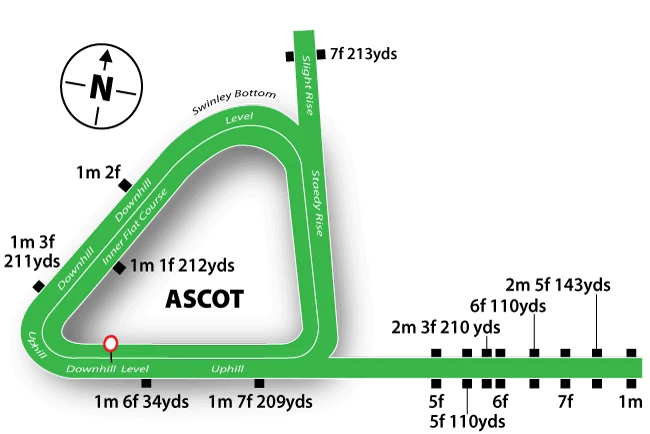
Ascot sits on Berkshire heathland about 25 miles west of central London and stages the most valuable Flat racing in Britain. It is right-handed, and it is really three courses in one. The Straight Mile runs dead straight for every trip from 5f to a mile and joins nothing — sprinters and the big straight-course handicaps never see a bend. The Round Course is a triangular circuit of roughly 1m6f used from about 1m1f up to the Gold Cup trip, with a run-in of just two and a half furlongs from the home turn. And the Old Mile, the one most guides forget, is a separate mile start that feeds into the round course at Swinley Bottom and takes in the home bend — officially 7f213y, six metres shorter than the Straight Mile, and a completely different test.
The thing that defines all three is the climb. The highest point on the course is at, or just past, the winning post, and Swinley Bottom — the lowest point, at the apex of the triangle on the far side, roughly a mile from home — sits 73 feet below it. So the finishing section rises substantially towards the post, with the stiffest of the climb coming before the final furlong and no downhill relief anywhere on it; since the 2006 rebuild the last furlong itself is comparatively level. That is the single most important fact about Ascot, and everything below is a consequence of it: horses who looked to be travelling best at halfway tie up in the last two furlongs, and a horse who wins here has proved it stays every yard of the trip rather than merely being fast enough for it.
Two corrections worth making, because they are repeated everywhere. Swinley Bottom is not two and a half furlongs from home — that figure belongs to the run-in from the home turn, a separate landmark much closer to the stands. And the home bend is no longer the tight, trouble-causing corner of its reputation: the 2006 redevelopment eased its geometry into a more sweeping turn, which is precisely why runners ridden prominently are hard to peg back off such a short run-in. Traffic problems still happen, but in big fields they come from the shortness of the straight, not from the sharpness of the bend.
Royal Ascot in mid-June is the meeting that defines the British Flat season — five days, eight Group 1s, and the deepest international competition anywhere in the calendar. The 2026 running drew 294,541 over the five days, the biggest crowd since the pandemic, and a record 634 runners. Beyond it, the King George VI & Queen Elizabeth Stakes in late July and QIPCO British Champions Day in mid-October give Ascot more Group 1 races than any other British Flat course. Former jockey Jason Weaver sums up what the two configurations actually ask of a rider:
Course Facts
- Founded 1711, by Queen Anne, on heathland six miles from Windsor Castle
- Configurations Three — the Straight Mile (5f–1m), the Round Course (~1m1f–2m5f), and the Old Mile
- Swinley Bottom The lowest point of the round course, at the apex of the triangle on the far side, about a mile from home and 73ft below the winning post
- Run-in 2½ furlongs from the home turn to the line — short for a track that stages 2m4f Group 1s
- Finish Highest point at or just past the post; a substantial overall rise, with the stiffest climb before the final furlong
- Group 1 density More Group 1 races than any other British Flat venue
The Straight Mile
- Trips 5f, 6f, 7f and the Straight Mile — dead straight, joins nothing
- Profile Gentle descent for the first couple of furlongs, flattens, then climbs to the post
- Field shape Wide enough that 25–30 runners split into two groups that race apart until they merge inside the last quarter-mile
- Signature races Queen Anne Stakes, Royal Hunt Cup, Wokingham, Britannia, Queen Elizabeth II Jubilee
The Round Course
- Shape Right-handed triangle of roughly 1m6f, used from about 1m1f to 2m5f
- Home turn Sweeping since the 2006 redevelopment; prominent runners are hard to peg back off the short run-in
- Measured trips Ascot races several round-course distances a few yards short of the round number — its “1m4f” is 1m3f211y, its “2m4f” is 2m3f210y
- Signature races Prince of Wales’s, King George VI & Queen Elizabeth, Gold Cup, Champion Stakes
The Old Mile
- What it is A separate mile start that joins the round course at Swinley Bottom and takes in the home bend
- Distance Officially 7f213y (1,603m) — six metres shorter than the Straight Mile, and a bend rather than a straight
- The test Tactical and positional: a sweeping turn into a short run-in rewards being handy and punishes being caught wide
- Signature races St James’s Palace Stakes and the Coronation Stakes, both Group 1
Distance Profiles
Ascot is not one track and it does not ask one question. The trip tells you which of the three courses you are on, and that decides almost everything about how the race is run. The gradient is the constant — every trip finishes on the climb described above — so what changes card to card is the pace shape, and that is what each block below leads with. Two things worth knowing first: several round-course trips are raced a few yards short of the distance they are advertised at (the “1m4f” is 1m3f211y, the “2m4f” is 2m3f210y), and every trip from 5f to a mile on the straight course never sees a bend at all.
PaceThe exception. Speed holds up here better than anywhere else on the course.
SignatureKing Charles III Stakes (Gp1), Norfolk Stakes (Gp2, 2yo).
PaceTransitional. Harder to lead all the way than over 5f, but leaders still do better here than the cross-course rankings suggest.
SignatureCoventry Stakes (Gp2, 2yo), Queen Elizabeth II Jubilee (Gp1), Wokingham.
PaceWhere the anti-front-runner bias genuinely bites — held-up runners have won more 7f races here than every other style combined.
SignatureJersey Stakes (Gp3), Buckingham Palace Stakes.
PaceStrongest hold-up bias on the course. Big fields split into two groups that race apart until they merge inside the last quarter-mile.
SignatureQueen Anne Stakes (Gp1), Royal Hunt Cup, Britannia.
PaceNothing like the Straight Mile despite the near-identical distance. A bend and a short run-in make it positional — be handy, don’t get caught wide.
SignatureSt James’s Palace Stakes (Gp1), Coronation Stakes (Gp1).
PaceThe read reverses. Horses racing in the first half of the field outperform those held up — the opposite of the straight course.
SignaturePrince of Wales’s Stakes (Gp1), Champion Stakes (Gp1), Golden Gates.
PaceA championship trip where stamina rather than tactics usually settles it. The draw does not stop mattering here, though: in big-field Royal Ascot handicaps over this trip the lowest stalls have been a real negative (see the draw section).
SignatureKing George VI & Queen Elizabeth Stakes (Gp1), Hardwicke (Gp2), King Edward VII (Gp2).
PaceOut-and-out stamina, but position at the home turn still counts for the reason given above.
SignatureQueen’s Vase (Gp2), Copper Horse Stakes.
PaceOften muddling early then a sprint from the turn — precisely the shape that strands a hold-up ride.
SignatureBritish Champions Long Distance Cup (Gp1, October).
PaceTactics vary year to year. Do not be detached turning in — the short run-in makes traffic and position expensive — but there is no established front-running bias at this trip; see the Gold Cup example below.
SignatureGold Cup (Gp1), Ascot Stakes.
PaceThe longest Flat race staged in Britain, shortened from 2m6f34y by the 2005–06 realignment. Stamina and a horse that settles beat any positional angle.
SignatureQueen Alexandra Stakes, final day of Royal Ascot.
Does the draw matter at Ascot?
Strong bias — material handicapping factor
Moderate lean — worth noting
Broadly fair — not a primary factor
How to read this: Ascot is not a draw track in the way Chester or Beverley are, and the honest answer at most trips is that no stable, published bias exists. Where a real one has been measured it is fixture-specific, not course-specific — and the two measured samples point in opposite directions, which is the whole point. Sample sizes are shown where one exists; where none does, the bar says so rather than guessing.
The practical summary: at Ascot the draw is a tie-breaker, not a starting point. The one genuinely structural feature is that the straight course is wide enough for a 25–30 runner field to split into two groups that effectively race separately until they merge inside the last quarter-mile — and which group is favoured is decided on the day by ground and rail, not by a rule you can look up. Ascot’s own Clerk of the Course, Chris Stickels, has said as much: “It’s not uncommon for it to change.”
Do front-runners win at Ascot?
This is the most misunderstood thing about Ascot, and the single biggest edge on the page. The received wisdom — “the pendulum has swung, hold up your horse at Ascot” — is true of one part of the course and flatly wrong about the rest. The bias is trip-specific, and applying a straight-mile finding to a round-course race is a reliable way to misread the race.
Start with the cross-course picture. Rank every British track by how well front-runners do at each trip and Ascot sits near the bottom almost everywhere — but note where it doesn’t:
| Trip | Ascot’s rank for front-runners | Read |
|---|---|---|
| 5f | 20th of 31 courses | Mid-pack — no meaningful bias |
| 6f | 29th of 29 courses | Worst-ranked, but see the caveat below |
| 7f | 23rd of 23 courses | Genuine anti-front-runner ground |
| 1m | 24th of 25 courses | Genuine anti-front-runner ground |
| 1m2f | 25th of 26 courses | Cross-course rank only — the within-course read differs |
| 1m4f | 14th of 16 courses | Weakest of the measured trips |
Now the within-course numbers, which is where it gets useful. Over the straight mile, held-up runners are not merely competitive, they are profitable: a £1 each-way bet on every hold-up runner would have returned a surplus of £83.60. Hold-up types have won as many races as every other running style put together, despite being outnumbered by them roughly two to one. Over 7f it is starker still — held-up runners win 6.73% of the time against 3.72% for all other styles combined, and of the 90 horses in the sample that went and disputed the early lead, two got home.
Champions Day sharpens the same point. In Ascot mile handicaps of 16 or more runners, filtered to ground away from fast, the place strike rate climbs almost perfectly as you move back through the field: 8.7% for front-runners, 10.79% prominent, 17.86% mid-division, 25.51% held up. Twenty of those 24 races were won from mid-division or the rear. Worth saying plainly though: that is a heavily filtered sample — big fields, autumn, and specifically not quick ground. It is not a general law of the course, and whether it holds on genuinely fast ground has not been tested by anyone publishing figures.
And now the two places the story breaks. At 5f, speed wins. In big-field, fast-ground five-furlong races at Ascot, runners who led or pressed the lead won nine races from 95 such horses, for a profit of £20.50 to a £1 level stake. At the same trip, prominent racers fare significantly better than hold-up horses. At 6f the picture is genuinely mixed — Ascot ranks last of 29 courses on the cross-course measure, yet within Ascot itself early leaders still post the best win and place strike rates at the trip, with an impact value above 1.5. Both can be true: front-running is a bigger edge at almost every other 6f track than it is here, while still being the best style to be on at Ascot. Do not fold 6f in with 7f as if they were the same case.
And in the one round-course sample we have figures for, 1m2f, the read reverses. The run-in is only two and a half furlongs. Since 2006 the home turn has been sweeping rather than sharp, so a horse bowling along in front is not checked and is very hard to reel in. Over 1m2f, horses racing in the first half of the field outperform those held up — the exact opposite of the straight-mile finding. The read is unambiguous, and nothing we have found contradicts it.
Gold Cup 2022 — Kyprios, drawn 5, 13/8f
The principle: over 2m4f on the round course you would expect a patiently-ridden stayer to be handed the race. The 2½f run-in says otherwise.
What happened: Ryan Moore settled Kyprios midfield in a nine-runner field on good to firm, pushed him along four out, came wide round the home turn and had him in front narrowly with two furlongs to run — already asserting before the short straight could matter. Stradivarius, going for a fourth Gold Cup, was still towards the rear with three furlongs to run, met traffic, had to switch left, and only got going on the outer inside the final furlong. He grabbed third with no extra to give. Whatever part stamina played, the traffic left him without the clear room, or the straight, in which to mount a challenge.
The lesson, and its limits: a horse still held up passing the three-furlong pole here has a short run-in and other horses to get past, and Stradivarius met exactly that. Read it as a tactical warning about traffic and being detached, not as proof of a leader bias over the Gold Cup trip. The round-course pace evidence above is drawn from 1m2f racing; two and a half miles is a different race with its own tactical questions, and the Gold Cup roll of honour is not short of horses delivered late. Where the finding does apply — 1m2f on the round course — get the run-in on your side by being close enough to use it.
Put it together and the honest verdict is this: the anti-front-runner bias at Ascot is real, it is strongest from 7f through the straight mile, it is weak-to-absent at 5f, mixed at 6f, and in the one round-course sample there are figures for, 1m2f, it reverses. At the longer round trips, treat position as coursecraft rather than assuming the same measured bias. Anyone who tells you Ascot is simply a hold-up track has read one study and applied it to a different racecourse. If you want to work the pace shape of a specific race yourself, our Pace Analyser is free and does the mapping for you, and How to Read Pace in Horse Racing covers the method.
The pace read, before the off
Every FormDial selection is posted before the race with the full reasoning — the angle, the price, the logic. Free, straight to your inbox.
Run Style Bias — Trip-Specific
Strong from 7f to the straight mile
Reversed at 1m2f round
No clear lean
Genuine anti-pace ground 7f–1m
Ascot is the one track where a single pace read is actively misleading: the straight-course evidence and the measured 1m2f round-course sample point opposite ways, and the bars above describe the straight.
Going & Ground
Ascot has a quirk almost no other British track shares: on a wet day the two courses ride differently at the same meeting. The straight was completely rebuilt in the 2004–06 redevelopment, relocated 42 metres north and reconstructed on a sand-and-gravel raft with new drainage. It sheds water faster than the round course, and the going reports show it — after one rainfall the official going went to good on the straight and good to soft on the round; after another it was soft on the straight and heavy in places on the round. Same rain, same afternoon, two different tests. If you are betting a straight-course race off a round-course going report, you are working from the wrong number.
The watering policy matters more than most punters realise, and it runs the opposite way to the assumption. Ascot waters to stop the ground going firm, not to soften it — the stated aim for Royal Ascot is to start on the good side of good to firm and hold it there through the week, with the straight and the round course watered separately according to moisture readings and the forecast rather than to any fixed cadence. Genuinely firm ground has not been the official description in any recent Royal meeting. It is a sand-based track that dries fast, which is precisely why it needs so much water in what looks like a wet June.
On the going-and-draw question, be careful, because the popular one-liner is not supported. What is genuinely documented is that the fixture matters more than the going alone. In Royal Ascot’s big straight-course handicaps on quick June ground, top-half draws have shown a real edge across 2021–23. On Champions Day in October, with cut in the ground, the bottom half of the draw supplied 71% of winners across 14 big-field races. That looks like a clean “soft favours one side, quick favours the other” rule — until you notice that a different October fixture a fortnight earlier, on similar ground but run with a false rail, produced the opposite bias. Rail position is doing real work on top of the going, and these effects hedge themselves year to year. Read the ground and the rail, and treat both as inputs rather than answers.
June and October are two different racecourses in temperament. Royal Ascot is a good-to-firm championship meeting; Champions Day is far more likely to be run on easier autumn ground — soft-ground specialists get their own annual previews for it in the racing press — though it is not guaranteed, and the 2025 renewal was officially Good, and in 2019 the clerk called the track “the softest and wettest I’ve ever known it”, forcing Ascot to switch races to the inner course for the first time. That is why autumn Ascot form is a different test rather than simply later form: the ground rewards a different horse, and the pace bias moves with it — hold-up and mid-division runners won 20 of 24 of those autumn mile handicaps.
One myth worth killing, because we went looking for it and it isn’t there: the idea that the pattern set on day one of Royal Ascot holds through to day five unless it rains. Nobody has quantified it, and the 2026 meeting contradicted it outright — see the handicaps section below. Watch each day on its own merits.
Royal Ascot Handicaps
These are the biggest betting races of the British year. The largest straight-course heats reach the high twenties and are worth more than most Group races, and they are where the straight course’s two-group split does its damage; the round-course handicaps run smaller but set different and equally useful draw and pace tests. Read this section alongside the pace and draw notes above — on the straight, field shape decides more than the stall does.
One thing to get straight before you go looking for trends: four of these races barely have a history. Royal Ascot went from 30 races to 36 in 2020 and the Copper Horse, Golden Gates and Palace of Holyroodhouse all date from that expansion; the Kensington Palace followed in 2021. The Buckingham Palace has an old name but a broken run — it disappeared between 2015 and 2019. Anyone quoting you decades of trends for these is quoting something that does not exist.
The archetype. A Class 2 heritage handicap for three-year-olds and up over the straight mile, filling to the high twenties, first run in 1843 at 7f and stretched to a mile in 1956.
ShapeSplits into two groups within a furlong and they run largely separate races until they merge inside the last quarter-mile. The winner comes from whichever group gets the cleaner run late.
DrawTop-half draws have led on the quick June ground across 2021–23, but the favoured side moves. Do not treat it as a law.
Three-year-olds and up over the straight six, one of the biggest fields of the week and older than the Hunt Cup. The same two-group split, but over a shorter trip — the merge comes closer to home and there is less time to recover from the wrong half.
DrawThe clearest illustration of instability we have: in 2026 the stands’ side was the place to be in Wednesday’s Hunt Cup, and by Saturday the two who went that way here were beaten quickly.
Three-year-old colts and geldings over the straight mile — a huge-field handicap for horses still on the up, and one of the hardest puzzles of the week.
NoteSame field shape as the Hunt Cup, with thinner form lines: these are lightly-raced three-year-olds, so the exposed-horse angles that work in the older handicaps do not.
A staying handicap over the Gold Cup trip on the opening day, and a traditional target for jumps yards raiding the Flat.
NoteRound course, so none of the straight-mile logic applies. Position turning in beats the draw, which is negligible at the trip.
Handicap over the straight seven. Old name, broken run — it restarts in 2020, so the useful sample is still a short one.
DrawThe best-quantified pattern in this group: six of the seven renewals since its 2020 return, to and including 2026, were won from stall 24 or higher — Mezcala came from stall 30 in 2026.
Pace7f is where the anti-front-runner evidence is strongest. Treat early speed with suspicion.
A staying handicap added in the 2020 expansion, so still only a handful of renewals and no trend book worth the name yet. Round-course staying test where position at the turn beats the stall.
Three-year-old handicap over the round course’s middle-distance trip, also new in 2020. This is the trip where the first half of the field outperforms hold-up runners — handy beats patient.
Three-year-old sprint handicap over the minimum trip, first run in 2020. The one Royal Ascot handicap where backing a front-runner is a plan rather than a hope — 5f is Ascot’s exception.
A fillies’ handicap over a mile and the newest of these handicaps. It moved from the round course to the Straight Mile in 2024 and has been run there since — which matters, because it changes which of the two mile courses you are reading.
NoteToo few runnings for trends. Handicap the race, not the history.
A big-field three-year-old handicap over twelve furlongs, and the clearest practical application of the 1m4f draw finding above: this is exactly the race shape — Royal Ascot, large field, 1m4f round — in which the lowest stalls have historically struggled.
DrawRead it with the 1m4f card in the draw section, not with the low-draw note that applies at 1m and 1m2f.
The older-horse counterpart to the King George V over the same trip and the same bend, run 24 hours later. The same 1m4f caution applies, and with a wider age range the field is usually more exposed, which makes the pace map easier to read.
A competitive fillies’ handicap over the straight mile, which makes it a two-group race like the Hunt Cup rather than a draw-number race. Find where the pace is concentrated before treating any stall as an advantage — a well-drawn filly in the smaller or slower-run group is not well drawn at all.
Royal Hunt Cup 2024 — Wild Tiger, drawn 20, 11/2 jf
The principle: a maximum-field straight-mile handicap does not resolve into a simple low-draw-or-high-draw answer. It resolves into two groups running separate races.
What happened: 29 runners, good to firm. The field split, and the race chart tracks a near-side group and a far-side group merging just over two furlongs out. Wild Tiger led his group throughout, took the lead overall as the groups came together, was challenged hard and rallied to win by a head from Sonny Liston. The near-side group filled seven of the first nine places, including the entire first three. The best the far-side group managed was Daysofourlives in fourth — beaten only about a length in total, so competitive, but never actually winning the race.
The lesson: being in the wrong group does not take a horse out of the shake-up, but it is a real handicap to overcome, and the winner nearly always comes from whichever group gets the cleaner run into the final furlong. Note also what the winner was doing: leading his group, not being dropped out. On the straight mile the hold-up bias is about the race as a whole — within your own group, you still have to be placed.
One clarification worth having: on Ascot’s straight course the high stall numbers are the ones drawn nearest the stands’ rail, so “high” and “stands’ side” line up under the current numbering. What does not line up reliably is which of those groups is favoured on the day — that is decided by ground and rail position, and the whole bank of stalls can be moved across the width of the course. So check the published stall position for the race rather than assuming last week’s answer.
Two-Year-Old Racing
Royal Ascot is the first serious examination most of these horses get, and the form is followed all season. Six races carry the programme, and they ask genuinely different questions — which is why the yards that target them are not the same yards.
Colts and fillies, established 1890, promoted to Group 2 in 2004. The first juvenile race of the week and the most valuable form line of the six — 21 runners in 2025.
ProfileSix furlongs up the straight is a real test for a two-year-old in June. Winners tend to be forward types with size as well as speed.
Two-year-old fillies only, established 1921. Fields have run from roughly 17 to 26 over the last decade — big, fast and messy.
ProfileRaw speed over the minimum trip. The one juvenile race where the 5f front-running exception genuinely applies.
Colts and fillies, established 1843 as the New Stakes, Group 2 since 2006. A smaller, sharper field — 15 runners in 2025.
ProfilePrecocious speed. This and the Queen Mary are where American raiders have historically aimed.
Fillies only, first run in 2002 and Group 3 since 2005. Twenty-five runners in 2025 makes it one of the biggest juvenile fields of the week.
ProfileSix furlongs for fillies who have usually had a run or two — a better guide to autumn than the 5f dashes.
Changed for 2026. Run over 5f through 2025, it moved to 6f and added a sire-eligibility condition — the sire must have won over 7f or further at two, or a mile or further at three and up. Twenty-five ran at the new trip in 2026.
WarningAlmost every published trend for this race predates the change. Historic 5f draw and pace data does not transfer to a 6f race with a different entry pool.
Colts, geldings and fillies over seven furlongs. It swapped days with the Norfolk for 2026, moving from the final day to Thursday. Deliberately restricted by pedigree, and the field is much smaller than the sprints as a result.
EligibilityWorth getting right, because it has moved twice: sire-only (winner over 10f+) before 2019; sire or dam (9½f+) from 2019 to 2023; back to sire-only over 10f+ from 2024. Plenty of reference pages still describe the middle version.
ProfileBy design this is the stamina-bred juvenile race — later-maturing types whose form often reads better the following season than it does in June.
On the yards: Wesley Ward’s American raiders are the angle everyone quotes, and the honest version is more nuanced than the legend. His juvenile record from 2009 to the start of the 2021 meeting was 13% (6 winners from 48) for a £20.50 level-stakes loss — but restricted to his outright favourites it was 3 from 6 and profitable. Note the scope: that is two-year-olds only, not his whole Royal Ascot record. His winners come only in the three sprints; he has never won the Chesham, which is exactly what the eligibility rules would predict. That is the whole lesson of this section in one record: at Ascot, know which race you are in before you apply a trainer angle.
The Full Royal Ascot Guide
Five days, eight Group 1s, 294,541 through the gates in 2026 and the biggest betting heats of the British year. Our dedicated Royal Ascot guide covers the ante-post market race by race, the dress code by enclosure, how to play the big handicaps, and where the form goes for the rest of the season.
The Full Shergar Cup Guide
Ascot’s team jockeys’ challenge is the one fixture where the racecard tells you less than usual: the rides are allocated by ballot, so a jockey booking carries no information at all. Our dedicated guide explains the format, and sets out fifteen years of the meeting’s own figures — what the market gets right, where the winners actually come from, and the one pattern it has not priced.
Read the Shergar Cup guide →
Which trainers and jockeys win most at Ascot?
| Trainer | Runs | Wins | Win% | Places | Place% | A/E | P/L |
|---|---|---|---|---|---|---|---|
| 1 Gosden, J H M | 822 | 126 | 15.33% | 308 | 37.47% | 0.95 | -86.14 |
| 2 O’Brien, A P | 668 | 87 | 13.02% | 220 | 32.93% | 0.82 | -171.63 |
| 3 Haggas, W J | 650 | 82 | 12.62% | 220 | 33.85% | 0.82 | -184.05 |
| 4 Balding, A M | 853 | 79 | 9.26% | 224 | 26.26% | 0.87 | -307.26 |
| 5 Appleby, Charlie | 394 | 60 | 15.23% | 137 | 34.77% | 0.84 | -76.98 |
| 6 Varian, Roger | 481 | 58 | 12.06% | 144 | 29.94% | 0.94 | -68.81 |
| 7 Hannon (Jnr), Richard | 766 | 55 | 7.18% | 166 | 21.67% | 0.78 | -220.63 |
| 8 Suroor, Saeed Bin | 310 | 42 | 13.55% | 93 | 30.00% | 1.15 | +14.30 |
| 9 Cox, C G | 430 | 41 | 9.53% | 113 | 26.28% | 0.91 | +24.59 |
| 10 Beckett, R M | 406 | 35 | 8.62% | 123 | 30.30% | 0.71 | -136.71 |
| 11 Charlton, Roger/Harry | 220 | 35 | 15.91% | 74 | 33.64% | 1.11 | -6.48 |
| 12 Walker, Ed | 256 | 34 | 13.28% | 75 | 29.30% | 1.22 | +26.25 |
| 13 Burke, K R | 244 | 27 | 11.07% | 63 | 25.82% | 1.14 | -23.80 |
| 14 Fahey, R A | 442 | 22 | 4.98% | 83 | 18.78% | 0.73 | +83.60 |
| 15 Hills, Charles | 331 | 22 | 6.65% | 56 | 16.92% | 0.71 | +35.72 |
| 16 Osborne, J A | 175 | 22 | 12.57% | 44 | 25.14% | 1.89 | +62.00 |
| 17 Botti, M | 165 | 21 | 12.73% | 57 | 34.55% | 1.23 | +28.71 |
| 18 Meehan, B J | 278 | 20 | 7.19% | 56 | 20.14% | 0.89 | -13.57 |
| 19 Fanshawe, J R | 189 | 20 | 10.58% | 69 | 36.51% | 0.85 | -26.67 |
| 20 O’Meara, D | 443 | 19 | 4.29% | 82 | 18.51% | 0.63 | -133.34 |
Ascot Flat · Current trainers, since 2010
| Jockey | Runs | Wins | Win% | Places | Place% | A/E | P/L |
|---|---|---|---|---|---|---|---|
| 1 Moore, Ryan | 910 | 146 | 16.04% | 362 | 39.78% | 0.81 | -219.33 |
| 2 Buick, William | 788 | 109 | 13.83% | 258 | 32.74% | 0.90 | -100.32 |
| 3 Doyle, James | 600 | 71 | 11.83% | 172 | 28.67% | 0.99 | -120.23 |
| 4 Murphy, Oisin | 554 | 61 | 11.01% | 173 | 31.23% | 0.93 | -121.63 |
| 5 Spencer, Jamie | 587 | 53 | 9.03% | 163 | 27.77% | 0.87 | +134.58 |
| 6 Marquand, Tom | 455 | 38 | 8.35% | 119 | 26.15% | 0.75 | -61.65 |
| 7 Atzeni, Andrea | 387 | 36 | 9.30% | 115 | 29.72% | 0.83 | -95.58 |
| 8 Sousa, Silvestre De | 500 | 33 | 6.60% | 109 | 21.80% | 0.64 | -247.01 |
| 9 Probert, David | 402 | 30 | 7.46% | 81 | 20.15% | 0.88 | -158.42 |
| 10 Tudhope, Daniel | 298 | 25 | 8.39% | 71 | 23.83% | 1.01 | -21.50 |
| 11 Ryan, Rossa | 247 | 24 | 9.72% | 65 | 26.32% | 1.03 | +77.38 |
| 12 Queally, T P | 305 | 23 | 7.54% | 62 | 20.33% | 0.84 | -116.43 |
| 13 Doyle, Hollie | 273 | 23 | 8.42% | 68 | 24.91% | 0.94 | -20.21 |
| 14 Shoemark, Kieran | 252 | 23 | 9.13% | 61 | 24.21% | 1.12 | +18.06 |
| 15 Osborne, Saffie | 141 | 21 | 14.89% | 41 | 29.08% | 1.63 | +67.83 |
| 16 Morris, Luke | 249 | 19 | 7.63% | 55 | 22.09% | 0.97 | -88.65 |
| 17 Havlin, Robert | 212 | 19 | 8.96% | 63 | 29.72% | 0.76 | -77.34 |
| 18 Dobbs, Pat | 325 | 18 | 5.54% | 79 | 24.31% | 0.62 | -132.02 |
| 19 Kingscote, Richard | 242 | 18 | 7.44% | 51 | 21.07% | 0.86 | -93.79 |
| 20 Cosgrave, Pat | 176 | 15 | 8.52% | 40 | 22.73% | 1.08 | +34.26 |
Ascot Flat · Current riders, since 2010
Top Sires, by Division
A single top-20 sire list at Ascot is close to useless, because the course stages a 5f dash and a 2m5f marathon on the same afternoon and a sire who underperforms at one is often a value angle at the other. So here is the aggregate first, then the same data split three ways — sprint (5f–7f, all on the straight), mile and middle-distance (1m–1m3f), and staying (1m4f and beyond). The three bands sum exactly to the 23,006-run total, so nothing is double-counted or dropped.
All distances
| Sire | Runs | Wins | Win% | Places | Place% | A/E | P/L |
|---|---|---|---|---|---|---|---|
| 1 Dubawi (IRE) | 534 | 87 | 16.29% | 189 | 35.39% | 1.11 | +81.99 |
| 2 Galileo (IRE) | 510 | 63 | 12.35% | 159 | 31.18% | 0.81 | -195.69 |
| 3 Dark Angel (IRE) | 567 | 51 | 8.99% | 132 | 23.28% | 0.97 | +112.45 |
| 4 Sea The Stars (IRE) | 321 | 49 | 15.26% | 127 | 39.56% | 0.95 | -27.65 |
| 5 Oasis Dream | 425 | 43 | 10.12% | 116 | 27.29% | 1.00 | -31.84 |
| 6 Frankel | 334 | 41 | 12.28% | 113 | 33.83% | 0.80 | -83.41 |
| 7 Shamardal (USA) | 295 | 39 | 13.22% | 95 | 32.20% | 1.05 | +7.43 |
| 8 Exceed And Excel (AUS) | 408 | 36 | 8.82% | 109 | 26.72% | 0.91 | +27.99 |
| 9 Kingman | 288 | 34 | 11.81% | 72 | 25.00% | 0.94 | -100.21 |
| 10 Invincible Spirit (IRE) | 397 | 32 | 8.06% | 85 | 21.41% | 0.79 | -173.80 |
| 11 Lope De Vega (IRE) | 334 | 31 | 9.28% | 93 | 27.84% | 0.80 | -100.82 |
| 12 Kodiac | 462 | 28 | 6.06% | 79 | 17.10% | 0.76 | -58.12 |
| 13 Pivotal | 286 | 28 | 9.79% | 93 | 32.52% | 0.84 | -68.18 |
| 14 Dansili | 213 | 25 | 11.74% | 64 | 30.05% | 0.94 | -20.77 |
| 15 Cape Cross (IRE) | 241 | 23 | 9.54% | 63 | 26.14% | 0.90 | -55.21 |
| 16 Wootton Bassett | 126 | 23 | 18.25% | 41 | 32.54% | 1.37 | -25.10 |
| 17 Acclamation | 359 | 21 | 5.85% | 83 | 23.12% | 0.66 | -162.89 |
| 18 Nathaniel (IRE) | 132 | 20 | 15.15% | 40 | 30.30% | 1.19 | +26.30 |
| 19 No Nay Never (USA) | 165 | 19 | 11.52% | 40 | 24.24% | 0.93 | -40.17 |
| 20 Iffraaj | 230 | 18 | 7.83% | 53 | 23.04% | 0.81 | -107.27 |
Ascot Flat · All distances, since 2010
Sprint — 5f to 7f, straight course
| Sire | Runs | Wins | Win% | Places | Place% | A/E | P/L |
|---|---|---|---|---|---|---|---|
| 1 Dark Angel (IRE) | 403 | 33 | 8.19% | 99 | 24.57% | 0.83 | -20.96 |
| 2 Exceed And Excel (AUS) | 305 | 29 | 9.51% | 81 | 26.56% | 1.02 | +19.08 |
| 3 Oasis Dream | 283 | 28 | 9.89% | 76 | 26.86% | 0.99 | -25.34 |
| 4 Shamardal (USA) | 135 | 22 | 16.30% | 45 | 33.33% | 1.30 | -15.28 |
| 5 Dubawi (IRE) | 131 | 21 | 16.03% | 47 | 35.88% | 1.08 | +42.55 |
| 6 Invincible Spirit (IRE) | 255 | 19 | 7.45% | 58 | 22.75% | 0.71 | -149.86 |
| 7 Kodiac | 357 | 18 | 5.04% | 55 | 15.41% | 0.61 | -92.62 |
| 8 Acclamation | 305 | 16 | 5.25% | 71 | 23.28% | 0.58 | -209.39 |
| 9 No Nay Never (USA) | 118 | 15 | 12.71% | 30 | 25.42% | 0.92 | -30.05 |
| 10 Holy Roman Emperor (IRE) | 88 | 14 | 15.91% | 27 | 30.68% | 2.05 | +225.83 |
| 11 Starspangledbanner (AUS) | 116 | 13 | 11.21% | 38 | 32.76% | 1.12 | -40.75 |
| 12 Dutch Art | 115 | 13 | 11.30% | 36 | 31.30% | 1.06 | -12.12 |
| 13 Wootton Bassett | 59 | 13 | 22.03% | 20 | 33.90% | 1.61 | +8.56 |
| 14 Lope De Vega (IRE) | 117 | 12 | 10.26% | 33 | 28.21% | 0.91 | -8.89 |
| 15 Iffraaj | 102 | 11 | 10.78% | 21 | 20.59% | 1.14 | -26.87 |
| 16 Kingman | 102 | 11 | 10.78% | 20 | 19.61% | 0.87 | -35.67 |
| 17 Mayson | 98 | 11 | 11.22% | 23 | 23.47% | 1.08 | -2.67 |
| 18 Bated Breath | 84 | 11 | 13.10% | 23 | 27.38% | 1.25 | -1.04 |
| 19 Pivotal | 150 | 9 | 6.00% | 32 | 21.33% | 0.61 | -54.37 |
| 20 Kyllachy | 138 | 8 | 5.80% | 32 | 23.19% | 0.71 | -87.70 |
Ascot Flat · 5f–7f straight, since 2010
Mile & middle-distance — 1m to 1m3f
| Sire | Runs | Wins | Win% | Places | Place% | A/E | P/L |
|---|---|---|---|---|---|---|---|
| 1 Dubawi (IRE) | 240 | 36 | 15.00% | 78 | 32.50% | 1.02 | -10.81 |
| 2 Kingman | 159 | 21 | 13.21% | 46 | 28.93% | 1.01 | -50.04 |
| 3 Dark Angel (IRE) | 144 | 18 | 12.50% | 33 | 22.92% | 1.55 | +153.41 |
| 4 Galileo (IRE) | 137 | 18 | 13.14% | 52 | 37.96% | 0.73 | -73.61 |
| 5 Frankel | 115 | 17 | 14.78% | 35 | 30.43% | 0.94 | -2.12 |
| 6 Sea The Stars (IRE) | 105 | 16 | 15.24% | 38 | 36.19% | 0.91 | -15.55 |
| 7 Pivotal | 107 | 14 | 13.08% | 49 | 45.79% | 1.00 | -17.81 |
| 8 Shamardal (USA) | 126 | 13 | 10.32% | 43 | 34.13% | 0.78 | -48.29 |
| 9 Dansili | 80 | 13 | 16.25% | 30 | 37.50% | 1.27 | +20.50 |
| 10 Lope De Vega (IRE) | 136 | 12 | 8.82% | 39 | 28.68% | 0.81 | -44.17 |
| 11 Invincible Spirit (IRE) | 115 | 12 | 10.43% | 24 | 20.87% | 1.07 | -0.69 |
| 12 Night Of Thunder (IRE) | 89 | 11 | 12.36% | 28 | 31.46% | 0.94 | +9.51 |
| 13 Oasis Dream | 111 | 10 | 9.01% | 25 | 22.52% | 0.90 | -6.50 |
| 14 New Bay | 50 | 9 | 18.00% | 17 | 34.00% | 1.76 | +64.16 |
| 15 Cape Cross (IRE) | 98 | 8 | 8.16% | 22 | 22.45% | 0.78 | -40.92 |
| 16 Mastercraftsman (IRE) | 58 | 8 | 13.79% | 20 | 34.48% | 1.42 | +39.13 |
| 17 Exceed And Excel (AUS) | 96 | 7 | 7.29% | 26 | 27.08% | 0.67 | +15.91 |
| 18 Danehill Dancer (IRE) | 61 | 7 | 11.48% | 12 | 19.67% | 1.13 | -16.17 |
| 19 Kodiac | 83 | 6 | 7.23% | 17 | 20.48% | 1.01 | +15.50 |
| 20 Wootton Bassett | 41 | 6 | 14.63% | 12 | 29.27% | 1.18 | -20.26 |
Ascot Flat · 1m–1m3f, since 2010
Staying — 1m4f and beyond
| Sire | Runs | Wins | Win% | Places | Place% | A/E | P/L |
|---|---|---|---|---|---|---|---|
| 1 Galileo (IRE) | 343 | 43 | 12.54% | 101 | 29.45% | 0.88 | -97.31 |
| 2 Sea The Stars (IRE) | 183 | 30 | 16.39% | 80 | 43.72% | 0.97 | -5.60 |
| 3 Dubawi (IRE) | 162 | 30 | 18.52% | 63 | 38.89% | 1.27 | +51.25 |
| 4 Frankel | 159 | 19 | 11.95% | 61 | 38.36% | 0.80 | -35.69 |
| 5 Nathaniel (IRE) | 107 | 17 | 15.89% | 30 | 28.04% | 1.20 | +11.55 |
| 6 Montjeu (IRE) | 99 | 11 | 11.11% | 28 | 28.28% | 0.88 | -43.63 |
| 7 Teofilo (IRE) | 99 | 11 | 11.11% | 36 | 36.36% | 0.90 | -27.61 |
| 8 Cape Cross (IRE) | 80 | 11 | 13.75% | 27 | 33.75% | 1.11 | +14.33 |
| 9 Authorized (IRE) | 64 | 11 | 17.19% | 23 | 35.94% | 1.85 | +55.83 |
| 10 Dansili | 87 | 9 | 10.34% | 25 | 28.74% | 0.87 | -19.27 |
| 11 Golden Horn | 82 | 9 | 10.98% | 27 | 32.93% | 0.74 | -47.64 |
| 12 Sir Percy | 82 | 9 | 10.98% | 21 | 25.61% | 1.08 | -2.25 |
| 13 Lope De Vega (IRE) | 79 | 7 | 8.86% | 21 | 26.58% | 0.66 | -45.76 |
| 14 New Approach (IRE) | 69 | 7 | 10.14% | 17 | 24.64% | 0.83 | +1.13 |
| 15 Mastercraftsman (IRE) | 67 | 7 | 10.45% | 23 | 34.33% | 0.80 | -23.12 |
| 16 Monsun (GER) | 38 | 7 | 18.42% | 12 | 31.58% | 1.51 | +1.25 |
| 17 Singspiel (IRE) | 50 | 6 | 12.00% | 15 | 30.00% | 1.15 | -6.50 |
| 18 Manduro (GER) | 46 | 5 | 10.87% | 15 | 32.61% | 0.93 | -22.12 |
| 19 Halling (USA) | 43 | 5 | 11.63% | 12 | 27.91% | 1.01 | -3.00 |
| 20 Nayef (USA) | 38 | 5 | 13.16% | 10 | 26.32% | 1.15 | +9.75 |
Ascot Flat · 1m4f and beyond, since 2010
On small samples: any angle built on fewer than about 150 runs is one or two big-priced winners away from looking completely different. Holy Roman Emperor’s +£225.83 from 88 sprint runs and Authorized’s A/E 1.85 from 64 staying runs are both flagged above for exactly that reason. They are worth knowing about. They are not worth staking as if they were the Dubawi line, which rests on 534 runs.
Betting Angles for Ascot Flat
Dubawi Strengthens With Distance
87 winners from 534 runs for a +£81.99 profit, and the only sire at the head of the aggregate table combining that volume with a profit. His aggregate A/E of 1.11 sits in the fair band rather than above it — the angle is the trip split: over 1m4f and beyond he is 30 from 162 at A/E 1.27 for +£51.25.
Respect Ryan Moore, Don’t Back Him Blind
146 wins from 910 rides, A/E 0.81, a level-stakes loss of £219.33 — the clearest oppose among the highest-volume riders, and the most robust for it. Lower figures exist further down the table (David Egan 0.52, Mickael Barzalona 0.54) on much smaller books. The record is real, and historically his Ascot mounts have been priced very aggressively for it.
Split the Sires by Trip
Dark Angel reads A/E 0.83 sprinting and 1.55 from a mile up, where he shows +£153.41. Same sire, same course, opposite conclusion.
The Pace Read Flips With the Course
Held-up runners over the straight mile returned +£83.60 to a £1 each-way stake. Over 1m2f on the round course, the first half of the field beats them. Know which course you are on.
Five Furlongs Is the Exception
Leaders and pressers won nine from 95 in big-field fast-ground 5f races for a +£20.50 profit. The Palace of Holyroodhouse is the one Royal Ascot handicap where a front-runner is a plan.
Ballydoyle’s Dominance Is Priced In
Aidan O’Brien is 87 from 668 — magnificent, and A/E 0.82 for a £171.63 loss. A reason to respect a horse, not to take the price.
The Best Trainer A/E Sits in Smaller Books
Marco Botti (A/E 1.23), Ed Walker (1.22) and Saeed bin Suroor (1.15) all meet the 1.15 threshold; Jamie Osborne’s 1.89 from 175 runs is the biggest trainer figure on the page. Among the yards still sending them here, Ralph Beckett and Charles Hills both sit on 0.71.
The Best Jockey A/E Sits Outside the Big Books
Saffie Osborne is the standout on historical market performance — 21 wins from 141 rides at A/E 1.63 for +£67.83 — with Seamie Heffernan (1.41 from 89) also clear of the 1.15 threshold on a smaller sample. Among the highest-volume riders none of them manages it: the best are Shoemark 1.12, Cosgrave 1.08 and Rossa Ryan 1.03. A big-name booking alone is not an angle here.
Read A/E and P/L Together
Richard Fahey shows +£83.60 off A/E 0.73 — big prices flattering a beaten record. Wootton Bassett is the reverse: A/E 1.37 with a level-stakes loss, winning more than his price implies but at short odds.
Demand Evidence a Horse Stays Its Trip
Nothing gets an easy last furlong here. Favour horses with evidence of staying the trip over horses merely fast enough for it. That holds from the straight five to the Gold Cup — it is a demand for proof of stamina at the trip, not an argument for slower horses.
Common Mistakes to Avoid
- Applying the straight-mile hold-up finding to a round-course race. This is one of the most important analytical errors at Ascot. The anti-front-runner evidence is strong from 7f to a mile on the straight; over 1m2f on the round course the read reverses, and off a 2½f run-in a prominent horse is very hard to peg back.
- Carrying a draw bias from one day of Royal Ascot to the next. There is no published analysis showing day-one patterns hold to day five, and the 2026 meeting actively contradicted it — the favoured side on Wednesday was beaten out of sight by Saturday. Ascot’s Clerk of the Course puts it plainly: “It’s not uncommon for it to change.”
- Reading the aggregate sire table without the division split. Holy Roman Emperor’s entire edge lives in the 5f–7f band. Dark Angel’s lives at a mile and beyond. The combined figure for either tells you something that is true of neither.
- Backing the biggest names because they are the biggest names. Gosden, O’Brien, Haggas, Balding and Moore top the volume tables and every one of them sits at or below fair value. At a meeting this well-watched, fame is priced.
- Treating the new Royal Ascot handicaps as if they had a trend book. The Copper Horse, Golden Gates and Palace of Holyroodhouse were first run in 2020 and the Kensington Palace in 2021. Any “X of the last Y winners” line about these races is drawing on a handful of runnings.
- Assuming soft ground has a fixed effect on the draw. Autumn fixtures have favoured the bottom half and June handicaps the top half — but a single fixture run with a false rail overturned the pattern entirely. Rail position is doing as much work as the going.
A Day at Ascot
Ascot is two entirely different days out depending on whether you go in June or any other time, and it is worth knowing which one you have bought a ticket for. Royal Ascot is five days of formal dress, crowds approaching 60,000 a day and a two o’clock Royal Procession. The other 21 fixtures are a normal, friendly, largely relaxed racecourse where the kids get in free and you can park for nothing.
The enclosures — Royal Ascot week
Four enclosures operate during Royal Ascot only. Prices below are the published Royal Ascot 2027 from-prices, per person per day, and they move — check before you book.
Royal Enclosure
Access to the Royal Enclosure Gardens, grandstand and Parade Ring, and the most formal end of the meeting. There is no walk-up price: a first-time applicant needs sponsorship from two existing eligible Members, plus a joining fee, and from 2027 an annual membership fee as well.
Traditionalists and regulars — and realistically, only if you already know someone who can sponsor you.
Queen Anne Enclosure
Ascot calls it the premier public enclosure, and it is the only public one with access to the Pre-Parade Ring and Parade Ring. Full grandstand viewing, a proper view of the finish, and the closest a general-admission ticket gets you to the horses.
First-timers who want the real Royal Ascot — the racing, the ring, the whole thing.
Village Enclosure
Thursday to Saturday only. Sits in the centre of the track, so you get a genuinely different perspective on the racing rather than a grandstand one, with a festival feel and live music after the last.
A younger crowd there for the atmosphere as much as the form.
Windsor Enclosure
The cheapest way in and the only enclosure where you can bring your own picnic. Furthest down the course, which means you see the Royal Procession before anyone else does and the racing from a distance.
Groups and families on a budget who want a picnic and a good day rather than a close-up view of the finish.
On ordinary racedays the enclosures are a completely different set — King Edward VII, Queen Anne and, on selected days only, the Winning Post. The Royal, Village and Windsor enclosures do not exist outside Royal Ascot week, which trips up a lot of people booking their first non-Royal fixture.
Dress code
At Royal Ascot it is real and it is enforced. The Royal Enclosure is the strictest — morning dress for men, and for women a hat, with dresses and skirts of a specified length and strap width. The Queen Anne Enclosure is a step down but still requires a hat or fascinator and formal daywear. The Village is smart but a little looser. The Windsor Enclosure has no formal dress code at all: people dress up because they want to, not because they have to. On every ordinary raceday, including Champions Day, there is no formal dress code outside the King Edward VII enclosure and hospitality. Turn up comfortable and nobody will look twice.
Getting there
By rail, South Western Railway runs direct from London Waterloo in around 52 minutes, and Ascot station is a seven-minute walk from the gates — though budget longer if you are moving with a Royal Ascot crowd. Oyster and contactless are not valid to Ascot, so buy a paper ticket in advance and save yourself the queue. By road it is M4 Junction 6 onto the A332 from London and the north, M3 Junction 3 from the south and east, and M4 Junction 10 to the A329(M) from the west. Parking is free on the 21 ordinary racedays with no need to pre-book; for Royal Ascot it is £45 in advance or £50 on the day.
Gates open at 11.00am on the ordinary Flat racedays, and at 10.30am for Royal Ascot and QIPCO British Champions Day. For Royal Ascot that is four hours before the first race, and it is not padding — with bag searches, random ID checks and up to 70,000 people arriving, getting in early is the difference between a relaxed morning and a scramble.
What the day actually feels like
The Royal Procession comes down the track at two o’clock sharp every day of the Royal meeting, a tradition running since 1825. It passes the Windsor Enclosure first and finishes in front of the grandstand, and the whole racecourse stops to watch it. First race is at 2.30pm, the last around 6.10pm, and then the bit that surprises people: from about 6.20pm several thousand racegoers gather around the bandstand in the Royal and Queen Anne enclosures and sing, for the better part of an hour. It is the least corporate thing about the week and the reason a lot of people go back.
For watching the racing itself, the Queen Anne Enclosure gives you the parade ring and the finish; the Village puts you inside the track for a view you will not get anywhere else; the Windsor is a picnic with horses going past. Food runs from ordinary racecourse fare to Parade Ring Restaurant packages costing more than most people’s ticket. On the family front, under-18s go free with a paying adult on the ordinary racedays, and Royal Ascot sets its own admission rules enclosure by enclosure — worth checking on Ascot’s ticket page rather than assuming either way. Four fixtures a year are dedicated Family Racedays with free fairground rides, crafts and face painting, and those are genuinely good days out for not much money.
Ascot Racecourse FAQs
Is there a draw bias at Ascot?
Which way does Ascot race, and what kind of track is it?
Where exactly is Swinley Bottom?
Does Ascot favour front-runners or hold-up horses?
Does the going differ between Ascot’s two courses?
Which trainers, jockeys and sires do best at Ascot?
What is the biggest mistake punters make at Ascot?
Nearby Tracks
Windsor
Unique figure-of-eight — flat and fair, riverside.
Newbury
Wide, galloping and fair — one of Britain’s longest run-ins.
Goodwood
Undulating downland loops — balance and tactics.
Epsom Downs
Camber, gradients and Tattenham Corner — a unique test.
Lingfield (Turf)
Sharp, downhill turf — low draw, a Derby trial.
Salisbury
Stiff, galloping uphill straight — stayers and class.
Want the thinking behind Ascot turf bets?
FormDial posts every selection before the off with the full reasoning — the angle, the price, the logic. See how course knowledge feeds into real tips.
The Trackside Companion is your day at the races, written to order — every race on your meeting’s card broken down, plus this track’s draw, angles and people distilled from the guide you’ve just read. Order at least a week before your raceday.
Plan your raceday →