Lingfield Park
Flat
Lingfield, Surrey · 26 miles south of central London
Turf
Left-Handed
Triangular
Derby & Oaks Trials
Lingfield Park also stages National Hunt and all-weather racing. Read the National Hunt racecourse guide → · Read the All-Weather racecourse guide →
What is Lingfield racecourse like?
Track Character
Lingfield’s turf track is one of the most bias-prone and idiosyncratic flat courses in Britain — and it is emphatically not the same animal as the Polytrack oval inside it. The round course runs approximately a mile and a half around a left-handed triangle, climbing stiffly up the back straight before a sharp downhill turn into a home straight of roughly three and a half furlongs. That descent is the decisive moment. Horses that arrive at the bend travelling and organised carry their momentum into the straight; those that have been fighting the track or losing ground on the climb are already beaten. The straight course — seven furlongs and one hundred and forty yards of it, and not a bend on it — is a pure speed test with a different bias problem altogether, though it is not quite a separate racecourse: the round course joins it about half a mile from home. Treating them as one track is the first mistake a casual punter makes.
The ground changes the course completely. On quick turf, Lingfield is a sharp, balance-dependent track that rewards speed and adaptability, and the downhill turn is where races are decided. When the going turns soft the whole complexion of the round course shifts — stamina becomes the commodity, the usual pace-and-position calculus is disrupted, and the form of previous quick-ground meetings loses much of its relevance. What soft ground does not do is switch the straight course off: at six furlongs the stands-rail edge sharpens rather than fades, and at seven furlongs it is the only going on which it shows at all. You are, in effect, handicapping two different racecourses depending on what the weather has done.
The round course is where Lingfield most resembles Epsom, which is precisely why the Derby and Oaks trials are staged here in May. The sharp left-hand descent into the home straight demands the same balance and tractability that Tattenham Corner will later require. A horse that gallops stiffly or hangs under pressure on the downhill bend at Lingfield is giving you advance warning about how it will behave at Epsom. This is not incidental — it is the point of the exercise. What the trials offer is an Epsom rehearsal rather than a superior form line: the last Derby Trial winner to follow up at Epsom was Anthony Van Dyck in 2019.
Lingfield Park holds the distinction of being the only racecourse in Britain to stage all three codes — flat turf, flat all-weather and National Hunt — and its history stretches back to 1890, when the Prince of Wales opened it as a jumps-only venue — Flat racing followed in 1894 — amid the Surrey countryside near the borders of Kent and Sussex. The Derby and Oaks Trials in May are the turf flat highlights; the Derby Trial alone has produced subsequent Epsom Derby winners including Slip Anchor, Kahyasi, Teenoso and High-Rise. These are not throwaway prep races. When Ballydoyle or another major operation sends a lightly raced three-year-old to run here in May, pay attention.
Jason Weaver rode the track extensively and his assessment of the straight-course bias is unambiguous:
— Jason Weaver, former jockey
What Weaver is describing is a track with a structural tilt that can be exploited by those who understand it and who punish those who do not. The stands’ rail is the golden line at six furlongs, on any going — being drawn to the stands’ side there and able to hold position near it is a material positional advantage. It is a six-furlong tilt rather than a straight-course one: seven furlongs is level on the draw unless the ground has eased, and the five-furlong evidence is unresolved. The downhill turn on the round course is the fulcrum of every race beyond a mile — get there in a good position travelling and you are dangerous; get there flat out and off the bridle and the race is gone.
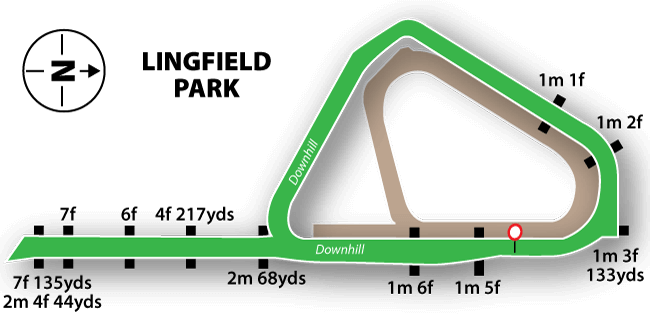
Course Facts
- Round course 1m4f, left-handed, triangular — stiff climb up the back, sharp downhill turn into a ~3.5f home straight
- Straight course 7f 140y — bend-free pure speed test; the round course joins it about half a mile from home
- Draw bias Straight course: high draws at 6f on any going, and at 7f only on soft; 5f contested on a thin sample. Round course: no significant draw bias at any distance band measured
- Run style Straight course: pace plus rail position. Round course: handling and position before the downhill bend
- Ground sensitivity No single going rule: soft brings stamina into play on the round course, but it sharpens the 6f draw edge rather than blunting it and is the only going at which 7f leans high
The Straight Course
- Distances 5f, 6f, 7f, 7f 140y
- Key bias The high third at 6f, on any going — the one settled draw call on the course
- 6f High draw plus early pace is the dominant combination: 1.23 against 0.76 across 100 handicaps of eight or more
- 7f–7f140y Level on good or faster; the high third only comes through on soft, and in fields of eleven or more
- 5f Contested — our figures lean low on 46 races, published stall studies say high. No call either way
- Run style Early pace with the rail at 6f; at the other two trips pace stands on its own, without a draw condition
The Round Course
- Distances 1m1f, 1m2f, 1m3f 133y, 1m6f, 2m+
- Draw No significant stall bias at any distance band measured — handling and position matter more
- Key moment The downhill bend — those arriving here travelling win; those under pressure lose
- 1m3f 133y The Derby/Oaks Trial trip — balance and tractability trump stall numbers
- Run style Get handy before the descent; do not be shuffled back into the straight
Ground & History
- Quick ground Balance off the hill at a premium; the 6f draw edge holds, but quick does not lift every trip
- Soft ground Stamina replaces speed on the round course — yet the 6f draw edge sharpens, and 7f only leans high here
- Course changes Scheduled turf fixtures here do get transferred to the Polytrack, in blocks. The turf was drained over three seasons: remedial work in 2021, then every Flat turf fixture from 4 June to 10 September 2022 switched for extensive works, then three more dates in 2023 — 30 August, 16 September and the turf races on the 6 September mixed card. Weather moves them too: four August 2026 fixtures — the 8th, 11th, 22nd and 25th — went to the Polytrack in prolonged dry conditions, the BHA citing the course’s ability to water the track. Check the declared surface before applying anything on this page: a Lingfield Flat form line from those windows is all-weather form on a turf-looking date
- Opened 1890 as NH-only, by the Prince of Wales (Edward VII); Flat added 1894
- Group race Chartwell Fillies’ Stakes — Group 3 over the straight 7f in May, the course’s only turf Pattern race
- Derby Trial Listed, 1m3f 133y in May; Group 3 until 2012, Listed from the 2013 running. Won by Slip Anchor, Kahyasi, Teenoso and High-Rise
- Oaks Trial Listed, same trip and same card. User Friendly, Lady Carla and Ramruma all won here before Epsom
Do front-runners win at Lingfield?
Lingfield’s turf course is the one that gets overlooked, because most material written about “Lingfield” is about the all-weather circuit sitting inside it. They are different tracks and they do not ride the same way.
The turf is left-handed and undulating with a pronounced downhill run into the straight — the reason it is spoken of alongside Epsom and used as a Derby trial. That descent rewards horses already travelling and balanced, and the read leans towards front-running and prominent racing, though what it is worth varies with the trip, the draw and the ground rather than being a constant. One honest caveat: at this course the pace advantage is hard to separate cleanly from the draw, because the same early positioning drives both, so treat the two as one combined question rather than stacking them as independent edges.
Run Style Bias — Qualitative Only
Balanced and travelling off the hill
Favoured, by a margin that varies
No dedicated read
The descent has already sorted it
Treat these bars as directional — a reading of how the track rides rather than a statistical measurement. This is the TURF course — the all-weather circuit inside it is a separate track with its own guide. The pace and draw effects here are confounded; do not count them twice.
Does the draw matter at Lingfield?
Strong bias — material handicapping factor
Moderate lean — worth noting
Broadly fair — not a primary factor
Draw figures are our own, from a first-party stalls pull dated 13 August 2026: Lingfield TURF handicaps of eight or more runners since 1 January 2010, with the draw cut into thirds inside each field size and split by going. There is no single going rule on the straight course — the 6f edge holds on quick and sharpens on soft, the 7f edge appears only on soft, and the 5f is unresolved. Ground, field size and how a race is actually run move the realised bias on the day, so let the card’s earlier races update this rather than treating it as fixed.
Which trainers and jockeys win most at Lingfield?
Data: Since 2010. A/E above 1.00 means the group won more often than its starting price implied — the market-adjusted read a strike rate on its own hides.
| Trainer | Runs | Wins | Win% | Places | Place% | A/E | P/L |
|---|---|---|---|---|---|---|---|
| 1 Haggas, W J | 128 | 46 | 35.94% | 76 | 59.38% | 1.21 | +43.87 |
| 2 Hannon (Jnr), Richard | 277 | 44 | 15.88% | 106 | 38.27% | 0.85 | -46.33 |
| 3 Moore, Gary and Josh | 261 | 34 | 13.03% | 75 | 28.74% | 0.97 | -54.96 |
| 4 Bridger, J / Cook, R | 330 | 29 | 8.79% | 89 | 26.97% | 0.92 | -33.53 |
| 5 Balding, A M | 143 | 25 | 17.48% | 50 | 34.97% | 0.85 | -30.67 |
| 6 Carroll, A W | 176 | 24 | 13.64% | 56 | 31.82% | 1.12 | -19.93 |
| 7 Boyle, J R | 158 | 24 | 15.19% | 43 | 27.22% | 1.23 | +14.26 |
| 8 Varian, Roger | 99 | 24 | 24.24% | 55 | 55.56% | 0.89 | +1.62 |
| 9 Beckett, R M | 123 | 22 | 17.89% | 55 | 44.72% | 0.76 | -39.46 |
| 10 Evans, P D | 165 | 20 | 12.12% | 53 | 32.12% | 0.86 | -24.72 |
| 11 Charlton, Roger/Harry | 60 | 19 | 31.67% | 30 | 50.00% | 1.14 | +0.94 |
| 12 Simcock, D M | 114 | 17 | 14.91% | 41 | 35.96% | 0.82 | -41.98 |
| 13 Hills, Charles | 94 | 17 | 18.09% | 36 | 38.30% | 1.00 | -45.88 |
| 14 Watson, Archie | 94 | 17 | 18.09% | 37 | 39.36% | 0.97 | +17.17 |
| 15 Jenkins, J R | 138 | 16 | 11.59% | 33 | 23.91% | 1.36 | -38.29 |
| 16 Houghton, Eve Johnson | 132 | 16 | 12.12% | 35 | 26.52% | 0.87 | -14.74 |
| 17 Dunlop, E A L | 104 | 16 | 15.38% | 37 | 35.58% | 0.94 | -33.16 |
| 18 Prescott, Sir Mark | 56 | 16 | 28.57% | 28 | 50.00% | 1.02 | -12.25 |
| 19 Osborne, J A | 123 | 14 | 11.38% | 30 | 24.39% | 0.92 | -46.78 |
Lingfield Flat · Current trainers, since 2010
| Jockey | Runs | Wins | Win% | Places | Place% | A/E | P/L |
|---|---|---|---|---|---|---|---|
| 1 Murphy, Oisin | 200 | 44 | 22.00% | 92 | 46.00% | 0.91 | -43.50 |
| 2 Sousa, Silvestre De | 179 | 38 | 21.23% | 74 | 41.34% | 0.86 | -31.04 |
| 3 Cosgrave, Pat | 220 | 37 | 16.82% | 86 | 39.09% | 0.96 | -60.23 |
| 4 Morris, Luke | 262 | 34 | 12.98% | 91 | 34.73% | 0.84 | -95.07 |
| 5 Probert, David | 230 | 33 | 14.35% | 62 | 26.96% | 1.10 | +16.81 |
| 6 Crouch, Hector | 161 | 26 | 16.15% | 49 | 30.43% | 1.06 | +6.77 |
| 7 Marquand, Tom | 149 | 25 | 16.78% | 58 | 38.93% | 0.86 | -19.89 |
| 8 Bentley, Harry | 124 | 24 | 19.35% | 48 | 38.71% | 1.09 | +20.53 |
| 9 Moore, Ryan | 104 | 23 | 22.12% | 52 | 50.00% | 0.76 | -26.62 |
| 10 O’Neill, K T | 267 | 22 | 8.24% | 73 | 27.34% | 0.75 | -62.38 |
| 11 Buick, William | 117 | 21 | 17.95% | 55 | 47.01% | 0.78 | -15.36 |
| 12 Doyle, James | 96 | 20 | 20.83% | 45 | 46.88% | 0.83 | -21.32 |
| 13 Doyle, Hollie | 115 | 19 | 16.52% | 36 | 31.30% | 1.02 | +13.73 |
| 14 Queally, T P | 181 | 17 | 9.39% | 41 | 22.65% | 0.67 | -78.41 |
| 15 Levey, S M | 127 | 17 | 13.39% | 41 | 32.28% | 0.80 | -34.93 |
| 16 Atzeni, Andrea | 105 | 17 | 16.19% | 41 | 39.05% | 0.92 | -9.35 |
| 17 Bishop, Charles | 121 | 15 | 12.40% | 40 | 33.06% | 0.86 | -22.39 |
| 18 Gordon, Josephine | 96 | 14 | 14.58% | 36 | 37.50% | 1.26 | +17.08 |
| 19 Carson, William | 233 | 13 | 5.58% | 57 | 24.46% | 0.57 | -140.02 |
| 20 Keniry, L P | 187 | 13 | 6.95% | 33 | 17.65% | 0.74 | -37.84 |
Lingfield Flat · Current riders, since 2010
Which sires do best at Lingfield?
A/E above 1.00 means those runners won more often than their starting prices implied. Updated June 2026
| Sire | Runs | Wins | Win% | Places | Place% | A/E | P/L |
|---|---|---|---|---|---|---|---|
| 1 Kodiac | 229 | 36 | 15.72% | 82 | 35.81% | 0.96 | -39.79 |
| 2 Oasis Dream | 162 | 28 | 17.28% | 62 | 38.27% | 1.01 | -34.87 |
| 3 Exceed And Excel (AUS) | 141 | 22 | 15.60% | 49 | 34.75% | 0.96 | -55.48 |
| 4 Sixties Icon | 133 | 21 | 15.79% | 49 | 36.84% | 1.05 | -23.51 |
| 5 Dark Angel (IRE) | 177 | 20 | 11.30% | 63 | 35.59% | 0.70 | -82.27 |
| 6 Pastoral Pursuits | 112 | 19 | 16.96% | 46 | 41.07% | 1.23 | -24.36 |
| 7 Acclamation | 154 | 18 | 11.69% | 48 | 31.17% | 0.67 | -96.64 |
| 8 Dubawi (IRE) | 77 | 17 | 22.08% | 31 | 40.26% | 1.05 | +3.11 |
| 9 Invincible Spirit (IRE) | 129 | 15 | 11.63% | 46 | 35.66% | 0.69 | -53.71 |
| 10 Dutch Art | 85 | 15 | 17.65% | 23 | 27.06% | 1.08 | +5.00 |
| 11 Iffraaj | 98 | 14 | 14.29% | 29 | 29.59% | 0.96 | -40.34 |
| 12 Sea The Stars (IRE) | 61 | 14 | 22.95% | 23 | 37.70% | 1.07 | +8.80 |
| 13 Dandy Man (IRE) | 101 | 13 | 12.87% | 25 | 24.75% | 0.91 | -25.99 |
| 14 Kyllachy | 112 | 12 | 10.71% | 28 | 25.00% | 0.74 | -41.42 |
| 15 Nathaniel (IRE) | 73 | 12 | 16.44% | 30 | 41.10% | 1.33 | -8.65 |
| 16 Havana Grey | 49 | 12 | 24.49% | 25 | 51.02% | 1.05 | +8.79 |
| 17 Kheleyf (USA) | 106 | 11 | 10.38% | 30 | 28.30% | 0.90 | -9.12 |
| 18 Footstepsinthesand | 75 | 11 | 14.67% | 26 | 34.67% | 1.04 | -13.29 |
| 19 Zebedee | 74 | 11 | 14.86% | 24 | 32.43% | 1.11 | +17.33 |
| 20 Bated Breath | 65 | 11 | 16.92% | 27 | 41.54% | 1.01 | -7.49 |
Lingfield Flat · Since 2010
Betting Tips for Lingfield Flat Turf
The stands’ rail is a six-furlong rule, not a Lingfield rule
On the straight course the rail advantage is real but narrower than its reputation. At 6f, the high third of the draw — nearest the stands side — runs at an impact value of 1.23 against 0.76 for the low across 100 turf handicaps of eight or more runners, and unusually it holds on soft ground as well as quick. At 7f the same lean appears only when the ground eases — on good or faster the trip measures level across 147 races. And at 5f our own figures run the other way — the low third at 1.25 against 0.97 on quick — against published stall studies that say high, which is why we make no 5f call at all. In the six-furlong sample the low third has been at a marked positional disadvantage; that is a measured win-frequency gap and not a measured return, so treat it as a handicap to overcome rather than a proven losing system.
Soft ground reprices everything
Lingfield turf on soft is a different betting puzzle from Lingfield turf on quick. On the round course stamina replaces speed as the decisive factor and the form of recent quick-ground winners is only partially relevant. On the straight course the opposite of the usual warning applies: the six-furlong high-draw edge sharpens on soft, 1.34 against 0.67 across 26 handicaps, and seven furlongs leans high only once the ground has eased. Horses bred or proven to stay further than their usual trip become live contenders; horses that have been thriving on pace and position may find the ground neutralising their advantages. The two going conditions demand separate form assessments.
The downhill turn is the race within the race
On every round-course trip, the left-handed descent into the home straight sorts horses. Those arriving at the bend already travelling and balanced carry momentum that is very difficult for hold-up horses to overcome. Horses that quicken in a straight line but are awkward through bends — or that hang under pressure — will often give away ground here that they cannot recover. Make a habit of watching how horses negotiate this bend and note it in their form record.
The Derby and Oaks Trials tell you something real
The 1m3f133y Derby and Oaks Trials in May are the races Lingfield turf is known for, though the highest-graded contest on the card is the Group 3 Chartwell Fillies’ Stakes over the straight seven furlongs; both trials are Listed. The course is genuinely Epsom-like in its demands — left-handed, downhill, requiring balance and tractability — which makes the trials a useful Epsom rehearsal. Do not stretch that into a superior form line: the last Derby Trial winner to follow up at Epsom was Anthony Van Dyck in 2019. A horse that handles Lingfield’s descent confidently is giving you a read on how it will cope with Tattenham Corner. When major yards send well-bred three-year-olds here in May, read the run at least partly as an Epsom examination rather than as a Lingfield result.
Mark up horses that win from adverse draws
When a horse wins a six-furlong straight-course handicap from the low third of the draw, or wins on the round course after being shuffled back before the descent, it has done something worth noting. These are wins achieved despite the course geometry, not because of it. Horses that can overcome structural disadvantages and still win are often operating at a level above what their bare form figure captures. They are worth marking up in subsequent form analysis.
Course form is transferable — with caveats
The balance, tractability and ability to handle changing gradients that Lingfield asks for are the qualities other left-handed, sharp or undulating turf tracks ask for too — Epsom especially, and Chepstow, Chester and Brighton in their different ways. Read that as a guide to the type of horse rather than a form line that carries over intact. Galloping tracks reward a different sort of horse altogether. And as Jason Weaver explicitly notes, Lingfield turf form sometimes needs a pinch of salt in the way Chester form does — a horse may have been flattered by the rail or the track topology in a way that will not replicate elsewhere. Know why the form happened before projecting it forward.
Pace from the right place, not pace from anywhere
At six furlongs the optimal shape is pace combined with a high draw. A leader from the low third is not in the optimal position even when it is in front — it may be conceding the rail advantage to rivals who settle just behind it on the better strip. That is a six-furlong shape rather than a straight-course one: at seven furlongs on good or faster the draw is level and early pace stands on its own merits, and at five furlongs we have no draw call to combine it with.
Specificity of course experience matters
A horse with winning form at Lingfield turf is not automatically a course specialist — check whether that win came on the straight or round course, and on what ground. A horse that won a 6f straight-course race on good has done something completely different from one that won over 1m3f on the round course in testing conditions. Lingfield turf course form is only reliable context when the conditions that produced it match the conditions of the day’s race.
Respect the big-yard Classic trial entries
When Aidan O’Brien, John and Thady Gosden or Charlie Appleby sends a lightly raced three-year-old to Lingfield’s Derby or Oaks Trial, the entry is often as much about the examination as the result: this horse gets a proper left-handed, undulating test before Epsom. The trial result is informative about the examination more than about the horse’s class — a fluent winner has shown it handles a left-handed descent, which is not the same as showing it is good enough for Epsom. One that gets beaten but runs with credit may still be Epsom-bound. In either case, treating these as normal handicap-style form analysis misses the point of the race.
Common Mistakes to Avoid
- Confusing Lingfield Flat with the AW circuit. The turf course is undulating and turns downhill into a home straight of about three and a half furlongs; the all-weather is a tight oval. Form between the two surfaces rarely transfers cleanly.
- Assuming quick-ground pace patterns carry over to soft turf. They do not carry over unchanged, and they do not simply invert either — reassess the pace by trip and race shape as the ground eases rather than automatically upgrading either the leaders or the closers.
- Applying the stands-rail read to every sprint trip and every going. It is real and strong at 6f, where the high third of the draw runs at an impact value of 1.23 against 0.76 on 100 turf handicaps of eight or more runners — and it holds on soft as well as quick. It does not apply at 5f, where our own figures lean low (1.25 against 0.97 on good or faster) while published stall studies say high, so we make no call there; and at 7f it is a soft-ground effect rather than a quick-ground one. Pricing a low draw as a negative across the whole straight course is the mistake; do it at 6f only.
- Reading the approach to the home straight as a level run-in. The descent is the turn INTO the straight, not the straight itself: horses that lose balance or position on the way down concede ground over the last three and a half furlongs that closers needing a long, level finish rarely get back. Balance and position off the bend matter more than raw finishing speed.
Lingfield (Turf) Racecourse FAQs
Is there a draw bias on Lingfield’s turf straight course?
Which way does Lingfield’s turf course run, and what kind of track is it?
How does soft ground change Lingfield’s turf course?
Why are the Lingfield Derby and Oaks Trials worth taking seriously?
What is the most reliable angle, and the biggest mistake, at Lingfield turf?
Nearby Tracks
Epsom Downs
Camber, gradients and Tattenham Corner — a unique test.
Brighton
Switchback left-hand horseshoe — draw-fair sprints, high draws over a mile.
Windsor
Unique figure-of-eight — flat and fair, riverside.
Ascot
Stiff, galloping right-hander — round and straight.
Goodwood
Undulating downland loops — balance and tactics.
Salisbury
Stiff, galloping uphill straight — stayers and class.
Want the thinking behind Lingfield turf bets?
FormDial posts every selection before the off with its full reasoning: the angle, the price, the logic. See how course knowledge feeds into real tips.
The Trackside Companion is your day at the races, written to order — every race on your meeting’s card broken down, plus this track’s draw, angles and people distilled from the guide you’ve just read. Order at least a week before your raceday.
Plan your raceday →