Windsor
Flat Turf
Windsor, Berkshire · Britain’s only figure-of-eight flat course
Turf
Figure-of-Eight
Right-handed (mostly)
Windsor also stages National Hunt racing. Read the National Hunt racecourse guide →
What is Windsor racecourse like?
Windsor is one of two figure-of-eight tracks in Britain — alongside Fontwell Park — and it sits on a 165-acre island bounded by the Thames and the Clewer Mill Stream. The full circuit measures 12.5 furlongs, with a five-furlong galloping home straight that rewards horses who can use their stride. Races at one mile and ten furlongs turn only right-handed despite the figure-of-eight shape; it is the longest Flat trip, 1m 3f 99y, that crosses the course and uses both loops. Nothing on the Flat here goes further than that — the longer Windsor races are run over jumps on the separate National Hunt course.
The defining feature for handicappers is not the layout but the pace bias. Across all distances at Windsor, around four times as many winners come from on-pace positions as from genuine hold-up rides. The normalised figures point the same way: over the mile, horses that led beat 0.60 of their rivals on average against 0.44 for those held up. The reasons differ by trip — the sprints run on the straight chute and are simply pace-sensitive, while the round-course trips add the positional demands of the bottom turn — but the instruction is the same at all of them, and any selection process that does not start with predicted run style is throwing away the most consistent edge this course offers.
The 5f and 6f races run on the straight chute, which joins the round course at the top of the home straight. Recent rail movements have made the draw close to neutral on good or firmer ground over those trips. When the rain comes, the picture changes sharply: low draws drift wide and end up against the far rail, where the ground rides faster, producing a distinct bias on good-to-soft or worse. At a mile and ten furlongs a low stall can help a horse take up position around the right-handed bends, but the measured effect is weak — over the mile the beaten-rivals figures are flat across the draw — and pace is the more important factor at every distance here.
Windsor is best known for its Monday Night Racing meetings, instituted in the 1960s and still dominating the summer fixture list, drawing crowds that mix serious punters with social attendees. The track stages 26 fixtures in 2026 — 22 Flat and four jumps — with the Flat season running from early May to mid-September. Jump racing returned in December 2024, restoring Windsor’s own jumps programme for the first time since 1998; the course had temporarily staged some of Ascot’s jumps fixtures during that track’s redevelopment in 2004 and 2005. The flagship Flat event is the Group 3 Winter Hill Stakes over 1m 2f in early September, a race restricted to three-year-olds from 2026.
— Jason Weaver, View from the Saddle (At The Races)
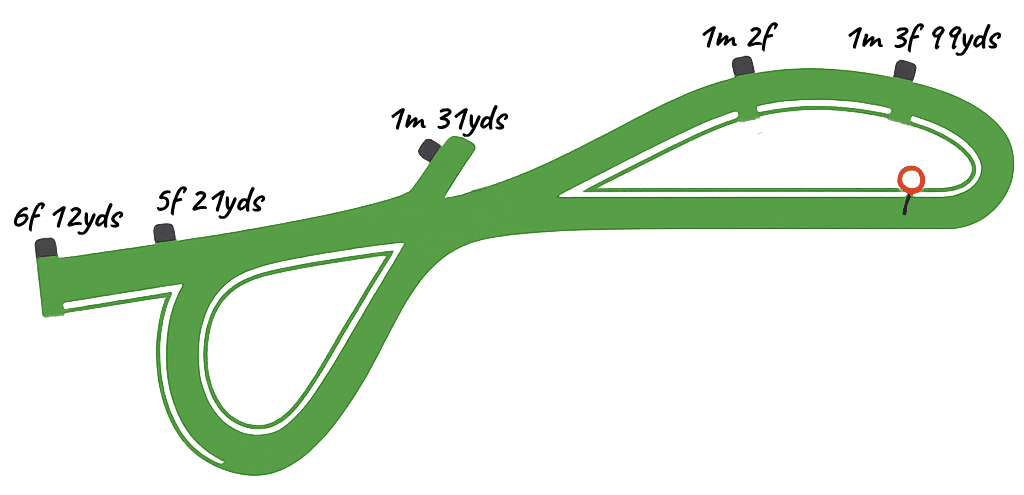
The Round Course
- Layout 12.5 furlongs total in a figure-of-eight configuration
- Flat distances Five in all — 5f, 6f, 1m and 1m 2f use the right-handed loop only; 1m 3f 99y, the longest Flat trip, crosses the course and uses both. The separate jumps course races much further
- Home straight Five furlongs with a slight kink three out
- Bottom turn Sharp — inexperienced jockeys lose ground here
- Run style Get handy before the descent; do not be shuffled back into the straight
The Straight Course
- Distances 5f and 6f races run on a near-straight chute joining the round course at the top of the home straight
- Elbow Slight kink at three furlongs from home
- Quick ground Level throughout — pure speed test, draw bias minimal
- Soft ground Far-side rail bias emerges; high draws favoured
- Run style Front-runners dominate; leaders from favoured draws are the structural play
Track & History
- Heritage Racing at Windsor since the reign of Henry VIII; modern course at Rays Meadow opened 1866
- Ownership Arena Racing Company (ARC)
- Wartime One of the few British courses allowed to stage racing through both World Wars
- Record card Richard Hughes rode seven winners on 15 October 2012 — only the second jockey to achieve that on a single British card
- Evenings Primary evening-racing venue for the South East; regular Monday fixtures through the summer
Key Betting Angles
- Pace bias Around four times as many winners come from on-pace positions as from genuine hold-up rides, at every trip
- Soft ground draw High draws on the straight track when ground turns soft
- Round course draw Broadly fair on its own; the combination that fails is a low draw ridden for a late run
- 2YO angle Favourites with a previous run were strongly profitable in research published in 2019 — recheck before relying on it
- Race type 2019 research had three-year-old favourites at A/E 1.02 in non-handicaps against 1.09 in handicaps — recheck before relying on it
Major Flat Races
- Winter Hill Stakes Group 3, 1m 2f — Windsor’s only Pattern race, and restricted to three-year-olds from 2026 (7 September in 2026, £95,000)
- August Stakes Listed, 1m 3f 99y — the late-summer staying feature, for four-year-olds and upwards from 2026 (29 August in 2026, £60,000)
- Sprint Series Ten 5f and 6f qualifiers through the season, building to a £75,000 final
- Wider programme Predominantly handicaps, alongside novice, maiden and Listed races, across 22 Flat fixtures, most of them Monday evenings
Does the draw matter at Windsor?
Draw × Run Style — The Combinations That Fail
4 from 115 · A/E 0.34
0 from 26
1 from 56 · A/E 0.17
Turf Flat handicaps at Windsor, 2021–25. The draw on its own is a weak signal at Windsor; the draw crossed with run style is not. A low-drawn horse that gets held up over the mile beat 0.38 of its rivals on average and lost 67p in the pound, and the equivalent 5f combination won once in five years for a beaten-rivals figure of 0.37. Read these as a filter for what to oppose rather than a rule for what to back.
Do front-runners win at Windsor?
If you take one thing away from this guide, it is this: pace is the single most consistent edge at Windsor. Across the full distance range, from the straight 5f sprints to the 1m3f99y handicaps that use both loops, roughly four times as many winners come from on-pace positions as from genuine hold-up rides. It matters most in the handicaps, and particularly on the popular Monday evenings where fields can stretch to 14 or more — the more runners there are, the harder position is to win and the more it is worth.
The mechanics are worth getting right, because the obvious explanation is the wrong one. It is not that there is no room to close — the home straight is a full five furlongs, unusually long for a track this sharp, which is exactly why Windsor does not punish galloping types. The cost is paid earlier. A horse out of position into the bottom bend loses momentum, waits for racing room, or has to come wide, and concedes first run before the straight even begins. By the time the field turns in, an on-pace horse can already hold a positional advantage that is hard to overturn. The jockey who can identify the speed in a race and grab the lead early at Windsor has a structural advantage, and one that can persist even when the ground turns testing.
The practical handicapping rule is straightforward. Build your shortlist from the pace map first, the form book second. A modest advantage on ratings can be outweighed by a serious tactical disadvantage here, so do not side with the best-rated horse automatically if the pace map leaves it badly placed. A race-day pace map is the cheapest single edge available to a Windsor punter.
Run Style Bias — The Defining Edge
PRB 0.60
PRB 0.53
PRB 0.50
PRB 0.44
Beaten-rivals figures from a 2017–25 sample of Windsor mile handicaps of eight or more runners; the whole-course headline — around four times as many winners from on-pace positions as from genuine hold-up rides — is a comparison of winner counts, not of strike rates. The pace advantage is most useful in handicaps, especially the big Monday-evening fields, where securing an early position is hardest and matters most.
Which trainers and jockeys win most at Windsor?
| Trainer | Runs | Wins | Win% | Places | Place% | A/E | P/L |
|---|---|---|---|---|---|---|---|
| 1 Hannon (Jnr), Richard | 794 | 116 | 14.61% | 295 | 37.15% | 0.84 | -165.71 |
| 2 Balding, A M | 492 | 86 | 17.48% | 209 | 42.48% | 0.92 | -65.24 |
| 3 Cox, C G | 487 | 78 | 16.02% | 188 | 38.60% | 0.95 | -58.87 |
| 4 Beckett, R M | 421 | 76 | 18.05% | 170 | 40.38% | 0.91 | -41.37 |
| 5 Haggas, W J | 295 | 74 | 25.08% | 159 | 53.90% | 0.91 | -61.59 |
| 6 Varian, Roger | 246 | 64 | 26.02% | 120 | 48.78% | 1.11 | +16.39 |
| 7 Gosden, J H M | 250 | 62 | 24.80% | 129 | 51.60% | 0.94 | -36.67 |
| 8 Evans, P D | 583 | 52 | 8.92% | 151 | 25.90% | 0.83 | -227.15 |
| 9 Hills, Charles | 352 | 49 | 13.92% | 122 | 34.66% | 1.05 | +50.77 |
| 10 Houghton, Eve Johnson | 391 | 46 | 11.76% | 117 | 29.92% | 0.92 | -42.23 |
| 11 Carroll, A W | 539 | 43 | 7.98% | 129 | 23.93% | 0.85 | -129.17 |
| 12 Charlton, Roger/Harry | 253 | 43 | 17.00% | 95 | 37.55% | 0.86 | +6.52 |
| 13 Millman, B R | 429 | 40 | 9.32% | 123 | 28.67% | 0.77 | -217.82 |
| 14 Walker, Ed | 232 | 39 | 16.81% | 89 | 38.36% | 1.05 | -36.12 |
| 15 Candy, H | 273 | 36 | 13.19% | 87 | 31.87% | 0.96 | -76.33 |
| 16 Suroor, Saeed Bin | 121 | 34 | 28.10% | 61 | 50.41% | 1.15 | +14.69 |
| 17 Bridger, J / Cook, R | 437 | 33 | 7.55% | 115 | 26.32% | 0.86 | -77.05 |
| 18 Williams, S C | 310 | 33 | 10.65% | 68 | 21.94% | 1.15 | +90.49 |
| 19 Morrison, H | 284 | 33 | 11.62% | 81 | 28.52% | 0.84 | -62.59 |
| 20 Moore, Gary and Josh | 348 | 32 | 9.20% | 87 | 25.00% | 0.81 | -110.38 |
Windsor Flat · Current trainers, since 2010
| Jockey | Runs | Wins | Win% | Places | Place% | A/E | P/L |
|---|---|---|---|---|---|---|---|
| 1 Murphy, Oisin | 685 | 134 | 19.56% | 318 | 46.42% | 0.90 | -99.74 |
| 2 Marquand, Tom | 703 | 106 | 15.08% | 247 | 35.14% | 0.88 | -63.97 |
| 3 Moore, Ryan | 353 | 83 | 23.51% | 177 | 50.14% | 0.90 | -60.66 |
| 4 Doyle, James | 399 | 79 | 19.80% | 179 | 44.86% | 0.95 | +11.48 |
| 5 Buick, William | 311 | 68 | 21.87% | 141 | 45.34% | 0.93 | -1.18 |
| 6 Atzeni, Andrea | 277 | 63 | 22.74% | 120 | 43.32% | 1.23 | +23.07 |
| 7 Ryan, Rossa | 352 | 58 | 16.48% | 131 | 37.22% | 0.96 | -31.22 |
| 8 Sousa, Silvestre De | 315 | 57 | 18.10% | 120 | 38.10% | 0.96 | -9.50 |
| 9 Levey, S M | 449 | 56 | 12.47% | 153 | 34.08% | 0.93 | -31.37 |
| 10 Probert, David | 605 | 54 | 8.93% | 163 | 26.94% | 0.77 | -185.78 |
| 11 Dobbs, Pat | 356 | 49 | 13.76% | 131 | 36.80% | 0.90 | -93.51 |
| 12 Spencer, Jamie | 286 | 44 | 15.38% | 114 | 39.86% | 0.84 | -49.69 |
| 13 Cosgrave, Pat | 405 | 41 | 10.12% | 111 | 27.41% | 0.88 | -83.54 |
| 14 Kingscote, Richard | 364 | 40 | 10.99% | 107 | 29.40% | 0.76 | -100.53 |
| 15 Hornby, Rob | 438 | 39 | 8.90% | 122 | 27.85% | 0.80 | -101.05 |
| 16 Shoemark, Kieran | 293 | 37 | 12.63% | 89 | 30.38% | 0.99 | -68.03 |
| 17 Crouch, Hector | 262 | 37 | 14.12% | 74 | 28.24% | 1.09 | -20.98 |
| 18 Morris, Luke | 384 | 36 | 9.38% | 86 | 22.40% | 0.94 | -61.46 |
| 19 Mitchell, Jack | 280 | 36 | 12.86% | 96 | 34.29% | 0.93 | -30.92 |
| 20 Havlin, Robert | 286 | 34 | 11.89% | 85 | 29.72% | 0.82 | -67.96 |
Windsor Flat · Current riders, since 2010
Which sires do best at Windsor?
| Sire | Runs | Wins | Win% | Places | Place% | A/E | P/L |
|---|---|---|---|---|---|---|---|
| 1 Kodiac | 542 | 68 | 12.55% | 183 | 33.76% | 0.86 | -120.72 |
| 2 Dubawi (IRE) | 195 | 52 | 26.67% | 90 | 46.15% | 1.29 | +69.85 |
| 3 Dark Angel (IRE) | 416 | 48 | 11.54% | 121 | 29.09% | 0.84 | -19.68 |
| 4 Oasis Dream | 345 | 48 | 13.91% | 114 | 33.04% | 0.94 | -94.79 |
| 5 Exceed And Excel (AUS) | 325 | 43 | 13.23% | 97 | 29.85% | 0.91 | -110.85 |
| 6 Acclamation | 407 | 42 | 10.32% | 135 | 33.17% | 0.66 | -149.95 |
| 7 Kyllachy | 314 | 38 | 12.10% | 98 | 31.21% | 0.87 | -67.37 |
| 8 Invincible Spirit (IRE) | 373 | 37 | 9.92% | 130 | 34.85% | 0.66 | -192.40 |
| 9 Pivotal | 212 | 37 | 17.45% | 96 | 45.28% | 1.07 | -8.89 |
| 10 Showcasing | 302 | 33 | 10.93% | 75 | 24.83% | 0.88 | -81.50 |
| 11 Mastercraftsman (IRE) | 186 | 32 | 17.20% | 65 | 34.95% | 1.16 | -29.44 |
| 12 Pastoral Pursuits | 215 | 30 | 13.95% | 66 | 30.70% | 1.19 | +87.37 |
| 13 Footstepsinthesand | 217 | 29 | 13.36% | 64 | 29.49% | 1.14 | +31.88 |
| 14 Iffraaj | 205 | 29 | 14.15% | 71 | 34.63% | 0.91 | -54.72 |
| 15 Bated Breath | 199 | 28 | 14.07% | 68 | 34.17% | 1.01 | -6.07 |
| 16 Shamardal (USA) | 155 | 26 | 16.77% | 60 | 38.71% | 1.04 | +24.88 |
| 17 Royal Applause | 268 | 25 | 9.33% | 70 | 26.12% | 0.83 | +6.01 |
| 18 Equiano (FR) | 210 | 25 | 11.90% | 64 | 30.48% | 1.00 | -57.57 |
| 19 Lope De Vega (IRE) | 208 | 25 | 12.02% | 68 | 32.69% | 0.78 | -92.07 |
| 20 Dutch Art | 178 | 25 | 14.04% | 56 | 31.46% | 1.17 | -23.85 |
Windsor Flat · Since 2010
Betting Tips for Windsor Flat Turf
Pace map first, form book second
Around four times as many winners come from on-pace positions as from genuine hold-up rides, at every trip here. Identify the speed in the race before you look at the ratings: at Windsor a modest advantage in the weights can be outweighed by a serious disadvantage in position.
Watch the bottom turn
The right-hand bend at the bottom of the figure-of-eight catches inexperienced jockeys repeatedly. A pro making early ground there can steal the race; two lengths lost round that turn is disproportionately expensive, because the leaders are already winding up. Give jockey strength extra weight at Windsor, because the bottom turn punishes poor positioning.
Soft ground flips the straight-track draw
On good or firmer over 5f-6f, draw is close to neutral. When the rain comes and the going turns good-to-soft or worse, the far rail rides faster — high draws have a clear edge. Re-read the draw the moment the going description changes; it is the same race numbers and a completely different stall preference.
Monday nights are the biggest fields
Monday evening racing was instituted at Windsor in the 1960s and carries the bulk of the summer programme. It matters to a punter for a structural reason rather than a market one: these are the cards where handicap fields stretch to 14 or more, which is exactly where the pace bias is worth most and where the small-field non-handicaps stop getting in the way.
Two-year-old experienced favourites
In research published in 2019, covering 2012 onwards, Windsor 2YO favourites with at least one previous run returned 24.4% on level stakes — 120 winners from 223 at an A/E of 1.22 — while debutant favourites were markedly worse. The author of that work was explicit that he had no confirmed explanation for it. Treat it as a pattern to recheck against current data, not a standing system.
Handicaps have been the better hunting ground
In the same research published in 2019, Windsor three-year-old favourites split sharply by race type: in non-handicaps they won around 44% of the time but returned an A/E of just 1.02 and a single point of profit from 206 runners, while in handicaps they returned an A/E of 1.09 and 14%. The market has historically had the short ones about right and left more room in the handicaps. As with every figure from that study, recheck it before treating it as live.
Long-striding gallopers over the round
The five-furlong home straight rewards horses who can find their stride and hold form. Bullringy sprint types who need every yard of a turn struggle to stretch out here. Form earned on galloping tracks is useful context for the long straight, though balance and tactical speed around the bends still decide whether a horse gets to use it.
Winter Hill Stakes is the only Group race
The Group 3 Winter Hill Stakes (1m 2f) is Windsor’s only Pattern race, and it is a different race from 2026. The BHA’s Flat Pattern Committee moved it back a week and restricted it to three-year-olds, with the Listed August Stakes switching to four-year-olds and upwards, to stop the two duplicating each other and to give slower-maturing middle-distance three-year-olds a Pattern target. So the old read — a small field of exposed older horses — no longer applies: treat it as a three-year-old Group 3, worth £95,000 and run on 7 September in 2026.
The market price often holds the answer
In research published in 2019, backing the Windsor favourite blind across the previous seven seasons would have returned a 4% profit at a 37% strike rate. More recent work on the mile, covering 2017–25, found favourites and second favourites profitable together across every age band. The front of the market has historically been the place to look here; as with any blind-backing figure, recheck it against current seasons before treating it as live.
Common Mistakes to Avoid
- Treating it as a regular right-handed track. The figure-of-eight changes how races run even when only the right-hand turns are used. Position from the gate matters more, jockey skill matters more, and the on-pace advantage remains relevant even when the ground turns testing.
- Backing hold-up horses on rating alone. A higher-rated horse held up at the back is still tactically vulnerable here. The pace advantage is the single most consistent feature of this course, and ignoring it means ignoring the strongest recurring bias Windsor has.
- Ignoring ground when reading the straight-course draw. On good-to-firm 5f and 6f races draw is close to neutral; on good-to-soft it tilts hard to the high numbers. Same race numbers, completely different stall preference. Check the going stick before fixing your selections.
- Backing a low-drawn horse over the mile on the draw alone. The stall number is close to irrelevant at that trip once you normalise for opportunity — what is not irrelevant is a low draw on a horse that will be ridden for a late run, which is one of the worst draw-and-run-style combinations in British Flat racing.
- Lumping all Windsor distances into one form profile. The straight 5f is a different course from the 1m3f99y handicap. A horse that excels in one is not an automatic fit for the other — segment your form lines by round vs straight before comparing.
Windsor Racecourse FAQs
Is there a draw bias at Windsor?
Which way does Windsor race, and what kind of track is it?
Does soft ground change how Windsor plays?
Which trainers and jockeys do best at Windsor?
What is the biggest mistake punters make at Windsor?
Nearby Tracks
Ascot
Stiff, galloping right-hander — round and straight.
Epsom Downs
Camber, gradients and Tattenham Corner — a unique test.
Lingfield (Turf)
Sharp, downhill turf — low draw, a Derby trial.
Goodwood
Undulating downland loops — balance and tactics.
Brighton
Switchback left-hand horseshoe — low draw in sprints.
Salisbury
Stiff, galloping uphill straight — stayers and class.
Want the thinking behind Windsor turf bets?
FormDial posts every selection before the off with the full reasoning — the angle, the price, the logic. See how course knowledge feeds into real tips.
The Trackside Companion is your day at the races, written to order — every race on your meeting’s card broken down, plus this track’s draw, angles and people distilled from the guide you’ve just read. Order at least a week before your raceday.
Plan your raceday →