Ayr
Flat Turf
Whitletts Road, Ayr · Scotland’s premier Flat venue
Turf
Left-handed
Galloping
Ayr also stages National Hunt racing. Read the National Hunt racecourse guide →
What is Ayr racecourse like?
Track Character
Ayr is the most westerly racecourse in Britain and Scotland’s premier Flat venue. The round course is a left-handed oval of about twelve furlongs in circumference, with a home straight of roughly four furlongs that rises gently into the line. The bends are sweeping and well-graduated rather than tight; the turn into the straight is slightly downhill, allowing prominent racers to flow into the lane with momentum intact. The straight is exceptionally wide, accommodating sprint fields of up to 25 runners — a configuration that defines how the course’s signature race, the Ayr Gold Cup, plays out.
What Ayr rewards above all is sustained galloping. The terrain is exposed and unforgiving for horses that hit a peak early and shorten before the line — galloping and well-graduated rather than genuinely level: the 5f is predominantly uphill, while the full 6f has a more varied profile before rising through the later stages. Honest stayers who can maintain their cruising speed around the bend and sustain it up the run-in are the profile the track keeps rewarding.
The straight 5f and 6f course runs alongside the round track and is the centrepiece of the Western Meeting in September. The Ayr Gold Cup, contested over six furlongs with a maximum field of 25, is one of the most studied draw races in the British calendar — a race where ground bias along each rail can split the field into two effectively separate contests. Two thirds of the Gold, Silver and Bronze Cups in one thirty-race sample showed a material draw bias; what the same study could not do was predict which side would be favoured from one year to the next. Work it out on the day, from the racing, rather than assuming the low-draw rule that applies to Ayr’s ordinary sprints.
— Jason Weaver, At The Races View From The Saddle
- Location
- Whitletts Road, Ayr, South Ayrshire
- Postcode
- KA8 0JE
- Established
- 1907 (current site)
- Capacity
- ~15,000
- Signature Race
- Ayr Gold Cup (Heritage Handicap, 6f)
- Nearest Station
- Ayr · ~1 mile
- Parking
- Free on-site
- Flat season
- May–October (16 Flat days in 2026)
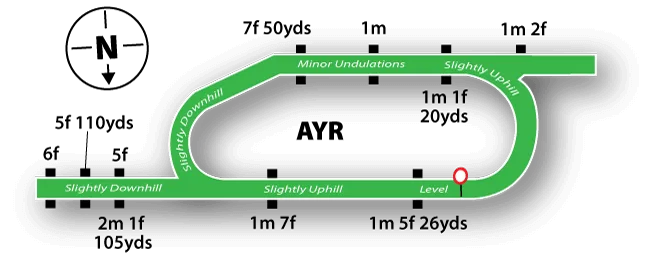
The Round Course
- Configuration Left-handed galloping oval of approximately twelve furlongs with a run-in of around half a mile
- Bends Sweeping and well-graduated — horses lose less ground around the bend than at sharper tracks like Chester or Musselburgh. The one exception is the 7f start, which reaches its turn soon enough for runners to be fanned wide into the straight, which is why the 7f draw tightens in bigger fields
- Turn into straight Slightly downhill, letting prominent racers carry momentum into the straight
- Trips on the round course 7f, 1m, 1m 1f, 1m 2f, 1m 5f, 1m 7f, 2m 1f — all share the long left-handed bend, the slightly downhill run into the straight and the gentle rise to the line
- First-bend dynamics The mile starts on the back straight itself before the long left-handed turn, as do the longer-distance starts
The Sprint Course
- Distances 5f and 6f run on the wide straight course alongside the round track
- Field capacity Up to 25 runners — the Ayr Gold Cup’s full field is among the biggest sprint fields staged in Britain
- Gradient No significant ridge or camber across the straight, but it is not level either — the 5f is predominantly an uphill test, while over the full 6f runners descend slightly before the course levels and rises again late. The round course carries undulations in the back straight and a dip and rise on the way home
- Rail dynamics Different strips of Ayr’s very wide sprint course can race at different speeds. In the biggest fields the ground, the stall placement and where the early pace concentrates can all decide which group is favoured — two thirds of the Gold, Silver and Bronze Cups in the published sample showed a material draw effect, though which side it favoured moved from year to year
- Pace shape Front-runners hold a real edge in ordinary Ayr sprint handicaps, and the big-field Ayr sprint research finds they hold it in the huge Western Meeting fields too — best of all run styles on both win and place rate
Major Flat Races
- Firth of Clyde Group 3, 6f, two-year-old fillies — Scotland’s only Group race, and the reason Ayr can call itself the country’s premier Flat venue
- Ayr Gold Cup Heritage Handicap, 6f, maximum field 25 — the richest and most famous Flat race run in Scotland, and the centrepiece of the September Western Meeting
- Doonside Cup Listed, 1m2f — one of the better middle-distance Listed races in the north
- Harry Rosebery Listed, 5f, two-year-olds — the sharpest juvenile test on the card
- Fillies’ Listed pair The Arran Scottish Fillies’ Sprint over 5½f on Ladies Day and the Land O’ Burns Fillies’ Stakes over 5f
- Kilkerran Cup Class 2 handicap over 1m2f — the middle-distance counterpart to the Gold Cup at the Western Meeting
- Gold and Silver Cup trials Ayr stages a Gold Cup Trial and, from 2026, a Silver Cup Trial (Class 4, rated 61–85) over the full Gold, Silver and Bronze Cup course and distance — course-and-distance evidence ahead of September
Surface & History
- Surface Turf only — no all-weather, no jumps surface mixed in
- Drainage Excellent by Scottish standards; the course handles rain well but can ride truly heavy after sustained wet weather
- Watering Full watering system installed
- Founded Current Ayr Racecourse opened in 1907. Racing at Ayr is recorded as far back as 1576, the first properly organised meeting was held in 1771, and the first Ayr Gold Cup was run in 1804
- Ownership The Western Meeting Club planned the move to the present Craigie course, which opened in 1907; the racecourse was sold in 2003 and is run independently today
Key Betting Angles
- Course form Proven Ayr form is useful evidence — worth a hard second look, particularly in the straight-course sprints and when the ground is testing
- Stamina The exposed, sustained nature of the track offers no recovery from a stamina deficit; form from other spacious galloping tracks such as Doncaster, York or Newbury is a useful guide to whether a horse will cope with Ayr’s sustained test
- Northern yards Scottish and northern stables saddle most of the runners here — Goldie above all — but volume is not value: every high-volume yard in the table below sits at or under an A/E of 1.00, so on this sample the biggest local yards have not beaten market expectation
- Western Meeting The September festival concentrates competitive sprint and middle-distance handicaps; many yards target it deliberately, so campaign intent and a protected handicap mark are worth checking — neither follows from a trainer’s reputation alone
- Ground reading Watch the first sprint race of any Ayr card before the feature — and read the whole finish, not the winning stall. A cluster of low, middle or high runners filling the places is far better evidence of which strip is riding faster than one winner, who may simply have had the run of the race
Do front-runners win at Ayr?
Ayr is a wide, galloping twelve-furlong oval with a run-in of about four furlongs, and on paper that is a fair track. In practice the turn out of the back straight tips slightly downhill into the home straight, and horses already up with the pace use it to hold their position rather than surrender it. The edge to front-running and prominent racing is real without ever being overwhelming.
It is at its clearest from five to seven furlongs, and it fades as the trip stretches towards a mile, where prominent racers rather than outright leaders become the best profile. Testing ground sharpens it rather than softening it over 6f and 7f, where the front-runner A/E rises to 1.33 and 1.82 on soft or heavy. At 5f the same study checked ground conditions and found nothing noteworthy, so do not carry the going angle down to the minimum trip.
Run Style Bias — Handicaps, 8+ Runners
A/E 1.41 · IV 1.80
A/E around 1.46
Front-running edge gone
Behind prominent in the big fields
Worse the further back you are
Figures are from published run-style research on Ayr handicaps with eight or more runners. The edge sharpens on soft or heavy ground rather than easing — the 7f front-runner A/E rises to 1.82 on soft or heavy, and over 6f the further a horse is from the early pace on testing ground the worse it does. One exception to hold in mind: the front-running edge fades at a mile, where prominent racing becomes the better profile. It does not fade in the huge Western Meeting sprint fields — the big-field Ayr sprint research puts front runners best of all there, on both win and place rate.
Draw and Run Style Together — the 6f
The two reads combine into the sharpest single filter on this page. Over Ayr’s 6f, a horse that is both drawn high and ridden for a late run has been close to unbackable: across 2021–25 handicaps of eight or more runners, high-drawn hold-up runners are 7 winners from 115 — a 6.1% strike rate at an A/E of 0.85 and a percentage of rivals beaten of just 0.37. On going of good to soft or softer that falls further, to a PRB of 0.32 and a win rate under 5%.
The practical point is that a wide stall is far less damaging to a horse with the tactical speed to take a position early. Judge the draw and the intended ride together, not one after the other.
Published draw-and-run-style research, 2021–25, handicaps of eight or more runners.
Does the draw matter at Ayr?
The two sprint distances run straight at Ayr and produce a real, persistent low-draw advantage in the data. Most round-course trips run close to fair — the long sweeping bends and four-furlong straight give horses on any draw time and room to recover — with 7f the exception, where bigger fields and testing ground do move the draw. The bar chart below covers the full course dataset; the distance-by-distance figures beneath it use the handicap and field-size samples each one names.
Strong bias — material handicapping factor
Moderate lean — worth noting
Broadly fair — not a primary factor
Which trainers and jockeys win most at Ayr?
| Trainer | Runs | Wins | Win% | Places | Place% | A/E | P/L |
|---|---|---|---|---|---|---|---|
| 1 Goldie, J S | 2035 | 225 | 11.06% | 596 | 29.29% | 0.91 | -210.75 |
| 2 Fahey, R A | 1076 | 113 | 10.50% | 317 | 29.46% | 0.74 | -314.40 |
| 3 Dods, M | 828 | 97 | 11.72% | 282 | 34.06% | 0.84 | -107.18 |
| 4 O’Meara, D | 618 | 89 | 14.40% | 224 | 36.25% | 0.90 | -77.79 |
| 5 Jardine, I | 700 | 79 | 11.29% | 195 | 27.86% | 0.98 | -151.41 |
| 6 Easterby, T D | 630 | 70 | 11.11% | 201 | 31.90% | 0.87 | -51.94 |
| 7 Smith, R Michael | 647 | 61 | 9.43% | 158 | 24.42% | 1.00 | -130.49 |
| 8 Perratt, Miss L A | 957 | 60 | 6.27% | 192 | 20.06% | 0.85 | -328.58 |
| 9 Ryan, K A | 580 | 56 | 9.66% | 158 | 27.24% | 0.76 | -226.65 |
| 10 Burke, K R | 339 | 56 | 16.52% | 117 | 34.51% | 0.99 | -13.62 |
| 11 Quinn, J J | 273 | 45 | 16.48% | 120 | 43.96% | 1.06 | +15.66 |
| 12 Carr, Mrs R A | 381 | 39 | 10.24% | 97 | 25.46% | 0.87 | -114.80 |
| 13 Keatley, Adrian Paul | 155 | 29 | 18.71% | 57 | 36.77% | 1.18 | +36.65 |
| 14 Ellison, B | 160 | 26 | 16.25% | 60 | 37.50% | 1.10 | -20.58 |
| 15 Barron, T D | 262 | 24 | 9.16% | 70 | 26.72% | 0.70 | -80.84 |
| 16 Easterby, M W | 237 | 20 | 8.44% | 55 | 23.21% | 0.83 | -59.67 |
| 17 Scott, Miss Katie | 160 | 18 | 11.25% | 45 | 28.13% | 1.06 | +59.00 |
| 18 Johnston, Charlie | 116 | 18 | 15.52% | 40 | 34.48% | 1.15 | +0.83 |
| 19 Watson, Archie | 58 | 18 | 31.03% | 33 | 56.90% | 1.39 | +28.25 |
Ayr Flat · Current trainers, since 2010
| Jockey | Runs | Wins | Win% | Places | Place% | A/E | P/L |
|---|---|---|---|---|---|---|---|
| 1 Mulrennan, Paul | 952 | 148 | 15.55% | 353 | 37.08% | 0.98 | -84.90 |
| 2 Tudhope, Daniel | 649 | 105 | 16.18% | 252 | 38.83% | 0.92 | -33.61 |
| 3 Hart, Jason | 538 | 74 | 13.75% | 196 | 36.43% | 0.97 | +13.53 |
| 4 McDonald, P J | 532 | 61 | 11.47% | 156 | 29.32% | 0.95 | -103.09 |
| 5 Allan, David | 472 | 58 | 12.29% | 161 | 34.11% | 0.92 | -76.33 |
| 6 Eaves, Tom | 634 | 53 | 8.36% | 150 | 23.66% | 0.86 | -190.61 |
| 7 Beasley, Connor | 533 | 53 | 9.94% | 165 | 30.96% | 0.76 | -184.10 |
| 8 Mullen, Andrew | 510 | 52 | 10.20% | 126 | 24.71% | 1.01 | -114.43 |
| 9 Sullivan, James P | 542 | 47 | 8.67% | 126 | 23.25% | 0.91 | -177.97 |
| 10 Curtis, B A | 263 | 42 | 15.97% | 91 | 34.60% | 1.05 | -25.54 |
| 11 Stott, Kevin | 260 | 36 | 13.85% | 88 | 33.85% | 0.91 | +33.42 |
| 12 Nolan, D | 254 | 34 | 13.39% | 89 | 35.04% | 1.02 | -26.22 |
| 13 Rodriguez, Callum | 319 | 32 | 10.03% | 100 | 31.35% | 0.75 | -100.63 |
| 14 Lee, Clifford | 225 | 31 | 13.78% | 77 | 34.22% | 0.91 | -43.49 |
| 15 James, S H | 205 | 22 | 10.73% | 55 | 26.83% | 0.85 | -71.31 |
| 16 Garritty, Billy | 143 | 19 | 13.29% | 40 | 27.97% | 1.13 | +6.33 |
| 17 Gormley, Jamie | 161 | 17 | 10.56% | 40 | 24.84% | 1.13 | +0.50 |
| 18 Garritty, Jack | 146 | 17 | 11.64% | 64 | 43.84% | 0.87 | +11.83 |
| 19 Orr, Oisin | 176 | 15 | 8.52% | 53 | 30.11% | 0.59 | -82.50 |
| 20 Fentiman, Duran | 159 | 15 | 9.43% | 37 | 23.27% | 1.05 | +66.75 |
Ayr Flat · Current riders, since 2010
Which sires do best at Ayr?
| Sire | Runs | Wins | Win% | Places | Place% | A/E | P/L |
|---|---|---|---|---|---|---|---|
| 1 Dark Angel (IRE) | 324 | 41 | 12.65% | 108 | 33.33% | 0.98 | +13.50 |
| 2 Kodiac | 356 | 36 | 10.11% | 103 | 28.93% | 0.89 | -64.75 |
| 3 Acclamation | 344 | 29 | 8.43% | 103 | 29.94% | 0.64 | -189.33 |
| 4 Dandy Man (IRE) | 280 | 28 | 10.00% | 68 | 24.29% | 0.85 | -77.50 |
| 5 Invincible Spirit (IRE) | 251 | 27 | 10.76% | 70 | 27.89% | 0.86 | -50.17 |
| 6 Orientor | 305 | 26 | 8.52% | 80 | 26.23% | 0.75 | -121.50 |
| 7 Iffraaj | 214 | 24 | 11.22% | 58 | 27.10% | 0.86 | -27.99 |
| 8 Equiano (FR) | 150 | 23 | 15.33% | 53 | 35.33% | 1.25 | +86.24 |
| 9 Bahamian Bounty | 153 | 22 | 14.38% | 50 | 32.68% | 1.03 | -7.24 |
| 10 Dutch Art | 160 | 21 | 13.13% | 48 | 30.00% | 1.06 | -34.49 |
| 11 Pivotal | 192 | 20 | 10.42% | 52 | 27.08% | 0.79 | -59.82 |
| 12 Pastoral Pursuits | 174 | 20 | 11.49% | 48 | 27.59% | 1.05 | -51.54 |
| 13 Lawman (FR) | 151 | 19 | 12.58% | 45 | 29.80% | 1.07 | -45.00 |
| 14 Footstepsinthesand | 148 | 19 | 12.84% | 48 | 32.43% | 0.88 | -25.69 |
| 15 Lope De Vega (IRE) | 117 | 19 | 16.24% | 43 | 36.75% | 0.94 | -0.40 |
| 16 Camacho | 189 | 18 | 9.52% | 50 | 26.46% | 0.75 | -34.97 |
| 17 Compton Place | 149 | 18 | 12.08% | 46 | 30.87% | 1.07 | +9.63 |
| 18 Mehmas (IRE) | 111 | 17 | 15.32% | 36 | 32.43% | 1.07 | +56.68 |
| 19 Poets Voice | 109 | 17 | 15.60% | 41 | 37.61% | 1.09 | -10.76 |
| 20 Kyllachy | 198 | 16 | 8.08% | 45 | 22.73% | 0.75 | -101.09 |
Ayr Flat · Since 2010
Betting Tips for Ayr Flat Turf
Prefer low to middle over high in ordinary sprints
Historical data shows a low-over-high advantage at both 5f and 6f, and stalls 1–6 have been the effective group — treat that as where the advantage has sat rather than a fixed cliff edge at stall 7. Do not scale it by field size: the 5f data shows no clear field-size pattern, and at 6f the high draws have actually fared worst in the SMALL fields — 14 winners from 82 races of eight to ten runners at an A/E of 0.43, against roughly a third of the 38 races of sixteen or more. Field size, stalls position and the expected pace can each move the picture. The recent evidence differs by trip: at 5f a separate 2021–25 study confirms high draws are still disadvantaged, while at 6f the strongest modern finding is the draw and the ride combined — high-drawn hold-up runners have been the poor combination rather than high draws as a group.
Watch the early card
In big-field 6f sprints — the Gold Cup especially — ground variation along each rail can override the structural low-draw bias. The first sprint race of any Ayr afternoon is your real-time going meter — but read the pattern of the finish rather than the winner’s stall. Where the first four or five raced tells you something; a single winner can be explained by the pace, the horse or the ride.
Front-runners hold up in the big Western Meeting sprints too
A 25-runner Gold Cup is run at a relentless gallop from the gates, and the intuition is that nothing can lead and last. The later big-field Ayr sprint research says otherwise: front runners come out best on both win rate (9.09%) and place rate (29.55%), with prominent next, mid-division behind that and hold-up runners worst. Backing every front runner each-way in those races returned a level-stakes profit of 17.11 points, against a loss of 110.71 doing the same with hold-up performers. The draw and the ride interact hard here: leading from a high draw is the single best combination on the card at a percentage of rivals beaten of 0.73, while from a low draw prominent is the better ride. ⚠ An older 2009–19 read of the same three Cups had mid-division outperforming, so the two samples genuinely disagree — which is the reason to build the pace map for the actual race rather than apply either as a rule.
Stamina is non-negotiable
The exposed, sustained nature of the track offers no recovery from a stamina deficit. Prioritise horses proven to see out today’s trip under galloping pressure, and treat any doubt about staying as a bigger negative here than the trip a horse is coming from.
Don’t confuse local volume with value
Goldie, Fahey, Dods and Jardine saddle most of the Ayr runners, but their historical figures show no market underestimation — every one sits below an A/E of 1.00 over the sample (Fahey as low as 0.74). The yards that have beaten their price here are the sharper, lower-volume books — Archie Watson (A/E 1.39) and Adrian Keatley (A/E 1.18) — rather than the big battalions.
Proven Ayr form is worth respecting
Ayr is a galloping track with distinctive sprint conditions, and a horse with two or three solid runs here has answered questions that a newcomer off a sharper track has not. Course-and-distance winners deserve a hard second look every time they reappear, and a horse arriving on a good mark with no Ayr form to its name is being asked a question it has not yet answered. It is a reading rule rather than a priced edge, but it is one of the first things worth checking here.
Read the going honestly
Ayr’s exposed west-coast position means the going can shift mid-card. When Ayr is testing, give extra weight to soft-ground form earned under sustained galloping pressure — Doncaster, York and Newbury are the obvious places to look for it. Do not assume every previous soft-ground run represents the same test.
Read the ground first, the market second
Ayr’s west-coast position means the going can move between the first race and the last, and the sprint course can ride differently down each rail — so the early races tell you more about how the track is playing than anything else will. Watch the market too. A yard that has sent one a long way to get here and then backs it is telling you something; so is a drift on a horse that has made the same journey. Weigh it as a read rather than a rule: the ground evidence in front of you is the harder currency.
Each-way the Western Meeting
September’s three-day festival concentrates the year’s most competitive handicaps. Field sizes are big, place terms generous, and ante-post draws don’t always land favourably. A 25-runner handicap that the draw may decide is a poor race to have one bullet in, which is why so many punters spread two or three each-way here and why the extra places are worth shopping for before the off. That is a staking judgement rather than a proven long-run edge, so play it the way that suits how you bet.
Common Mistakes to Avoid
- Treating Ayr like a generic left-handed mile. Ayr is a galloping twelve-furlong circuit with a sweeping bend and a long four-furlong run-in that rises gently to the line. In the shorter handicaps, particularly 5f to 7f, being too far off the early pace is expensive; by a mile that edge has gone and prominent racing is the better profile. Adjust pace expectations by trip — sustained galloping types are rewarded here in a way they aren’t at Catterick or Hamilton
- Reading west-coast going reports the same as the rest of the calendar. Ayr’s exposed Ayrshire position means west-coast weather can move the ground materially between the declaration and the off, so work from the latest official going update rather than an earlier report — and read the GoingStick alongside the description, the 24-hour rainfall and any rail movement, not instead of them. Soft-ground form earned on less testing ground translates poorly to a genuinely heavy Ayr surface.
- Backing Western Meeting fancies blind. Don’t assume a familiar northern yard is automatically value: across the long-term Ayr figures several of the highest-volume trainers sit at or below market expectation. The generous place terms are why so many go each-way here; whether you spread a stake or keep one bullet is a staking call, not a rule.
- Overlooking a small but striking Ayr book. Hollie Doyle has ridden 12 winners from 41 rides here (29.27%) at A/E 1.32 for +24.61. Forty-one rides is a modest sample, so treat it as a pointer worth checking rather than a standalone angle.
Ayr Racecourse FAQs
Is there a draw bias at Ayr?
Which way does Ayr race, and what kind of track is it?
How does soft ground change Ayr, and how should I read the going?
Which trainers and jockeys do best at Ayr?
What is the most reliable angle, and the biggest mistake, at Ayr?
Nearby Tracks
Hamilton Park
Undulating right-hander — uphill straight six.
Chester
The Roodee — Britain’s sharpest track, low draw is king.
Haydock Park
Galloping, often soft — stamina and class.
Catterick
Sharp and undulating — speed and a low draw.
York
Wide, galloping, fair — draw shifts on soft ground.
Redcar
Flat, fair, galloping — little draw bias.
Want the thinking behind Ayr turf bets?
FormDial posts every selection before the off with the full reasoning — the angle, the price, the logic. See how course knowledge feeds into real tips.
The Trackside Companion is your day at the races, written to order — every race on your meeting’s card broken down, plus this track’s draw, angles and people distilled from the guide you’ve just read. Order at least a week before your raceday.
Plan your raceday →